Chapitre 1
The Dawn of a New Digital Reality
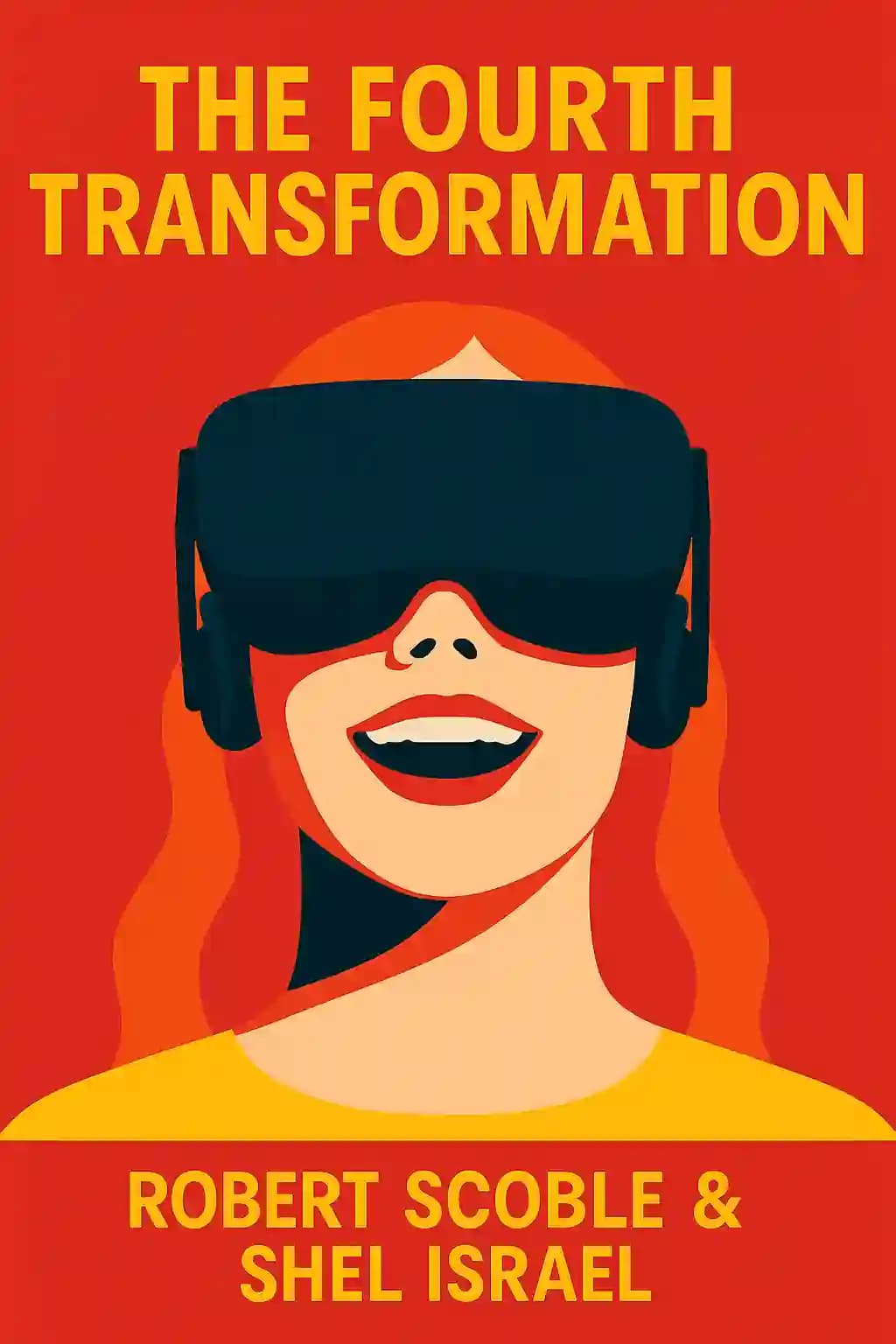
Remember when Pokemon Go swept the world in 2016, transforming millions of people into avid hunters of virtual creatures overlaid on the real world? That phenomenon was just a glimpse of what Robert Scoble and Shel Israel call "The Fourth Transformation" - a fundamental shift in how humans interact with technology. After mainframes with punch cards, text interfaces like MS-DOS, and graphical interfaces with mice, we're now entering an era where technology moves from what we carry to what we wear. Mark Zuckerberg and Facebook's massive investment in Oculus wasn't just a bet on gaming - it was a declaration that mixed reality will become our primary computing interface. This book has become required reading in Silicon Valley boardrooms and tech innovation labs, with industry leaders from Apple to Microsoft treating its predictions as a roadmap for the next decade of development.
Chapitre 2
Beyond Screens: The New Interface Revolution
In April 2016, Mark Zuckerberg revealed Facebook's ten-year vision centered on seemingly ordinary smart glasses. This wasn't just another product announcement but confirmation of a massive technological shift that would fundamentally change how humans interact with digital information. Unlike today's bulky VR headsets that immerse users in artificial worlds or early AR devices that overlay simple graphics on reality, future mixed reality glasses will integrate computer-generated images so seamlessly with our surroundings they'll be indistinguishable from reality. This represents the culmination of decades of research and development in spatial computing and human-computer interaction.
By 2020, these glasses will resemble normal eyewear but contain nano-technological screens creating image density eight times greater than HDTV. They'll house powerful computers in their frames, controlled through intuitive interfaces like subtle hand gestures, natural voice commands, or even precise eye movements. The processing power packed into these slim frames will exceed that of current desktop computers, while consuming only a fraction of the energy. Though we're early in development, industry analysts predict that by 2025 people will spend more time with smart glasses than smartphones, marking a decisive shift in how we consume and interact with digital content.
The technology making this possible is called "spatial computing," a concept with academic roots stretching back 50 years to pioneers like Ivan Sutherland at MIT. It enables computers to understand contextual relationships between objects through point clouds - sophisticated technology that converts raw environmental data into visible virtual objects that can render precise 3D relationships between users and their surroundings. This allows for unprecedented accuracy in placing virtual objects in the real world and enabling natural interactions with them.
What makes this transformation different from previous ones is how it eliminates the artificial separation between us and our devices. We'll no longer look at screens but through them, with computer-generated content appearing as part of our natural environment. Virtual displays could float in mid-air, digital objects could sit on physical surfaces, and interfaces could wrap around real-world objects. This shift represents something fundamentally different - not just a better interface, but the disappearance of the interface altogether. The technology will become invisible, seamlessly integrated into our daily lives in ways that enhance rather than distract from human interaction and environmental awareness.
The implications extend far beyond entertainment and social media. These devices will revolutionize fields like education, where students could interact with 3D models of historical events or complex molecular structures; healthcare, where doctors could see patient data overlaid during procedures; and industrial design, where engineers could manipulate virtual prototypes in real space. This new paradigm of computing promises to be more natural, intuitive, and human-centered than anything that has come before.
Chapitre 3
The Minecraft Generation: Digital Natives 2.0
While new technologies typically begin with early adopters before reaching mainstream audiences, the Fourth Transformation will be driven by a unique demographic force. Beyond Millennials - the first digital natives - emerges what Scoble and Israel call the "Minecraft Generation" or "Minecrafters." These children, born after 2010, have never known a world without touchscreens and enter grade school already using digital devices to play, learn, and socialize.
The difference between learning technology early versus later in life mirrors language acquisition. Children naturally acquire languages before puberty and speak like natives, while those learning post-puberty typically speak with accents. Similarly, Minecrafters don't just use technology - they communicate with it, making coding a universal language that transcends borders.
Robert Scoble's own children, ages seven and nine, demonstrate this phenomenon. They independently find, learn about, and download games without parental guidance. When first introduced to VR headsets, they needed minimal instruction and intuitively understood the experience. This suggests that AR and VR will be crucial for businesses wanting to gain the interest and loyalty of this generation.
Minecraft itself exemplifies this generational shift. From humble beginnings in 2009 when founder Markus Persson offered unfinished versions for $10 each (ecstatic at receiving just 15 purchases on the first day), it has grown to over 100 million registered users. The game offers players a virtual world where they mine materials and build whatever they choose with few rules. Most participate in multiplayer versions, sharing their creations on YouTube where over 150 million uploads exist.
As Minecraft releases VR versions for Oculus Rift and Samsung Gear, with AR versions planned for Microsoft HoloLens, this generation will grow up expecting these technologies in all aspects of life. What begins in games inevitably shapes business and society.
Chapitre 4
Storytelling Reimagined: From Passive to Participatory
Humans have always been drawn to stories, from ancient cave paintings to modern cinema. But virtual reality is revolutionizing storytelling in ways Aristotle never imagined. For 2,400 years, we've accepted his rule that stories must have a beginning, middle, and end. In VR storytelling, that structure dissolves as viewers determine their own experience based on where they choose to look and focus.
At Sundance Film Festival's New Frontiers section, Oculus Story Studio showcased "Dear Angelica," a groundbreaking work allowing viewers to walk around three-dimensional illustrations that "float in midair" while choosing their own focus points within scenes. Similarly, 20th Century Fox is adapting traditional films like "Wild" for VR, where turning around might reveal characters not present in the original version.
Studios like Penrose, founded by Oculus Rift co-founder Eugene Chung, are reimagining classic children's stories in VR. Their adaptations of "The Little Prince" and "The Little Matchstick Girl" create experiences where viewers feel like giants looking into miniature worlds. Children and viewers under 35 are particularly receptive to this new form of storytelling.
The influence flows both ways. The Tony-winning play "The Curious Incident of the Dog in the Night Time" demonstrates VR-like storytelling on a bare stage where LED-lighted walls transform scenes from classrooms to streets to outer space. "Sleep No More," a Macbeth adaptation in a converted warehouse, influenced VR narrative pioneers by allowing attendees to walk freely through scenes happening simultaneously.
Entertainment giants are rapidly adopting these approaches. Disney's "The Lion King" Broadway show is being converted to VR where viewers experience performances from multiple perspectives. Disney leads corporate VR investment, using proprietary technology to design theme parks in virtual reality before construction. Meanwhile, The Void has created the first native-VR theme park chain, transforming urban warehouses into immersive adventure centers with haptic vests that let visitors feel heat, wetness, and impacts during experiences like their "Ghostbusters Dimension" attraction.
Within five years, traditional films may become niche categories at the Academy Awards, much like foreign language or documentary films today, while VR categories will dominate.
Chapitre 5
The Retail Revolution: Shopping Without Boundaries
Over the next decade, mixed reality will transform shopping by blurring the boundaries between online and in-store experiences until they virtually disappear. Brands that adapt quickly will thrive; those that delay face extinction like travel agents did when airlines began online ticketing.
Major brands like Coke, Nike, Disney, and Walmart are already experimenting with VR and MR strategies. By 2018's holiday season, VR will enhance customer experiences; by 2020, most shoppers will use AR and VR in personal devices; and by 2025, headsets will dominate shopping. Customers will see product information through smart glasses, view themselves in virtual clothing, and make purchases with eye interaction.
Google's Tango represents one of the most ambitious mixed reality platforms. This robust AR system for mobile handsets uses motion-tracking and depth-sensing technology to understand spaces in 3D without GPS or WiFi. The technology enables practical applications like measuring furniture in stores and projecting how it would fit at home.
Lowe's Innovation Labs, led by Kyle Nel, is pioneering retail AR applications. Their HoloRoom concept allows customers to visualize remodeling projects in 3D. Critically, Lowe's sells the Tango-enabled Phab 2 phone as a "power tool" for home improvement projects, positioning it as a $500 investment that prevents costly remodeling mistakes.
While Google dominates outdoor mapping, indoor mapping presents unique challenges as store inventory constantly moves. Aisle411, a leader in internal mapping with data on 3.7 million products across 367,000 North American stores, has partnered with Tango to create unprecedented 3D indoor navigation. Their system uses crowdsourced updates like Waze and adds AR capabilities showing not just aisles but specific shelf locations.
The $382 billion beauty industry has embraced these technologies, with AR allowing customers to virtually try cosmetics before buying. Sephora leads retail innovation, having disrupted the industry in 1998 by eliminating brand counters and creating playful environments where customers could freely sample products. Their Sephora Lab regularly tests innovations with input from store associates.
Blippar is bringing the concept of "the world as your department store" to life. Founded in 2011, this mobile AR app identifies objects when users point their phones at them, adding contextual information. The app eliminates language barriers in shopping and enables "Blipp to Buy" - scanning items in stores for automatic payment or purchasing from store windows, friends' Facebook photos, or even strangers on the street.
Location will become less relevant as people shop anywhere they see desirable products, using smart glasses to identify logos and make purchases that can be delivered wherever they want. By 2025, even passengers in autonomous cars will shop using eye interaction and smart windshields.
Chapitre 6
Enterprise Adoption: Business Leads the Way
While consumer markets typically drive new technologies, enterprise adoption of AR has been surprisingly extensive and longstanding. The term "augmented reality" was coined in 1990 by Boeing researcher Thomas Caudell to describe head-mounted devices helping electricians wire 747 jets.
Companies are already seeing impressive results from AR implementations. Boeing tested AR manuals for wing assembly, finding the AR group was 30% faster and 90% more accurate than those using standard PDFs. Similarly, DHL conducted tests using AR for order processing in fulfillment warehouses with significant improvements over traditional methods.
The Daqri Smart Helmet serves hardhat workers who need hands-free operation in dangerous environments. These helmets contain sensors detecting issues like pressure buildup in pipes or wiring errors. Using machine learning, they adapt to individual knowledge levels-showing complete manuals to novices while advancing for experienced workers, and preventing critical step-skipping.
Automakers have been early AR/VR adopters, using these technologies from design through manufacturing and sales. Since 2009, companies like Ford and GM have employed virtual reality for testing visibility and paint colors, while enabling global collaborative design reviews. AR streamlines logistics-VW workers wear glasses displaying bin locations and part numbers while scanning barcodes for accuracy.
NASA leverages AR technology throughout its operations, particularly with HoloLens headsets that allow Earth-based experts to guide astronauts through International Space Station repairs. Future applications will enable space travelers to assemble equipment delivered by unmanned spacecraft.
The real estate industry is rapidly adopting AR/VR technologies. Skanska USA partnered with Studio 216 to create the first Holographic Real Estate Center in Seattle, using HoloLens to give potential lessees tours of unbuilt properties. In residential real estate, Sotheby's International Realty provides Samsung Gear VR headsets to serious luxury home shoppers, allowing virtual walkthroughs of properties.
Unlike previous tech adoption patterns where consumers drove enterprise adoption, AR/VR is starting in enterprise environments before flowing to consumers. Organizations across industries are increasingly interested in these technologies as competitive necessities.
Chapitre 7
Healing Through Virtual Worlds
Healthcare costs topped $3 trillion in the US in 2014, and while the Fourth Transformation won't slow that increase, it shows promise in treating debilitating conditions and disorders.
MindMaze, a Swiss company founded by neurologist Tej Tadi, uses virtual reality to simultaneously develop games and ease pain. Their technology allows gamers to control actions with brainwaves rather than hand controls, while on the healthcare side, they use similar brainwave headsets to treat amputees, stroke victims, and patients with brain trauma, Parkinson's, cerebral palsy, and PTSD.
Using motion capture with "mirroring" technology, MindMaze tricks amputees' brains into thinking lost limbs are still present, reducing phantom pain. Their approach helps stroke victims recover faster than traditional physical therapy, and may eventually help treat schizophrenia, potentially curing the disorder by 2025.
Beyond MindMaze, organizations like Braingate work with major universities teaching quadriplegics to use robotic devices for self-help tasks. Progress in prosthetics has enabled patients to move artificial fingers using brain power, while implanted chips have helped paralyzed individuals control prosthetic fingers with brainwaves.
Ekso Bionics pioneers brain-operated external skeletons for people with skeletal dysfunction. At Duke University, eight spinal cord injury victims regained movement and sensation after years of paralysis using Ekso Bionic exoskeletons with VR headsets connected to their cortex. By focusing on moving VR avatars, patients tricked their brains into controlling the exoskeletons.
AR and VR technologies are helping medical practitioners better understand the human body to save lives. In one case at NYU Langone Medical Center, doctors used AR to develop a novel surgical approach for removing a pelvic tumor that preserved the patient's leg function.
For the world's 285 million blind people, new bionic eyes and AR headsets offer hope. NuEyes uses modified ODG R-7 headsets with cameras that capture and magnify images onto dark optical lenses, allowing legally blind users to see in HDTV quality. SecondSight's Argus II combines an AR headset with a tiny sensor implanted behind the retina, creating a bionic eye that sends visual perceptions to the brain.
VR and AR help autistic children who typically relate better to digital devices than people. University of Haifa researchers developed VR applications to teach autistic children to safely cross streets. Cambridge University's Zhen Bai designed AR that encourages imaginative play by transforming blocks into vehicles in a mirror display. Similar approaches help autistic adults develop social skills for job interviews.
Chapitre 8
Education Transformed: Learning by Doing
Mixed reality represents the most significant advancement in teaching methodology since Socrates introduced dialectical learning. Instead of passive absorption of information, students can now be virtually present at pivotal historical moments, conduct dangerous experiments safely, and practice specialized skills in fully immersive environments. This shift from theoretical to experiential learning fundamentally changes how knowledge is acquired and retained.
Case Western Reserve University and Cleveland Clinic are pioneering a revolutionary health education campus where HoloLens technology replaces traditional cadavers with sophisticated mixed reality. Medical students can virtually examine and practice on detailed holographic organs and tissues, viewing complex anatomical structures from any angle and even "walking inside" the human body. The system enables unprecedented learning opportunities, such as watching a beating heart in real-time or observing disease progression. Additionally, it facilitates remote instruction, with holographic professors teaching from anywhere in the world, demonstrating complex procedures in real-time.
In the K-12 space, two major players dominate western VR learning: Google Expeditions and Nearpod. Both platforms offer immersive virtual field trips through Cardboard viewers, transporting students to over 200 carefully curated destinations. Students can explore coral reefs in the Great Barrier Reef, traverse the harsh landscape of Antarctica, or tour historical landmarks like Buckingham Palace and the Pyramids of Giza. While Google's comprehensive 30-student kit requires an investment of approximately $10,000, Nearpod provides more accessible options starting at $1,000 and operates an equity program that donates kits to economically disadvantaged school districts.
zSpace has revolutionized science education by developing VR labs for public schools using sophisticated touch-sensitive monitors and specialized 3D glasses. Their platform allows sixth graders to conduct virtual dissections, explore human anatomy in detail, disassemble and reassemble complex bionic arms, or participate in interactive species identification quizzes. The technology enables students to make mistakes safely and learn through trial and error without material waste. Meanwhile, innovative mobile apps like Books & Magic are transforming literacy education by bringing classic stories to life through AR, creating interactive 3D illustrations that emerge from the pages when viewed through a smartphone.
In China, where rapid population growth creates persistent teacher shortages despite aggressive recruitment efforts, NetDragon is developing sophisticated virtual teaching software for headset-equipped classrooms. These AI-powered virtual teachers utilize advanced sensors to monitor each student's engagement levels, facial expressions, and learning patterns, dynamically adjusting lesson pace and difficulty to meet individual needs. The system can administer spontaneous assessments to verify comprehension and provide immediate feedback. Students can personalize their learning experience by customizing their virtual instructor's appearance, including gender, age, and teaching style preferences.
The transformative power of mixed reality in education extends beyond novelty, fundamentally changing how we acquire and retain knowledge. These technologies accelerate learning by combining visual, auditory, and kinesthetic elements in ways previously impossible. By creating immersive, interactive experiences that engage multiple senses, mixed reality helps students develop deeper understanding and create stronger neural connections - the "secret sauce" that makes these tools significantly more effective than traditional educational methods.
Chapitre 9
The Shadow Side: Ethical Concerns in a Mixed Reality World
Despite their optimism about the Fourth Transformation, Scoble and Israel acknowledge serious concerns about technologies that connect directly to our brains and monitor our physical responses. They worry about how these technologies might fundamentally alter human experiences, including childhood itself.
When children trust software more than humans, what happens? Can teaching systems be corrupted by commercial or government agendas? How will society change when children grow up with avatars as role models instead of people? Will automated instruction teach precision at the expense of creativity?
As AI and mixed reality technologies advance, they're eliminating human jobs across industries. Arthur C. Clarke envisioned a world where entertainment became the leading industry, employing creative people to amuse the unemployed masses. Currently, the fastest growing VR entertainment segment is violent games - raising concerns about whether virtual violence might desensitize players to real-world horrors.
Mixed reality's ability to replace unpleasant realities with beautiful illusions raises troubling questions. When we can simply replace ugly surroundings with virtual waterfalls, what happens to our capacity for empathy? Will people lose compassion when virtual flowers mask homeless people in doorways?
In conversations with Meta CEO Meron Gribetz, the authors learned that mixed reality could create virtual companions personalized to users' preferences - including virtual relationships programmed solely to please lonely individuals. This raises the disturbing possibility that people might prefer virtual relationships to real ones, potentially threatening human reproduction.
The blurring of reality creates perfect conditions for deception. Scammers and criminals have always existed, but mixed reality offers them unprecedented opportunities to adopt appealing, righteous avatars while bilking innocent people. Law enforcement already struggles to patrol online illegal activities.
The Internet of Things backbone of the Fourth Transformation creates frightening vulnerabilities. What began as pranks like making lights flicker has evolved into ransomware holding medical records hostage for millions. More terrifying is the potential for hackers to seize control of connected medical devices like insulin pumps or surgical robots mid-procedure.
The ultimate concern is how AI devices alter humanity itself. We don't know the long-term impact of these technologies on the human brain or how they'll change our perception of reality. Will we cleanse ourselves of unpleasantness through entertainment and pleasing images? What happens to compassion? Will VR social interactions improve or worsen our relationships with real people?
Chapitre 10
The Age of Spatial Computing: Our Inevitable Future
The Fourth Transformation will take us from the mobile era into the Age of Spatial Computing where the world becomes our interface. While mass adoption of mixed reality headsets may not occur until 2025, influential early adopters will embrace them within 2-3 years, shaping market trends.
The transformation will unfold in three waves: First, virtual reality (already attracting millions); second, mixed reality (beginning 2018-2020 with Magic Leap, Apple, HoloLens and Meta); and third, smart glasses (2020-2021) that are small, self-contained and fashionable. By 2025, smart glasses will become the center of digital life for billions, surpassing smartphones in both sales and usage.
Spatial computing will transform everything-taking us to ocean floors, outer space, and into our own bodies. Our everyday experiences will change dramatically: blank walls can display different virtual art daily or become windows to other worlds. Virtual animals might inhabit our yards for children to play with. Work, transportation, health, and communication will function in ways that make today's smartphones seem primitive.
IoT serves as the nervous system of spatial computing, with inexpensive sensors connecting nearly all people to nearly all things in a robust global ecosystem. Your glasses will direct you to the liveliest nightclub, the restaurant with the freshest food, or the nearest restroom. Meanwhile, artificial intelligence functions as the soul of this transformation-enabling visual perception, natural language recognition, and autonomous decision-making.
Looking back at the best tech products of 2006 - the BlackBerry Pearl, Xbox 360 with its first interface gestures, and iPod Shuffle 2 - shows how far we've come in just ten years. These once-revolutionary devices are now obsolete. The authors predict we'll go much further in the next decade than we did in the last, as the Fourth Transformation accelerates beyond what most businesses are prepared for.
The question isn't whether this transformation will happen-the technological momentum is already unstoppable. The real questions are how we'll adapt to it, how we'll harness its benefits while mitigating its risks, and whether we're prepared for a world where reality itself becomes fluid and customizable. For businesses, educators, healthcare providers, and individuals alike, understanding this transformation isn't optional-it's essential for navigating the world that's rapidly emerging around us.