Chapitre 1
The Enigmatic Force That Rules Our Lives
Money is everywhere yet nowhere. It dominates our decisions, structures our societies, and shapes our very identities-yet few of us truly understand its nature. In "The Evolution of Money," David Orrell and Roman Chlupaty embark on a fascinating journey through money's 5,000-year history, revealing it as far more than a mere medium of exchange. The book has garnered praise from economists and cultural critics alike for its interdisciplinary approach, combining history, psychology, physics, and biology to explain money's mysterious power. Particularly relevant in our post-2008 financial crisis world, the work has influenced thinking at institutions like the Bank of England, which acknowledged in 2014 the truth at the heart of this book: most money today exists only as numbers in computer systems, created by private banks rather than governments. This revelation-shocking to many-is just one of the paradigm-shifting insights that makes this exploration of our financial system so compelling.
Chapitre 2
The Dual Nature of Money: More Than Meets the Eye
Money possesses a strange duality that has fascinated philosophers since ancient Greece. It's simultaneously concrete and abstract, physical and virtual, a store of wealth and a representation of debt. This paradoxical nature makes money uniquely powerful but also deeply misunderstood.
Traditional economics treats money as a neutral, inert medium-a mere "veil" over real economic activity. But this view misses money's transformative power. Money isn't just a passive reflection of value; it actively shapes how we perceive value itself. When we reduce complex qualities to simple numbers, we fundamentally alter our relationship with the world.
This numerical aspect of money connects to ancient philosophy. The first coins appeared in Miletus, the same Greek city that produced the first Western philosophers. While Thales sought to reduce all physical reality to water, the Pythagoreans believed numbers were the ultimate reality. This numerical worldview developed alongside money, as both systems translate diverse qualities into abstract quantities.
Money's duality appears even in its physical form. A coin's "heads" represents authority (the abstract, masculine principle in Greek thought), while "tails" expresses numerical value (the material, feminine principle). This split between abstract number and concrete reality creates a magnetic-like tension that drives money's behavior.
Unlike other goods, money objects uniquely possess fixed numerical values. While the price of bread fluctuates, a five-dollar bill always equals five dollars. This property gives money its strange quantum-like nature-it exists simultaneously as abstract number and concrete reality, collapsing into one state only during transactions. Like quantum particles whose properties remain undetermined until measured, goods have no definite price until exchanged for money.
This duality explains why economists have struggled to define money's essence. Metallists believe only precious metals constitute real money, chartalists argue money derives value from government authority, while functionalists define money by what it does rather than what it is. Yet all these theories miss money's most fundamental characteristic-it's based on number, treating the quantification of value as self-evident rather than examining this core assumption.
Understanding money's dual nature reveals why our financial system behaves as it does-oscillating between stability and chaos, creating both wealth and inequality, and periodically generating crises that conventional economics fails to predict or explain.
Chapitre 3
From Ancient Credit Systems to Coins: Money's Surprising Origins
The standard Economics 101 story about money's origins is completely backward. According to this narrative, money emerged naturally from barter economies when people needed a more efficient medium of exchange. Yet anthropologists have never found evidence of pure barter economies that later adopted money. The reality is far more interesting-and political.
Money began not as coins but as elaborate credit systems. In ancient Mesopotamia around 3000 BCE, temple accountants used the silver shekel as a standard unit of account. However, this wasn't physical money that circulated; it was primarily a virtual accounting device. Transactions were recorded on clay tablets, with payments often made in barley or other goods valued in shekels. The economy operated largely on credit, with debts recorded and sometimes traded to others.
This system wasn't based on barter or coins but on a complex network of debts denominated in a virtual currency backed by the state. Interest rates were standardized-typically one-sixtieth per month-and unpayable debts could lead to slavery, requiring occasional debt cancellations called "Jubilees" to prevent social collapse.
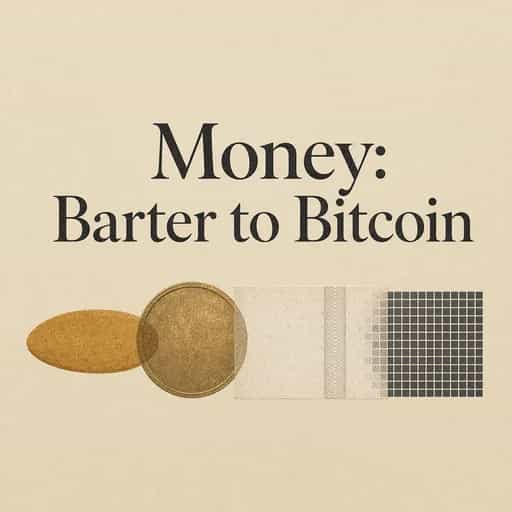
The first physical coins appeared not in Mesopotamia but in seventh-century BCE Lydia (modern Turkey). These oval pieces of electrum-a gold-silver alloy-bore simple stamps certifying their value. While convenient for trade, coins spread primarily because of military needs rather than market demands. Alexander the Great's conquests required paying an enormous army-about half a ton of silver daily-using coins minted from Persian mines worked by war captives.
Rather than emerging naturally from barter, money was imposed at swordpoint. Alexander wiped out existing credit systems in conquered territories and demanded taxes be paid in his coins. This revolutionary development transformed social connections by standardizing transactions across different social circles and regions.
The Romans industrialized this monetary system, creating a massive currency network that supported imperial spending (estimated at 225 million denarii annually, mostly for military purposes). The system was so effective it outlasted the empire itself, with people still calculating debts in Roman currency terms centuries after the coins disappeared.
Money's history has alternated between virtual and metal phases, reflecting its dualistic nature. Early agrarian empires used virtual credit systems, the Axial Age relied on precious metal coins, and the Middle Ages swung back to virtual credit due to metal scarcity. This pattern continues today, as we've moved from the gold standard to entirely digital currencies-completing a millennial-long cycle back to money's virtual roots.
Chapitre 4
Medieval Money: The Return to Virtual Finance
After Rome's collapse, precious metals became scarce as cities shrank and trade routes collapsed. Money became increasingly virtual-an abstract means of account rather than physical metal. The Islamic world led this transformation, using credit instruments like promissory notes called sakk (the origin of our word "check"), where reputation was as important as wealth.
Mathematical advances facilitated this shift. Indian mathematician Brahmagupta conceptualized positive numbers as "fortunes" and negative numbers as "debts" in 628 CE. These concepts spread through the Islamic world and eventually to Europe through mathematicians like Fibonacci, who popularized the Arabic number system for business calculations. Double-entry bookkeeping, codified by Luca Pacioli in 1494 but used for over a century prior, formalized this balance between debits and credits.
In feudal Europe, society valued land and power over money. Estates were self-contained communities where money served mainly as an accounting device, with rents and taxes paid through labor or goods. For everyday transactions, Europeans used copper "black money" and silver deniers, while gold coins like florins and ducats were preferred for larger transactions.
The Crusades created financial challenges that sparked innovation. The Knights Templar established an early version of travelers checks, allowing pilgrims and warriors to deposit valuables at one castle and withdraw funds at another using letters of credit. Italian cities like Venice, Florence, and Genoa became financial hubs, with moneylenders forming guilds like the Arte de Cambio.
The revolutionary innovation was the bill of exchange-letters instructing distant bankers to make payments, typically with a 10% fee built into the exchange rate. These bills eliminated the need to transport physical coins, which was slow, risky, and expensive. The system expanded the money supply while boosting circulation efficiency, as when the pope arranged for English church collections to fund Italian purchases of English wool without physical cash crossing borders.
Unlike immediate cash transactions, these financial instruments depended on time and trust. The bill of exchange system functioned because bankers formed an exclusive network operating in a shadow economy resistant to competition and government interference. This private monetary system represented a power shift from state to private sector, though the sovereign maintained monetary authority until the founding of the Bank of England would eventually merge state and private money systems.
Despite financial developments like bills of exchange, viewing the Middle Ages through a modern economic lens is misleading. Medieval economy functioned more as a gift economy where "caritas" (charity) was the core principle defining human relationships. Thomas Aquinas called charity "the mother of all virtues," and the ban on usury reflected a static worldview where everything had its place in God's scheme.
Chapitre 5
Gold, Paper, and the Birth of Modern Banking
When Cortes encountered the Aztecs, the Spaniards' reaction to gold gifts revealed what Cortes called "a disease of the heart which can only be cured by gold." The subsequent conquest led to massive precious metal extraction that transformed the European economy, triggering what historians call the "price revolution"-a sustained period of inflation.
Paradoxically, despite the treasure flowing into Spain, the wealth didn't stay there. It flowed to other European powers and to the East Indies through trade, while Spain became a debtor nation that defaulted fourteen times between 1550-1700. The influx of gold boosted money supply but not productive activity, creating what economist Richard Cantillon described as a "resource curse" where Spain grew "poor because she is rich."
This period saw the rise of mercantilism-the doctrine that nations should accumulate as much "treasure" as possible to build military power. England under Queen Elizabeth I fully embraced this approach, compensating for its lack of mines through trade, exploration, and colonial labor. The British East India Company became a quasi-military organization that virtually ruled India with its own armies and even minted its own coins.
By the seventeenth century, European investors could access many modern banking services. Goldsmiths and notaries issued receipts for deposited coins and bullion, eventually realizing they could lend most of this gold or simply issue notes against it. The Bank of England, created in 1694 to fund King William III's navy rebuilding, represented a breakthrough public-private partnership. The bank provided the government a permanent gold loan in exchange for interest-bearing notes that soon circulated as money.
Isaac Newton, as master of the Mint, inadvertently established the gold standard in 1717 by setting the guinea coin's value at 21 shillings, creating a fixed ratio between gold and silver that slightly favored gold. This "Newtonian accident" effectively shifted England from a bimetallic standard to a gold standard that would last, with wartime interruptions, for 200 years.
While the gold standard established precise mathematical relationships between currency and metal weight, the economy itself was behaving unpredictably. Financial innovations like joint-stock companies and stock exchanges increased economic activity but also magnified risk. The Dutch "tulip mania" of 1637 and England's South Sea Bubble demonstrated the volatility of these new financial instruments. Even Isaac Newton lost a fortune in the South Sea Bubble, lamenting: "I can calculate the motions of heavenly bodies, but not the madness of people."
By the end of the nineteenth century, the Bank of England had become the go-to financier and backstop for the British Empire and unofficial guardian of the international gold standard. This model of a dominant central bank at the hub of private banks was adopted by other wealthy countries. However, linking money to a finite commodity meant the supply couldn't adjust to economic needs, making it vulnerable to gold supply fluctuations.
Chapitre 6
From Gold to Fiat: The Transformation of Modern Money
The international gold standard was suspended during World War I but continued to serve as backing for central banks. Britain's return to the gold standard in 1925 led to a general strike, while adherence to gold worsened the Great Depression in America by preventing monetary expansion. In 1933, Roosevelt ordered citizens to surrender gold coins and bullion to boost reserves.
At the 1944 Bretton Woods conference, the dollar became the reference currency, with fixed exchange rates and dollars redeemable for gold at $35 per ounce-advantageous for America, which now controlled the world money supply. By the 1960s, however, the private market gold price began exceeding $35, partly due to trade expansion and partly because America was printing money to fund the Vietnam War, Cold War, and space program.
The gold system finally collapsed on August 15, 1971, when Nixon halted the dollar's convertibility to gold-the "Nixon shock." This transformed the dollar and linked currencies into pure fiat money, completing a millennial reversal from metal-based to state-backed currency. The Federal Reserve now backed its notes with electronic ledger entries rather than gold reserves.
These changes triggered inflation and nervousness about the dollar. Simultaneously, electronic money forms emerged-credit cards, ATMs, and electronic stock markets like NASDAQ (1971). With the Internet's development, salaries became electronic deposits, online banking flourished, and e-commerce expanded. Money was returning to its virtual roots as digital ledger entries rather than physical tokens.
The post-Nixon shock era raised fundamental questions about the dollar's backing. With gold removed, what supported the world's reserve currency? Some argued oil replaced gold as backing when OPEC countries agreed to price petroleum in dollars. Others suggested military force backed the currency, explaining America's global military presence.
By 2009, money's virtualization was complete, as Ben Bernanke revealed on "60 Minutes" that the Fed simply uses "the computer to mark up the size of the account." This virtualization accelerated in the 1990s with complex financial derivatives like CDOs and CDSs, which bundled mortgages into tradable securities and provided insurance against defaults. These innovations appeared to reduce risk but merely concealed it through complexity, enabling banks to lend more money.
The Great Financial Crisis revealed these schemes' flaws when banks needed massive public bailouts-4.5% of GDP in the US, 8.8% in the UK, and 40% in Ireland. The GFC represented a delayed aftershock from the Nixon shock, exposing both the fiat currency system's problems and the flaws in neoclassical economic theories that failed to account for monetary instability.
Chapitre 7
The Money Power: Who Controls Our Financial System?
Money and power are inextricably entwined, particularly at the moment of currency issuance. As Susan Strange notes, control of money causes conflict at every level of social interaction. Yet mainstream economics curiously omits power from its models, preferring perfect competition and efficient market theories.
Frederick Soddy, a Nobel Prize-winning chemist who turned to economics, identified the confusion between real wealth and virtual wealth (bank money) as the source of economic problems leading to social conflict. Real wealth consists of tangible assets like pigs, while paper money represents debt-a negative quantity with no physical existence. Soddy warned that virtual wealth eventually exceeds real wealth under fractional reserve banking, creating instability when people try to convert virtual wealth to real assets during crises.
The greatest economic power is the power to issue money. Under fractional reserve banking, this power transfers largely to private banks, which Soddy saw as challenging state authority through their ability to create and destroy money by manipulating ledger figures without concern for community interests.
The "revolving door" between Wall Street and government began in 1934 when FDR appointed bank executive Joseph Kennedy to chair the SEC. Since then, the financial-political complex has grown increasingly intertwined, with Goldman Sachs ("Government Sachs") exemplifying this phenomenon. Financial institutions maintain their power through intensive lobbying-from 1998-2008, American financial institutions spent $5 billion on political influence.
As finance globalized, the "money power" became increasingly international. The U.S. dollar remains the world's lingua franca despite declining from 70% to 61% of central bank reserves between 2000-2014. It dominates international trade and commodity pricing, functioning universally from remote villages to financial centers.
Like ancient Rome debasing its silver coins, America has followed a similar path-since the Fed's 1913 establishment, the dollar has lost 96% of its value and 25% against trading partners' currencies since 1971. Historically, currencies maintain prime position for roughly a century; the dollar has reigned for 94 years.
China commands the world's second-largest economy and may soon be first after thirty years of 10% annual growth. Yet the yuan only began playing an international role in 2008, as China's growth strategy relied on keeping its currency undervalued to boost exports. By 2014, cross-border yuan transactions reached nearly $1 trillion, representing 20% of China's global trade volume. In November 2015, the IMF added the yuan to its SDR basket of reserve currencies.
The euro, first proposed at the League of Nations in 1929, was finally adopted by eleven European countries on January 1, 1999. Nobel laureate Robert Mundell, one of the euro's architects, believed that like the gold standard, the euro's monetary constraints would impose fiscal discipline on politicians. Unlike the gold standard, the ECB can adapt money supply but lacks a fiscal branch or sovereign government backing it. Countries effectively operate fiscal policy in a foreign currency, creating vulnerabilities exposed during the Greek debt crisis.
Chapitre 8
Economics Without Money: The Blind Spot in Economic Theory
Orthodox economists "wanted to create a science that ignored money," focusing on mathematical abstractions rather than money's complex nature. Irving Fisher's quantity theory of money, expressed in the equation MV = PT (where M is money supply, V is velocity, P is price, and T is transaction volume), became the dominant monetary theory. This Newtonian-inspired formula equates GDP with money times velocity, treating money's flow like physical momentum.
Fisher argued that since velocity and transaction volume remain relatively fixed, increasing money supply by a certain percentage would increase prices proportionally. This theory formed the basis of monetarism, championed by Milton Friedman, who proposed treating money supply as "a natural constant like gravity." The theory fails to account for complex systems behavior-velocity isn't constant but changes unpredictably with other economic variables.
John Maynard Keynes offered an alternative, emphasizing psychological factors in economic decision-making. He noted that most positive economic decisions stem from "animal spirits" rather than calculated probabilities. Keynes highlighted economic paradoxes like the "paradox of thrift"-during recessions, individual saving behavior worsens collective outcomes as money velocity halts.
Neoclassical economics became the gold standard of economic theory, with its mathematical purity mirroring gold's chemical stability. The Arrow-Debreu model demonstrated that under certain conditions, market economies reach a stable optimal equilibrium where no change can occur without making someone worse off. This mathematical "proof" of capitalism's superiority over communism had clear Cold War political implications.
The Chicago school, led by Milton Friedman, became the standard-bearer for this approach with its free-market ideology and confidence in market self-regulation. Robert Lucas pushed rationality to extremes with his rational expectations theory, claiming people have perfect mental models of the economy.
Eugene Fama's 1965 efficient market hypothesis asserted that markets consist of rational profit-maximizers with perfect information, driving securities to their correct "intrinsic value." This updated version of Smith's market theory claimed price changes were random or news-driven, making it impossible to beat the market. The theory effectively outlawed bubbles by denying their existence.
The 2008 financial crisis blindsided the entire economics profession. Not one forecaster predicted recession in any of 77 countries studied (49 experienced one). Central bankers were equally unprepared, with Alan Greenspan calling the crisis "almost universally unanticipated."
While Alfred Marshall wrote that "the Mecca of the economist lies in economic biology," economics instead built models where people act like inert atoms without life or relationships. Living systems exhibit emergent behaviors that can't be predicted from individuals-an ant colony isn't simply a larger version of a single ant. In this reality, money isn't an inert placeholder but a vital, active medium that transforms the economy as it circulates through it.
Chapitre 9
The Future of Money: Alternative Currencies and New Possibilities
Since the 1970s, the world has operated on virtual fiat currencies that lack intrinsic value. Yet psychologically, we remain anchored in gold standard thinking-governments borrow at interest, banking maintains Victorian traditions, and money remains artificially scarce despite being electronic. Alternative currencies are reinventing money's basic design principles and pushing the economic system toward something radically different.
The Federal Reserve's quantitative easing (QE) program following the Great Financial Crisis surprised many as it appeared to bend the rules of money scarcity. The process involved creating new money to purchase assets like government bonds from private banks, theoretically stimulating the economy. Critics viewed QE as disguised money printing that would lead to inflation, while others argued it merely filled the void left by imploded credit instruments.
Unlike QE, unconditional basic income is straightforward-give people money without conditions, typically around $10,000 per year. This would allow people to work less if desired while eliminating the need for complex tax allowances and benefits systems. Though often labeled socialist, the concept has broad appeal-even Milton Friedman supported it (as "negative taxation"), believing it would shrink government size.
If governments can print money for banks, why not for themselves? In our current system, governments borrow at interest from quasi-private central banks that sell bonds via private banks-a model based on the gold standard. But with fiat currency, governments could simply create money directly, avoiding burdening future generations with debt payments.
Money naturally tends toward unification, with governments and private partners monopolizing its creation. But would multiple complementary currencies create more resilience and address scarcity issues? Natural ecosystems thrive through modularity rather than single highly connected networks, suggesting similar structures might benefit finance.
Local currencies have gained steady popularity since the Nixon shock, fueled by community activism, environmental concerns, and digital technology that simplifies administration. The 2008 financial crisis further accelerated interest, with debt-stricken Greece seeing a resurgence in local currencies when euros became scarce. Today, thousands of alternative currencies operate worldwide.
Corporate loyalty programs have evolved into powerful quasi-currencies, with Air Miles potentially being the world's largest currency system. The Economist calculated $700 billion in Air Miles circulating worldwide in 2005, with over 100 million participants. By 2012, outstanding frequent-flier miles had doubled to 14 trillion.
In early 2000s Africa, mobile phone airtime emerged as an alternative currency where people transferred minutes via text message as a value exchange method. Mobile operators recognized this opportunity and developed dedicated financial technology. Vodafone launched M-Pesa in 2007, allowing users to deposit money with retail agents and make purchases by entering merchant account numbers and PINs, with transactions confirmed by text message.
Bitcoin represents perhaps the most radical monetary innovation. Created by the pseudonymous Satoshi Nakamoto as a response to the flaws of conventional currency, Bitcoin offers "e-currency based on cryptographic proof" that eliminates middlemen. Bitcoin appeals to several groups beyond criminals-migrant workers benefit from drastically reduced transaction fees, citizens of authoritarian countries with hyperinflation embrace it as protection against currency devaluation, and the 2.5 billion "unbanked" adults worldwide represent another potential market.
Chapitre 10
Reimagining Money for a Sustainable Future
Despite enormous economic growth, we face two interlinked problems reflecting money's dual nature: environmental limits (physical debt to the planet) and economic inequality (numerical debt between groups). The human economy has grown to affect the environment at every level, requiring a transition from Boulding's "cowboy economy" with unlimited frontiers to a "spaceman economy" with natural constraints.
Despite Keynes' 1930 prediction that technological progress would enable 15-hour workweeks by now, many people work longer hours than ever. While production efficiency has increased, we've maintained workloads through managing one another as professional and service jobs grew from one-quarter to three-quarters of employment between 1910-2000. Our monetary system fosters competition and inequality rather than Keynes' vision of spreading "bread thin on butter" by sharing work widely.
When prices no longer reflect true value and economic incentives lead us down dangerous paths, we must question our monetary system's design. We've drifted from having market economies to becoming market societies where nearly everything is for sale. While some might advocate eliminating money entirely, money's persistence suggests three more practical approaches: regulation, redesign, or creating protected spheres beyond money's reach.
Beyond redesigning money, we can create spaces where money's influence is limited. Money fundamentally alters our behavior-experiments show that merely seeing money makes people less collaborative and more self-centered. Yet grassroots movements like the Global Freecycle Network (with 9.3 million members exchanging 32,000 items daily) demonstrate alternatives to market economics.
The sharing economy that emerged after the 2008 financial crisis represents another alternative to pure market economics. From tool libraries offering thousands of items for nominal membership fees to platforms like Airbnb and Uber, these systems enable more efficient resource use through sharing rather than individual ownership.
The path forward for monetary innovation may paradoxically involve looking backward-not to the exploitative conditions of the nineteenth century, but to the High Middle Ages (11th-13th centuries) when virtual currencies flourished before finance was "Medicified." While preserving modern technological advances, we might learn from this earlier era of monetary experimentation.
The emerging monetary paradigm will likely feature overlapping currencies at local, national, regional and global scales; alternative currencies incubated in the virtual economy; digital wallets holding multiple currency types; reward schemes functioning as money; reduced reliance on traditional money as the internet enables sharing, gifting and direct barter; an emerging reputation-based gift economy; acceleration of change through debt crises; more time for non-monetary pursuits through robotics and basic income; and a slower but more resilient economic metabolism.
Like McLuhan's famous observation that "the medium is the message," our evolving money systems will determine what civilization-building projects we leave for future generations. By understanding money's true nature and redesigning it to serve human and planetary well-being, we can create a more sustainable, equitable, and fulfilling economic system for all.