Chapitre 1
The Future of Higher Education: A Revolution in Progress
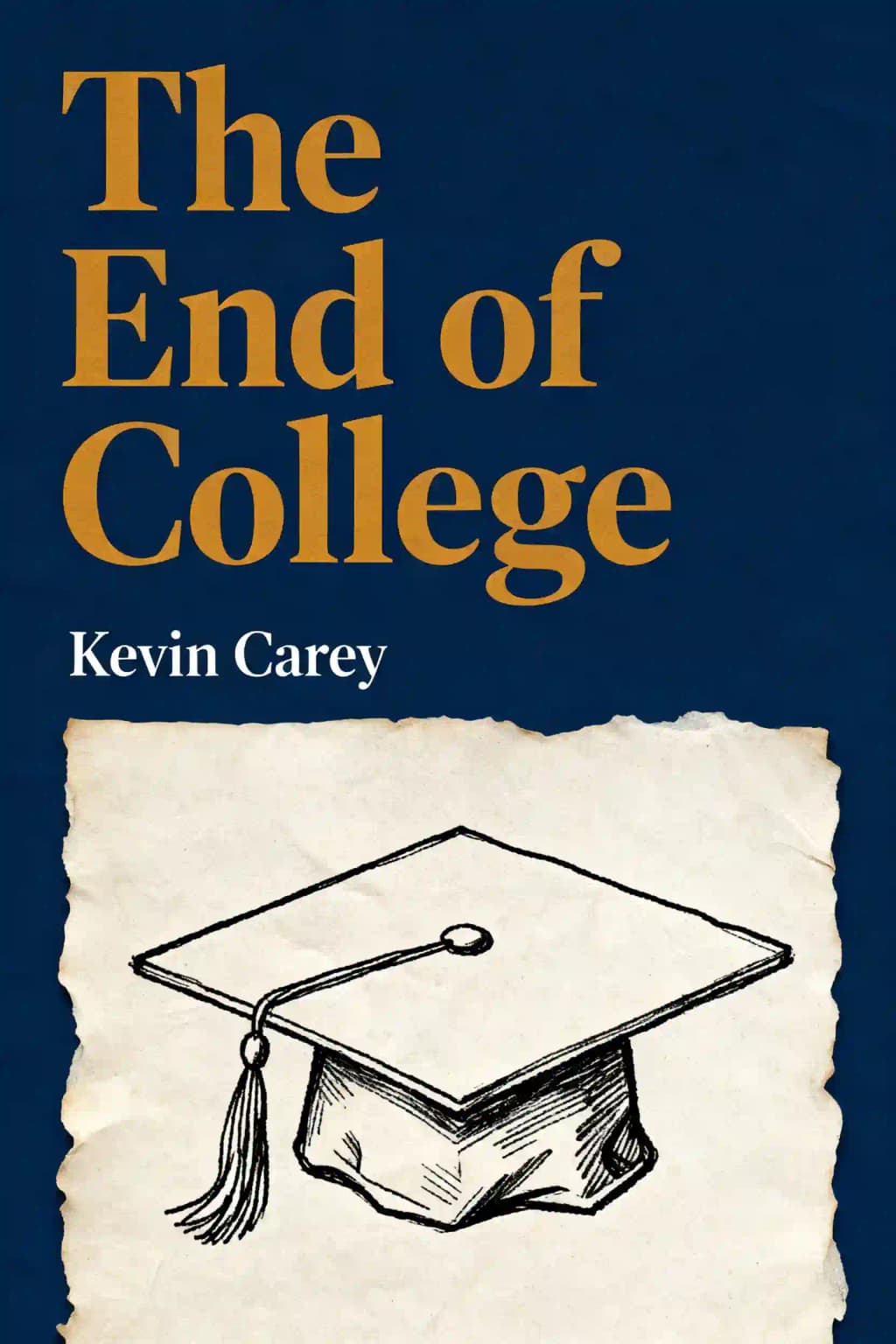
Harvard and MIT's unprecedented collaboration is reshaping higher education as we know it. What started as a Japanese television crew filming at MIT's Introduction to Biology course has evolved into a global movement that's making scarce educational resources abundant and free. This transformation is building what Kevin Carey calls "the University of Everywhere" - a new paradigm where the concept of "admission" becomes obsolete as students access learning from specialized organizations rather than single institutions.
This global university will serve students from all cultures using sophisticated digital environments and artificial intelligence to provide personalized education at scale. Students will accumulate digital evidence of lifelong learning instead of arbitrary degrees, forming decades-long relationships with learning organizations based on their needs. The institutions that adapt will thrive; those that cannot will disappear.
Carey's interest in this transformation stems from personal experience. Raised by academic parents, he benefited from affordable public higher education in the late 1980s, graduating without student loans. But this affordable education has become a historical relic, with inflation-adjusted tuition at public universities more than tripling since then. By 2012, 71 percent of students graduated with nearly $30,000 in debt, while only a third of American adults hold bachelor's degrees. Even more troubling, studies show many graduates lack critical thinking skills. Yet amid these concerning trends, Carey sees hope in the technological revolution transforming access to information - perhaps the University of Everywhere is beginning to emerge.
Chapitre 2
The Birth of Universities and Their Evolution
While college admission has become an anxiety-filled American rite of passage, signing up for MIT's "The Secret of Life" course on edX took just two minutes. Though initially skeptical about taking an MIT-caliber course online, the class proved to be a faithful digital translation of MIT's required Introduction to Biology course. The lectures were engrossing, covering biochemistry, protein structures, enzymes, and complex biochemical pathways - a teaching interaction dating back to higher education's beginnings, though information technology has been reshaping the balance of power between students and teachers throughout university history.
Ironically, the Greeks and Romans invented much of Western civilization without universities themselves. Despite Raphael's famous fresco titled "The School of Athens," the classical world had teachers and students but no formal institutions of higher learning as we recognize them today.
The first modern university emerged in Bologna, Italy around 1088 and remains remarkably familiar today. But unlike today's professor-centered institutions, Bologna began with students hiring teachers under strict contracts - professors could be fined for poor attendance or failing to complete the curriculum. This student-centered power balance shifted when the University of Paris organized around professors grouped by disciplines, establishing the model that has dominated for centuries.
Even Socrates distrusted new learning technology - he argued that written words would create "forgetfulness in learners' souls" as they would rely on external characters rather than memory. When Gutenberg's printing press arrived, professors at the University of Paris outlawed silent reading, fearing loss of control. Yet universities adapted because books remained expensive, and institutions still offered unique value through teachers, guidance, peers, and credentials.
The Puritans founded Harvard just eight years after establishing the Massachusetts Bay Colony. Unlike England's tightly controlled system, America took a laissez-faire approach to college creation. By the Civil War, nearly 250 colleges existed across the nation, though they were small and limited. These early colleges focused not on creating or distributing knowledge but on "mental discipline" - students memorized and recited texts in Greek and Latin, supervised by poorly paid teachers under the leadership of clergymen presidents.
Chapitre 3
The American University System Takes Shape
After the Civil War, three competing visions emerged for American higher education: practical training for industrial classes (embodied in the 1862 Morrill Land-Grant Act), German-style research universities centered on independent scholars advancing knowledge, and liberal arts education championed by Cardinal John Henry Newman, who saw universities as places of "teaching universal knowledge" where students developed critical thinking rather than merely accumulating facts or skills.
Charles William Eliot, Harvard's president for forty years starting in 1869, ingeniously reconciled these competing visions by creating the modern American university structure. He made bachelor's degrees prerequisites for professional schools and replaced mandatory curricula with elective systems. This allowed research professors to teach in their specialties while giving students freedom of choice. Universities built departments around specialized scholars, creating the familiar hierarchy of trustees, presidents, deans, and professors, with the PhD becoming the standard teaching credential.
Almost immediately, critics identified problems with this hybrid model. William James denounced universities' insistence on hiring only doctorate holders, arguing the degree was "a mere advertising resource, a manner of throwing dust in the Public's eyes" and "a sham, a bauble, a dodge." Under academic freedom, professors designed courses in isolation with no evaluation of their teaching effectiveness. As historian Jacques Barzun imagined an experienced professor advising a graduate student: "Bluff through your classes... use the time thus saved to bone up for your orals and start writing your book."
The American university structure was fundamentally designed to meet researchers' needs, not students'. As historian Laurence Veysey observed, the system "throve, as it were, on ignorance" with students as "pawns." Initially, only exceptional students attended college, minimizing the damage of amateur teaching. But as more students enrolled, the balance shifted further against undergraduates' interests. Recent evidence showing most bachelor's degree holders cannot read critically at advanced levels confirmed what critics had long suspected: the hybrid university was "designed to be bad at the most important thing it does: educate people."
Chapitre 4
The Economics of Modern Universities
The George Washington University campus reveals itself as a contradiction - deeply familiar college iconography that somehow feels artificial upon closer inspection. This physical environment mirrors deeper issues: no transparency about educational outcomes, professors hired and promoted for research rather than teaching excellence, and no comparative data on student learning. Students themselves recognize the problems - one calling GW "the world's most expensive trade school" while another describes it as split between serious learners and wealthy students essentially "buying a degree."
This environment is the deliberate creation of Stephen Joel Trachtenberg, who transformed GW from an inexpensive commuter school into America's most expensive university during his 1988-2007 presidency. Growing up in a one-bedroom Brooklyn apartment, Trachtenberg was intellectually curious, encouraged by his mother to immerse himself in New York's cultural offerings. Despite his father's preference for the affordable Brooklyn College, Trachtenberg chose Columbia University in 1955, placing him at the center of America's expanding higher education system.
The structural weaknesses of American universities were obvious to critics, yet these institutions thrived largely because of America's geopolitical fortune. While Germany's Humboldt University declined after the devastation of Nazism and World War II, American universities benefited from continental safety and national prosperity. As the first country to widely implement high school education, America created an unprecedented pool of potential college students, with degrees becoming powerful signals of upward mobility.
Yale sociologists DiMaggio and Powell explained universities' resistance to change through "institutional isomorphism" - organizations becoming increasingly similar over time through coercive forces, mimetic tendencies, and normative pressures. While isomorphism typically makes organizations vulnerable to disruption, universities avoided this fate due to powerful historical forces.
The G.I. Bill of 1944 sent over two million veterans to college, while Vannevar Bush's influential report "Science: The Endless Frontier" directed massive federal research funding to universities for Cold War scientific advancement. Meanwhile, social changes including the growing middle class and increased access for women and minorities created unprecedented demand for higher education.
Chapitre 5
The College Wage Premium and Status Competition
The answer to whether college remained valuable was unequivocally "Yes." As manufacturing jobs disappeared due to foreign competition, they were replaced by white-collar positions requiring college degrees. The percentage of young adults with bachelor's degrees rose from under 10% in 1960 to over 33% today. Despite this increased supply, the wage premium for college graduates actually grew. By 2005, college graduates earned 80% more per hour than high school graduates, double the 40% premium of 1977.
The great American college building spree ended after the 1960s. With accessible institutions within driving distance of most people, competition shifted to status-seeking among existing institutions, with colleges constantly one-upping each other with famous scholars and fancy buildings, passing costs to students. The 1983 introduction of U.S. News & World Report college rankings accelerated this trend.
This environment created opportunity for a new breed of college president - the empire builder. John Silber of Boston University exemplified this approach, launching massive building campaigns while recruiting luminaries like Saul Bellow and Elie Wiesel. His protege Stephen Joel Trachtenberg continued this model at George Washington University, understanding that universities weren't selling education but "signs and signals of success" - luxury goods whose high price was itself part of the appeal.
Trachtenberg compared college to vodka and watches: "Vodka is by definition a flavorless beverage. It all tastes the same. But people will spend $30 for a bottle of Absolut vodka because of the brand. A Timex costs $20, a Rolex $10,000. They both tell the same time." This strategy worked brilliantly - GW went from below-average tuition to becoming America's most expensive university at $47,000 plus $11,000 for room and board by 2014. In the "looking-glass world of college economics," demand increased as prices rose.
Chapitre 6
The Science of Learning and Educational Technology
If education were merely about presenting information, the Gutenberg revolution would have destroyed universities centuries ago. But learning requires active knowledge construction as students integrate new information with existing mental frameworks. This is why MIT courses include challenging problem sets that test students' ability to apply abstract concepts to concrete problems.
The human brain contains 80-100 billion neurons forming trillions of connections, with education essentially being a deliberate process of rewiring these networks. Experts develop sophisticated pattern recognition through practice, allowing them to instantly recognize meaningful situations and filter noise to focus on what matters. Chess masters consider strategic principles rather than individual moves, while expert quarterbacks can process complex patterns of movement that would overwhelm novices.
Born in Oklahoma in 1922, Patrick Suppes rose from the Dust Bowl to intellectual prominence through a fortunate placement in "The Eight-Year Study." After studying at Chicago under Robert Hutchins's Great Books program and serving in the Pacific during WWII, Suppes joined Stanford in 1950. In 1963, he established an educational computing laboratory, and three years later published his visionary article "The Uses of Computers in Education," predicting that technology could provide every student with the personalized tutoring that Alexander the Great received from Aristotle.
Suppes recognized computers could individualize instruction by tracking each student's learning history and using past performance to select appropriate new problems. His math programs contained questions of escalating difficulty, advancing students who succeeded while giving more practice to those who struggled. The variation among students was enormous - some progressed five to ten times faster than peers.
Chapitre 7
The Evolution of Distance Education
Information technology has been used for education since 1728, when the Boston Gazette advertised weekly shorthand lessons by mail. Universities later established postal correspondence courses, reaching remote locations worldwide. Electronic media sparked greater excitement - radio courses emerged in the 1920s but faltered due to increasing costs and professors' inability to translate classroom brilliance to broadcast.
A 1947 U.S. Army experiment demonstrated that identical scripts about operating a micrometer, delivered via live instruction, paper copies, or film, produced exactly the same learning outcomes. Hundreds of subsequent studies confirmed these findings - the medium doesn't matter; design does. The Department of Education even found students in online conditions performed slightly better than those in face-to-face instruction.
The crucial difference with computers wasn't about distance - unlike previous technologies that merely stored or moved information, computers could process it, analyze it, and act on it. The patterns in algorithms connected with students' neural patterns, changing both in the process.
John R. Anderson at Carnegie Mellon developed the Adaptive Control of Thought-Rational (ACT-R) model, dividing knowledge into "declarative chunks" (facts) and "procedural chunks" (how-to knowledge). Carnegie Mellon scientists developed "cognitive tutors" using ACT-R to create personalized learning experiences. These AI systems solve problems alongside students, understanding their thinking processes.
Despite promising innovations, technology failed to transform higher education's core functions. William Bowen's research showed students taking interactive online statistics courses with minimal face-to-face instruction performed equally well as traditional students, yet most colleges ignored these findings. By 2013, college costs had increased 80% after inflation since 1995, with student loan debt growing tenfold - technology had failed to make education more affordable.
Chapitre 8
Silicon Valley Disrupts Education
Like biological evolution that creates elegant systems through competition over millions of years, human organizations exist in environments that determine their development. Traditional universities have spent a century in a protected environment, shielded from competitive pressures that would force painful organizational changes. Only when new competitors found ways to challenge this protected environment would the University of Everywhere emerge - likely from Silicon Valley, with its unique combination of money, talent, and cultural prestige.
Silicon Valley embodies a mindset that sees every inconvenience and inefficiency as a problem technology can solve. This ethos drives entrepreneurs to reimagine established systems rather than accepting their limitations.
Douglas Engelbart, inspired by Vannevar Bush's article "As We May Think," left academia to join Stanford Research Institute in 1957. His team developed revolutionary tools - windows, cursors, folders, hyperlinks, word processing commands, and video conferencing - in a system called NLS/Augment, creating what would become known as being "online."
In 1969, the Pentagon's ARPANET connected four locations including Stanford Research Institute and three universities. While Engelbart never profited significantly from his inventions, they migrated to Xerox PARC before being leveraged by Bill Gates and Steve Jobs. By 1995, ARPANET had evolved into the Internet, and Marc Andreessen's Netscape IPO launched the dot-com boom, beginning the digital disruption of information industries.
Despite the dot-com crash of 2001, Silicon Valley's mechanisms remained intact. Marc Andreessen, now a venture capitalist, proclaimed "software is eating the world," identifying healthcare and education as the next industries ripe for disruption due to their ancient business models, complacency, and inefficiency.
Chapitre 9
New Educational Models Emerge
Various startups are targeting different segments of higher education. Companies like USEED help students create crowdfunded learning projects, Course Hero has amassed millions of shared study documents, and Quizlet offers student-created learning materials. These startups represent the unbundling of traditional university services into specialized pieces that can be reassembled into the "University of Everywhere."
Ben Nelson's Minerva Project secured an unprecedented $25 million in seed funding to serve the unmet global demand for elite education. Unlike place-bound universities like Harvard that haven't expanded undergraduate enrollment in decades, Minerva offers a $10,000/year education (75% cheaper than Ivies) with a global approach. Students spend their first year in San Francisco, then rotate through international cities while taking online seminars.
Dev Bootcamp represents a radical departure from traditional education, designed to teach just enough to successfully start a career rather than everything needed for mastery. Unlike universities that arbitrarily require four years regardless of profession, Dev Bootcamp completes training in just nine weeks. Similarly, Dale Stephens' UnCollege "Gap Year" program focuses on what students actually gain from college: peer experiences, internships, travel, and personal growth.
Silicon Valley's most successful businesses operate as platforms - digital marketplaces connecting buyers and sellers while taking a percentage of transactions. Unlike manufacturing, software offers near-zero reproduction costs and increasing value as more users adopt it. Universities already functioned as platforms, connecting students with scholars while taking a percentage of every transaction, but technology companies now sought to bypass regulatory barriers and cultural resistance to create their own higher education platforms.
Chapitre 10
MOOCs and the Platform Revolution
Sebastian Thrun, an AI pioneer who built self-driving cars at Google while teaching at Stanford, was inspired by Khan Academy to bring college courses online. In 2011, he and Peter Norvig offered their Stanford graduate course "Introduction to Artificial Intelligence" online for free. When Stanford restricted what credentials Thrun could offer students, he walked away, using $300,000 of his own money to found Udacity.
While Udacity built courses from scratch, Coursera pursued a different strategy - creating a platform for elite universities to offer their courses online. Co-founded by Stanford AI professors Andrew Ng and Daphne Koller with backing from John Doerr of Kleiner Perkins, Coursera exploited universities' fear of being left behind in the MOOC revolution. Within a year, Coursera had enrolled three million students in over 400 courses contributed by prestigious institutions. As Koller explained, even charging just $74 to 2% of the global population would generate $10 billion annually.
Visiting 93-year-old Patrick Suppes at his Stanford faculty home revealed a man still intellectually vibrant, recently remarried, and actively publishing on learning and psychology. Suppes criticized MOOC pioneers like Koller for being "completely naive about the history" of educational technology and failing to study learning science properly. Despite his criticisms, Suppes remained convinced his early vision was correct - computers would revolutionize education. "The consequences of really teaching everything you can do well with computers were terrifying for a lot of us," he reflected, predicting an inevitable "revolution" in college education.
Chapitre 11
Elite Universities Respond
Walking through Harvard's gates produced an odd sense of deja vu - seeing the original form countless universities had copied with their redbrick buildings and oak-dotted lawns. The Harvard of public imagination has become the template for universities worldwide and the reflexive aspiration for striving students globally. Yet beneath its wealthy, ruling-class veneer lurked insecurity - an institution never meant to be this wealthy or important, now struggling with expectations it cannot fulfill for everyone seeking admission.
MIT sits just two miles from Harvard yet represents a completely different university ethos. Founded during the Civil War with no surrounding walls and modern buildings, MIT embodies practicality rather than tradition. Its 1861 charter established it as "a school of industrial science" focused on practical applications - positioning it perfectly for the 20th century's scientific and engineering triumphs.
Following MIT's decade-long OpenCourseWare initiative and Stanford's sudden success with free online courses, MIT announced MITx in December 2011 to provide complete free courses online. Harvard - conspicuously absent from previous online education efforts - finally recognized the shifting landscape and joined forces with MIT in May 2012 to create edX. At their joint press conference, edX CEO Anant Agarwal boldly declared their mission "to educate a billion people around the world."
Attending Eric Lander's genetics class in person at MIT's Brain and Cognitive Sciences Complex revealed something surprising: live lectures are worse than their online versions. Without the pause button, note-taking became difficult while trying to keep pace with Lander's rapid delivery. The lecture hall's acoustics and distractions from other students made the experience inferior to watching at home with headphones at my chosen time.
Chapitre 12
The Credential Revolution
I graduated from Binghamton in 1992 with a political science degree that transformed my life opportunities despite no one ever seeing the actual diploma. The credential itself - not the content of my education - determined my future. My university kept no meaningful records of my coursework; my transcript with entries like "PLSCWE 484A" is nearly indecipherable. By contrast, everything about my 7.00x experience remains digitally accessible - syllabi, lectures, problem sets, and test results.
A credential is merely information whose value depends entirely on collective agreement, like currency. We collectively agree that university diplomas are the gateway to worthwhile employment, so people sacrifice enormously to obtain them. But there's no natural law requiring this system - we could collectively agree to something different.
American colleges grant over four million degrees annually: one million associate's, two million bachelor's, one million master's, and two hundred thousand doctorates. These centuries-old credential structures weren't always standardized - Thomas Jefferson's University of Virginia initially offered independent credentials from eight autonomous schools based on mastery rather than time. But when universities settled into their current form in the late nineteenth century, credentials became time-based: three hours weekly for fifteen weeks earned three credit hours, with 120 credit hours earning a four-year degree.
While some programs like nursing teach verifiable skills, many degrees primarily signal general cognitive ability and organizational aptitude - nothing more. The elective system prevents universities from claiming graduates have common, identifiable traits. The credential system shoehorns diverse fields into identical four-year timeframes regardless of actual learning requirements. This hurts the majority of Americans without bachelor's degrees who possess knowledge and skills but lack formal credentials.
Chapitre 13
Open Badges and New Credentials
A month after my Cambridge visit, I received an official certificate from MITx confirming my completion of Introduction to Biology-The Secret of Life. This document, bearing Eric Lander's signature and a verification link, represented what thousands worldwide wanted but couldn't get without winning admissions tournaments and paying hefty sums.
Born from Netscape's defeat by Microsoft, the Mozilla Foundation created Firefox, an open-source browser that attracted 100 million downloads within a year of its 2004 release. After revolutionizing web access, Mozilla turned to replacing college diplomas with a system reflecting the same principles of openness.
Mozilla's Open Badges creates an alternative credential system controlled by no central authority. Anyone can create badges using Mozilla's common protocols, allowing people to collect and display credentials earned in different contexts. The real power lies in the metadata beneath the stylized images - information about who issued the badge, when, what was required to earn it, and links to portfolios of work and assessment scores.
While some traditional universities like Purdue and UC Davis created badges for subjects like "Fundamentals of Atomic Force Microscopy" or "Agricultural Pests of California," most participants weren't colleges at all. Disney-Pixar, Intel, NASA, the Smithsonian, the Girl Scouts, veterans groups, and the National Manufacturing Institute all developed badge systems to recognize learning that happens outside educational institutions.
Our educational system suffers from fundamental information problems. College admissions officers face overwhelming quantities of imperfect information about a tiny fraction of potential students, creating conditions where privilege and wealth can game the system. Meanwhile, employers struggle to interpret vague credentials like degrees and transcripts. But technology is changing this landscape. Companies like Brilliant connect math-talented youth globally, with only 10% coming from North America. As learning becomes more discoverable, elite institutions will find exceptional talent worldwide rather than waiting for applications.
Chapitre 14
The Future of Higher Education
The University of Everywhere will emerge from profound changes in scale - both technological and educational. Computing power continues to increase while costs decrease. Organizations like edX, Coursera, and the open educational resources movement are building high-quality versions of common courses to distribute freely. Meanwhile, the global middle class is exploding - projected to grow from 1.8 billion people in 2009 to 4.8 billion by 2030. These billions of new middle-class people will demand education, but traditional university infrastructure is too expensive to meet this demand.
Digital learning environments will generate unprecedented data about human learning. While cognitive theories have improved our understanding, they can't match the insights that will come from analyzing billions of unique learning experiences. Machine learning will find patterns in trillions of data points as more people learn in digital environments, automatically refining future analyses.
The University of Everywhere will create international learning communities with enormous advantages of scale. These environments will be inexpensive or free, generating sophisticated data from millions of simultaneous students that enables customized learning experiences. Far from being solitary, future education will include rich human interaction, with students taking courses alongside half a million global peers while simultaneously working with small local mentored groups.
The economic logic of higher education will fundamentally change. New institutions won't need hundreds of professors and expensive buildings, making it much cheaper to create "start-up colleges." These won't resemble traditional universities but will focus on mentorship, relationship-building, and connecting students to digital resources and global peers. They'll be human-scale organizations - numerous as churches in a community - where people gather to access the University of Everywhere.
Traditional hybrid universities have been shortchanging undergraduate learning while charging increasingly exorbitant fees. Students should seek institutions with authentic, coherent educational programs that prioritize student learning over research. Be wary of institutions that aren't rapidly integrating technology into teaching. Colleges that treat the internet as a passing fad will eventually disappear, taking students' investments with them.
Four years is a brief interval for developing into an enlightened person and productive citizen. The most challenging and rewarding programs are in traditional liberal arts, sciences, math, and engineering. As higher education opens globally, competition will intensify dramatically. Elite admissions will become less game-able, with institutions electronically searching among millions of potential students worldwide.
Parents of younger children should prepare them for the fully-realized University of Everywhere by helping them thrive in digital learning environments. Students must accumulate "discoverable evidence of learning" through badges, certificates or other credentials, as trusting obsolete organizations with educational credentials becomes increasingly risky. Technology will make education better but not easier - global academic standards will rise to match the most capable students worldwide, requiring deliberate practice and hard work that no technology can replace.