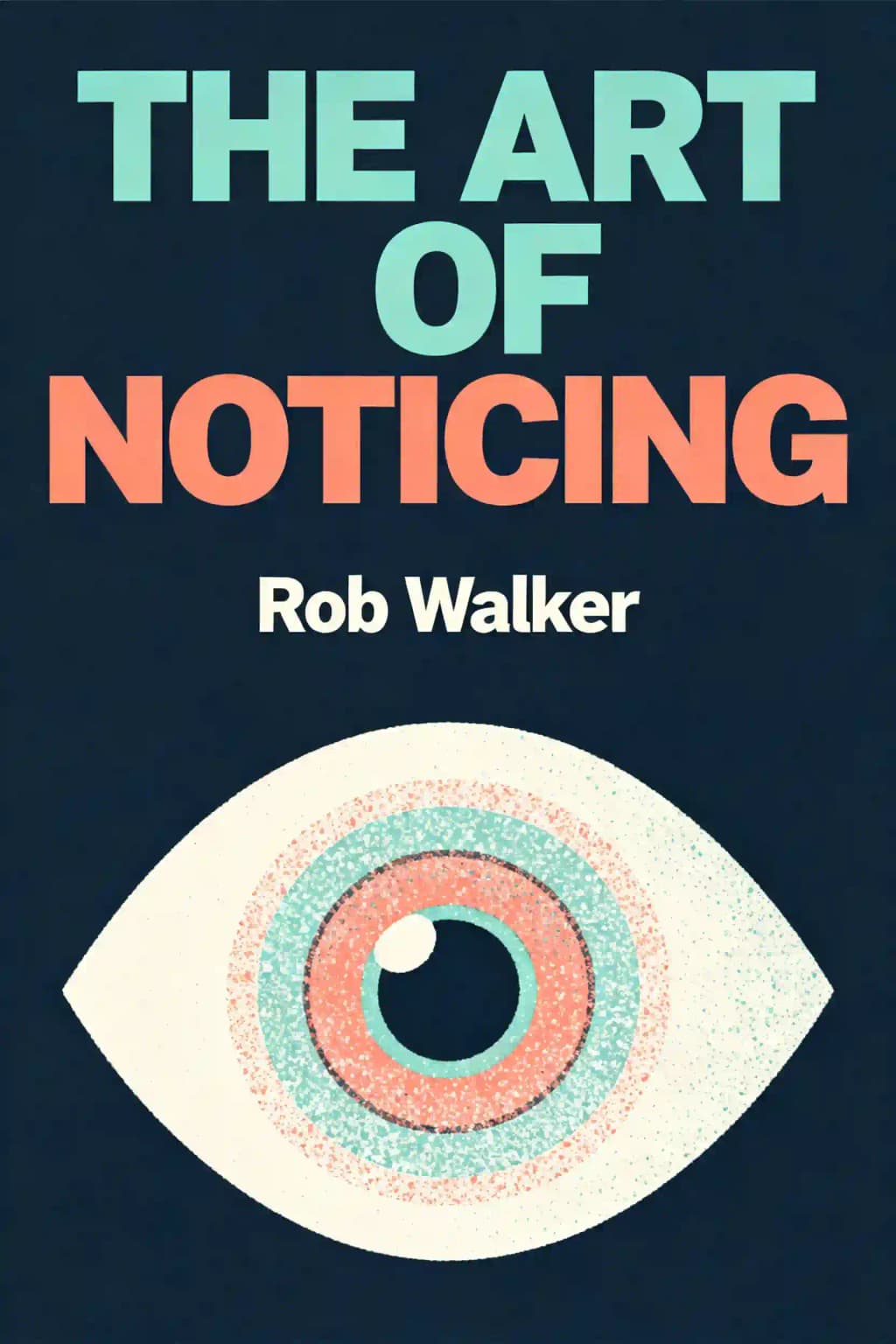
In a world of digital distraction, Rob Walker's "The Art of Noticing" offers 131 exercises to reclaim your attention. Endorsed by Seth Godin and taught at the School of Visual Arts, this New York Times-featured manual transforms ordinary moments into extraordinary discoveries. What might you see today that everyone else misses?
Rob Walker is the author of The Art of Noticing: 131 Ways to Spark Creativity, Find Inspiration, and Discover Joy in the Everyday, and a journalist specializing in design, technology, and the psychology of attention. This mindfulness and creativity guide provides 131 practical exercises to help readers combat digital distraction and rediscover presence in everyday life.
Walker brings extensive authority to the subject, having contributed to The New York Times, Fast Company, Bloomberg Businessweek, and The Atlantic. He writes the Human Resource column for Lifehacker and shares regular insights through his newsletter, The Art of Noticing. He teaches at the School of Visual Arts' Products of Design MFA program, where he focuses on creative observation and critical thinking. His latest book, Lost Objects, co-edited with Joshua Glenn, explores how everyday objects shape our lives and memories.
The New York Times praised the book for offering "simple, low-stakes activities [that] can open up the world," establishing it as an essential guide for creativity and mindful living in the digital age.
The Art of Noticing by Rob Walker is a practical guide containing 131 exercises designed to help readers spark creativity, find inspiration, and discover joy in everyday life. The book teaches how to overcome modern distractions and pay closer attention to familiar environments, transforming mundane surroundings into sources of creative inspiration. Each short chapter offers simple techniques for adjusting perspective and seeing the ordinary in extraordinary ways.
Rob Walker is an author, journalist, and columnist for Fast Company who has been a longtime contributor to The New York Times. After years covering technology, consumer culture, and the modern workplace, Walker noticed that the ability to be present was lost in an "age of nonstop distraction". He wrote The Art of Noticing to solve this epidemic by providing exercises that help people reclaim their attention and notice what others overlook.
The Art of Noticing should be on the compulsory reading list for anyone pursuing creative courses including writing, art, and filmmaking. It's ideal for creative professionals, entrepreneurs, and anyone feeling disconnected from their surroundings due to modern distractions. The book benefits people seeking to develop clearer thinking, better listening skills, enhanced creativity, and a more mindful approach to daily life.
The Art of Noticing is worth reading for anyone wanting to cultivate creativity and mindfulness through simple, actionable exercises. While the lack of sequential narrative structure makes it somewhat tiring to read straight through, the book's 131 perspective-altering techniques deliver real value. It's lightweight yet profound, teaching readers to find creative inspiration without traveling or seeking new experiences—just by noticing what's already around them.
The Art of Noticing contains 131 short exercises that engage all senses including sight, sound, smell, touch, taste, and temperature. Specific exercises include:
Other activities involve looking slowly at art, counting with numbers found in the environment, and digging into backstories of everyday objects.
The Art of Noticing teaches that creativity begins with noticing what others have overlooked or taken for granted. Rob Walker demonstrates that major innovations—from Velcro to the iPhone—started when someone noticed overlooked details that everyone else missed. By cultivating attention skills through deliberate practice, readers develop more original perspectives and distinct points of view essential for creative breakthroughs. Regular noticing exercises help overcome mass distraction and stimulate imagination.
The central idea of The Art of Noticing is that attention is vitality—paying attention is crucial for connecting with others and staying eager and engaged with life. Walker argues that we've allowed media, technology, and marketing to direct our attention instead of experiencing the world directly. By deliberately practicing the art of noticing through simple exercises, readers can regain focus, ground themselves in the present moment, and transform familiar environments into unmissable adventures.
The Art of Noticing teaches mindfulness through practical, fun rituals rather than complicated meditation practices. Rob Walker encourages mindful observation by having readers engage directly with their environment—taking note of details they normally cruise through or switch off from in daily life. The exercises build "attention muscles" through activities like:
The key takeaways from The Art of Noticing include that attention is vitality for connecting with others and staying engaged with life. Regularly practicing noticing leads to more original perspectives and distinct viewpoints. The book emphasizes overcoming modern distractions to regain focus and creativity while finding joy and inspiration in everyday mundane experiences. Ultimately, readers have power over how they direct their attention—noticing what you observe can reveal something about yourself.
The Art of Noticing helps professionals become clearer thinkers, better listeners, and more creative colleagues by teaching them to notice what everybody else missed. Rob Walker draws on examples of successful individuals like Warren Buffett and Jerry Seinfeld who excelled by noticing overlooked details in their fields. The attention skills cultivated through the book's exercises apply across various professional contexts—from science to entrepreneurship—making it valuable for anyone seeking competitive advantage through thoughtful observation.
The main criticism of The Art of Noticing is that the lack of a larger narrative through the content makes reading somewhat tiring. The 131 short chapters have no sequential order, which can feel disconnected and exhausting to read straight through. Some readers may find that certain suggested exercises don't appeal to their personal style or preferences. However, most reviewers acknowledge that despite this structure, the book delivers valuable perspective-altering techniques.
Books similar to The Art of Noticing include works by John Berger and Susan Sontag that focus on seeing versus merely looking. For readers interested in mindfulness and attention, related titles explore observational skills and creative thinking. Rob Walker's book shares thematic connections with works on consumer culture, design thinking, and cultivating presence in an age of distraction. His other work, Lost Objects: 50 Stories About The Things We Miss and Why They Matter, extends similar themes about noticing and appreciating overlooked objects.
Ressentez le livre à travers la voix de l'auteur
Transformez les connaissances en idées captivantes et riches en exemples
Capturez les idées clés en un éclair pour un apprentissage rapide
Profitez du livre de manière ludique et engageante
We've reached what might be called 'peak distraction' in modern society.
A wealth of information creates a poverty of attention.
The world becomes richer and more textured.
What am I not seeing?
Humans possess the unique ability to outmaneuver our own base instincts.
Décomposez les idées clés de Macbeth en points faciles à comprendre pour découvrir comment les équipes innovantes créent, collaborent et grandissent.
Découvrez Macbeth à travers des récits vivants qui transforment les leçons d'innovation en moments mémorables et applicables.
Posez vos questions, choisissez votre style d’apprentissage et co-créez des idées qui vous correspondent vraiment.

Cree par des anciens de Columbia University a San Francisco
"Instead of endless scrolling, I just hit play on BeFreed. It saves me so much time."
"I never knew where to start with nonfiction—BeFreed’s book lists turned into podcasts gave me a clear path."
"Perfect balance between learning and entertainment. Finished ‘Thinking, Fast and Slow’ on my commute this week."
"Crazy how much I learned while walking the dog. BeFreed = small habits → big gains."
"Reading used to feel like a chore. Now it’s just part of my lifestyle."
"Feels effortless compared to reading. I’ve finished 6 books this month already."
"BeFreed turned my guilty doomscrolling into something that feels productive and inspiring."
"BeFreed turned my commute into learning time. 20-min podcasts are perfect for finishing books I never had time for."
"BeFreed replaced my podcast queue. Imagine Spotify for books — that’s it. 🙌"
"It is great for me to learn something from the book without reading it."
"The themed book list podcasts help me connect ideas across authors—like a guided audio journey."
"Makes me feel smarter every time before going to work"
Cree par des anciens de Columbia University a San Francisco

Obtenez le resume de Macbeth en PDF ou EPUB gratuit. Imprimez-le ou lisez-le hors ligne a tout moment.
In a world where the average person checks their smartphone 150 times daily (once every six waking minutes), we've reached what might be called "peak distraction." Our attention has become the most valuable-and endangered-commodity of the modern age. This isn't entirely new; as far back as 1903, sociologist Georg Simmel lamented the overwhelming stimulation of modern life. What's different today is both the scale and intentionality of the attention economy. Tech companies employ thousands of engineers specifically to make their products more addictive, while our environments grow increasingly cluttered with up to 10,000 advertisements daily. The cost? Studies show constantly divided attention impairs cognitive performance by up to 40%, increases stress levels, and diminishes our capacity for deep thought. But there's hope-our brains remain remarkably plastic throughout our lives, meaning we can train ourselves to resist the pull of constant distraction and rediscover the joy of deep engagement with the world around us.
Our brains process only about 40 bits of the estimated 11 million bits of visual information we encounter every second. This creates "inattentional blindness" - our tendency to miss what we're not specifically looking for, even when it's right before our eyes. In the famous study where viewers watching basketball passes missed a person in a gorilla suit walking through the scene, we see this isn't a perceptual flaw but a feature. Our brains evolved to focus on what matters and filter out the rest. Active seeing means breaking through these perceptual filters. Claude Monet demonstrated this by studying the same haystack at different times of day, capturing subtle variations most would miss. This heightened observation isn't reserved for artistic geniuses - it's a skill anyone can develop. Practice techniques like the "five senses scan" by systematically noting what you can see, hear, smell, feel, and taste. Challenge yourself by asking: What am I not seeing? What details have I overlooked? What patterns might emerge with more careful attention?
What if you approached your daily environment as a treasure hunt? Developing what psychologist Alexandra Horowitz calls a "search image" - a visual expectation that helps find meaning in chaos - transforms ordinary observation into adventure. Once you begin looking for specific objects like security cameras or architectural details, they appear frequently, revealing hidden patterns. One student committed to noticing something new on her two-block walk to class. Within weeks, her routine path became a landscape of discovery - from changing window displays to evolving graffiti. Another practiced "color walks," letting herself be guided solely by colors that caught her attention, creating spontaneous journeys through familiar areas. Collections provide another framework. Design Within Reach founder Rob Forbes photographed house numbers, sewer tiles, and bike locks across Amsterdam, revealing cultural values. These collections aren't just image accumulations but records of attention - evidence of a mind actively engaging with surroundings rather than sleepwalking through them. Perhaps most powerful is looking really, really slowly, revealing infinite variations in the seemingly mundane.
Vision dominates our awareness, but true noticing engages all senses. John Cage's composition 4'33" - four minutes and thirty-three seconds of performed silence - revolutionized listening by highlighting typically filtered ambient sounds. Setting a timer for this duration reveals a surprising "plenitude" in what we consider silence. Sound offers rich opportunities for discovery. Try walking toward quieter areas, creating neighborhood sound maps, or focusing on single instruments within familiar songs. Composer Pauline Oliveros developed "deep listening" after performing in an underground cistern with extraordinary reverb. Her practice encompasses remembered, dream, and imagined sounds - "the whole space-time continuum of sounds." Our sense of smell provides another dimension. Urban planner Victoria Henshaw's "smellwalks" revealed how people often recognized familiar scents they'd never consciously registered. Touch deserves attention too - compare natural and human-made surfaces, as architecture critic Ada Louise Huxtable suggested: "Kicked a Building Lately?" Beyond the traditional senses lie what Marcel Duchamp called "infrathin" perceptions - subtle experiences like the warmth of a recently vacated seat.
Our habitual routes through familiar spaces often lead to perceptual blindness - we stop seeing what we pass daily. Changing how we move can dramatically alter what we notice. Taking different routes to common destinations helps avoid the "zombie commuter state" where we arrive with no memory of the journey. More radical approaches include the 1950s Parisian "drift" - dispensing with usual reasons for movement to follow the landscape's pull. Try exploring your hometown without spending money to shift your perspective on familiar spaces. Even mundane places like big-box stores can become discovery sites. At Walmart, play "big-box archaeologist" by finding the most absurd, poetic, or revealing products. Food offers another exploration avenue. Pulitzer Prize-winner Jonathan Gold built his career by exploring uncelebrated restaurants, deciding to eat at every establishment on Los Angeles's Pico Boulevard not for famous eateries, but because it was "unremarked" yet "at the center of entry-level capitalism."
The quieter you become, the more you can hear. Silence isn't about not speaking - it's about cultivating deeper awareness through intentional listening. Challenge yourself to speak only what's necessary for a day. We often treat conversation as competition, mentally rehearsing our next comment while others speak. If you limited yourself to fifty words tomorrow, you'd listen differently, attending carefully to every word. A 66-year-old accountant offers a powerful technique: deep breathing. When listening, especially when feeling defensive, he takes deep breaths - three full seconds for each inhale and exhale. This practice reduces cortisol during stressful moments and creates a natural pause before responding. "That breath stops time," he explains - sharpening hearing, attuning you to nonverbal cues, and opening receptivity to the speaker's underlying message. Even shy people can find connection through stranger interactions. Writer Kio Stark advocates breaking the norm of "civil inattention" - our agreement not to bother others in public spaces. Simple openings like "I couldn't help noticing..." can lead to meaningful exchanges.
The art of noticing transforms how we experience life-a journey rather than a destination. Timothy "Speed" Levitch demonstrates this through his "connoisseur that honk" approach during Manhattan tours, teaching participants to appreciate each honk based on "voluminousness, intensity, context, and duration." This converts irritations into fascination. The key is learning to "cruise" (appreciating beauty around you) rather than "commute" (seeing others as obstacles). Making appointments with yourself ensures noticing isn't crowded out by busy schedules. Comedian Mike Birbiglia realized this when he wrote himself a note: "Mike! You have an appointment at Cafe Pedlar at seven a.m....with your mind." Noticing flourishes when we care for something. Student Miguel Olivares demonstrated this by making a planter for a cactus, reasoning that "by nurturing or caring for something, you pay more attention to it." In a world designed to fragment our attention, noticing becomes a radical act-reclaiming our most precious resource. It's not about seeing everything but choosing what deserves our attention and giving it proper care.