Chapitre 1
The Warrior's Path: Where Words Meet Flesh
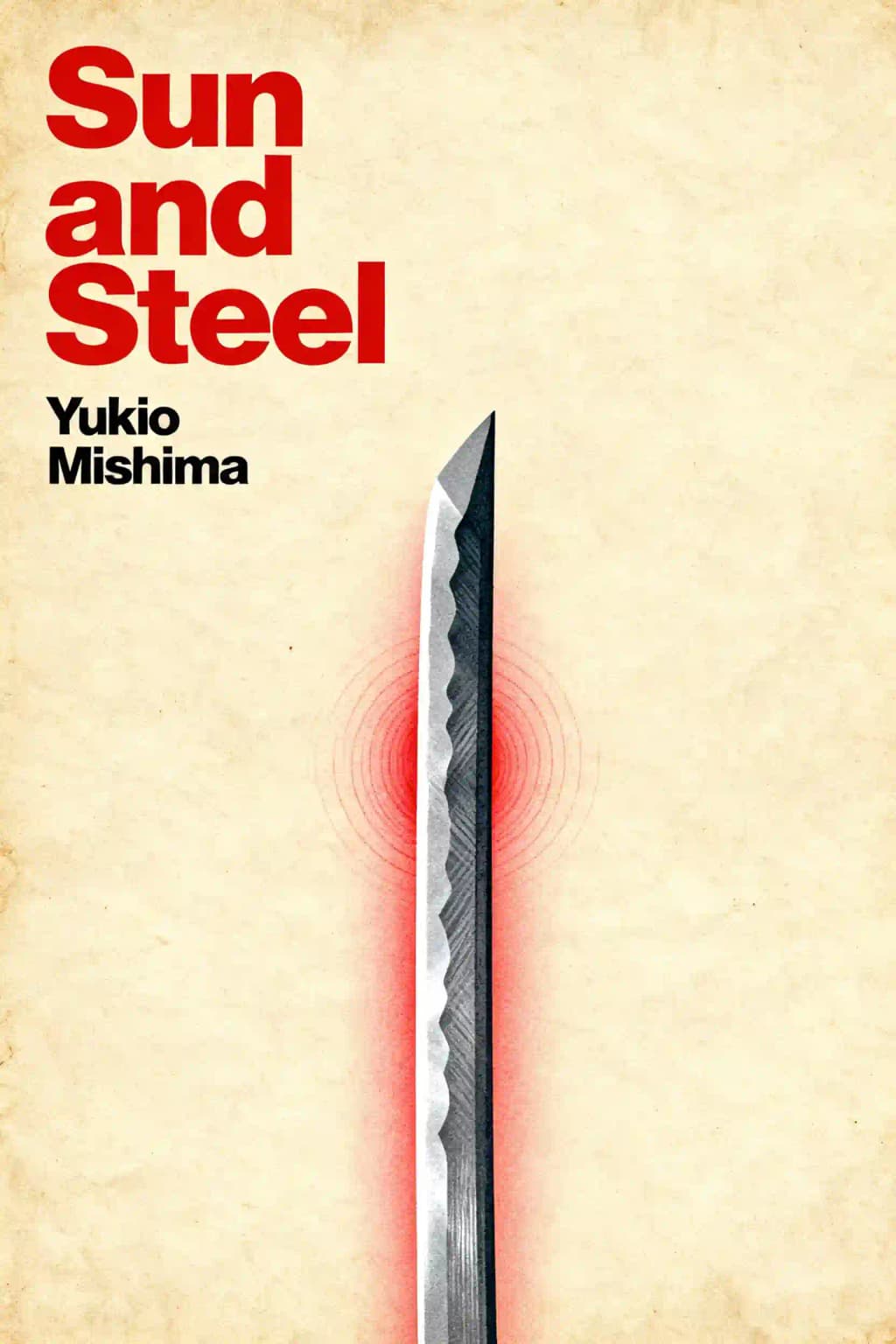
Yukio Mishima's "Sun and Steel" stands as one of the most profound explorations of the body-mind relationship in modern literature. This deeply personal meditation on physicality, language, and mortality has influenced generations of writers, philosophers, and artists since its publication in 1968. Mishima, already an internationally acclaimed novelist when he wrote this work, was simultaneously building his body through rigorous weight training and martial arts-a seemingly contradictory pursuit for a literary intellectual. The book emerged from this tension, becoming a cult classic among those seeking to understand the relationship between physical and intellectual development. Even David Bowie cited it as one of his favorite books, drawn to its exploration of the divided self. What makes this philosophical memoir so compelling is how it transforms Mishima's personal journey into a universal meditation on human existence-revealing the profound contradictions between our intellectual and physical selves that we all must navigate.
Chapitre 2
The Paradox of Words and Flesh
For most people, bodily awareness precedes language-we experience our physical existence before we learn to describe it. But Mishima's experience was dramatically reversed. Words came first, with his physical self arriving belatedly, already "clothed in concepts" and "wasted by words." This inversion created a fundamental tension in his life: his professional calling was to continue with words' "corrosive function," yet he simultaneously yearned to encounter reality in a "wordless field."
This contradiction became the central struggle of Mishima's existence. Words, by their nature, reduce reality to abstraction. They carry the danger of corroding themselves like stomach acid eventually eating through the stomach. Yet as a novelist, words were his livelihood, his art, his primary mode of engaging with the world. The cleverness of this arrangement, as Mishima recognized, was that it ensured words and reality never confronted each other directly. This separation fueled both his novel-writing and his increasing thirst for physical reality.
Through rigorous physical training-the "sun and steel" of his title-Mishima gradually learned what he called "the language of the flesh" as though it were a foreign tongue. This second language became an essential aspect of his spiritual development. The body, he discovered, possessed its own logic and eloquence beyond mere taciturnity and beauty. By equating his fetish for physical existence with his fetish for words, Mishima unknowingly freed himself from words' spell, recognizing their identical origins in formal beauty.
What makes this insight so powerful is how it challenges our conventional understanding of the mind-body relationship. Most of us assume that our physical and intellectual selves are naturally integrated. Mishima's experience reveals how modern life can drive these aspects apart, creating a profound alienation from our embodied existence. His struggle to reconcile these dimensions speaks to anyone who has felt the disconnect between their thinking self and their physical being.
Chapitre 3
The Reconciliation with the Sun
Mishima's relationship with the sun evolved dramatically throughout his life. His first encounter came unconsciously in the summer of 1945, when merciless sunlight poured over war's end and lush grass. That sun had become associated with corruption and death, gleaming on military equipment and blood alike. At fifteen, he had written poetry shunning the sun, preferring introspection and shadow. After the war, he sensed that treating the sun as enemy had become following the herd, as nocturnal thought dominated literature.
In 1952, aboard a ship on his first journey abroad, Mishima reconciled with the sun. It became his life's main highway, tanning his skin and marking him as different from the pale intellectuals of his literary circles. He began questioning why thought must always descend rather than rise toward the surface-why the skin, which guarantees our existence in space, should be despised and left to mere senses while the intellect retreated inward.
The sun enticed Mishima's thoughts from visceral night toward sunlit muscles, commanding him to build a dwelling of tanned skin and powerful muscles where his mind could surface securely. Unlike nocturnal thought born of diseased organs, this surface-oriented thinking required bodily training to precede mental training. He realized only muscle could justify his attraction to surface profundities-who respects a decrepit physical education theorist?
This reconciliation with the sun represented more than just a personal transformation. It was Mishima's rejection of post-war Japan's intellectual trends, which had turned inward and embraced darkness. The sun represented clarity, exposure, and a return to classical values-the very qualities that modern Japanese literature had abandoned. By embracing the sun, Mishima was making both a personal and cultural statement about the need to return to more embodied, vital forms of expression.
"I believe training can transform both involuntary muscles and automatic mental patterns," Mishima wrote, "creating temporary 'false orders' that provide fleeting happiness like a hedgehog's protective curl." This quality is shared by both spirit and body-their tendency to instantly create their own small universe when controlled by a particular idea. Though actually a standstill, it feels like lively, centripetal activity, providing fleeting happiness as protection against surrounding chaos.
Chapitre 4
The Education of Steel
On the day Mishima first approached the weights, he began a decade-long relationship with steel that would transform both his body and mind. The nature of steel is peculiar-as he gradually increased its weight, it created a balanced effect like scales: muscles on the opposite pan increased proportionately, as though steel maintained strict equilibrium between them. Slowly, his muscles began resembling steel's properties, a development remarkably similar to education's remodeling of the intellect through progressively difficult material.
With a classical ideal of the body as his ultimate goal, the process mirrored classical education. Yet which truly resembled the other? Was Mishima not already using words to imitate the classical physical type? Beauty always retreated from his grasp-he valued only what existed once or should have existed. The steel restored the body's classical balance it had begun losing, reinstating its natural, rightful form.
Modern life has rendered certain muscle groups virtually unnecessary, though they remain vital elements of a man's body. Like classical education to practical men, bulging muscles serve no practical purpose in contemporary society. Muscles have become akin to classical Greek-to revive this dead language required steel's discipline, transforming death's silence into life's eloquence.
Steel taught Mishima the correspondence between spirit and body: feeble emotions matched flaccid muscles, sentimentality a sagging stomach, overimpressionability an oversensitive white skin. Conversely, bulging muscles, taut stomach, and tough skin corresponded to intrepid fighting spirit, dispassionate intellectual judgment, and robust disposition. Though he acknowledged ordinary people aren't necessarily like this-he'd seen countless timid minds within bulging muscles-since words preceded flesh for him, these moral qualities needed bodily manifestation.
What's particularly striking about Mishima's relationship with weightlifting is how it differs from contemporary fitness culture. Today's gym-goers often pursue physical development for aesthetic reasons or vague notions of "health." Mishima's approach was fundamentally philosophical-each rep was an education, each muscle gained was a moral quality embodied. His was not mere vanity but a profound attempt to reshape his entire being through physical discipline.
Chapitre 5
The Romantic Impulse Toward Death
Beyond education lurked a romantic design in Mishima's physical transformation. The romantic impulse toward death had formed his boyhood's undercurrent, making sense only as classical perfection's destruction. This pattern established itself within him before he'd achieved anything practical in life. Mishima cherished a romantic impulse toward death yet required a classical body as its vehicle. He believed his romantic death remained unfulfilled because he lacked necessary physical qualifications-powerful, tragic frame and sculpturesque muscles seemed indispensable for romantically noble death. Any confrontation between weak, flabby flesh and death seemed absurdly inappropriate.
At eighteen, longing for early demise, Mishima felt unfitted for it, lacking muscles suitable for dramatic death. It deeply offended his romantic pride that this unsuitability had permitted his war survival. Yet these intellectual convolutions were merely entangling themes within life's prelude, awaiting achievement or destruction. Steel provided the clue to resolving this tension.
Mishima discovered intellect wasn't a harmless cultural asset but a weapon for survival. His later necessary physical disciplines resembled how someone who lived solely through body frantically attempts intellectual education when youth fades. Steel taught him utterly new knowledge beyond books or experience. Muscles were both strength and form, each complex subtly directing its exerted strength like flesh-formed light rays. Nothing accorded better with his cherished definition of art than form enfolding strength, radiating light in all directions.
This romantic impulse toward death might seem pathological to modern readers, but it connects to a long tradition in Japanese aesthetics-the idea that beauty is most profound at the moment of its destruction. The cherry blossom is beautiful precisely because its flowering is so brief. Similarly, Mishima saw human physical perfection as meaningful only in relation to its inevitable decline or destruction. This perspective helps explain his later actions and his lifelong fascination with the samurai code of bushido, which valued beautiful death above prolonged life.
Chapitre 6
The Language Beyond Words
When Mishima experienced the pure sense of strength that came from his physical training, he knew he'd found the future focus of his thought. He planned to dally with it leisurely, experimenting with different formulations while preventing the idea from becoming fixed-like a dog playing with a bone to prolong the pleasure of its aroma. His attempts at rephrasing took the form of boxing and fencing, seeking the "ultimate sensation" that lies just beyond the reach of senses.
Something lurked in that empty space beyond physical exertion. Even with pure power, Mishima could only reach one step short of it; with intellect or artistic intuition, he couldn't get within ten or twenty paces. Art might "express" it, but expression requires a medium, and words themselves became barriers. Expression's dubious nature became apparent-the strange phenomenon where subtle arrangement of words excites imagination, making author and reader accomplices in creating that "thing that is not a thing" called literature.
What lurked beyond the fist and sword was the opposite of verbal expression-the essence of something concrete, of reality itself. There lay the essence of action and power, referred to simply as "the opponent." Unlike ideas, the opponent and Mishima existed in the same world of "being seen," where they gazed at each other without intermediary imagination. In a realm where one's gaze is constantly returned, there's no time for verbal expression. The opponent constitutes the true essence of things-not ideas, but things that stare back.
Mishima discovered that consciousness and physical suffering share an undeniable interdependence. Pain might be the sole proof of consciousness persisting within flesh. As his body acquired muscle and strength, he developed a positive acceptance of pain. This wasn't imagination-his discovery came directly through his body, thanks to sun and steel.
This exploration of the language beyond words speaks to a universal human experience-those moments when we feel most alive are often precisely when we're least capable of articulating our experience. In intense physical exertion, in combat, in moments of great danger or passion, we touch something more fundamental than language. Mishima's genius was in recognizing this paradox and attempting to bridge it through his writing and his bodily practices.
Chapitre 7
The Warrior's Aesthetic
Mishima's physical transformation wasn't merely about strength-it was about creating a particular aesthetic aligned with his literary style. He had crafted a writing style matching his muscles: flexible yet free of excess, maintaining necessary ornament while rejecting both merely functional and purely sensuous expression. Like his body, his style stood isolated, rejecting rather than accepting, with the grave beauty of polished wood in a samurai mansion. He deliberately turned against contemporary preferences, maintaining ceremonial formality and military bearing while others' styles stooped and sagged.
He sought to unite art and life, style and action. His style, like his muscles, restrained imagination-he deliberately selected specific truths rather than pursuing all-inclusive ones, ignoring enervating realities through careful selection. Yet he remained vigilant against imagination's cowardly assaults from beyond his stylistic fortifications. What he detested most was defeat-the corrosion from within by sensibility until one loses outline and dissolves. Though masterpieces sometimes arise from such spiritual death, Mishima sought the struggle itself, preferring to defend within art while fighting outside it, acquiring a warrior's attributes.
After the war, he advocated reviving the Japanese ideal combining letters and martial arts. As he learned to pursue words with his body rather than merely pursuing the body with words, he achieved balance between these opposing elements. His system installed two antipathetic forces that created a living equilibrium constantly destroyed and renewed-his own blend of "art and action." The sword's principle allied death with energy and physical perfection, directly opposing literature, which preserves life blended with death to create artificial, eternal flowers.
To combine action (the flower that wilts) with art (the flower that lasts forever) is to blend humanity's most contradictory desires. When one understands both realms completely, each secretly destroys the ultimate dreams of the other. When action views itself as reality and art as falsehood, it entrusts this falsehood with authority for endorsing its own truth. Epic poems emerged this way. Conversely, when art considers itself reality and action falsehood, it faces the reality of its own death without falsehood's backup.
This warrior's aesthetic represents Mishima's most original contribution to modern thought-a way of being that refuses the false choice between intellectual and physical existence. By embracing both simultaneously, he created a third position that challenges our conventional categories. This integration of seeming opposites offers a powerful model for anyone seeking wholeness in a fragmented world.
Chapitre 8
Moments of Wordless Happiness
It is risky to discuss a wordless happiness, Mishima acknowledges. Creating this happiness requires extremely troublesome conditions and complex procedures. During his brief army life, he experienced many fragments of happiness, but one insignificant, unmilitary moment stands out. Though surrounded by group army life, this supreme wellbeing came upon him, as always, when he was alone.
The late afternoon sky was dyed in shades of blue and pink, with jade turf below. Aging wooden buildings from the old cavalry school lined his path-a covered riding paddock now used as a gymnasium, stables converted to a post-exchange. He wore simple PT clothes: white cotton training pants, rubber gym shoes, and a running shirt. Even the mud soiling his pants contributed to his sense of wellbeing. The morning's parachute training lingered within him like a transparent residue. His body felt pleasantly lethargic from circuit training and running. Rifles were at hand, his shoulder ready for slinging a gun. He had run freely under the summer sun, jumped from the silver tower, momentarily freed from his shadow and self-awareness.
His day had been filled with physical excitement, strength, sweat and muscle-the life he had wanted. He sensed absolute rest for the spirit, a beatification of the flesh. The complex procedures to attain this existence allowed concepts close to fetishes to associate directly with his body, independent of words. Nothing was lacking; every piece of the mosaic was in place, bringing infinite joy of being one with the world.
These moments of wordless happiness represent the rare integration of Mishima's divided self-those fleeting instances when his intellectual and physical aspects achieved perfect harmony. They are significant not just for their personal meaning but for how they illuminate the possibility of transcending the mind-body divide, if only temporarily. These experiences suggest that our modern alienation from our bodies is not inevitable-that through disciplined practice, we might recover a more integrated way of being.
Chapitre 9
The Tragedy of Time and the Group
What Mishima called happiness may coincide with what others call imminent danger. The world he blended into without words was the tragic world-unfulfilled tragedy with seeds of ruin and no future. His happiness came from having acquired the qualifications to dwell there through bodily cultivation alone, not through words which had actually driven him further from it. Ironically, when catastrophe had been brimming over during the war, he lacked these qualifications; when he finally acquired them after long training, he found himself past forty with the cup already drained. Everything wasn't recoverable after all. Time was beyond recall, though attempting to defy time had characterized his post-war existence of committed heresies.
Refusing to recognize his existence's conditions, Mishima sought a different existence. Since words had laid down his existence's conditions, acquiring another meant flinging himself toward the phantom evoked by words-changing from word-creator to word-created being. He succeeded in existing only at one solitary moment during his army life, transforming into a phantom formed by shadows of moldering words. Now muscle, not words, endorsed his existence. Yet the sense of existence that produced such happiness disintegrated moments later, though muscles miraculously survived.
The contradiction between self-awareness and existence troubled Mishima. For centripetal self-awareness, one can "exist" like the transparent "I" in Amiel's Diary, but this existence is endorsed only by words. Another type of self-awareness concerns itself with forms-how can the core be seen through an opaque apple skin? The core anxiously seeks reassurance of its perfect existence, but seeing and existing simultaneously creates contradiction. Only by splitting the apple open can the core see, but then existence falls into fragments. Mishima learned that his momentary sense of existence could be finally endorsed only by death.
What had eluded Mishima, more accurately, was the tragedy of the group, or tragedy as a group member. If he had achieved identity with the group, participating in tragedy would have been easier, but words had driven him increasingly apart from it. Feeling he lacked physical ability to blend with the group and was constantly rejected, he sought self-justification by polishing words, which naturally rejected the group's significance.
His infantile intuition that the group represented the flesh principle was correct-he never needed to amend it. Only later, when experiencing what he called the flesh's dawn-that rosy vertigo after grueling physical exertion and intense fatigue-did he begin perceiving the group's significance. The group concerned itself with everything words could never produce: sweat, tears, cries of joy or pain, and deeper still, blood that words could never cause to flow.
This meditation on the tragedy of time and the group reveals the political dimensions of Mishima's thought. His growing fascination with collective experience and group identity points toward his later embrace of ultranationalist politics. While these aspects of his thinking remain controversial, they help explain the trajectory of his life and his eventual ritual suicide. His search for meaning beyond individualism led him toward collective identity and action-a path that would ultimately prove fatal.
Chapitre 10
The Circle Where Opposites Meet
Before Mishima's eyes emerged a giant snake coiled about earth, constantly swallowing its tail, vanquishing all polarities-the ultimate snake mocking all opposites. Extremes come to resemble each other; things farthest removed, by increasing distance, come closer. This is the circle-snake's secret. Flesh and spirit, sensual and intellectual, outside and inside-all will rise from earth and join together, higher even than the snake-ring of white clouds encircling our world.
Mishima had always been interested only in the edges of body and spirit, their outlying regions. The depths held no interest; he left them to others as shallow and commonplace. What exists at the outermost edge? Perhaps nothing save ribbons dangling into void. On earth, gravity weighs man down in heavy muscles; he sweats, runs, strikes, leaps with difficulty. Yet Mishima had unmistakably glimpsed, amidst fatigue's darkness, those first tinges heralding the flesh's dawn. Similarly, man exhausts himself in intellectual adventures, seeking to fly to infinity. Motionless at his desk, he edges closer to the spirit's borders, risking plunging into void. Rarely, the spirit too glimpses dawn light.
But body and spirit had never blended or resembled each other. Mishima had never discovered in physical action anything like the chilling satisfaction of intellectual adventure, nor experienced in intellectual pursuit the selfless heat of physical action. Somewhere, they must connect-but where? Some realm must exist between them, where motion becomes rest and rest motion.
If he flailed his arms, he lost intellectual blood. If he thought before striking, his blow failed. Somewhere must exist a higher reconciling principle. That principle, he realized, was death-though his conception remained too mystical, forgetting death's physical aspect. Earth is surrounded by death. The airless upper regions contain death pure and unalloyed, rarely bringing bodily death to humans because physical conditions prevent their ascent. For man to encounter the universe uncovered is death; he must wear an oxygen mask to survive.
This final vision of unity-the ouroboros snake consuming its own tail-represents Mishima's ultimate philosophical insight. After a lifetime of struggling with duality, he glimpsed the possibility that at their extremes, opposites might meet and merge. This circular vision suggests that the path of physical development and the path of intellectual refinement, if pursued far enough, might ultimately converge. Though Mishima himself would not live to fully realize this unity, his work points toward this possibility-that through disciplined practice of both body and mind, we might transcend their apparent opposition.
In the end, "Sun and Steel" offers no easy answers but rather a profound meditation on the contradictions inherent in human existence. Mishima's journey between words and flesh, between individual and group, between life and death, illuminates the tensions we all navigate. His work continues to challenge readers precisely because it refuses simplistic resolutions, instead embracing the paradoxes that make us human.