Chapitre 1
When Nature Speaks, Do We Still Listen?
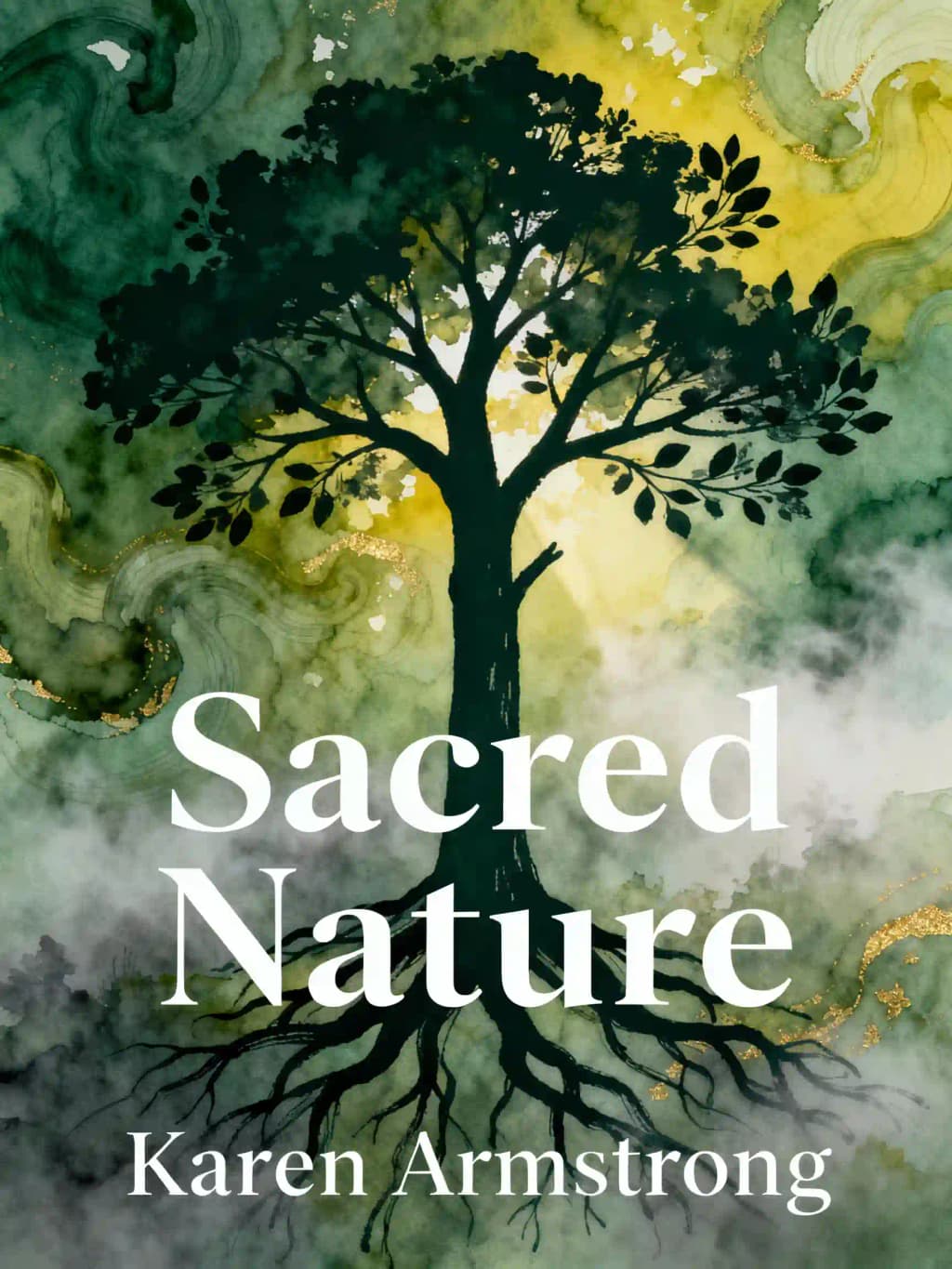
In an age where our phones capture more sunsets than our memories, Karen Armstrong's "Sacred Nature" arrives as a timely spiritual wake-up call. Armstrong, whose work has been translated into forty-five languages, invites us to rediscover what indigenous peoples and ancient civilizations understood intuitively-that nature isn't merely a resource to be exploited but a sacred presence deserving reverence. The book has garnered praise from environmentalists and spiritual seekers alike, with figures like Jane Goodall calling it "essential reading for anyone concerned about the future of our planet." What makes Armstrong's approach unique is her ability to draw from diverse religious traditions without proselytizing, offering practical wisdom for our environmental crisis. As climate anxiety grows, "Sacred Nature" provides something rare: a path forward rooted in humanity's oldest wisdom traditions rather than technological quick fixes. By reconnecting with what our ancestors knew-that nature speaks a language we've forgotten how to hear-Armstrong suggests we might find not just ecological salvation but spiritual fulfillment.
Chapitre 2
The Severed Sacred Connection
I vividly recall my first visit to the British Museum as a young nun, experiencing an almost shocking immediacy with handwritten manuscripts of Wordsworth and Keats. This communion with poetry contrasts sharply with today's museum visitors who seem compelled to photograph everything rather than truly seeing it. We've developed a troubling relationship with nature-physically present in beautiful places yet fundamentally absent, obsessively capturing images instead of allowing landscapes to find intimate places in our hearts.
Our urban living and technology have profoundly alienated us from the natural world. Where we see separate phenomena requiring scientific explanation, indigenous peoples perceived a continuum where animals, plants, and humans are permeated by an immanent sacred force. David Abram discovered this while sheltering in a cave during a rainstorm, becoming fascinated by spiders weaving intricate webs. He learned "of the intelligence that lurks in nonhuman nature" and that his body could "enter sensorially into these dimensions"-an experience most of us would find utterly foreign.
This participatory understanding wasn't exclusive to tribal cultures. Ancient civilizations experienced the divine not as a supernatural distant God but as an intrinsic presence-ilam in Akkadian, Brahman in India, the Dao in China. Even monotheism initially maintained elements of this connection, though the Hebrew Bible eventually gave humans "dominion" over nature and focused divine presence in human events rather than the natural world.
The sacred connection was definitively severed in early modern Europe. Francis Bacon argued humans should exploit nature as God commanded. Descartes established a mathematical foundation for science that viewed the material universe as lifeless and inert. Newton reduced God to a physical phenomenon of "dominion" controlling the cosmos. Nature became merely a resource to be exploited-a perspective we've now embraced globally with devastating consequences.
Despite our destructive behavior, we haven't entirely lost our love for the natural world. The religious practices of the past, particularly those from the Axial Age when major world religions emerged, can help us develop an ethical and aesthetic appreciation of nature essential to saving our planet. What we need isn't just new technology but a fundamental shift in consciousness-a recovery of the sacred dimension of nature that our ancestors understood intuitively.
Chapitre 3
The Forgotten Language of Mythos
We've largely forgotten that humans have always understood reality through two complementary modes: logos and mythos. While logos deals with practical matters, objective facts, and rational thought that enables technological advancement, mythos addresses meaning, timeless truths, and the deeper currents of human experience. Modern society has increasingly privileged logos at the expense of mythos, yet we desperately need both.
Myths aren't simply false stories but events that happened once yet happen all the time, pointing beyond historical flux to life's stable core. When we dismiss myths as primitive superstition, we misunderstand their function. They connect us to our unconscious mind through intuitive insights that must be embodied in ritual to become meaningful. Unlike logos, which excels at solving practical problems but can't answer questions about ultimate value or assuage sorrow, myths help us identify with all humanity and find our place in the cosmos.
Consider how differently we experience time through these two lenses. Logos sees time as linear progression, while mythos perceives recurring patterns and eternal truths. When indigenous peoples performed creation rituals, they weren't naively believing they were literally recreating the world-they were connecting with the timeless patterns that give meaning to existence. Similarly, when Hindus meditated on sacred texts, they weren't merely remembering ancient stories but experiencing their truths directly.
The ancient myths about nature weren't primitive attempts to explain what science now clarifies. They were sophisticated efforts to describe hidden reality and live effectively within our environment. Each tradition offers building blocks for creating a new attitude toward the natural world-one that recognizes its inherent value beyond utility.
Why does this matter? Because recycling and political protests alone won't save us. We need a fundamental shift in consciousness that can only come through reconnecting with the mythic dimension of existence. Each myth asks something different of us personally, requiring practical commitment and response. The environmental crisis isn't just a technical problem requiring technical solutions-it's a spiritual crisis requiring spiritual renewal.
Chapitre 4
The Cosmic Life Force
When Jesuit missionaries brought European science to China in the seventeenth century, Chinese scholars were bewildered by Western concepts of a deity confined to a distant heaven. Scholar Fang Yizhi concluded Westerners were "detailed in material investigation" but fundamentally deficient in understanding qi-the essence of being that transcends language and permeates everything.
Unlike Western thought with its sharp separation between divine and human realms, Chinese philosophy embraced an "anthropocosmic" continuity where heaven, earth, and humanity form an organic, holistic triad. Qi, neither wholly spiritual nor material, is the vital energy pervading all life, harmoniously linking plant, animal, human, and divine worlds in constant flux. This concept wasn't unique to China-similar ideas appear across cultures.
The ancient Indo-Aryans experienced divinity through poetic vision that revealed sacred forces within nature. Their rishis or "seers" composed verses of such beauty that audiences felt touched by divine power, glimpsing the numinous reality behind ordinary existence. They perceived devas (shining ones) in every natural phenomenon-stars as the eyes of goddess Ratri, rivers embodying the flowing Sarasvati, lightning as Indra's thunderbolt.
Through ritual and meditation, these seers discovered Rta, the "active, creative truth" or "the way things truly are"-an impersonal, animating force similar to qi and Dao. By the sixth century BCE, this evolved into Vedanta, which redefined ultimate reality as Brahman-the foundation of all existence permeating everything "right up to the fingernails." This insight that the divine pervades both nature and humanity's inner self became fundamental to Indian spirituality.
Even Buddhism, which began by rejecting metaphysical speculation, eventually embraced the concept that Buddha-Nature exists in all things. Zen teaches that the phenomenal world itself is Buddha-Nature, with everything striving for and achieving Nirvana in its own way. This sense of inherent sacrality appears across traditions, including Jewish Kabbalah and Byzantine Christian mysticism.
How might we recover this vision? We must shift our perception of the divine from a distant creator to an "inexpressible but dynamic inner presence that flows through all things." Wordsworth's poetry exemplifies this approach, as he carefully describes a "presence" and "something far more deeply interfused" in nature. We can cultivate this awareness through simple practices: sitting in nature without distractions, truly observing rather than photographing our surroundings, and developing what Wordsworth called a "wise passiveness" that allows nature to impress itself upon our minds.
Chapitre 5
The Wisdom of Job's Humility
In the Book of Job, we find a passionate, beautiful approach to nature that differs dramatically from elsewhere in the Bible. This dramatic poem was composed by an Israelite involved in the Wisdom movement, which saw nature rather than gods as the true source of morality. When God finally responds to Job's suffering and complaints, He pointedly ignores Job's anthropocentric questions about why virtuous men suffer. Instead, God reveals a cosmic order of staggering beauty where violence and suffering are essential to all species' life and, paradoxically, their glory.
God bombards Job with unanswerable questions about creation: "Where were you when I laid the earth's foundation? Who marked off its dimensions? Who stretched a measuring line across it?" These questions aren't meant to humiliate Job but to reveal nature's intrinsic value and beauty beyond human understanding. Where Job saw darkness and death, God shows a cosmos pulsing with energy and purpose.
What's remarkable is how God celebrates animals' noble values-the mountain goats that allow their young perfect liberty, the proud wild donkey free from human control, the magnificent horse that "laughs at fear," and Behemoth (the hippopotamus), whose immense strength makes him "the masterpiece of all God's work." These creatures rise magnificently to life's challenges without complaint, teaching humans they are not the center of the world.
Through this revelation of sacred nature, Job experiences a theophany comparable to Moses at Sinai. His only response is humble silence-perhaps the most appropriate response when confronting the mystery of existence. At this perilous juncture in our history, it's time to acknowledge Job's message: when we look at the natural world, we must learn to appreciate its mystery and cry, "Holy! Holy! Holy!"
Traditional religions devised stories and rituals compelling people to look unflinchingly at life's inherent sorrow, unlike our modern tendency to avoid distressing news. Indian creation myths portrayed our world as fundamentally flawed from the beginning, contrasting with Genesis's optimism. The Brahmanas described how Prajapati, the creator god, didn't create effortlessly but exploded from strain, his fractured pieces becoming the universe. Daily rituals reconstructed this damaged cosmos, teaching that nature was vulnerable and humans must revere and rescue it.
Perhaps we should make ourselves feel more disturbed by the pain inflicted on fellow humans and the environment-the broken lives in war-torn regions, migrants risking death crossing seas, shameful inequity in wealthy cities, the widening wealth gap, and persistent racism. Religious traditions ask us to reflect seriously on the world's pain, not for comfort but to elicit compassion-the ability to feel with others-which frees us from our ego and enables us to experience the holiness that transcends our limited perspective.
Chapitre 6
The Sacred Practice of Sacrifice
Animal sacrifice was central to ancient religion, though modern people consider it barbaric while our ancestors would be horrified by our casual industrial slaughter of animals. In ancient times, meat was rarely eaten unless ritually slaughtered, with ceremonies designed to transform all participants-including the animal victim.
India provides our richest knowledge of sacrificial rites. Originally, Aryan nomads conducted raucous sacrifices where gods received choice portions conveyed to heaven by Agni, the sacred fire, followed by rowdy celebrations. By the ninth century BCE, however, Brahmin priests reformed these rituals, extracting much of the violence and showing new concern for the animal's welfare. The Brahmanas condemned animal sacrifice as cruel, recommending the animal be spared if possible or killed as painlessly and with dignity if necessary.
What's crucial to understand is that religion demands hard work and transformation, not just going through motions. The ancient sacrificer spent months in uncomfortable preparation, undergoing demanding rites before performing temple sacrifice with intense concentration. These rituals challenged participants profoundly, insisting that proper observance would change their minds.
This transformation is precisely what our environmental crisis requires. We must re-form our attitude to nature through sacrifice-no longer using airplanes, cars, or burning coal with our former insouciance. Creating a viable world demands awakening reverence for nature, seeing ordinary things as sacred. This radical change of mind and heart will be demanding and cannot happen overnight.
The "Five Great Sacrifices" of Hindu tradition-daily feeding hungry animals, honoring all guests as divine, remembering the deceased and devas, and studying scripture-offer a model. Perhaps we should create our own daily practices to honor the holiness of every natural object and person we encounter. Though we'll often fail, we must persistently try to recognize that each person is a holy mystery and each animal or plant has unique dignity and beauty, all deserving kindness and reverence.
The concept of sacrifice challenges our consumer culture directly. We've been taught that happiness comes through acquisition and consumption, but ancient wisdom suggests the opposite-that true fulfillment comes through giving up, letting go, and recognizing our place within a larger whole. What if the sacrifices required to address climate change aren't burdens but opportunities for deeper connection and meaning? What if living with less actually means living more fully?
Chapitre 7
The Power of Self-Emptying
The concept of kenosis-an "emptying" of self-appears throughout spiritual traditions as crucial not only to personal spiritual life but to the entire world order. While modern society values self-assertion as strength, the ancient practice of self-emptying actually liberates us from destructive egotism and opens fresh perception of the world.
Unlike Genesis where creation comes from an external divine power, many cosmologies see creation as a dynamic force working within everything. The Dao infuses nature with power that "gives life yet claims no possession," benefiting without demanding gratitude. The sage aligns with this natural pattern through continuous kenosis-putting himself "in the rear" to come naturally to the fore.
Buddhism offers anatta ("no-self") as practical action, observing how our feelings fluctuate to realize "this is not me." Early Christianity placed kenosis at its center, with Paul quoting how Christ "emptied himself" to become a slave, accepting death on a cross. Islam similarly demands surrender (the meaning of "islam") of ego, with prostrations five times daily physically enacting this self-relinquishment.
Modern society teaches us to value achievement, assert ourselves, and constantly self-promote. But ancient creation myths suggest kenosis lies at the heart of the world order and forms the core of true spirituality. While Daoists saw kenosis as the source of true power, we often seek the direct opposite-serving ourselves, imposing our will on others and nature with terrible results.
The Buddha experienced this truth shortly before achieving Nirvana, recalling a childhood moment when he felt profound compassion for insects killed during field plowing. This spontaneous empathy took him beyond himself in ekstasis, allowing him to experience advanced meditative states instinctively.
The spiritual traditions all point to kenosis: yoga as the dismantling of egotism, Hebrew prophets insisting on submission to God's will, Jesus teaching that a grain must die before bearing fruit. We can practice a simple daily exercise-considering how little we know, how often we fail in kindness, and how limited our desires are-to remind ourselves of our essential frailty and see ourselves realistically.
Isn't it striking that across vastly different cultures and eras, spiritual teachers arrived at the same conclusion-that our self-importance is the greatest obstacle to wisdom? What if our environmental crisis stems not from lack of knowledge but from excess of ego? Perhaps the path forward requires not more assertion of human dominance over nature but a humble recognition of our place within it.
Chapitre 8
The Practice of Radical Gratitude
In 2020, a British Museum exhibition on Arctic culture revealed how people living in harsh climates could still be filled with gratitude toward nature, celebrating their severe seasonal cycles. This echoes Islam's approach to the natural world, where nature is considered a divine revelation equal to the Qur'an itself.
Each verse of the Qur'an is called an ayah, a "sign" of God-but so is every phenomenon in nature. Despite Arabia's harsh climate, the Qur'an insists Muslims see nature as Allah's prime miracle, making themselves aware of the extraordinary signs of divine compassion evident in everyday life. The Qur'an, meaning "recitation," was designed to be spoken aloud, with its rhythms helping Muslims slow their mental processes and enter a different mode of consciousness. Its rich, allusive language teaches about nature aesthetically rather than rationally.
Muslims are instructed that wherever they look in nature, they find divine revelation: "The East and West belong to God; wherever you turn, there is his face." They must not take nature for granted but regard its rhythms as God's self-disclosure, appreciating the regular patterns of nature more than supernatural miracles. From early on, Muslims advanced natural sciences as sacred studies, seeing nature itself as the supreme example of islam-wholehearted "surrender" to the divine. All creatures praise God simply by existing and doing what is ordained for them, making them ideal muslims who surrender wholly to God.
The Qur'an teaches that humans should create societies reflecting the balance that enables the natural world to function harmoniously. Muslims were taught tazaqqa ("refinement") through practices like giving alms (zakat), fasting during Ramadan, and daily prayer (salat) with physical prostration symbolizing surrender to God. These practices helped counter the haughty individualism (istighna) prevalent in their society.
The Qur'an reminds us that the natural order cannot be sustained without balance-a delicate equilibrium we've damaged through our lack of respect. This balance must extend to society, where despite our democratic ideals, we've failed to share essential resources equitably.
Unlike our ancestors who expressed gratitude for nature's rhythms, modern people take natural phenomena for granted. The ancient Egyptians celebrated the rising sun and annual Nile flooding as sacred miracles. Perhaps we should relearn to marvel at these intricate natural rhythms through daily recitation of poems or texts expressing gratitude to nature, especially given our planet's fragility.
When was the last time you felt genuine wonder at a sunrise? Have you ever considered that the predictable cycles of nature that make life possible aren't inevitable but extraordinary? What might change if we approached each day with radical gratitude for the air we breathe, the water we drink, and the soil that feeds us?
Chapitre 9
The Golden Rule for All Creation
The Golden Rule-do not do to others what you would not have done to you-demands we dethrone ourselves from the center of our world, regarding others as equals, and valuing their needs and desires as much as our own. Confucius first articulated this principle as the essence of "ren," which combines dutifulness toward others with the ability to put oneself imaginatively in another's place. He taught that by using our own feelings as a guide to treating others, practicing these virtues "all day and every day," we could transform society more effectively than economic growth or military victory.
Confucians emphasized that physical rituals of respect (li) could cultivate inner virtues. Small courtesies-opening doors, standing when someone enters, offering seats-create habits of mind and heart that honor human dignity. These practices help us lay aside our ego and develop reverence for others, which naturally extends to respect for the natural world.
Confucian teachings evolved to embrace environmental ethics through the concept of "flood-like qi." As one develops awareness of human sanctity, this reverence naturally extends to all beings in nature. The neo-Confucian movement emphasized that humans must form a trinity with heaven and earth, treating the "myriad things" of nature as we would wish to be treated ourselves.
Neo-Confucians developed a profound reverence for ordinary natural elements, seeing the essential ren pervading the cosmos. Zhang Zai's "Western Inscription" beautifully captured this vision: "Heaven is my father and earth is my mother, and even such a small creature as I finds an intimate place in their midst." This philosophy recognized all things as our companions.
The Cheng brothers transformed this piety into a movement, teaching that understanding the "oneness of things" was essential to practicing ren. This wasn't mystical insight but moral discipline through the Golden Rule: "The man of ren takes Heaven-and-earth as being one with himself." Cheng Yi insisted that "every blade of grass and every tree possesses a principle and should be examined."
The neo-Confucians view humanity and nature as inseparable, something Western thinking often fails to appreciate. Their cultivation of reverence contrasts with Western glorification of irreverence, which can be mere egotism. While our environmental damage often produces paralyzing fear, neo-Confucians cultivated religious awe leading to responsibility.
Their vision of humanity "forming one body with all things" offers a trinity with heaven and earth based on empathy rather than power. This unity is cultivated through "quiet sitting" (jing-zuo), where one opens mind and heart to nature, developing universal compassion-not pity, but "feeling with" others.
In our contentious times, we should remember Jesus's words to "love your enemies" and "be compassionate." In our unforgiving world, we urgently need compassion-feeling with all others, whether we like or agree with them. What would happen if we extended the Golden Rule beyond humanity to include all living beings? How might our relationship with nature transform if we asked, before every action, "Would I want this done to me?"
Chapitre 10
The Practice of Harmlessness
Like the Golden Rule, ahimsa is crucial to spiritual and social life, especially in Indian traditions. Though literally meaning "harmlessness," it's a radical concept prohibiting any injury to others. In classical yoga, practitioners couldn't even sit in yogic position until mastering this moral precept, which forbade swatting insects or speaking unkindly.
Jains developed this principle most rigorously, believing every being possessed a jiva (soul). Their practice required extreme caution in all actions-walking carefully to avoid crushing insects, drinking only filtered water, and abstaining from picking fruit. Twice daily, Jains would repent for any harm caused to living creatures. This empathic discipline was seen as the path to enlightenment and self-control.
Jainism made the Golden Rule its essence: "Persons should always behave toward other beings after the manner they like others to observe towards themselves." This ethic influenced Indian political life through figures like Emperor Ashoka, who instituted policies of military restraint and animal protection, and later the Muslim emperor Akbar, who studied with a Jain monk and passed laws protecting various animals.
The Mahabharata epic ultimately teaches that we must "see all beings as like oneself" and surrender our destructive egotism. After depicting catastrophic violence, it concludes by advocating for breaking down barriers between ourselves and all other beings.
The Jain practice of profound empathy asks us to recognize the pain we inflict on other species. While the full Jain lifestyle might be too intense for most, we could still cultivate awareness of our impact-treading carefully, handling objects with care, and contemplating the life force in everything we encounter.
We should extend the Golden Rule beyond humans, using our imagination to enter the lives of other species and break free from our solipsism. Sterne's novel Tristram Shandy illustrates this through Uncle Toby, who refuses to kill a fly that had bothered him, saying "This world surely is wide enough to hold both thee and me"-a moment that left a lasting impression of "universal good-will" on the narrator. Such small daily acts of consideration can help us recognize the sacrality and vulnerability of all creatures.
The principle of ahimsa challenges our casual acceptance of violence-not just physical violence but the structural violence built into our economic systems and daily habits. Each time we purchase a product, we participate in complex supply chains that may cause harm to workers, communities, and ecosystems. What would it mean to truly commit to harmlessness in our modern context? How might we begin to disentangle ourselves from systems of exploitation?
Chapitre 11
Expanding Circles of Compassion
Zhang Zai believed every element of nature possessed a unique moral capacity that the sage could empathically "enter into" through conscious extension of sympathy. This Chinese concept was expressed through imagery of concentric circles, traced back to the legendary kings Yao and Shun from the twenty-third century BCE.
The Shujing depicts Yao as a man of de (virtue)-"reverent, intelligent, accomplished, sincere and mild"-whose moral force radiated outward in ripples. Beginning with cherishing his own family, his affection extended to neighboring clans and finally to distant kingdoms, until "the numerous people were amply nourished and prosperous and became harmonious."
This ancient Chinese global thinking contrasts with modern isolationism. The concentric circles represent stages of self-transcendence, moving beyond self-obsession. Chinese family rituals were designed to make this expansion of sympathy habitual-first revering parents and siblings, then reaching out to the local community (overcoming nepotism), then serving the entire state, and finally extending sympathy to all humanity.
The concentric circles concept must now extend beyond humanity to include the entire cosmos, as we realize our existence depends on nature. Tu Weiming argues we must develop an anthropocosmic mentality uniting individuals with community while preserving harmony between humans and the non-human world. This requires recognizing nature's inherent sacrality at the heart of ongoing creativity.
Daily contemplation of these concentric circles can transform us. Beginning with nature, we should closely observe our immediate environment until trees, flowers, and clouds become daily marvels rather than mere backdrop. We must recognize the essential "holiness" or "otherness" in nature that makes it more than a resource, acknowledging its mystery like Job did.
When extending to human circles, we must cultivate compassion for those unlike ourselves, acknowledging that any single worldview is inadequate. We should conclude with the Buddha's prayer "Let all beings be happy"-not addressed to a deity but to ourselves, calling us to extend boundless goodwill "without limit" to the whole world.
This expansion of moral consideration has profound implications. If we truly recognized our interconnection with all life, how would our priorities change? Would we continue to value economic growth above ecological integrity? Would we persist in defining progress as increasing consumption rather than increasing harmony? The concentric circles invite us to reimagine our place in the world-not as masters of creation but as participants in a vast community of life.
Chapitre 12
Rediscovering Our Place in the Cosmos
Coleridge's "Rime of the Ancient Mariner" speaks directly to our environmental crisis. The Mariner's transformation begins when he suddenly perceives sea creatures with new eyes: "A spring of love gushed from my heart, And I blessed them unaware." This moment of ekstasis-stepping outside ego-centered perception-breaks his isolation.
To redeem the natural world, we must align ourselves emotionally with it, recognizing our affinity and utter dependence upon it. Like Kabbalists, Muslims, Christians, Confucians, Daoists and Hindus before us, we must look beneath nature's surface to experience its sacrality-not through scientific study but through creativity, art, ritual, poetry and bodily practices that transform mental life.
The Mariner's vision wasn't temporary; it enabled him to see connections between heaven, earth and nature. But our love can't be confined to the natural world-it must extend to fellow humans. As the Mariner tells the Wedding Guest: "He prayeth best, who loveth best/All things both great and small." The poem ends with the Wedding Guest turning away "sadder and a wiser man." We too must leave recognizing our environmental predicament and personal responsibility, but intent on transforming mind and heart to repair the damage.
The wisdom traditions Armstrong explores offer not just philosophical concepts but practical pathways toward healing our relationship with nature. Each tradition, in its own way, points to the same fundamental truth-that we are not separate from the natural world but intimately connected with it. Our current environmental crisis stems not just from technological excess but from a profound spiritual disconnection.
The way forward requires more than policy changes or technological fixes. It demands a fundamental shift in consciousness-a recovery of what our ancestors knew intuitively: that nature is not merely a resource to be exploited but a sacred presence to be revered. Through practices of mindfulness, gratitude, compassion, and self-emptying, we can begin to heal the rift between humanity and the natural world.
As we face unprecedented environmental challenges, Armstrong's exploration of sacred nature offers not just analysis but hope. By drawing on the wisdom of diverse traditions, she reminds us that we already possess the spiritual resources needed to transform our relationship with the planet. The question is whether we have the wisdom and courage to put them into practice.