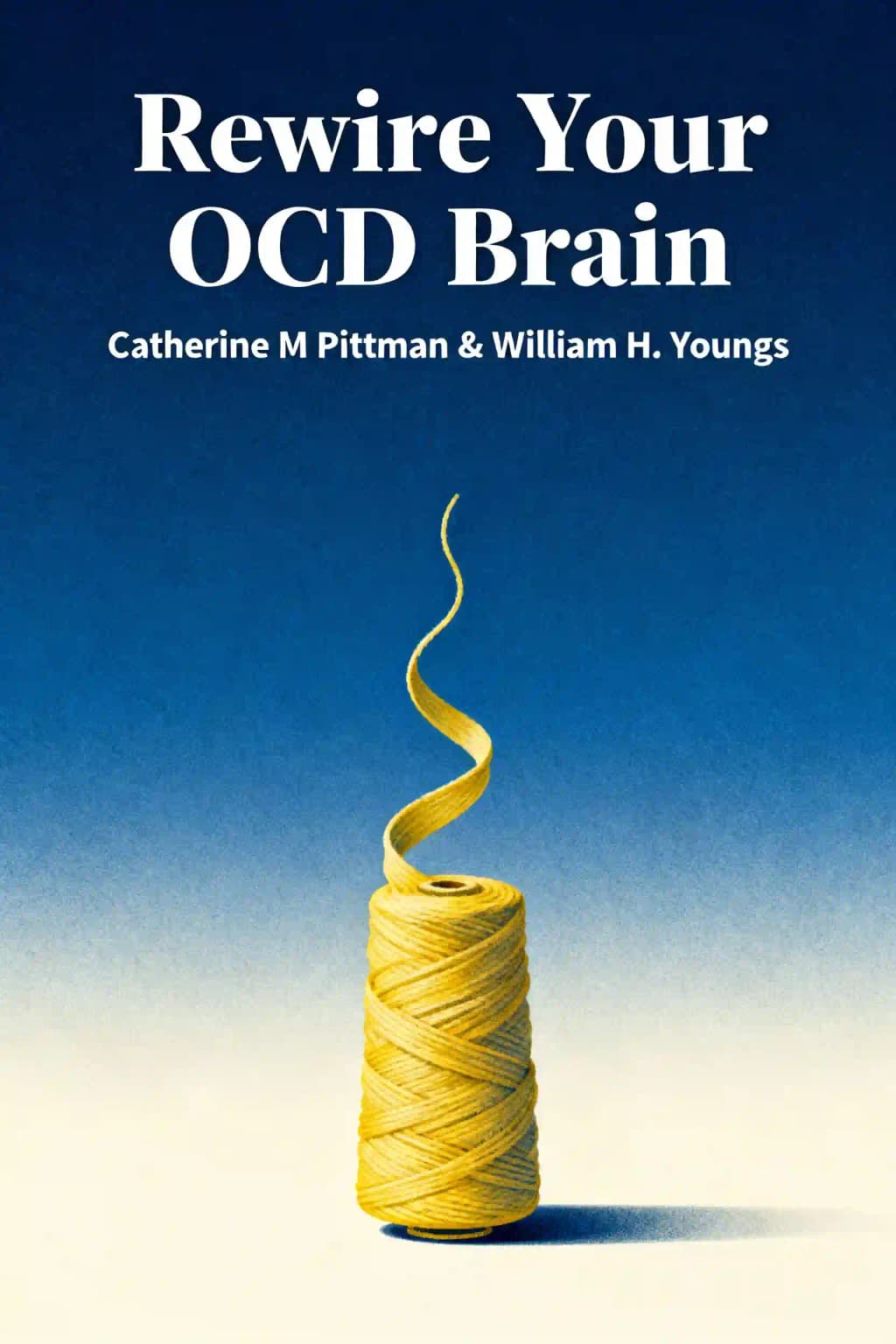
Unlock your mind from OCD's grip with neuroscience-backed strategies praised by top therapists. What if understanding your brain's wiring was the key? This groundbreaking guide transforms complex neurological concepts into practical freedom - making self-compassion replace shame in the battle against intrusive thoughts.
Catherine M. Pittman, PhD, HSPP, is a clinical psychologist and professor at Saint Mary’s College. She is also the co-author of Rewire Your OCD Brain, and is known for her expertise in anxiety disorders and neuropsychologically informed CBT.
With over three decades of clinical practice, she integrates neuroscience research into accessible strategies for OCD management, earning her the nickname “the Amygdala Whisperer.” Her co-author, William H. Youngs, is a clinical neuropsychologist specializing in brain-based approaches to behavioral change.
Together, they combine psychological and neurological insights in this self-improvement guide, which explores themes of habit restructuring, mindfulness, and calming obsessive thought patterns. Pittman’s prior works include the acclaimed Rewire Your Anxious Brain and Taming Your Amygdala, both blending scientific rigor with practical tools.
Published by New Harbinger Publications, Rewire Your OCD Brain distills cutting-edge research into exercises for rewiring neural pathways, reflecting the authors’ commitment to evidence-based, actionable mental health solutions. The book has been widely recommended by clinicians for its accessible approach to complex brain-behavior connections.
Rewire Your OCD Brain explains how neurological processes in the brain drive obsessive-compulsive thoughts and behaviors, offering neuroscience-backed strategies to disrupt these cycles. Combining cognitive behavioral therapy (CBT) with brain-based insights, it teaches skills like cognitive restructuring, mindfulness, and habit change to reduce anxiety and regain control over OCD symptoms.
This book is ideal for individuals with OCD or anxiety seeking science-based self-help tools, as well as therapists looking to integrate neuroscience into treatment. It provides actionable strategies for managing intrusive thoughts, compulsions, and fear-driven behaviors.
Yes—the book blends accessible neuroscience with practical exercises, making it valuable for understanding OCD’s roots and developing coping mechanisms. Readers praise its clear explanations of brain functions and evidence-based techniques like cognitive defusion and sleep optimization.
The book details how the amygdala, cortex, and basal ganglia contribute to obsessive loops. It provides tools to “rewire” these regions through CBT, mindfulness, and behavioral changes, helping reduce hypersensitivity to uncertainty and fear.
Key strategies include cognitive restructuring (changing thought patterns), cognitive defusion (detaching from obsessive thoughts), mindfulness practices, habit-reversal training, and sleep hygiene. These methods target both brain chemistry and behavioral responses.
Unlike generic advice, it focuses on neurology-first solutions, explaining why OCD occurs and how to directly alter brain pathways. Co-author William Youngs’ neuropsychology expertise adds clinical depth to the CBT framework.
The amygdala’s overactivity heightens fear responses to intrusive thoughts, perpetuating anxiety. The book teaches calming techniques to reduce amygdala activation, such as diaphragmatic breathing and sensory grounding.
Yes—it cites studies on fear conditioning, neuroplasticity, and CBT efficacy. The authors link OCD symptoms to specific brain regions (e.g., basal ganglia’s role in compulsions) and validate strategies with clinical research.
While designed for self-management, the authors note that severe cases may require therapy alongside the book’s tools. Techniques like exposure response prevention (ERP) and cognitive restructuring are proven to complement clinical treatment.
Some readers note the neuroscience content requires focus to grasp, and results depend on consistent practice. However, most praise its balance of scientific rigor and actionable steps.
Pittman’s 30+ years treating anxiety and brain injuries grounds the advice in clinical experience. Her earlier work on amygdala-centered anxiety (Rewire Your Anxious Brain) laid the foundation for this OCD-focused approach.
Yes—the skills apply to generalized anxiety, phobias, and panic. Techniques like cognitive defusion and mindfulness build broader resilience against fear-based thinking patterns.
Progress varies, but daily practice of strategies like habit tracking and mindfulness can yield improvements in 4-6 weeks. The authors emphasize patience, as neural rewiring requires repetition.
Ressentez le livre à travers la voix de l'auteur
Transformez les connaissances en idées captivantes et riches en exemples
Capturez les idées clés en un éclair pour un apprentissage rapide
Profitez du livre de manière ludique et engageante
Our brain can become an inescapable torture chamber.
Understanding the brain's rules is key to gaining control.
Your brain can be remodeled through experiences.
Cognitive fusion-believing in the absolute truth of mere thoughts-is fundamental to OCD development.
Ironically, even arguing against obsessions reinforces their neural pathways.
Décomposez les idées clés de Rewire Your OCD Brain en points faciles à comprendre pour découvrir comment les équipes innovantes créent, collaborent et grandissent.
Découvrez Rewire Your OCD Brain à travers des récits vivants qui transforment les leçons d'innovation en moments mémorables et applicables.
Posez vos questions, choisissez votre style d’apprentissage et co-créez des idées qui vous correspondent vraiment.

Cree par des anciens de Columbia University a San Francisco
"Instead of endless scrolling, I just hit play on BeFreed. It saves me so much time."
"I never knew where to start with nonfiction—BeFreed’s book lists turned into podcasts gave me a clear path."
"Perfect balance between learning and entertainment. Finished ‘Thinking, Fast and Slow’ on my commute this week."
"Crazy how much I learned while walking the dog. BeFreed = small habits → big gains."
"Reading used to feel like a chore. Now it’s just part of my lifestyle."
"Feels effortless compared to reading. I’ve finished 6 books this month already."
"BeFreed turned my guilty doomscrolling into something that feels productive and inspiring."
"BeFreed turned my commute into learning time. 20-min podcasts are perfect for finishing books I never had time for."
"BeFreed replaced my podcast queue. Imagine Spotify for books — that’s it. 🙌"
"It is great for me to learn something from the book without reading it."
"The themed book list podcasts help me connect ideas across authors—like a guided audio journey."
"Makes me feel smarter every time before going to work"
Cree par des anciens de Columbia University a San Francisco

Obtenez le resume de Rewire Your OCD Brain en PDF ou EPUB gratuit. Imprimez-le ou lisez-le hors ligne a tout moment.
Imagine being trapped in a mental prison where your own thoughts become your tormentors. For millions with Obsessive-Compulsive Disorder, this isn't imagination - it's daily reality. The same magnificent brain that enables humans to compose symphonies and land on Mars can transform into an inescapable torture chamber, cycling through disturbing thoughts and compelling ritualistic behaviors. What makes this condition so baffling is how it turns the brain against itself, creating a paradoxical situation where the more you try to control unwanted thoughts, the stronger they become. But there's profound hope in understanding the neuroscience behind these symptoms - knowledge that transforms seemingly irrational behaviors into comprehensible brain patterns that can be changed. The revolutionary insight is that OCD isn't a mysterious psychological quirk but a neurological condition with specific brain circuits that can be rewired. While genetic factors play a role (with studies showing 25-30% concordance rates in identical twins), the brain's remarkable plasticity means these patterns aren't permanent. Brain imaging has revealed that OCD involves hyperactivity in specific circuits connecting the frontal lobes, basal ganglia, and amygdala - and more importantly, targeted interventions can normalize these patterns, literally rewiring the OCD brain.
That racing heart and overwhelming dread? That's your amygdala-an almond-sized structure deep in your brain-triggering your defense system. This ancient security guard operates through two pathways: a lightning-fast direct route triggering immediate physical responses, and a slower cortex pathway providing context. Your amygdala makes split-second decisions based on incomplete information, like reacting to a curved stick before recognizing it's harmless. People with OCD misinterpret these anxiety sensations as evidence of danger rather than unnecessary defense responses. While the amygdala drives anxiety, obsessions begin in the cortex. The fundamental issue in OCD is cognitive fusion-believing thoughts are absolute truths rather than simply mental events. When a random thought like "Did I lock the door?" appears, most people dismiss it, but someone with OCD treats it as crucial information requiring action. Most college students report occasionally having disturbing intrusive thoughts, surprising many OCD sufferers who believe such thoughts uniquely significant. The difference isn't having these thoughts-it's how seriously you take them. The brain operates on "survival of the busiest"-neural pathways used frequently become stronger while unused ones weaken. This explains why obsessive thoughts gain strength through repetition. Even arguing against these thoughts reinforces their neural pathways. The amygdala monitors your thoughts like watching "Cortex Television," responding to threatening mental images by triggering anxiety regardless of whether they reflect reality.
Unlike animals, humans use their advanced frontal lobes to project into hypothetical futures. This evolutionary advantage comes with a cost: we torture ourselves with elaborate worries about things that may never happen. Worry provides paradoxical relief by keeping us in abstract thought rather than anxiety-provoking imagery - switching from a frightening mental "movie" to merely hearing a narrative. Though many believe worrying helps prepare for problems, chronic worry actually depletes mental resources without producing solutions. Obsessions differ from worry. While worry is something we consciously engage in, obsessions feel involuntary - intrusive, unwanted thoughts that cause distress and contradict our values. Common themes include contamination fears, needs for symmetry, fears of harming others, perfectionism, and unwanted religious or sexual thoughts. Neuroimaging shows abnormalities in the anterior cingulate cortex of people with OCD - a crucial region bridging the emotional amygdala and rational prefrontal cortex. In OCD, this region may get stuck in repetitive loops, creating a "faulty worry circuit" that prevents progression from threat assessment to problem-solving.
When anxiety strikes, physical reactions like trembling and racing heart aren't danger signals but your protective defense system at work. These responses helped our ancestors survive threats. The issue is misinterpreting these normal reactions as dangerous. Slow, deep breathing directly calms the amygdala by affecting blood CO2 levels. Breathing at five to six breaths per minute reduces stress hormones. Practice diaphragmatic breathing by sitting with one hand on your chest and another on your stomach, breathing deeply to expand your abdomen like filling a balloon. Progressive muscle relaxation offers another approach. Tense muscle groups for five seconds, then completely release them, working systematically through your body. Notice the relaxation spreading as you release unconscious tension that accompanies anxiety. Regularly practicing these techniques during calm periods creates neural pathways that make relaxation responses more automatic and accessible during high-stress situations, preventing chronic amygdala overactivity.
The defense response prepares your body for physical activity, making exercise exactly what the amygdala wants. Just twenty minutes of moderate exercise reduces anxiety by utilizing blood flow, burning excess adrenaline, and increasing endorphins and serotonin. Regular exercise creates lasting changes in the amygdala, making it calmer and less reactive. Sleep is equally crucial yet often disrupted by OCD's perfectionism. During sleep, your brain releases hormones, produces neurochemicals, removes toxins, and stores memories. Sleep deprivation heightens amygdala reactivity to emotional stimuli, creating a cycle where anxiety disrupts sleep and poor sleep worsens anxiety. To improve sleep, keep your amygdala calm before bedtime by avoiding worry-focused thoughts. Replace worrying with calming activities like reading, which uses the same verbal processing as worrying. Aim for 7-9 hours of sleep to maximize REM sleep, which helps regulate amygdala reactivity.
The amygdala learns through direct experience, not logic or reassurance. Exposure with response prevention (ERP) is the most effective OCD treatment, requiring you to face triggers while resisting compulsions. This approach creates new neural pathways that don't trigger anxiety. Anxiety typically peaks before encountering the feared situation, not during it. This anticipatory nature serves an evolutionary purpose - the fight-flight-freeze response works best when activated before danger arrives. Understanding this pattern helps you push through initial anxiety, knowing that facing fears often diminishes anxiety. Response prevention - resisting compulsions during exposure - is crucial. Compulsions provide temporary relief but prevent the amygdala from learning that triggers aren't dangerous. Only by experiencing triggers without seeking relief will the amygdala learn they're safe. With repeated exposure, amygdala activation decreases as new memories override fear associations.
The path to freedom from OCD combines changing thought patterns and accepting what you cannot control. Cognitive restructuring transforms self-defeating thoughts that trigger problematic emotional responses. Your interpretations - catastrophizing, perfectionism, need for certainty, and excessive responsibility - activate the amygdala and fuel OCD. Instead of trying to erase negative thoughts (which reinforces them), follow "Don't erase - replace!" When anxiety-producing thoughts arise, use thought-stopping by saying "Stop!" then immediately substitute an engaging alternative thought. Simultaneously, practice acceptance by observing anxiety mindfully rather than fighting it. Your brain's neuroplasticity means you're not permanently trapped in OCD patterns. Each time you choose a different response to a trigger, you're rewiring neural circuits. The goal isn't eliminating anxiety completely but developing a new relationship with it - where intrusive thoughts lose their power and your brain becomes an ally. Freedom comes from understanding your brain's mechanisms and working with them rather than against them.