Chapitre 1
The Revolution Begins Within: Breaking Free from Faux Self-Care
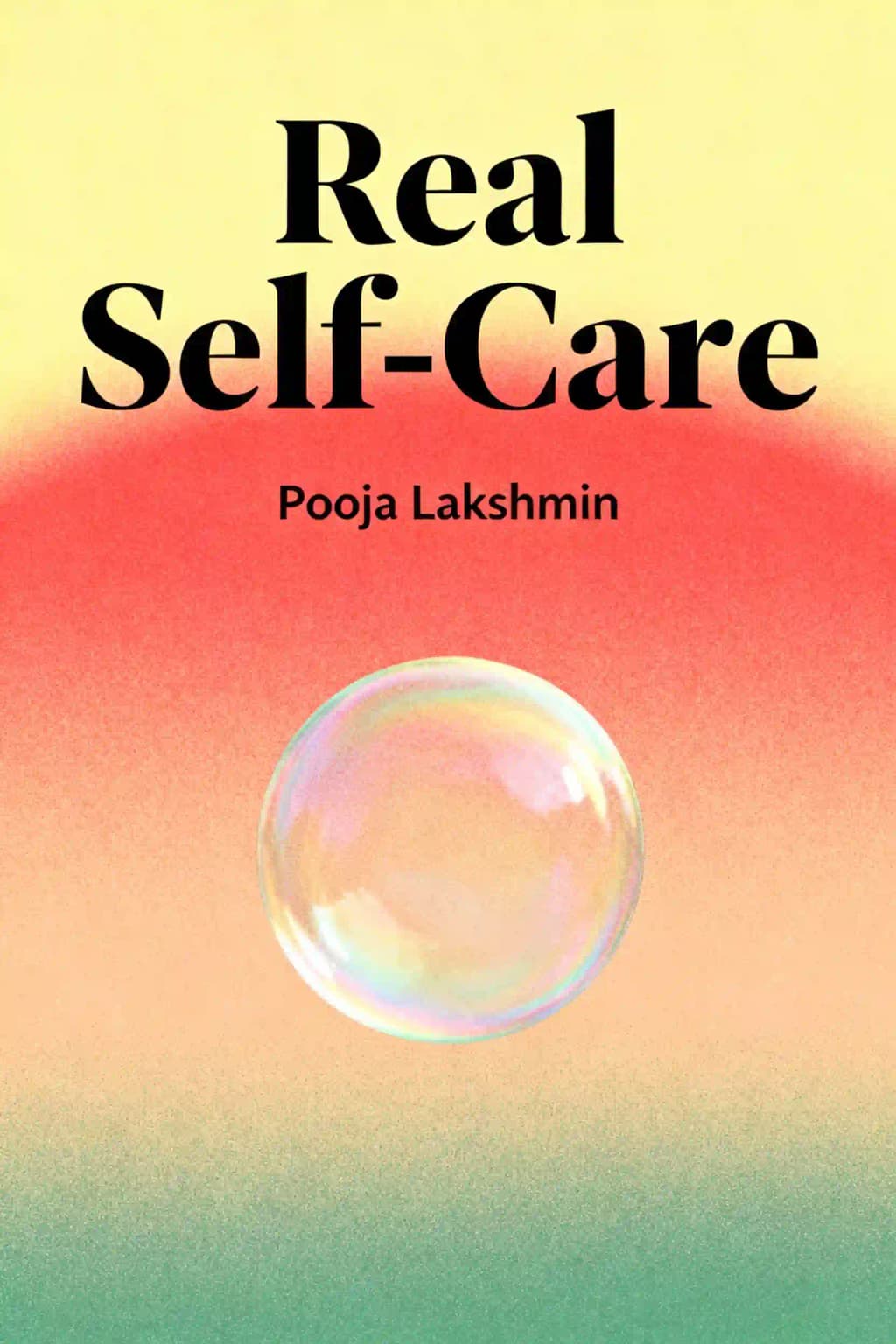
What if the self-care industry has been selling us empty promises? In her groundbreaking book, psychiatrist Pooja Lakshmin exposes the hollow core of today's wellness culture while offering a radical alternative. As a Harvard-educated physician who once abandoned her medical career to join a wellness commune focused on orgasmic meditation (only to discover its dark underbelly), Lakshmin brings unique credibility to this critique. The book has garnered praise from influential figures like Glennon Doyle and Lori Gottlieb, with The New York Times calling it "a manifesto for women everywhere." In an era when burnout among women has reached epidemic proportions, Lakshmin's approach isn't just timely-it's revolutionary, offering a framework that transforms personal choices into systemic change.
Chapitre 2
The Empty Calories of Modern Self-Care
"When in this chaos am I supposed to find time for self-care?" This desperate question from Erin, a mother of three who begins her days at 5 a.m. and ends them with late-night work sessions, captures the fundamental problem with today's wellness culture. The advice she finds in rare free moments-meditate, take bubble baths, make gratitude lists-feels not just inadequate but insulting.
This is the tyranny of faux self-care: the cultural obsession that has paradoxically added more guilt and pressure for women. "I'm burned out, I just can't do it anymore, and I feel like it's my fault because I should be taking care of myself" is a common refrain among women. Self-care has become another burden-another item on the to-do list to feel bad about.
We're right to feel insulted that the supposed solution to the unrelenting demands of modern womanhood is a twenty-dollar bath bomb. Our culture has commodified wellness and placed it on the individual-where it can be bought, measured, and held as personal success-instead of investing in healthy social systems.
The data confirms commodified wellness isn't working: American women report higher stress levels than men and feel worse at managing it. Women experience nearly twice the anxiety rates as men and higher depression rates, with one in five women aged 40-59 taking antidepressants. Yet Instagram boasts over sixty million #SelfCare posts of beachside yoga, mommy blogs, and "curative" smoothies.
Self-care wasn't always like this. In the 1950s, psychiatrists used the term to describe how institutionalized patients could assert independence through diet and exercise. By the 1970s, self-care had moved to activist circles, with the Black Panther Party promoting it as a way for Black Americans to preserve their humanity against systemic racism. As Audre Lorde wrote in 1988, "Caring for myself is not self-indulgence, it is self-preservation, and that is an act of political warfare."
Self-care morphed into its current commodified form as our world became hyperconnected. With smartphones, 24-hour news, and social media overload, self-care became a release valve-no longer about health or fighting oppression, but providing momentary relief. Google searches for "self-care" peaked in November 2016, following the U.S. election.
Chapitre 3
Why We Fall for the Seduction
Why do we keep turning to faux self-care despite its failures? There are three primary reasons: escape, achievement, and optimization.
Consider the typical wellness retreat: beachside yoga at 8:00 a.m., juice cleanse at lunch, sound healing before dinner-the agenda is set for you. These temporary escapes allow us to avoid tough decisions in daily life, creating a euphoric sense of lightness. This feeling is so powerful that even a famous rock star in recovery once told his therapist he needed to check into rehab-not for substance use but for the structure where he wouldn't need to make real decisions.
For others, self-care becomes another achievement metric. Sharon, a 45-year-old journalist, built her life around professional success. When laid off from her volatile media industry job, she doubled down on wellness-completing yoga teacher training, running a 5K, and devouring self-help books. She obsessively documented her yoga with selfies, tracked running times on spreadsheets, and constantly judged herself against internal measuring sticks. Despite attending exclusive retreats, she returned home feeling no better, having spent the entire time obsessing over perfecting headstands and how she looked in yoga outfits.
Then there's optimization-the trap that keeps women on a hamster wheel, especially those managing countless household tasks. Anita, a Korean American small business owner and mother of three, approached family life like her business: with hypercompetence and emphasis on productivity. This meant endless researching and outsourcing-meal delivery kits, Amazon Dash Buttons, TaskRabbit errand runners-any "time hack" that promised to create more time for self-care.
The seductive promise that one more gadget or scheduling secret will transform our lives is a fallacy. It whispers, "Here's the magic solution" to reach perfect control, but we never arrive because we haven't identified the underlying principles we actually need.
Chapitre 4
The Game Is Rigged
What women call "burnout" is actually societal betrayal. This distinction matters: burnout places blame on individuals for not being resilient enough, while betrayal points directly to broken social structures. The pandemic merely intensified existing problems in our patriarchal society that had long saddled women with the cognitive and emotional burden of running households. This betrayal manifests in countless daily moments - from being interrupted in meetings to carrying the mental load of remembering everyone's doctor appointments.
Women are systematically conditioned to prioritize others' needs over their own, a pattern that begins in childhood when girls are praised for being helpful and accommodating. Research confirms this inequality: working women are twice as likely to manage households and three times more likely to manage children's schedules than male partners. The pandemic widened this gender gap by 20-50%, with women taking on additional responsibilities like remote schooling and elderly care. With America being the only high-income nation without required paid parental leave, mothers face career penalties and unaffordable childcare, often paying more for childcare than college tuition. This creates a devastating cycle where women step back from careers to manage family responsibilities, further perpetuating economic inequality.
Women carry the invisible mental load of anticipating, planning and monitoring household needs, leading to emotional emptiness and resentment. This includes tracking birthdays, scheduling appointments, maintaining relationships with extended family, planning meals, monitoring household supplies, and coordinating children's activities. Studies show women spend an average of 37 hours per week on unpaid household labor - equivalent to a second full-time job. The cruel paradox? Women must fix these systems themselves, as those benefiting from the status quo rarely surrender power voluntarily.
Women aren't simply choosing to overburden themselves-they're trapped in what sociologist Martha Beck calls an "unsolvable problem." Our culture pulls women in contradictory directions: be selfless and accommodating while simultaneously excelling professionally. Be ambitious but not too ambitious. Be a devoted mother but always available to work. The choices available are often false ones, forcing women to choose between competing values. Beck describes this as a koan-an unsolvable riddle. This manifests in practical dilemmas like choosing between attending a child's event or an important meeting, between career advancement and family time, between self-care and caring for others. Women have become society's scapegoats, tasked with reconciling our culture's irreconcilable contradictions. The result is a generation of women who feel they're failing at everything despite working harder than ever.
Chapitre 5
The Four Principles of Real Self-Care
Real self-care isn't a life hack or wellness retreat-it's a verb, an ongoing internal process requiring self-knowledge, self-compassion, and difficult decisions. This approach aligns with the concept of eudaimonic well-being, which emphasizes living in alignment with personal values rather than pursuing fleeting pleasure. True self-care demands consistent attention and practice, much like developing any other fundamental life skill.
Unlike hedonic well-being (focused on immediate happiness), eudaimonic well-being connects us to deeper meaning and purpose. Research shows this approach correlates with improved health outcomes including better sleep quality, increased lifespan, reduced inflammation, and stronger immune function. Studies have found that people who pursue meaningful activities, even when challenging, report greater life satisfaction and resilience compared to those seeking purely pleasurable experiences. The common thread is that each person understands the meaning behind how they spend their time and makes conscious choices aligned with their values.
The four principles that guide this approach are:
1. Setting boundaries with others: This involves learning to say "no" effectively, protecting your time and energy, and communicating your limits clearly. It means recognizing that boundaries aren't selfish but necessary for sustainable relationships and personal growth.
2. Changing how you talk to yourself: This requires developing awareness of negative self-talk patterns and actively cultivating self-compassion. It involves replacing harsh internal criticism with understanding and constructive dialogue, while maintaining high standards through encouragement rather than punishment.
3. Bringing in what matters most to you: This means identifying core values and intentionally structuring your life around them. It requires regular reflection on whether your daily actions align with your deeper priorities and making adjustments when they don't.
4. Using your power for good: This involves recognizing your sphere of influence and leveraging it responsibly. It means understanding that self-care extends beyond individual well-being to impact communities and relationships, creating positive ripple effects through conscious choices.
These principles work together synergistically - as you strengthen one area, the others naturally improve. The key is viewing self-care as an integrated practice rather than isolated actions. This authentic alignment, not passing fads or wellness retreats, constitutes real self-care and leads to sustainable well-being over time.
Chapitre 6
Boundaries: The Foundation of Real Self-Care
Setting boundaries is the cornerstone of real self-care-without them, none of the other work can happen. Boundaries are the energetic space between two people. When I was a new faculty member, my mentor gave me revolutionary advice: "You don't have to answer your phone." This contradicted my medical training to always be available. She suggested letting calls go to voicemail to give myself time to decide how to respond rather than reacting immediately.
My boundary was in the pause-that space where I could choose my response. Setting boundaries means recognizing you have choices and communicating them, while understanding that others will have their own feelings about your boundaries.
The first challenge in setting boundaries is learning to "Put Guilt in the Background." Many women struggle with guilt tolerance when establishing boundaries, feeling responsible for others' emotions. The goal isn't eliminating guilt but rather turning down its volume so it doesn't control decisions. Guilt shouldn't serve as our moral compass-it's often a product of contradictory cultural expectations placed on women.
Consider Tonya, a new mother during the pandemic who struggled with guilt about disappointing her Jewish in-laws who valued family time with new babies. Her dilemma wasn't about knowing what boundary to set, but whether she could tolerate the guilt of enforcing it. Learning to tolerate guilt requires accepting that we cannot control others' emotions.
The second challenge is silencing the "killjoys"-those voices (internal and external) that make us worry about "what people will say." I learned this lesson painfully through my own experience of rushing into marriage partly due to family pressure and fear of disappointing others. The longer you let others' judgments dictate your choices, the higher the emotional cost becomes.
When setting boundaries, remember you have three options: say yes, say no, or negotiate. Taking time to consider all options is itself a boundary. Negotiation involves asking questions and gathering information before deciding.
Chapitre 7
Self-Compassion: The Voice That Guides You
Self-compassion forms the second principle of real self-care, building upon the foundation of boundaries. Unlike the "treat yourself" mentality often associated with self-care, true self-compassion focuses on your relationship with your mind through psychological flexibility.
Research divides self-compassion into three components: replacing self-judgment with self-kindness, recognizing your shared humanity, and being curious about negative thoughts rather than accepting them as truth. Unlike self-esteem which builds psychological defense through high self-regard, self-compassion develops self-clarity by looking inward at how we treat ourselves.
A major barrier to self-compassion is what I call "Martyr Mode"-when you care for everyone else until you're completely depleted, yet paradoxically take pride in your suffering. Women receive tremendous social approval for self-sacrifice, creating a perverse satisfaction in "saving the day" while making ourselves smaller.
This mindset creates a competition of suffering: "You worked fifty hours? Well, I keep a sleeping bag under my desk!" When we engage in Martyr Mode, we mistakenly believe compassion must be earned from outside by serving others, rather than generating it internally.
One powerful way to practice self-compassion is to notice when your inner critic is being cruel. When my patient Sonia berated herself for sending her children to a babysitter on a weekend, my immediate response was "Ouch." This simple reaction helped her recognize how harshly she was speaking to herself-in ways she would never speak to a friend.
Shame-the belief that we are inherently unworthy or bad-often lurks beneath our inability to practice self-compassion. Unlike guilt (feeling bad about a specific action), shame condemns your entire being. The antidote is to remind yourself that you are "Good Enough"-a concept from psychoanalyst Donald Winnicott. Coming from Good Enough means acknowledging your humanity and extending the same generosity to yourself that you offer others.
Chapitre 8
Values: Your Internal Compass
Real self-care brings you closer to yourself by connecting you with your values and engaging you in activities aligned with them. This third principle involves identifying personal values to make clear choices that lead to purpose and fulfillment.
Goals and values are distinct but often confused. Goals are tangible objectives like running a marathon or getting into graduate school, while values are desired qualities of action-how we approach our goals. Using a road trip metaphor, goals are destinations while values represent how it feels to be on the journey. Unlike faux self-care's goal-orientation, real self-care focuses on living by your values.
Values become clearest when framed as choosing one quality over another. For my patient Kleo, renovating her kitchen revealed a conflict between conforming to conventional design and expressing her authentic self. Despite growing up poor and feeling pressure to have a "proper" kitchen, she ultimately chose boldness and authenticity over prudence and self-restraint, selecting a bright blue kitchen island and patterned tiles that reminded her of her honeymoon.
Making such clear, values-based choices is energizing and represents real self-care. We're all hardwired to conform-research shows even two-year-olds change decisions based on peer influence-but identifying our unique values helps counteract these "shoulds" and comparisons.
When facing difficult decisions, we must embrace our values as our guide. I share my own professional crossroads between global mental health research and writing for a general audience. After years of trying both paths simultaneously and burning out, I recognized my core values of creativity and connection were better served through writing. Though academia offered prestige, being my own boss aligned with who I truly was.
The lesson? At life's forks, you must choose a path guided by internal values, not external validation. Trying to pursue too many directions simultaneously leads to burnout where neither path fulfills you.
Chapitre 9
Power: Transforming Systems Through Individual Change
If real self-care is truly a fight for self-preservation and self-expression as Audre Lorde suggests, then we must develop practices that keep us connected to our own power. Systems of oppression function by convincing us we're powerless against them, crushing our hope and sense of meaning. Our essential work is to reframe our narratives around power, maintaining our agency to create change in our relationships, workplaces, and systems.
Individual and systemic change form a positive feedback loop where personal transformation inspires broader social shifts. A system only changes after a critical mass of individuals show up differently. Mikaleh's decision to take a leave of absence for mental health led to organizational changes in her workplace. Similarly, elite athletes Naomi Osaka and Simone Biles demonstrated real self-care by prioritizing their mental health despite tremendous pressure and criticism.
When we feel powerless within broken systems, cynicism becomes an easy default. My patient Lena, a video producer at a prestigious but exploitative TV station, initially believed she had no power to change her terrible working conditions. She gradually implemented real self-care practices-setting boundaries against all-nighters, taking needed sick days, and practicing self-compassion. She began advocating for herself, asking for an assistant and questioning her below-market pay.
After a year-long battle, Lena secured an assistant and inspired policy changes that benefited other producers. Her advocacy created ripple effects as younger women sought her guidance. Though still fighting for fair compensation and departmental restructuring, Lena's early wins demonstrated how real self-care can transform both personal circumstances and systemic inequities.
Hope isn't naive optimism but a practical skill we can cultivate through four specific coping mechanisms: problem-solving (taking concrete actions), emotion regulation (managing stress), activating core identity (connecting with individual or collective identities), and relational coping (engaging with supportive people). These practices help maintain agency without becoming overwhelmed by trying to fix the entire system.
Chapitre 10
From Self-Care to Community Care
Real self-care naturally evolves into community care-using your power to benefit others. In 2021, thousands of women mobilized to demand paid parental leave in the Build Back Better Act. Many protesters were past childbearing age and wouldn't personally benefit, yet they donated time, money and energy to support future parents. This movement demonstrated how individual healing can spark collective action, as women who had struggled without parental support fought to create better conditions for the next generation.
This exemplifies "community care," which marginalized communities have practiced for centuries through neighborhood libraries, shared childcare, and carpooling. In urban food deserts, community gardens provide fresh produce while building relationships. Immigrant communities establish informal childcare networks where mothers take turns watching each other's children. During COVID-19, mutual aid networks emerged organically as neighbors helped elderly residents with groceries and medication. As Angela Garbes notes, community requires "decentering yourself"-sometimes giving rather than receiving.
My journey to understanding real self-care began with disillusionment in psychiatry, where I was taught patients needed fixing while I observed social structures holding them down. I witnessed countless women diagnosed with anxiety and depression when they were actually responding normally to abnormal circumstances - crushing work schedules, domestic violence, poverty, and discrimination. I think of Yayoi Kusama, a schizophrenic Japanese artist who transformed her hallucinations into world-renowned art worth millions-proving that power emerges from hardship when we own our pain while moving forward. Her polka dot installations and infinity rooms reimagined mental illness as a source of creativity rather than shame.
My patients increasingly recognize they aren't broken; our social fabric needs repair. Women working multiple jobs to afford childcare aren't failing at "work-life balance" - they're surviving in a system designed without their needs in mind. This is progress: seeing reality clearly. Real self-care means holding hope and pain together while women exist at a precipice, fighting to maintain ourselves amid pressures to surrender. It means acknowledging both personal agency and systemic barriers, individual healing and collective transformation.
While faux self-care keeps us exhausted and treading water, real self-care becomes our life raft. When we support each other through community care networks, we create resilient systems that can weather storms together. When enough of us internalize it, the tide shifts, awakening our collective power to demand and create meaningful change. This is how movements are born - when personal healing catalyzes social transformation.
Chapitre 11
The Path Forward: Revolution Through Real Self-Care
What if instead of blaming ourselves for not being enough, we recognized that systems have failed us? What if we abandoned quick-fix solutions for internal work that truly belongs to us? What if self-care became an internal, quiet process with the power to create dramatic external change? These questions challenge the core assumptions that keep many women trapped in cycles of inadequacy and exhaustion.
Real self-care isn't about fixing yourself-women have been told they need fixing for far too long. The beauty industry, diet culture, and productivity gurus have profited from convincing women they're perpetually lacking. Instead, authentic self-care is about caring for yourself from within, creating ripple effects that transform your relationships, family, and workplace. When you prioritize genuine well-being, you model healthier behaviors for your children, set better boundaries at work, and inspire others to question harmful norms. Real self-care is revolutionary because it addresses the root causes of our problems-the systems themselves that perpetuate unrealistic standards and expectations.
Some of this work will challenge you deeply, as women are conditioned from childhood to believe self-care is selfish or indulgent. We're taught to put everyone else's needs first, to be constantly available, to sacrifice our own well-being for others. But this book gives you permission to prioritize your well-being without guilt or apology. It dispels the pervasive myth that you can "have it all" without offering another set of impossible ideals. Instead, it guides you to examine how you spend your precious time and energy, how you talk to yourself, and whether your daily choices align with what truly matters to you. This means learning to say no, setting firm boundaries, and sometimes disappointing others to honor your own needs.
This is the revolution that begins within-a radical practice of reclaiming power from predatory systems that profit from women's insecurities and exhaustion. While it won't be as easy as buying a crystal-infused water bottle or following a 30-day wellness challenge, it works infinitely better because it creates lasting change. The status quo isn't just broken-it's actively harmful, and it demands radical change that begins with each of us recognizing our own inherent worth. This recognition becomes a powerful catalyst, transforming not just our individual lives but rippling out to affect our families, workplaces, and communities. When women collectively reject the message that they need fixing and instead embrace their authentic selves, they become agents of profound social change.
True self-care requires examining inherited beliefs about worthiness, productivity, and success. It means questioning whether traditional markers of achievement truly serve our well-being. Most importantly, it involves creating new models of living that prioritize genuine human needs over artificial standards of perfection. This revolution may start quietly, but its effects are far-reaching and transformative.