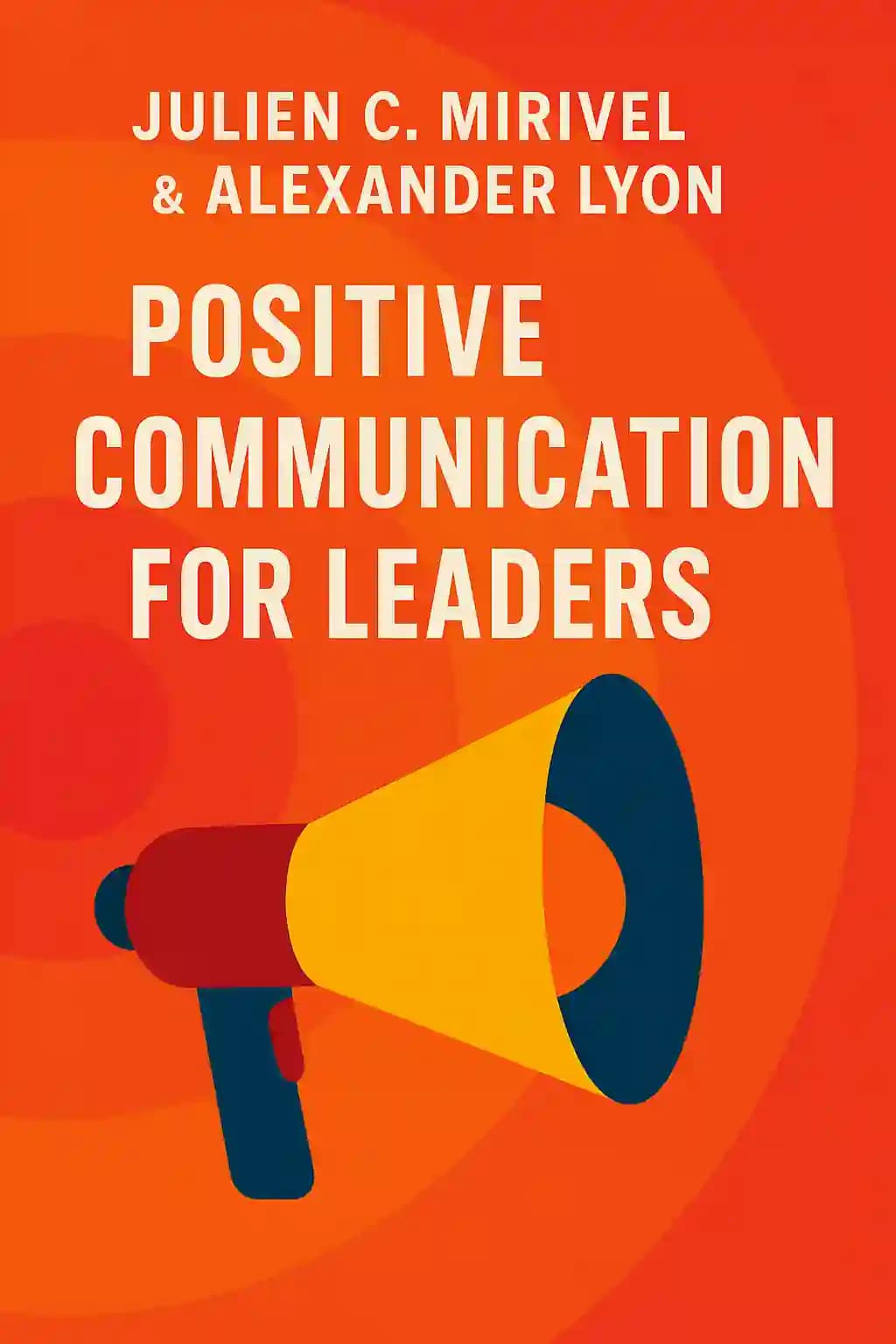
Positive Communication for Leaders
Proven Strategies for Inspiring Unity and Effecting Change
Aperçu de Positive Communication for Leaders
Transform your leadership with "Positive Communication for Leaders" - the groundbreaking guide Arvind Singhal called "one of the most significant books of the decade." What communication secret do top executives use that instantly builds trust? Discover the research-backed strategies reshaping workplace dynamics nationwide.
Thèmes clés dans Positive Communication for Leaders
- appreciative inquiry
- active listening
- positive reinforcement
- workplace morale
- interpersonal trust
Citations de Positive Communication for Leaders
Leadership is about influence.
The journey starts with a single word.
Practice repeating back what you've heard.
Adopt a positive communication approach.
Be intentional with your greetings.
Personnages de Positive Communication for Leaders
- Julien C. MirivelAuthor and expert in positive communication
- Alexander LyonCo-author and leadership consultant
Telecharger le resume de Positive Communication for Leaders
Obtenez le resume de Positive Communication for Leaders en PDF ou EPUB gratuit. Imprimez-le ou lisez-le hors ligne a tout moment.
FAQ sur ce livre
Positive Communication for Leaders offers research-backed strategies for fostering unity and driving organizational change through empathetic dialogue. It provides a practical model for mastering core leadership skills like active listening, constructive feedback, and conflict resolution, with real-world examples and exercises to navigate difficult conversations. The book emphasizes relationship-building as the foundation of effective leadership.
New and experienced leaders across industries, communication professionals, and anyone seeking to improve team dynamics. It’s particularly valuable for managers aiming to build trust, resolve conflicts, or inspire collaboration in remote or hybrid work environments. The actionable frameworks also benefit HR teams and organizational trainers.
Yes—it’s praised for blending academic rigor with practicality. Readers gain tools like the "Mutual Influence Model" and strategies for transforming toxic workplace cultures. The book’s focus on measurable outcomes (e.g., reducing turnover through empathy) makes it a standout in leadership literature. Over 90% of workshop participants report improved communication skills after applying its methods.
- Relationship-first leadership: Prioritizing trust over authority
- The 5:1 positivity ratio: Balancing constructive feedback with reinforcement
- Conversational agility: Adapting messages for diverse audiences
- Micro-engagements: Leveraging brief interactions to strengthen connections
The book teaches leaders to:
- Replace confrontational language with collaborative framing
- Use “impact statements” to link actions to organizational values
- Conduct “pre-mortem” discussions to anticipate resistance
For example, Chapter 5 demonstrates resolving team conflicts by reframing critiques as shared problem-solving opportunities.
A founding scholar of positive communication, Mirivel combines 20+ years of academic research (University of Arkansas) with real-world consulting for Fortune 500 companies. His TEDx talks and 90+ workshops annually ground the book’s theories in tested practice. Co-author Alexander Lyon adds expertise in organizational storytelling.
Unlike generic advice, it provides a systematic framework validated across healthcare, tech, and education sectors. While Crucial Conversations focuses on conflict, Mirivel’s approach proactively builds communication “immune systems” against dysfunction. Case studies show 40% faster conflict resolution compared to traditional methods.
Yes—Chapter 9 details virtual communication tactics like:
- Zoom mindfulness: Starting meetings with 90-second check-ins
- Asynchronous clarity: Writing emails that prevent misinterpretation
- Recognition cadences: Scheduling weekly praise moments in Slack
A tech firm case study reports 30% higher remote employee retention using these methods.
Some practitioners note the strategies require consistent practice to master, which may challenge time-constrained leaders. However, the book’s modular structure allows gradual implementation. A minority of readers desired more metrics for tracking communication improvements.
With AI disrupting workplace dynamics, the book’s human-centric principles help leaders:
- Counteract chatbot depersonalization through “high-touch” check-ins
- Address AI-related employee anxiety with transparency frameworks
- Maintain psychological safety during rapid tech adoption
Yes:
- Free self-assessment quiz: Measures communication positivity scores
- LinkedIn Learning course: Mirivel’s video series on conflict de-escalation
- Podcast episodes: Interviews breaking down key concepts (Enterprise Podcast Network)