Chapitre 1
The Extraordinary Journey of a Neurological Explorer
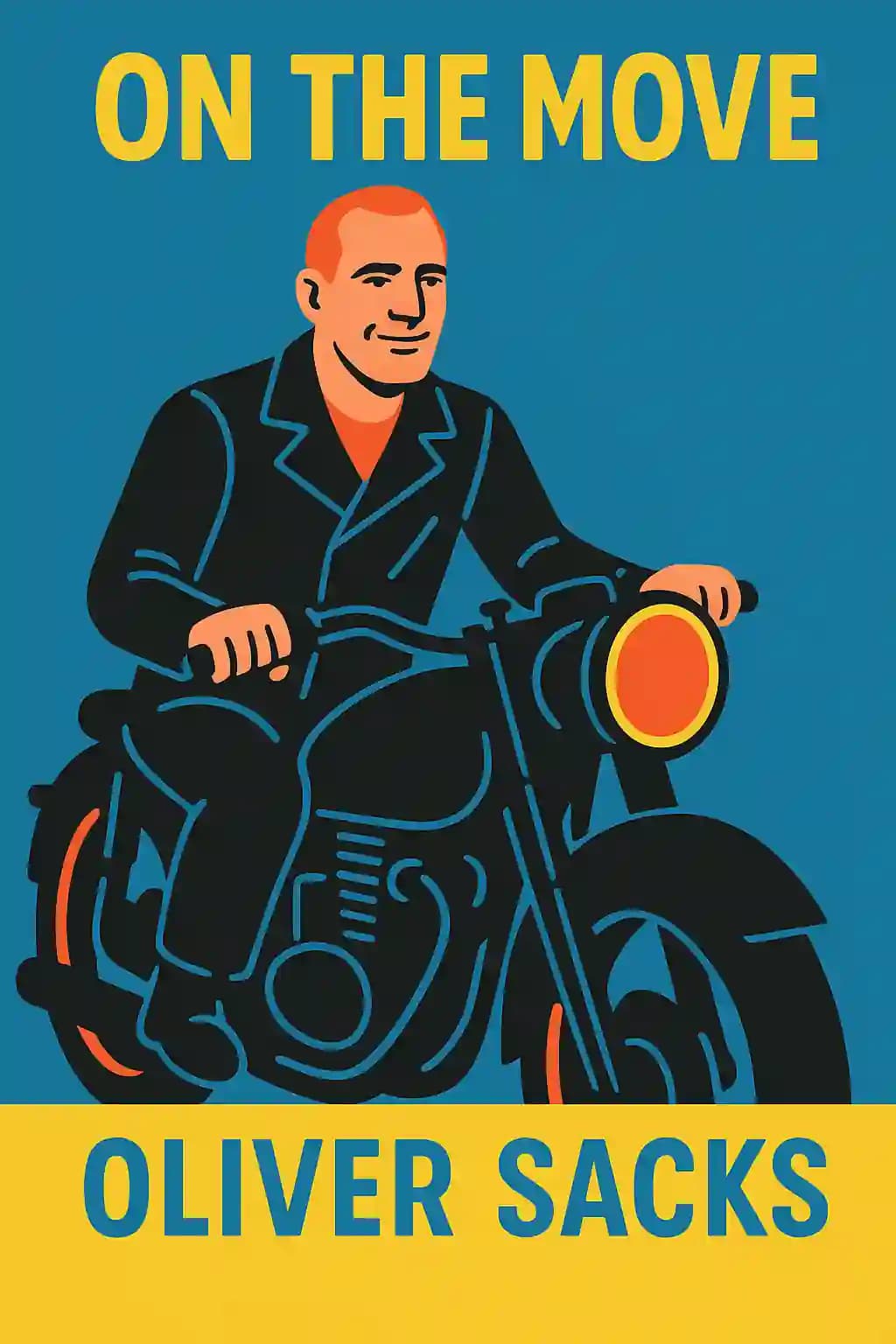
In the world of neurology, few names evoke the same sense of wonder and human connection as Oliver Sacks. His memoir "On the Move" stands as a testament to a life lived in perpetual motion-intellectually, physically, and emotionally. This deeply personal account has become required reading for medical students at Harvard and Stanford, with Bill Gates naming it one of his all-time favorite books. Through Sacks' eyes, we experience the extraordinary journey of a man whose insatiable curiosity about the human condition transformed our understanding of the brain and what it means to be human. His work bridges science and humanity in a way that continues to inspire millions, from medical professionals to casual readers fascinated by the mysteries of the mind.
Chapitre 2
Motorcycles and Movement: The Quest for Freedom
When young Oliver was a boarding school child during World War II, he found escape in dreams of movement and power. Motorcycles became his particular obsession, fueled by memories of his father's Scott Flying Squirrel and boyhood fantasies of speed and freedom. At eighteen, despite parental opposition, he acquired his first bike-a secondhand BSA Bantam with faulty brakes that once left him circling Regent's Park endlessly when the throttle jammed. This inauspicious beginning led to progressively more powerful machines, including a 250cc Norton that saved his life through two near-accidents, and eventually a 600cc Norton Dominator.
The North Circular Road around London in the 1950s had no speed limits, and the legendary Ace Cafe became a gathering place for motorcyclists. "Doing the ton"-reaching one hundred miles per hour-was the minimum criterion for joining the elite Ton-Up Boys. While Sacks enjoyed road racing on his souped-up "Dommie," he couldn't match the 1000cc Vincents favored by the inner circle. Once, he tried a Vincent but found it horribly unstable compared to his wonderfully balanced Norton with its "feather bed" frame.
This passion for motorcycles would follow Sacks to America, where he found the classless society he'd dreamed of among fellow riders. In San Francisco, he joined Sunday morning rides over the Golden Gate Bridge and up Mount Tamalpais. "Those early morning rides, feeling the wind and smelling eucalyptus, have an almost intolerable sweetness in memory," he wrote. He thought nothing of riding seven hundred miles at a stretch, exploring Northern California's gold country, Oregon's Crater Lake, and Death Valley. His most ambitious journey was an 8,000-mile cross-country expedition on his BMW R69, during which he experienced America's vastness and diversity in the most immediate way possible.
For Sacks, motorcycles represented more than transportation-they embodied freedom, risk, and a form of meditation. The motorcycle responded almost as an extension of his own body, creating a union between bike and rider unlike anything experienced in a car. This lifelong love affair with motorcycles reflected his larger approach to life: direct engagement, sensory immersion, and an embrace of both danger and beauty.
Chapitre 3
Oxford and Academic Awakening
Sacks arrived at Oxford University in 1951, a tumultuous year marked by his beloved Auntie Birdie's death and a painful confrontation with his parents about his sexuality. When his father asked if he preferred boys and Sacks admitted he did, his mother's reaction was devastating: "You are an abomination. I wish you had never been born." Though she never mentioned it again, something had come between them, and her words, influenced by biblical verses and her Orthodox upbringing, haunted him for years.
At Oxford, Sacks struggled academically at first, failing his "prelims" three times before finally passing. He missed the easy mix of arts and sciences he'd enjoyed at St. Paul's School with brilliant friends Jonathan Miller and Eric Korn. The science departments were physically and socially separated from the rest of the university, creating an intellectual isolation he found stifling. His academic performance was paradoxical-he ranked near-bottom in anatomy finals yet won the prestigious Theodore Williams Scholarship in Human Anatomy by drunkenly answering just one of seven questions with an inspired essay.
The university's magnificent libraries became his sanctuary. He particularly loved Queen's College library, reportedly designed by Christopher Wren. In its underground stacks, he held ancient books like Gesner's illustrated Historiae animalium and discovered Darwin's original editions. There he fell in love with Thomas Browne's magnificent language and was introduced to seventeenth and eighteenth-century literature. These weren't locked away as rare books but sat freely on shelves, giving him a profound sense of history and language.
His closest Oxford friend was Kalman Cohen, a Rhodes scholar and mathematical logician with extraordinary intellectual focus. Though different-Cohen's highly focused mind versus Sacks' wildly associative one-they complemented each other perfectly. Together they hitchhiked through Europe, ending up bald-headed with lice and sampling every liqueur in Vienna.
After a disastrous attempt at laboratory research involving chickens, earthworms, and frogs, Sacks became convinced he could never be a research scientist. With his research failing and friends gone, he sank into despair, finding relief only in nightly runs along the Isis followed by swims and frantic philosophical writings he called "Nightcaps." His concerned tutor contacted his parents, who arranged for him to join Ein HaShofet, a kibbutz near Haifa, where physical labor transformed him-he lost nearly 60 pounds and felt more at home in his body than ever before.
Chapitre 4
Medical Training and Awakening to Human Complexity
In 1956, Sacks returned home and began medical school, rotating through various specialties. To his surprise, he particularly enjoyed obstetrics, where midwives and he would bicycle to homes for deliveries, experiencing the human drama in a way hospital work lacked. Their training emphasized bedside teaching-learning to listen to patients, ask the right questions, and use their hands as therapeutic tools.
After qualifying in December 1958, Sacks began at the Middlesex Hospital where his eldest brother Marcus had trained. After six months on the medical unit, he moved to the neurological unit under Michael Kremer and Roger Gilliatt-a brilliantly incongruous pair. Kremer was genial and intuitive, able to diagnose rare conditions at a glance and deeply empathetic with patients. Gilliatt was forbidding and methodical, with ferocious black eyebrows that terrified junior doctors, preferring systematic examination over intuitive leaps. Both influenced Sacks profoundly-Kremer teaching observation and intuition, Gilliatt emphasizing physiological mechanisms.
His Oxford pre-med studies hadn't prepared him for real medicine-encountering passionate individuals with agonizing problems that went beyond mere diagnosis and treatment to questions about quality of life. This reality hit him when Joshua, a young swimmer, was admitted with puzzling leg pains that turned out to be leukemic infiltrations of sensory nerves. When Sacks prevented the young man from jumping from a second-floor ward balcony, Joshua later told him, "You shouldn't have pulled me back," before dying in agony days later.
As his medical training concluded, Sacks faced a decision about military service. Disappointed that his Colonial Service option in New Guinea had disappeared, he decided to leave England. The "brain drain" of the 1950s saw many qualified professionals departing the crowded, rigid British system, and Sacks felt America's more capacious medical world would have room for him. He also wanted to escape the shadow of too many Dr. Sackses competing in London's medical circles. He flew to Montreal on his twenty-seventh birthday, eventually making his way across Canada and down to San Francisco, where he instantly fell in love with the city and its magnificent surroundings.
Chapitre 5
San Francisco and the Birth of a Clinical Identity
Upon arriving in San Francisco-a city he had long dreamed of-Sacks faced the challenge of having no green card and thus no legal employment. Through his former neurology chief's connections, he secured an informal position with neurosurgeons Grant Levin and Bert Feinstein at Mount Zion Hospital. They were pioneers in stereotactic surgery, a technique for safely accessing otherwise unreachable areas of the brain. Unable to pay him a salary due to his immigration status, they kept him afloat with twenty-dollar notes while he helped evaluate their patients before and after surgery.
For eight months before his official internship began, Sacks worked with Levin and Feinstein-a fascinating complementary pair. Grant Levin was "unhurried and judicious" while Feinstein was "passionate and intense." Their partnership reminded him of other productive duos he'd admired: his London neurological chiefs Kremer and Gilliatt, the chemistry pioneers Kirchhoff and Bunsen, Watson and Crick with their DNA discoveries, and the vision researchers Hubel and Wiesel. Their neurosurgical unit included not just surgeons but an engineer, a physicist, and visiting physiologist Benjamin Libet-creating a rich intellectual environment where Sacks could continue his neurological education.
San Francisco offered rich cultural experiences that deepened his love for the city. Through Grant Levin's generosity, he attended conferences like "The Control of Mind" where he saw his idols Aldous Huxley and Arthur Koestler. Huxley, nearly blind with "pebble like eyes" and "corpse like hair," delivered a brilliant speech on education that brought the audience to their feet. Koestler, with his "litvuk face ostentatiously lined, seamed with great furrows of anguish and intelligence," spoke on the creative process.
In San Francisco, Sacks also formed a significant friendship with poet Thom Gunn. He had been determined to meet Gunn since reading his collection "The Sense of Movement." When they finally met at a party, Sacks felt unformed compared to Gunn's maturity and assurance. He resonated deeply with Gunn's motorcycle poems like "On the Move" and "The Unsettled Motorcyclist's Vision of His Death." Thom was "lapidary and incisive" while Sacks was "centrifugal and effusive," but his directness was always tempered with tenderness.
By early 1961, Sacks had received his green card, becoming a "resident alien" with intentions of gaining citizenship without forfeiting his British nationality. After passing his state board exams, he planned an ambitious 8,000-mile journey across America, estimating 50 days and $400, hoping to avoid "sunstroke, frostbite, imprisonment, earthquakes, food poisoning and mechanical disaster" on what he anticipated would be "the greatest time of my life."
Chapitre 6
Muscle Beach and the Physical Life
After completing his American journey, Sacks returned to New York in June 1961, where he borrowed money from a cousin to buy a new BMW R60 motorcycle. He then embarked on a solitary return journey to California, covering thousands of miles across empty roads through South Dakota and Wyoming. The experience was magical and dreamlike, with the motorcycle responding almost as an extension of his own body.
Upon returning to San Francisco just in time to begin his internship at Mount Zion Hospital, Sacks decided to "bulk up" for weightlifting. He had previous weightlifting experience from London's Maccabi Jewish sports club, where he'd competed in power-lifting alongside Olympic lifters like Ben Helfgott. At London's Central YMCA, he trained under Ken McDonald, an Australian Olympic lifter with massive thighs who specialized in squats. During a lifting exhibition with Ken, Sacks managed a 525-pound deadlift to Ken's 700 pounds, but days later developed excruciating back pain that would plague him for forty years.
At San Francisco's Central YMCA, he encountered Karl Norberg, a seventy-year-old former Swedish longshoreman whose phenomenal natural strength let him easily bench press nearly 400 pounds. This white-haired, gorilla-like man with his broad chest and bowlegged stance could warm up with twelve reps at weights no one else could lift, eventually working up to nearly 500 pounds. Inspired by Karl, Sacks trained obsessively at a small San Rafael gym, focusing on squats. He developed a routine of five sets of five reps with 555 pounds every fifth day-a symmetry that amused others at the gym. When encouraged to attempt the California squat record, he succeeded with 600 pounds, which served as his introduction to the power-lifting world.
After his UCLA residency began in 1962, Sacks settled near Muscle Beach in Venice, quickly earning acceptance among the weightlifting elite. After matching Olympic lifter Dave Ashman pound-for-pound in front squats up to 550 pounds, then pushing to 575, he earned the nickname "Dr. Squat." The beach featured legendary strongmen: Mac Batchelor, the world's arm-wrestling champion with hands powerful enough to allegedly bend silver dollars; the semi-divine giants Chuck Ahrens (who could one-arm side press 375 pounds) and Steve Merjanian (inventor of the incline bench press); and Hal Connolly, an Olympic hammer thrower who overcame Erb's palsy in one arm to become a champion.
Sacks sometimes wondered why he pushed himself so relentlessly in weight lifting. Though he became very strong, it did nothing to change his timid, diffident character. His excessive squatting eventually exacted a price-he ruptured one quadriceps tendon in 1974 and the other in 1984. While hospitalized, he was visited by Dave Sheppard from his Muscle Beach days, who himself was awaiting hip replacements due to severe arthritis. Looking at their half-destroyed bodies, Dave said simply, "What fools we were."
Chapitre 7
Awakenings: Medical Breakthrough and Literary Birth
In the fall of 1966, Sacks started seeing patients at Beth Abraham, a chronic disease hospital where he discovered some eighty patients who were survivors of the encephalitis lethargica pandemic from the 1920s. These patients had been frozen in deeply parkinsonian states for decades, with their consciousness suspended yet intact minds and personalities behind their statuesque appearances. He was fascinated by this disease that manifested differently in each patient-a true "phantasmagoria" that revealed the organization of the nervous system at its most primitive levels.
After learning about George Cotzias's breakthrough with L-dopa for Parkinson's disease in 1967, Sacks cautiously began a double-blind trial with six patients in March 1969. The effects were spectacular-patients who had been almost inanimate for decades burst into explosive life. But complications soon followed: unpredictable fluctuations, extreme sensitivity to the drug, and bizarre reactions that couldn't be controlled by simple dose adjustments. The system seemed to have a dynamic of its own, with nothing between too much L-dopa and too little.
These patients revealed the artificial divide between neurology and psychiatry. Their disorders spanned both realms-parkinsonism, myoclonus, chorea, tics, strange compulsions, obsessions, and gusts of passion. Their "awakenings" were not merely physical but intellectual, perceptual, and emotional-a global animation that contradicted the compartmentalized neuroanatomy taught in the 1960s.
In 1968, Sacks read Luria's "Mind of a Mnemonist"-initially thinking it was a novel before realizing it was the deepest, most detailed case history he'd ever encountered, with the dramatic power and structure of a novel. Luria had achieved international renown as neuropsychology's founder, but believed his richly human case histories were equally important as his scientific treatises. His endeavor to combine classical science with romantic storytelling became Sacks' own model, altering the focus of his life and serving as an exemplar not only for Awakenings but everything else he would write.
In 1972, Sacks felt compelled to articulate his overwhelming experiences with the postencephalitic patients but couldn't find an appropriate form combining scientific objectivity with the closeness he felt with them. That summer, he returned to London, taking a flat near Hampstead Heath. Every morning he'd walk and swim on the Heath, spend afternoons writing, then read the latest installment to his mother each evening. She was both emotional listener and sharp critic, with "ringing true" as her ultimate value. In this way, they wrote the case histories together during that enchanted, creative summer.
The book received excellent reviews from the general press, winning the 1974 Hawthornden Prize for "imaginative literature," but faced "strange mutism" from the medical profession. After one reviewer suggested his patients were fictional, they insisted, "Show us, or the book will never be believed." Though Sacks had misgivings about exposing their identities on film, Duncan Dallas of Yorkshire Television impressed him with his combination of scientific knowledge and human feeling. The resulting documentary, incorporating Sacks' Super 8 footage from 1969 and patient interviews, was broadcast in England in 1974-the only documentary account of these last survivors of a forgotten epidemic.
Chapitre 8
The Man Who Mistook His Wife for a Hat: Finding a Literary Voice
Although Sacks' book "A Leg to Stand On" consumed nearly a decade, he simultaneously pursued other subjects, particularly Tourette's syndrome. In 1971, New York Times journalist Israel Shenker approached him for a follow-up on his L-dopa patients. Sacks described how many were experiencing odd reactions including sudden tics and expletives resembling Tourette's syndrome-a condition he'd read about but never witnessed. After Shenker's article detailed this "astonishing topography of tics," Sacks began receiving letters from people with multiple tics. Though reluctant to see patients who found him through the newspaper, he made an exception for "Witty Ticcy Ray," whose rapid-fire tics and remarkable speed of thought fascinated him.
After meeting Ray, Sacks' perception shifted dramatically-suddenly he spotted multiple people with apparent Tourette's syndrome on New York streets daily. This astonished him since the condition was described as extremely rare (one or two per million), but he realized it must be at least a thousand times more common. His "neurological eye" had been tuned to recognize it.
In 1980, Sacks wrote about Ray, whom he'd followed for nearly ten years. Anxious about his reaction, he read him the piece at his home. Though Ray twitched throughout and once exclaimed "You take a few liberties!" he ultimately approved, saying "It's essentially true. But don't publish it here. Publish it in London." This piece, "Witty Ticcy Ray," published in the London Review of Books, was his first full-length case history about living a full life despite a complex neurological condition. Its reception encouraged him to write more such narratives.
Later, after describing a patient with visual agnosia during a seminar, Sacks wrote "The Man Who Mistook His Wife for a Hat" and sent it to the same publication, not realizing it would become the title story of a collection. In summer 1983 at Blue Mountain Center, he experienced writer's block for two weeks until reading Bunuel's memoirs triggered memories of Jimmie, an amnesic sailor. He wrote "The Lost Mariner" and sent it to Bob Silvers at The New York Review of Books. Following his suggestion to incorporate clinical notes for immediacy, Sacks published several pieces that would form the nucleus of The Man Who Mistook His Wife for a Hat.
The book was published in November 1985 in the UK and January 1986 in the US with a modest initial printing of fifteen thousand copies. Unexpectedly, it became a bestseller, remaining on the New York Times list for twenty-six weeks. What moved Sacks most were the letters from readers who had experienced similar neurological problems but never shared them with anyone, or from people who asked about his patients as if they were real acquaintances. With Hat's success, he became a public figure with all its advantages and disadvantages-greater contact with people but less creative solitude, and continued dismissal from many medical colleagues who viewed "popular" writing as unserious.
Chapitre 9
A New Vision of the Mind: From Neural Darwinism to Consciousness
In March 1986, after publishing "Hat," Sacks received a letter from Mr. I., a 65-year-old artist who had become completely colorblind following a car accident. Despite perfect visual acuity, he saw the world entirely in black and white. Most strikingly, he had lost not only the ability to see color but also to imagine it-even his dreams and migraine auras were now colorless. This suggested damage not to his retina but to specialized color-processing areas in his brain. Months earlier, Sacks had attended a lecture by Semir Zeki on the neurophysiology of color perception, where he discussed how a specific brain area (V4) "constructs" color. This opened a new way of thinking about the neural basis of consciousness that he found exhilarating.
At a Carnegie Hall concert featuring Mozart's Mass in C Minor and Requiem, Sacks was writing continuously in his notebook when Ralph Siegel, a young neurophysiologist from the Salk Institute and one of Francis Crick's proteges, recognized him and introduced himself. Ralph was excited to hear about Sacks' colorblind artist patient, Mr. I., and outlined several tests that could help pinpoint where color construction had broken down in the painter's brain. For twenty years they remained close friends, with Ralph bringing his physicist's computational approach to neuroscience while Sacks shared his patients' phenomenological experiences.
Though Sacks read Watson and Crick's famous "double helix" paper in 1953 while at Oxford, he didn't immediately grasp its significance. When he met Crick at a 1986 conference, Crick pulled him aside at dinner saying, "Tell me stories!"-particularly about altered vision from brain damage. Sacks described his patients, including Mr. I., and each case sparked bursts of hypotheses from Crick. Working with Mr. I. shifted Sacks' thinking from "naive realism" toward seeing the brain-mind as essentially constructive and creative.
In the mid-1950s, neurology faced a conceptual crisis-the clinico-anatomical model that located brain damage and correlated it with symptoms couldn't explain learning, memory reconstruction, neural plasticity, or consciousness. In 1986, Sacks discovered Gerald Edelman's revolutionary work through Israel Rosenfield's article. Edelman's 1987 book Neural Darwinism presented his theory of neuronal group selection, a radical concept that was difficult to penetrate due to its density and lack of concrete examples.
While Crick cracked the genetic code for building bodies, Edelman realized that genes couldn't specify every neural connection. Development involves contingencies-nerve cells die, migrate, and form unpredictable connections. Edelman conceived that processes analogous to natural selection operate within individual organisms, with life experiences strengthening certain neural connections while weakening others. The basic unit of selection isn't a single neuron but groups of fifty to a thousand interconnected neurons.
The brain's functional machinery consists of millions of neuronal groups organized into "maps" that converse in ever-changing patterns. These maps respond selectively to elemental categories like movement or color, involving thousands of synchronized neuronal groups. Edelman emphasized that perception requires creating categories-"Every perception is an act of creation." His concept of "reentrant signaling" explains how scattered mappings synchronize to form rich percepts.
After dining with Edelman in Florence, Sacks experienced a profound intellectual liberation. Edelman's theory freed him from "epistemological despair" and computer analogies, offering instead a rich biological framework for mind and consciousness-the first truly global theory of individuality and autonomy.
Chapitre 10
Finding Home: From Wanderer to Beloved
Despite living in America for decades, Sacks continued regarding England as home, visiting frequently and feeling stronger as a writer whenever he stood on English soil. This sense of England as "home" weakened in 1990 when his father died and their family house was sold, leaving him without a place to return to. Though he remained a "resident alien" in America with his UK passport, he was deeply moved when named to the Queen's Birthday Honours List in 2008, becoming a Commander of the Order of the British Empire. During the ceremony at Buckingham Palace, he felt as if England were saying, "You have done useful, honorable work. Come home. All is forgiven."
Sacks continued seeing patients at Beth Abraham, the Little Sisters, and elsewhere while writing books like Seeing Voices, Island, and Uncle Tungsten. In 2005, he visited Clive Wearing, an amnesic musician who could still play organ despite remembering almost nothing of his adult life. This inspired him to write Musicophilia, which began as a modest project but expanded as he explored musical synesthesia, amusia, musical talents emerging from frontotemporal dementia, musical seizures, and the therapeutic power of music.
In December 2005, at age seventy, Sacks discovered he had melanoma in his right eye. Though initially terrifying, he learned ocular melanomas rarely metastasize. During treatment, his vision fluctuated dramatically, producing fascinating visual phenomena that he meticulously documented. By September 2009, his right eye hemorrhaged and went blind, causing new perceptual challenges including loss of stereo vision and right-side neglect. He approached these symptoms as an "experimentum suitatis," performing perceptual experiments on himself.
Shortly after turning seventy-five in 2008, Sacks met Billy, a writer who had moved from San Francisco to New York. They began having dinners together, and a friendship grew between them. Only in December 2009, while recovering from surgeries and in terrible pain, did he realize the depth of their connection when Billy told him, "I have conceived a deep love for you." Sacks recognized he felt the same, and his eyes filled with tears. This relationship transformed him deeply, requiring geological changes in his lifetime habits of solitude and self-absorption. After previous loves throughout his life, now at seventy-seven, he discovered the tranquil joy of sharing his life with someone.
Throughout his life, Sacks remained "ink-stained," accumulating nearly a thousand journals. He kept notebooks everywhere-beside his bed for dreams and nighttime thoughts, by swimming pools and seashores where thoughts often came in fully formed paragraphs. Though he rarely reviewed these journals, the act of writing itself clarified his thoughts and feelings, serving as an indispensable form of talking to himself. For Sacks, writing at its best transported him to a place of total absorption where he was oblivious to distractions, worries, and time's passage. Despite having written millions of words over his lifetime, the act remained as fresh and joyful as when he began nearly seventy years earlier.