Chapitre 1
Unlocking the Brain's Algorithm: How Intelligence Really Works
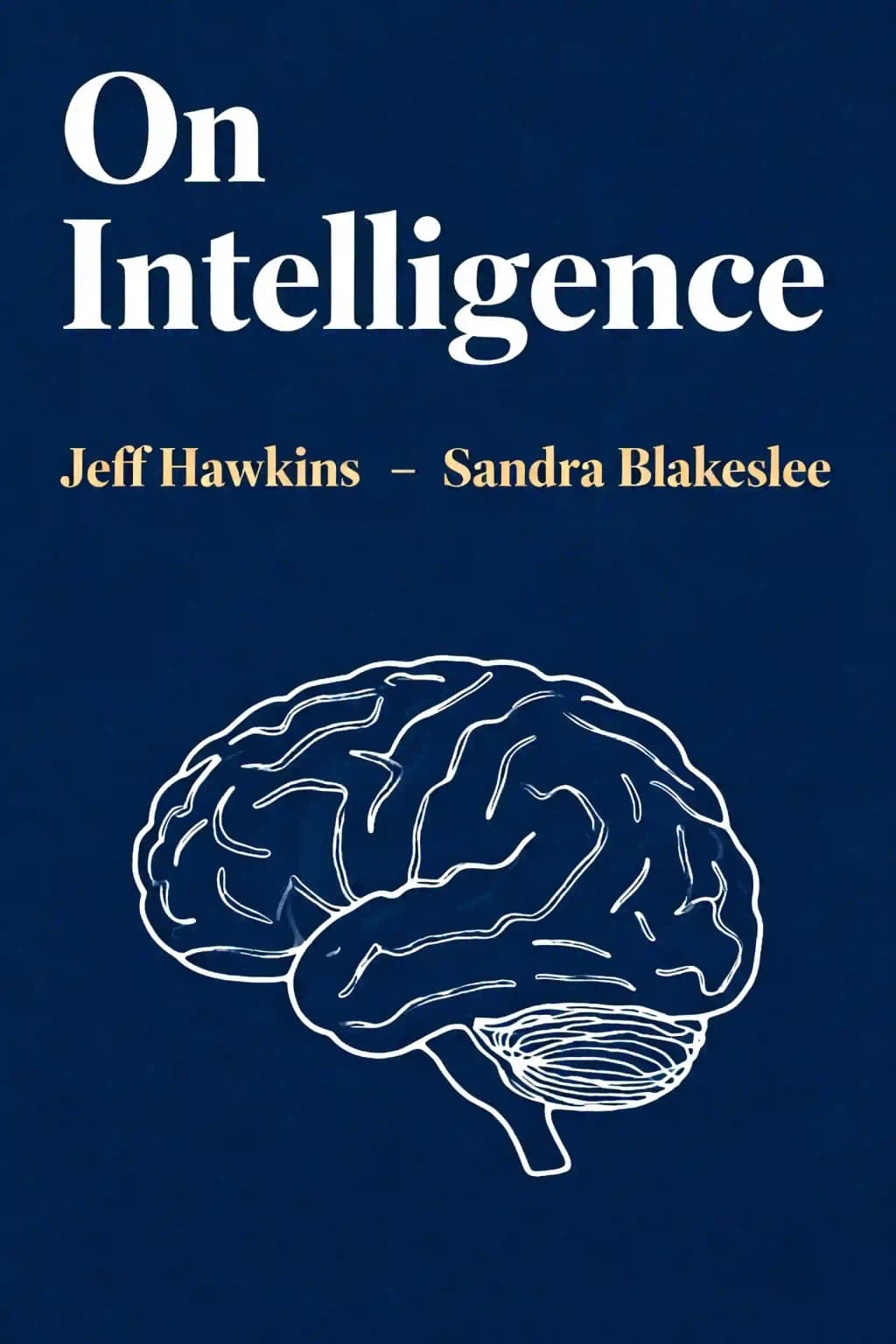
When Jeff Hawkins picks up his coffee cup each morning, his brain performs a feat more remarkable than any supercomputer on Earth. Without conscious effort, his neocortex predicts the cup's weight, texture, and temperature before his fingers make contact. This predictive capability-not the behavioral outputs that AI researchers have chased for decades-is the true essence of intelligence. Hawkins' groundbreaking book "On Intelligence" has influenced everyone from Elon Musk, who cited it as inspiration for his Neuralink venture, to Ray Kurzweil, who incorporated its concepts into his singularity theories. Though published in 2004, its insights remain startlingly relevant as tech giants pour billions into artificial intelligence research. Unlike most neuroscience texts that gather dust in academic libraries, this book has maintained a devoted following among both scientists and technologists for nearly two decades, precisely because it offers something rare: a comprehensive theory of how intelligence actually works.
Chapitre 2
The Failed Quest for Artificial Intelligence
The history of artificial intelligence has been marked by grand promises and disappointing results. After graduating from Cornell in 1979, Hawkins began working at Intel but soon discovered a life-changing issue of Scientific American dedicated to the brain. Inspired by Francis Crick's article highlighting neuroscience's lack of theoretical framework, Hawkins proposed researching brain function at Intel-only to be rejected. MIT's AI lab similarly dismissed his brain-focused approach, preferring pure computer programming solutions to intelligence.
This resistance stemmed from AI's founding principle: the central dogma that the brain is just another kind of computer, with intelligence viewed as symbol manipulation. This belief traces back to Alan Turing's concept of universal computation and his famous test suggesting that if a computer can fool a human into thinking it's a person, it must be intelligent. McCulloch and Pitts' 1943 paper suggesting neurons could function as logic gates further reinforced this view, though nobody verified if brains actually worked this way.
Early AI pioneers made extravagant claims about quickly surpassing human intelligence. Programs like Eliza (mimicking a psychoanalyst), Blocks World (simulating object manipulation), and IBM's Deep Blue chess computer created public excitement but proved severely limited. Deep Blue beat chess champion Garry Kasparov not through intelligence but through computational speed-it played chess without understanding chess, just as calculators perform arithmetic without understanding mathematics.
After decades of unfulfilled promises, AI lost its luster. The field had fundamentally misunderstood intelligence by focusing on behavior rather than understanding. Following Turing's influence, they equated intelligence with producing correct outputs for given inputs. But intelligence isn't just about behavior-you can be intelligent while lying in the dark, thinking. This behavior-centric approach significantly impeded progress in building truly intelligent machines.
Chapitre 3
Neural Networks: A Promising Alternative That Lost Its Way
Neural networks emerged in the mid-1980s as an alternative to the failing AI approach, offering an architecture loosely based on real nervous systems. Unlike traditional computers with CPUs and centralized memory, neural networks distributed knowledge throughout their connectivity. Initially promising, they quickly settled on overly simplistic models that failed to capture three essential brain characteristics: time-based processing, feedback connections, and hierarchical physical architecture.
Most neural networks consisted of just three rows of neurons (input, hidden, and output units) with variable connection strengths. These networks only processed static patterns, lacked feedback, and bore little resemblance to actual brains. The media misrepresented them as "brain-like" or working on the "same principles as the brain." Demonstrations like NetTalk, which mapped letter sequences to sounds, were incorrectly heralded as machines "learning to read" when they merely matched patterns without understanding.
The gap between neural networks and real brains was vast-like the difference between a simple transistor amplifier and a complex computer. Both use the same basic components but function in fundamentally different ways. At a 1987 neural network conference, Hawkins saw a company trying to sell a million-dollar handwriting recognition neural network. He designed a simpler, non-neural network solution in just two days, which eventually became the Graffiti text entry system for Palm devices.
While mainstream neural networks grabbed attention, a small group developed auto-associative memories with crucial brain-like properties. Unlike standard neural networks, these used extensive feedback connections and could retrieve complete patterns from partial or corrupted inputs-like exchanging damaged money for crisp bills. More importantly, they could store and recall temporal sequences of patterns, similar to how we learn melodies. This approach hinted at the importance of feedback and time-varying inputs, features largely ignored by mainstream researchers.
Chapitre 4
The Brain's Architecture: A Fundamentally Different Design
The brain's architecture reveals fundamental differences from computers that explain its unique intelligence. The neocortex-a thin, uniform sheet of neural tissue enveloping older brain regions-is where perception, language, imagination, mathematics, art, and planning occur. This dinner-napkin-sized area contains approximately thirty billion neurons packed into six distinct layers and folded into our skull. These cells constitute our entire conscious experience-all memories, knowledge, skills, and accumulated life experiences.
Despite its uniform appearance, the cortex contains specialized functional regions arranged in a hierarchical structure, with primary sensory areas feeding information upward to increasingly abstract processing regions. Each sense has its own hierarchy that eventually connects with association areas that integrate multiple senses.
Vernon Mountcastle made a revolutionary discovery in neuroscience-the neocortex is remarkably uniform in structure across all regions. Despite anatomists focusing on minute differences between cortical areas, Mountcastle recognized that all regions share the same six-layered structure, cell types, and connections. He proposed that the entire cortex performs the same computational operation regardless of function-vision, hearing, motor control, or language. The differences between regions stem from what they're connected to, not their fundamental algorithm.
This elegant, radical idea suggests a universal cortical algorithm that can be applied to any sensory or motor system-essentially the Rosetta stone of neuroscience. Despite its profound implications, most scientists either ignore or reject this principle, continuing to study specialized brain modules rather than the common underlying process.
The neocortex demonstrates remarkable plasticity, adapting to process whatever information flows into it. Experiments show newborn ferrets' brains can be rewired so visual signals go to auditory cortex, resulting in functional vision through brain tissue normally used for hearing. Similarly, transplanted pieces of rat visual cortex can process touch information when relocated. In humans, blind adults use their visual cortex to read braille, while deaf individuals process visual information in normally auditory regions.
All sensory inputs to the brain are fundamentally the same-just spatial and temporal patterns flowing through neural pathways. Though we experience vision, hearing, and touch as distinct senses, inside the brain they're all identical action potentials or spikes. Our perceived reality is constructed entirely from these patterns, not direct perception. This explains remarkable phenomena like feeling sensations in fake hands when visual and tactile inputs align, or how blind people can "see" with their tongues through sensory substitution devices.
Chapitre 5
Memory: The Foundation of Intelligence
The cortex constructs a model of the world through patterns from our senses, holding this model in memory. Memory-what happens to patterns after they enter the cortex-is the key to understanding intelligence.
Despite common analogies, the brain isn't a computer. Neurons are five million times slower than computer transistors, yet humans can perform complex tasks like identifying a cat in an image within half a second-using no more than 100 neural steps. This "one hundred-step rule" reveals that brains don't compute solutions; they retrieve answers from memory. When catching a ball, we don't calculate equations like a robot would-we recall learned sequences of muscle commands and adjust them to the present situation.
The neocortex's memory differs fundamentally from computer memory in four ways. First, we can only recall memories sequentially, not all at once. Whether telling stories, visualizing our home, reciting the alphabet, or remembering songs, we must follow the temporal sequence in which we learned them. Even tactile memories like feeling gravel or habitual actions like drying off after a shower are stored as sequences.
Second, auto-associative memory means we can recall complete patterns from partial inputs. When a small detail triggers a memory, the entire sequence floods back-like Proust's madeleine cookie launching a thousand pages of recollection. During conversations, we constantly fill in words we didn't actually hear, completing patterns automatically without awareness. Our thoughts follow associative chains, with one memory linking to another through connections formed by experience.
Third, unlike computer memory that stores information with exact fidelity, our neocortex remembers the important relationships in the world independent of details. We form invariant representations-stable internal patterns that remain consistent despite constantly changing inputs. When seeing a friend's face, the visual input changes completely with every movement, distance, and lighting condition, yet our internal representation remains stable. The cortex stores memories as relationships rather than specific instances-a melody's interval structure rather than actual notes, or a face's relative proportions rather than any particular view.
Fourth, the neocortex stores memories in a hierarchical structure that mirrors the hierarchical structure of the real world. Everything in our world exhibits nested structure-notes form intervals, intervals form melodies, melodies form songs; letters form syllables, syllables form words, words form sentences; objects consist of subobjects that consistently travel together. The cortex naturally discovers and captures this hierarchical structure through its learning algorithm.
Chapitre 6
The Memory-Prediction Framework: A New Theory of Intelligence
Intelligence fundamentally hinges on prediction-the brain's constant forecasting of what we'll experience next. This insight struck Hawkins while contemplating what it means to "understand" something. Understanding isn't about behavior but about neurons making accurate predictions.
When we look around a familiar room, our brain predicts everything we'll see before we see it. Only when something unexpected appears-like a new blue coffee cup-do we consciously notice, because a prediction has been violated. These predictions happen automatically, in parallel, and mostly outside awareness, covering everything from object locations to textures and movements.
Imagine someone secretly changes something about your front door-moves the knob, changes its weight, adds a window. You'd notice immediately upon encountering it, despite not consciously checking every attribute. This happens because your brain makes low-level sensory predictions about what you expect to see, hear, and feel at every moment. When predictions are met, you proceed unconsciously. When violated, you notice immediately.
Prediction permeates every aspect of our lives. Making pancakes involves dozens of unconscious predictions about how cabinet knobs feel, how milk containers open, and how griddle knobs turn. Walking requires constant predictions about when your foot will stop moving. Music listening involves hearing the next note before it plays. In conversation, we often anticipate others' words before they're spoken.
Intelligence is fundamentally about remembering and predicting patterns-whether in language, mathematics, physical properties, or social situations. Our brains receive patterns, store them as memories, and make predictions by combining past experiences with current input.
The relationship between prediction and behavior is crucial-we don't move our arm and then predict seeing it; rather, we predict seeing our arm move, and this prediction generates the motor commands to make it happen. The human cortex has evolved differently from other animals, with a disproportionately larger anterior (front) half and more direct connections to muscles. While dolphins have large neocortices that likely provide excellent memories, humans are unique in the dominant role our cortex plays in behavior, enabling complex language and tool use.
Chapitre 7
How the Cortex Works: The Mechanics of Prediction
The cortex transforms rapidly changing sensory input into stable invariant representations. In vision, cells in V1 respond to specific patterns in tiny portions of the visual field and change activity with each eye movement. However, in higher regions like IT, cells respond to entire objects regardless of position-such as "face cells" that fire whenever a face appears anywhere in view, regardless of tilt, rotation or partial occlusion.
The cortex processes information through both feedforward and feedback connections, with as many or more feedback connections flowing from higher to lower regions. These feedback connections are crucial for prediction-what's actually happening flows up, while what you expect to happen flows down.
Our cortex integrates information across sensory modalities to create unified experiences and predictions. When we hear a sound, like a cat's collar jingling, our brain predicts what we should see. Similarly, when we manipulate objects, our brain coordinates predictions across vision, touch, and hearing. These multisensory predictions are remarkably precise-we would immediately notice if any sensations were uncoordinated or unusual.
A typical cortical region consists of six layers of cells organized in columns. Though visually we see horizontal layers, functionally the cortex operates in vertical columns-units of cells working together. These columns aren't visibly distinct structures but can be inferred because vertically aligned cells respond to the same stimulus.
Hawkins proposes that layer 2 cells learn to remain active during familiar sequences, providing a constant "name" pattern to higher regions, while layer 3b cells fire only when a pattern is unexpected. When a column correctly predicts input, layer 3a cells inhibit layer 3b cells from firing. These mechanisms enable the cortex to learn sequences, make predictions, and form invariant representations.
In normal functioning, observed patterns flow up the hierarchy while predictions flow down. In familiar environments, most pattern matching occurs in lower cortical regions, freeing higher regions for other tasks. Novel environments force unexpected patterns to rise higher up the hierarchy, consuming more cortical resources. The "aha!" moment occurs when a high-level prediction successfully propagates all the way down the hierarchy without conflicts.
The hippocampus sits at the top of the cortical hierarchy, receiving only information that cannot be understood through previous experience. This explains why we can instantly remember novel events in the hippocampus, but permanently store memories in the cortex only through repetition. As we age, we may struggle to remember new things because our extensive experience means fewer things reach the hippocampus-"the more you know, the less you remember."
Chapitre 8
Consciousness and Creativity: Emergent Properties of Prediction
Creativity isn't confined to a specific cortical region or limited to the gifted-it's an inherent property of every cortical region and a necessary component of prediction. At its core, creativity is simply making predictions by analogy, something our cortex does continuously. It exists on a spectrum from everyday perception (hearing a song in a new key) to rare acts of genius (composing revolutionary symphonies).
When we enter an unfamiliar restaurant seeking a restroom, we predict its location based on analogies to previous experiences. Similarly, playing a melody on an unfamiliar instrument like a vibraphone after learning piano demonstrates creative prediction through analogy. Higher-level creativity emerges when our memory-prediction system operates at greater abstraction-a mathematician solving problems by recognizing patterns from previous equations, doctors diagnosing mysterious conditions through pattern recognition, or Shakespeare crafting metaphors like "There's daggers in men's smiles."
Creativity varies among individuals due to both nurture and nature. Our unique life experiences shape different mental models and memories, leading to different analogies and predictions. Expertise develops as memories are pushed down the cortical hierarchy through repeated exposure, allowing experts to recognize subtle patterns invisible to novices. Physical brain variations also play a role-Einstein's brain showed unusual characteristics including more glial cells per neuron, unusual parietal lobe patterns, and 15% greater width than average.
False analogies pose genuine dangers to creative thinking. Hawkins cites Johannes Kepler's elegant but ultimately incorrect theory that planetary orbits corresponded to the five Platonic solids. This cautionary tale demonstrates how our pattern-seeking brains readily accept false correlations when correct ones remain elusive. Pseudoscience, bigotry, faith, and intolerance often stem from such false analogies.
Hawkins tackles consciousness by proposing that "consciousness is simply what it feels like to have a cortex." He divides consciousness into two categories: self-awareness and qualia. Everyday consciousness he equates with forming declarative memories. Through a thought experiment involving memory erasure, he demonstrates that our sense of having been conscious depends entirely on our ability to remember experiences.
Imagination occurs when we allow our predictions to become inputs. Without physical action, we can follow prediction chains-"if this happens, then this will happen"-which is essential for planning. Chess players imagine moves and their consequences; athletes mentally rehearse performances. When you close your eyes and imagine a hippopotamus, your visual cortex activates as if actually seeing one-you literally see what you imagine.
Chapitre 9
The Future of Intelligent Machines
Hawkins presents a practical recipe for building intelligent machines: attach a hierarchical memory system to specialized senses and train it through repetitive sessions to build a model of its world. Unlike science fiction robots, these machines need not look human-they could be integrated into planes, cars, or computer racks, with sensors potentially located remotely from the memory system.
The biggest technical challenges are memory capacity and connectivity. For capacity, we'd need roughly 8 trillion bytes to match human cortical capacity-significant but achievable. For connectivity, unlike the brain's dedicated axons between communicating cells, we'll need to develop shared connection systems similar to telephone networks.
Hawkins dismisses apocalyptic scenarios like self-replicating robots or mind-uploading as fundamentally misguided. Building intelligent machines doesn't mean creating self-replicating ones-these are entirely separate capabilities. Most importantly, intelligent machines won't possess human emotional drives or ambitions. They won't resent being "enslaved" or seek power because they'll lack the old brain structures that generate such motivations.
Silicon-based intelligent machines will operate a million times faster than biological brains. This speed differential means machines could read entire libraries or analyze complex datasets in minutes rather than years, while achieving the same level of understanding. This would enable unprecedented scientific and mathematical problem-solving-a machine could give ten seconds of thought to a problem and match a human's month of contemplation.
Unlike human brains-constrained by skull size, metabolic demands, and evolutionary pressures-intelligent machines can be built with virtually unlimited memory capacity. We can increase their capabilities by adding depth to their hierarchies, enlarging memory regions, or adding new sensory systems.
While human brains require decades of growth and learning, intelligent machines can be replicated instantly. Once a system is properly designed and trained, it can be mass-produced like software. Components of learning could be shared like software components-combining one machine's superior visual system with another's superior hearing without retraining from scratch.
Unlike humans, whose senses are fixed by genetics and biology, intelligent machines could perceive the world through any natural sense or entirely new ones of human design. Beyond basic augmentations like sonar or infrared vision, machines could experience truly exotic sensory worlds. A global weather-sensing system could understand and predict weather patterns as naturally as humans recognize objects. Intelligent machines might even "perceive" abstract mathematical spaces with more than three dimensions, allowing them to tackle problems in physics and mathematics that humans struggle to visualize.
Chapitre 10
The Path Forward: A New Understanding of Intelligence
Understanding how our brains work doesn't diminish the wonder of existence but deepens it. By unraveling the intricate mechanisms of neural function, we gain a profound appreciation for the complexity and elegance of natural intelligence. The quest to understand the brain and build intelligent machines represents a logical next step for humanity, building upon centuries of scientific progress in understanding our physical world.
The memory-prediction framework makes several specific, testable predictions that can validate or falsify the theory. Tony Zador's lab has already found cells in rat primary auditory cortex that fire precisely when the rat expects to hear a sound, even when no sound occurs-a finding that directly supports the memory-prediction framework. These anticipatory neurons demonstrate the brain's predictive nature, constantly generating expectations about future inputs. Other predictions include finding anticipatory cells throughout the cortex, observing predictions flowing down the cortical hierarchy, and detecting neurons that respond to unexpected but not expected inputs. Recent studies have also revealed similar predictive mechanisms in visual processing, where neurons in the visual cortex actively anticipate upcoming visual patterns based on past experiences.
The framework suggests that intelligence emerges from the hierarchical organization of memory and prediction across different levels of the cortex. At the lowest levels, predictions deal with basic sensory patterns - edges, sounds, or tactile sensations. Moving up the hierarchy, predictions become increasingly abstract, encompassing complex objects, concepts, and behaviors. This hierarchical structure allows the brain to efficiently process information by constantly comparing incoming sensory data against stored patterns and making rapid adjustments when predictions fail.
With the right perspective, the brain's seemingly chaotic details become meaningful and manageable. Rather than viewing the brain as an impenetrable black box, we can now understand it as a sophisticated prediction machine built on relatively simple principles repeated across different scales. The brain isn't magical but understandable, suggesting we can eventually build intelligent machines on the same principles. This insight opens new avenues for artificial intelligence research, moving beyond traditional neural networks to systems that truly emulate the brain's predictive capabilities.
The time is right to begin designing cortex-like memory systems that incorporate these principles of hierarchical prediction and pattern recognition. Those who jump into this field now may help create one of the greatest technologies ever seen - machines that can learn and adapt like biological brains, making predictions and updating their models of the world in real-time. This approach could lead to AI systems that are more robust, adaptable, and truly intelligent than current implementations.