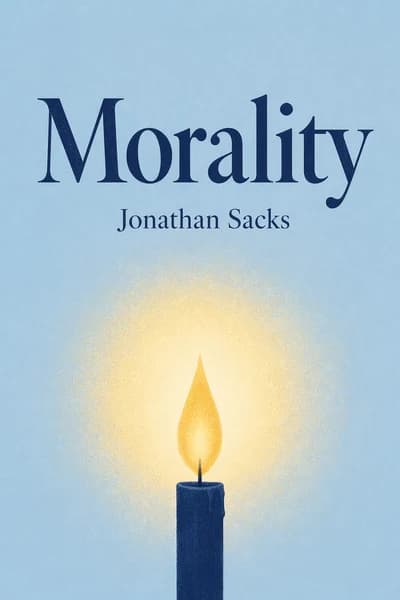
In "Morality," Rabbi Jonathan Sacks diagnoses our societal shift from "We" to "I" - a bestseller praised by Tim Ferriss and Jonathan Haidt. What if rebuilding shared moral foundations could heal our divided world? The late Sacks' prophetic final work offers exactly that path.
Rabbi Lord Jonathan Sacks (1948–2020), author of Morality: Restoring the Common Good in Divided Times, was a globally revered philosopher, theologian, and moral voice whose work bridged religious wisdom and contemporary ethics.
As Chief Rabbi of the United Hebrew Congregations of the Commonwealth for 22 years and a professor at institutions like Yeshiva University and King’s College London, his writings—including The Dignity of Difference (winner of the Grawemeyer Prize) and Not in God’s Name—explore themes of justice, interfaith dialogue, and societal cohesion.
Knighted in 2005 and awarded the Templeton Prize in 2016, Sacks became a trusted commentator through BBC’s Thought for the Day and columns in The Times. Morality, a Sunday Times top-ten bestseller and 2020 National Jewish Book Council “Book of the Year,” reflects his lifelong mission to unite divided societies through shared values.
His 35+ books have been translated worldwide, cementing his legacy as one of the 21st century’s most influential Jewish thinkers.
Morality by Rabbi Jonathan Sacks argues that modern society’s crisis of division stems from abandoning shared moral values for self-interest. Sacks traces this decline to secular materialism’s erosion of human dignity and communal bonds, advocating for a return to ethics rooted in religious wisdom and collective responsibility. The book blends philosophy, social science, and historical analysis to propose rebuilding a moral framework for unity.
This book is essential for policymakers, educators, and leaders seeking solutions to societal polarization, as well as readers interested in ethics, philosophy, or interfaith dialogue. It appeals to those concerned with modern challenges like loneliness, inequality, and the clash between individual rights and communal well-being.
Yes. A Sunday Times Top Ten Bestseller and 2020 National Jewish Book Award winner, Morality offers timely insights into repairing fractured societies. Sacks’ blend of rigorous analysis, interfaith perspectives, and accessible storytelling makes it a compelling resource for understanding today’s cultural crises.
Key themes include:
Sacks defines morality as “un-self-help” – a shift from self-centeredness to collective responsibility. It involves recognizing inherent human dignity, prioritizing the common good, and fostering trust through ethical action.
The “solitary self” describes modern individualism’s consequences: isolation, loss of belonging, and societal fragmentation. Sacks argues this mindset undermines empathy and cooperation, necessitating a return to community-oriented ethics.
While critiquing secular materialism’s failure to sustain moral foundations, Sacks emphasizes interfaith dialogue. He highlights Judaism’s contributions but stresses universal values like justice and compassion, advocating for diverse traditions to collaboratively restore ethics.
Sacks cites Greek philosophy, Enlightenment thinkers, and America’s Founding Fathers like Washington and Franklin, who linked liberty to public virtue. He also draws on Jewish texts, sociologists like Durkheim, and modern psychologists.
Yes. Sacks proposes rebuilding “covenantal relationships” through family, education, and community institutions. He urges rebalancing markets/states with moral frameworks and reviving public discourse grounded in mutual respect.
While The Dignity of Difference focused on interfaith tolerance, Morality examines broader societal breakdowns and synthesizes Sacks’ career-long themes: ethics, community, and Judaism’s relevance to global challenges.
Some argue Sacks overemphasizes religion’s societal role or lacks concrete policy steps. However, most praise his ability to diagnose cultural divides and offer hopeful, multidisciplinary solutions.
The book remains vital for addressing rising isolation, political extremism, and AI-driven disinformation. Its call for ethical renewal provides a roadmap for navigating modern crises while preserving human dignity.
Ressentez le livre à travers la voix de l'auteur
Transformez les connaissances en idées captivantes et riches en exemples
Capturez les idées clés en un éclair pour un apprentissage rapide
Profitez du livre de manière ludique et engageante
Morality is precisely un-self-help.
This atomization makes us vulnerable.
The move from 'We' to 'I'.
Morality gives us unique power.
Décomposez les idées clés de Morality en points faciles à comprendre pour découvrir comment les équipes innovantes créent, collaborent et grandissent.
Condensez Morality en indices de mémoire rapides mettant en évidence les principes clés de franchise, de travail d'équipe et de résilience créative.

Découvrez Morality à travers des récits vivants qui transforment les leçons d'innovation en moments mémorables et applicables.
Posez n'importe quelle question, choisissez la voix et co-créez des idées qui résonnent vraiment avec vous.

Cree par des anciens de Columbia University a San Francisco
"Instead of endless scrolling, I just hit play on BeFreed. It saves me so much time."
"I never knew where to start with nonfiction—BeFreed’s book lists turned into podcasts gave me a clear path."
"Perfect balance between learning and entertainment. Finished ‘Thinking, Fast and Slow’ on my commute this week."
"Crazy how much I learned while walking the dog. BeFreed = small habits → big gains."
"Reading used to feel like a chore. Now it’s just part of my lifestyle."
"Feels effortless compared to reading. I’ve finished 6 books this month already."
"BeFreed turned my guilty doomscrolling into something that feels productive and inspiring."
"BeFreed turned my commute into learning time. 20-min podcasts are perfect for finishing books I never had time for."
"BeFreed replaced my podcast queue. Imagine Spotify for books — that’s it. 🙌"
"It is great for me to learn something from the book without reading it."
"The themed book list podcasts help me connect ideas across authors—like a guided audio journey."
"Makes me feel smarter every time before going to work"
Cree par des anciens de Columbia University a San Francisco

Obtenez le resume de Morality en PDF ou EPUB gratuit. Imprimez-le ou lisez-le hors ligne a tout moment.
We're living through what Rabbi Jonathan Sacks calls a "cultural climate change" - a profound shift from "We" to "I" that has transformed Western society over the past half-century. This isn't abstract philosophy but measurable reality: Google searches show "I" usage skyrocketing since 1965 while "we" remains flat. Pop music lyrics between 1980-2007 reveal the same pattern - more self-reference, fewer words expressing positive social connections. What happens when individualism becomes our highest value? Any functioning social institution requires occasional sacrifice of self-interest for collective good. Without "we-consciousness," relationships crumble, communities dissolve, and nations fragment. The consequences are all around us: more people living alone than ever before (40% of households in major cities), a loneliness epidemic so severe Britain appointed its first "Minister for Loneliness," and research showing isolation is as harmful as smoking fifteen cigarettes daily. Our individualism has liberated us to live as we choose, but at devastating cost to our well-being.