Chapitre 1
The Power of Self-Mastery: Transforming Intentions into Reality
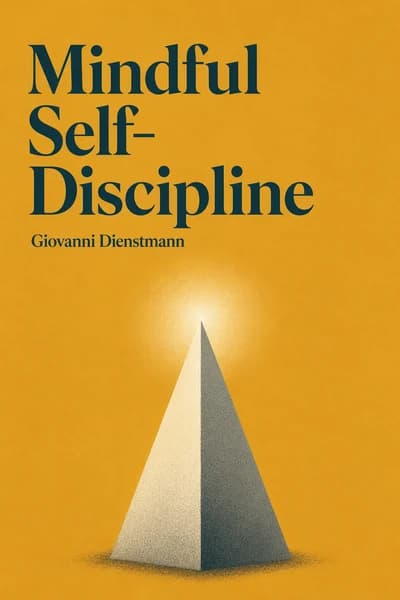
Imagine waking up tomorrow with the unshakeable ability to follow through on every promise you make to yourself. Picture having the strength to consistently choose long-term fulfillment over momentary pleasure, even when nobody's watching. This is the transformative power of mindful self-discipline-a practice that author Giovanni Dienstmann has mastered to an extraordinary degree, waking daily at 2:30am for meditation, taking cold showers, and maintaining a level of focus that seems superhuman to most.
Unlike typical self-help approaches, Dienstmann's system has garnered praise from psychology heavyweight Roy Baumeister, who notes in the foreword that self-discipline rivals intelligence as a predictor of life success. The book has become a quiet phenomenon among high-performers across industries, from Silicon Valley executives to Olympic athletes, who cite its practical framework as their secret weapon. What makes this approach revolutionary is how it merges Eastern mindfulness traditions with Western productivity science, creating a system that feels sustainable rather than punishing.
Chapitre 2
The Three Pillars: A Framework for Lasting Discipline
Mindful self-discipline isn't about forcing yourself to do things you hate-it's about aligning your actions with your deepest values. Dienstmann structures his approach around three essential pillars: Aspiration (your purpose), Awareness (your attention), and Action (your follow-through). Each pillar serves as a fundamental building block that, when developed, creates sustainable and meaningful self-discipline.
The first pillar, Aspiration, connects you to your core motivation and life purpose. It answers the crucial question: "Why am I doing this?" Without aspiration, discipline becomes mechanical and unsustainable. For example, someone might struggle to maintain a workout routine when focused solely on external goals like losing weight, but find lasting motivation when connecting it to deeper aspirations like being healthy for their children or expressing self-respect.
Awareness, the second pillar, functions as your internal compass and monitoring system. It helps you stay present and mindful of your choices throughout the day. Without awareness, we easily fall prey to automatic behaviors and environmental triggers that derail our best intentions. This might manifest as mindlessly scrolling through social media when we intended to work, or stress-eating despite our health goals. Developing awareness involves practices like regular self-reflection, meditation, and conscious pause points throughout your day.
Action, the third pillar, transforms intentions into reality through consistent implementation. This pillar emphasizes practical strategies, habit formation, and overcoming resistance. Without action, even the most inspiring goals remain unrealized. This includes specific techniques like implementation intentions ("If X happens, then I will do Y") and environment design to support desired behaviors.
This framework effectively counters what Dienstmann calls the "three Fs of chaos": Fragmentation (lacking clear direction), Forgetfulness (losing sight of goals), and Futility (feeling powerless to change). Each pillar directly addresses these challenges: Aspiration fights fragmentation by providing clear purpose, Awareness combats forgetfulness by keeping goals present in mind, and Action overcomes futility by building momentum through small wins.
The framework's flexibility is one of its greatest strengths. Rather than requiring a complete lifestyle overhaul, it allows for gradual implementation. You might begin by clarifying your aspirations through journaling, then gradually add mindfulness practices for awareness, and finally incorporate specific action strategies. Even focusing on strengthening just one pillar can create significant positive change. For instance, someone struggling with procrastination might start by simply increasing their awareness of when and why they procrastinate, leading to natural improvements in their behavior.
Success stories often demonstrate how these pillars work together. Consider a writer who connects their daily writing practice to their aspiration of sharing important ideas (Aspiration), develops awareness of their peak creative hours (Awareness), and creates a distraction-free writing environment (Action). When all three pillars are aligned, self-discipline transforms from a burden into a natural expression of personal values.
Chapitre 3
Beyond Willpower: The Science of Sustainable Discipline
Contrary to popular belief, self-discipline isn't primarily about willpower. The research Dienstmann cites reveals that willpower isn't simply a limited resource that depletes like a battery-our beliefs about willpower significantly impact its availability. People who believe willpower is unlimited actually show greater self-control than those who think it's finite.
This explains why some individuals maintain extraordinary discipline despite facing the same biological limitations as everyone else. Their mindset creates a different experience of effort. As Stanford psychologist Carol Dweck discovered, people with an unlimited willpower mindset sometimes perform better after taxing tasks, while those believing in limited willpower show classic depletion effects.
The implications are profound: by changing our beliefs about self-discipline, we can actually change our capacity for it. This doesn't mean willpower is infinite-decision fatigue remains real, explaining why judges make fewer favorable rulings before breaks and why leaders like Obama wear only blue or gray suits to reduce decision burden. But it does mean our capacity for self-discipline is far more malleable than previously thought.
Dienstmann also challenges the modern obsession with habit formation as a replacement for willpower. While habits are essential, they're not sufficient. Some activities will always require conscious effort, and life's unpredictability demands the ability to exercise self-control in novel situations. Habits make you show up; willpower makes you excel.
The most sustainable approach combines environmental design with willpower development. Use your environment to make good choices easier, but simultaneously strengthen your ability to make good choices even when the environment doesn't support them.
Chapitre 4
Aspiration: Finding Your Deeper Why
Self-discipline without purpose is like a car without a destination-powerful but ultimately pointless. The Aspiration pillar addresses this by connecting discipline to something meaningful that pulls you forward naturally.
Dienstmann distinguishes between goals and aspirations. Goals are specific and visible (lose 20 pounds, write a book), while aspirations represent the deeper motivation behind those goals (feel confident, express creativity). Two people might share identical goals but have completely different aspirations driving them.
When goals don't match your deeper aspiration, achieving them leaves you unfulfilled-like climbing a ladder leaning against the wrong wall. This explains why many successful people feel empty despite their accomplishments. Their goals weren't aligned with their true values.
The book offers several powerful exercises for uncovering your core values and aspirations. One particularly effective approach is the "Deeper Why" exercise, where you repeatedly ask yourself "why?" for each goal until you reach an intrinsic value that can't be broken down further. For example, if your goal is to "lose twenty pounds," you might discover through successive "whys" that what you truly seek is confidence or vitality.
Once you've identified your aspiration, Dienstmann suggests magnifying it by exploring both the pain of not actualizing it and the rewards of bringing it to life across different areas of your existence. This process creates what he calls the "pull effect"-an internal attraction toward pursuing your aspiration that naturally enhances discipline and focus.
Chapitre 5
Awareness: The Mother of All Virtues
Awareness forms the heart of mindful self-discipline. It's the quality of noticing what's happening inside you-the ability to look inward with presence of mind and radical self-honesty. Without awareness, we live on autopilot, reacting to triggers rather than responding consciously.
Three qualities make awareness particularly powerful for self-discipline: clarity (seeing things as they truly are), neutrality (observing without judgment), and acceptance (allowing thoughts and emotions to exist without suppression). Research shows that trying to suppress unwanted thoughts actually makes them stronger-like the famous white bear experiment where people told not to think about white bears thought about them more than those encouraged to think about them.
The PAW Method (Pause-Awareness-Willpower) brings awareness into daily life. When facing temptation, first pause with three deep breaths to interrupt automatic reactions. Then become aware of your options, labeling them as either moving toward (+1) or away from (-1) your goals. Finally, apply willpower to shift your state toward choices aligned with your aspirations.
Dienstmann offers several powerful techniques for this third step. "Shift Your Focus" helps you zoom out to see long-term consequences, remember your aspiration, and connect with your future self. "Shift Your Perception" uses cognitive reappraisal to change how you feel about temptations or difficult tasks. And "Embrace Your Pain" helps you accept discomfort as part of growth rather than something to avoid.
The ROAR Method (Recognize, Observe, Accept, Release) particularly stands out as a practical tool for embracing discomfort. When facing an unpleasant emotion or urge, you recognize and label it, observe it as pure bodily sensation, accept it without contraction, and release it with each breath. This mindful approach to pain transforms what would normally trigger avoidance into something you can work through consciously.
Chapitre 6
Breaking Free from Distractions and Excuses
Modern life bombards us with unprecedented opportunities for instant gratification. Each time we choose these quick pleasures over meaningful goals, we're making poor investments of our motivational energy. Our brains naturally gravitate toward immediate rewards unless we've developed effective awareness tools.
Dienstmann explains that dopamine-often misunderstood as the "pleasure chemical"-is actually the arousal chemical that creates feelings of alertness and craving when your brain recognizes potential rewards. Constant exposure to dopamine causes downregulation, making receptors less sensitive and requiring more stimulation for the same effect. This creates a vicious cycle: the more we indulge in instant gratification, the harder it becomes to pursue meaningful goals.
The solution isn't eliminating pleasure but prioritizing purpose first. Dienstmann suggests visualizing life as a jar filled with rocks (meaningful goals), pebbles (important but not critical activities), and sand (pleasures and comforts). If you fill your jar with sand first, there's no room for rocks. But starting with rocks allows everything to fit.
To reset your dopamine sensitivity, Dienstmann recommends a "Monk Week"-completely cutting out all sources of junk dopamine (comfort food, email, gaming, social media, news, pornography, aimless browsing, entertainment) for seven days. This radical reset helps break addiction patterns and redirects your hunger for dopamine toward meaningful goals.
For daily management of distractions, the "Procrastinate Distraction" technique proves remarkably effective. Rather than procrastinating important work, postpone distractions instead. When tempted, simply tell yourself "not now, but later" and refocus on your goal-promoting activity. Research shows this approach is more effective than saying "never," as it partially satisfies the craving while reducing consumption.
Chapitre 7
Designing Habits That Last
The Action pillar translates aspirations into reality through effective habits. While experts disagree on how long it takes to build a habit (from 21 to 254 days), the greater challenge is maintaining them throughout life's changes.
Dienstmann's approach to habit design emphasizes three key elements: cues, actions, and rewards. The cue is your environmental trigger-when you'll perform the habit. Time-based cues like phone alarms work well, but you can also use location, people, or feelings as triggers. The action should have two versions: the ideal (what you'd like to perform) and the minimum (what you'll do no matter what, with no excuses). The minimum action exists to maintain momentum on difficult days.
The golden rule of habit formation is simple but powerful: once you get the reminder, do the action. When your cue appears, you have only two options: do it and get a +1, or ignore it and get a -1. This binary thinking eliminates the gray area where discipline typically fails.
For rewards, intrinsic satisfaction is most sustainable-finding enjoyment in the activity itself, appreciating how you feel afterward, or savoring the emotional satisfaction of making progress. When intrinsic rewards aren't possible, extrinsic rewards like temptation bundling (combining your habit with something enjoyable) or temptation sequencing (making your habit a prerequisite for a reward) can bridge the gap.
Dienstmann suggests starting with a 30-day commitment to one keystone habit, then gradually adding others as the first becomes established. This creates a foundation of success rather than overwhelming yourself with too many changes at once.
Chapitre 8
Overcoming the Final Obstacles: Procrastination, Doubt, and Failure
Even with clear aspirations and well-designed habits, three major obstacles often derail self-discipline: procrastination, doubt, and failure. Understanding and preparing for these challenges is crucial for long-term success in any endeavor.
Procrastination stems from pain avoidance-whether physical discomfort, anxiety, fear of failure, or task aversion. When we anticipate pain, our lizard brain steers us toward dopamine-releasing distractions like social media, entertainment, or busy work. This response is deeply wired into our neural circuitry as a survival mechanism, making it particularly challenging to overcome. The solution requires using the PAW Method (Prepare, Act, Witness), then applying one of three proven approaches: decreasing the pain of action (breaking tasks into tiny steps, like writing just 50 words or exercising for only 5 minutes), increasing the pain of inaction (vividly visualizing the consequences of not acting, such as health issues from skipping exercise or career stagnation from avoiding skill development), or embracing the pain (accepting discomfort as part of growth and reframing it as a signal of progress).
Doubt is the enemy of action and achievement, manifesting in various forms like imposter syndrome, perfectionism, or questioning one's capabilities. It pulls us back, dissipates energy, and makes us quit prematurely. The "Not Now" technique creates a doubt-free experiment where you temporarily suspend all doubts for a specific period, typically 30-90 days. When doubts arise, simply respond with "Not now"-effectively using procrastination as a tool against doubt itself. This technique works because it doesn't require permanently eliminating doubts, just postponing them. During this doubt-free period, you focus wholeheartedly on your task with full conviction, allowing momentum and evidence of progress to naturally dissolve many doubts.
Failure is inevitable on any meaningful journey and should be viewed as valuable feedback rather than a final verdict. Preparing for it requires both contingency planning (anticipating specific challenges and preparing detailed response strategies) and learning to fail gracefully. The ALFA Method helps with the latter: Acknowledge what happened without emotional language or self-judgment (state facts only), Learn what specifically triggered the failure (identify patterns and circumstances), Forgive yourself and release self-criticism (practice self-compassion and remember past recoveries), and Act by recommitting to your goals with adjusted strategies. This systematic approach transforms failures from devastating setbacks into stepping stones for growth.
These obstacles become less formidable when approached with the right mindset and specific tactical responses. Success often comes not from avoiding these challenges but from developing robust systems to handle them effectively when they inevitably arise.
Chapitre 9
The Never Zero Commitment
Self-discipline ultimately requires acting despite fluctuations in motivation. While motivation may provide the initial spark for change, it's an inconsistent and unreliable force that naturally ebbs and flows. Some days you'll feel energized and capable, while other days the same task feels monumentally difficult. This emotional variability makes motivation alone insufficient for lasting change.
The Never Zero commitment represents the heart of Dienstmann's approach-an uncompromising yet manageable commitment that represents the minimum acceptable version of your habit. For example, if your goal is meditation, your Never Zero might be one minute of mindful breathing. For exercise, it could be five push-ups or a five-minute walk. The key is choosing a threshold so modest that it feels almost impossible to fail, yet still maintains the habit's continuity.
You commit to this minimum for a specific period, typically 30 to 90 days, regardless of circumstances. This creates mental clarity by eliminating decision fatigue - there's no daily negotiation about whether to practice. The binary nature of the commitment (you either did it or didn't) builds profound self-trust through consistent follow-through on your words to yourself.
This commitment isn't about perfection but consistency. On high-energy days, you might meditate for 30 minutes or complete a full workout. On challenging days, you fulfill just your Never Zero minimum-but crucially, you maintain the streak. This flexibility acknowledges human nature while preventing complete breaks in practice that can derail progress.
The approach transforms self-discipline from an occasional heroic effort into a sustainable practice that shapes your identity over time. Each day you honor your commitment, regardless of its scale, you reinforce your self-image as someone who follows through. This compound effect of small, consistent actions ultimately creates more lasting change than sporadic bursts of motivation-driven effort.
As Dienstmann writes, "Commitment, not motivation, is what gets you through the defining moments-the setbacks, doubts, and disappointments." When you're tired, stressed, or facing unexpected challenges, your Never Zero commitment serves as an unwavering standard that keeps you moving forward. The inner strength developed through this consistent practice becomes its own reward, creating a positive feedback loop that makes future commitments easier to maintain.
The Never Zero principle also acknowledges that progress isn't linear. There will be natural fluctuations in energy, circumstances, and capacity. By maintaining a minimum standard that never drops to zero, you preserve momentum through difficult periods while allowing for the natural ebb and flow of life.
Chapitre 10
Beyond Self-Discipline: Virtues and Spirituality
Self-discipline ultimately leads to something greater than achievement-it fosters virtues that enrich every aspect of life. Virtues like courage, patience, trust, kindness, confidence, focus, serenity, determination, resilience, and integrity serve as both shields against suffering and special powers enabling deeper well-being. These virtues work synergistically - for example, patience reinforces resilience, while courage strengthens determination, creating a robust foundation for personal growth.
Every virtue represents a way to see, feel, and navigate the world, powered by a specific narrative or mindset. These narratives-our self-talk-forge our character and destiny. For instance, the virtue of courage might be supported by the narrative "I can handle whatever comes my way," while patience might stem from "Everything unfolds in its own time." Most people don't consciously develop empowering narratives, instead repeating disempowering stories they've absorbed from parents, friends, media, and society. Common limiting narratives include "I'm not good enough" or "Success requires struggle," which can unconsciously sabotage growth.
Dienstmann suggests two powerful techniques for developing virtues: "Kindle the Virtue" and "Absorb the Virtue." The "Kindle the Virtue" technique involves recreating the bodily sensations, emotions, and narratives associated with a virtue. For example, to develop confidence, one might recall a moment of triumph, focusing on the physical sensations of standing tall, the emotional warmth of success, and the empowering thoughts that accompanied it. "Absorb the Virtue" involves visualizing a role model and absorbing their qualities through identification - whether it's a historical figure like Nelson Mandela for resilience, or a personal mentor for wisdom.
For those inclined toward spirituality, Dienstmann notes how spiritual practice naturally strengthens self-discipline through three mechanisms: the power of faith (bypassing doubt completely), long-term outlook (considering consequences beyond immediate gratification), and stronger sense of purpose (feeling called to make the best use of your life). Faith acts as an antidote to overthinking and self-doubt, while a long-term perspective helps maintain motivation during challenging times. This spiritual foundation can transform daily challenges into opportunities for growth and transcendence.
While traditional spirituality often emphasized self-denial and renunciation of worldly ambitions, Dienstmann advocates for a new, more integrated approach-one that fulfills needs rather than effacing them, empowering worldly goals while using this journey as a path to something higher. This modern synthesis allows practitioners to remain engaged in the world while maintaining spiritual awareness, creating a balanced approach that honors both material and spiritual development. For example, career success can be pursued not just for personal gain, but as a means to serve others and express one's highest potential.
The integration of virtues, self-discipline, and spirituality creates a comprehensive framework for personal development that addresses both practical achievement and deeper fulfillment. This holistic approach recognizes that true success encompasses both external accomplishments and internal growth, leading to a more authentic and sustainable form of self-development.
Chapitre 11
Living the Disciplined Life
Mindful self-discipline transforms from a dreaded chore into a natural expression of who you truly want to be. Rather than viewing it as a restrictive force, it becomes an empowering alignment between your actions and deepest values. This shift in perspective allows you to move beyond the constant battle with momentary impulses and into a state of purposeful living where choices flow naturally from your core principles.
The benefits of this approach extend far beyond mere achievement or goal attainment. Self-discipline forms the foundation of a good life by enhancing multiple dimensions of human experience. It improves physical health through consistent healthy habits, increases mental wellbeing by reducing internal conflicts, boosts income through focused effort and strategic persistence, strengthens relationships through reliability and emotional regulation, and brings dreams within reach through sustained action. Whether learning a musical instrument, building a business, or maintaining a fitness routine, self-discipline helps you master any skill while simultaneously developing character.
If self-discipline is the father of all virtues, self-awareness is the mother - together in mindful self-discipline, they create a powerful partnership. Self-awareness helps you understand your patterns, triggers, and true motivations, while self-discipline provides the framework to act on these insights. This combination enables you to break free from unconscious habits and create intentional change in any area of life.
The journey of disciplined living produces both external and internal rewards. While achieving goals is valuable, the ultimate reward is the person you become through the process: more proud of your choices, genuinely happier with your life direction, deeply engaged in meaningful pursuits, and equipped with a broader perspective on what's possible. You develop emotional resilience, mental clarity, and an expanded sense of capability. This personal growth - the strengthening of character and expansion of consciousness - makes every challenge and sacrifice worthwhile.
As Dienstmann powerfully concludes, "You face a choice: either close this book thinking 'I've learned a lot' and hope self-discipline magically appears, or take real action based on what you've learned." This decision point represents more than just the application of knowledge - it's the threshold between passive learning and active transformation. The difference between these choices is the difference between remaining who you are today and stepping into who you could become tomorrow. The path of mindful self-discipline offers not just a way to achieve more, but a way to become more.