Chapitre 1
The Lost Art of Deep Reading: Unlocking the Power of Books
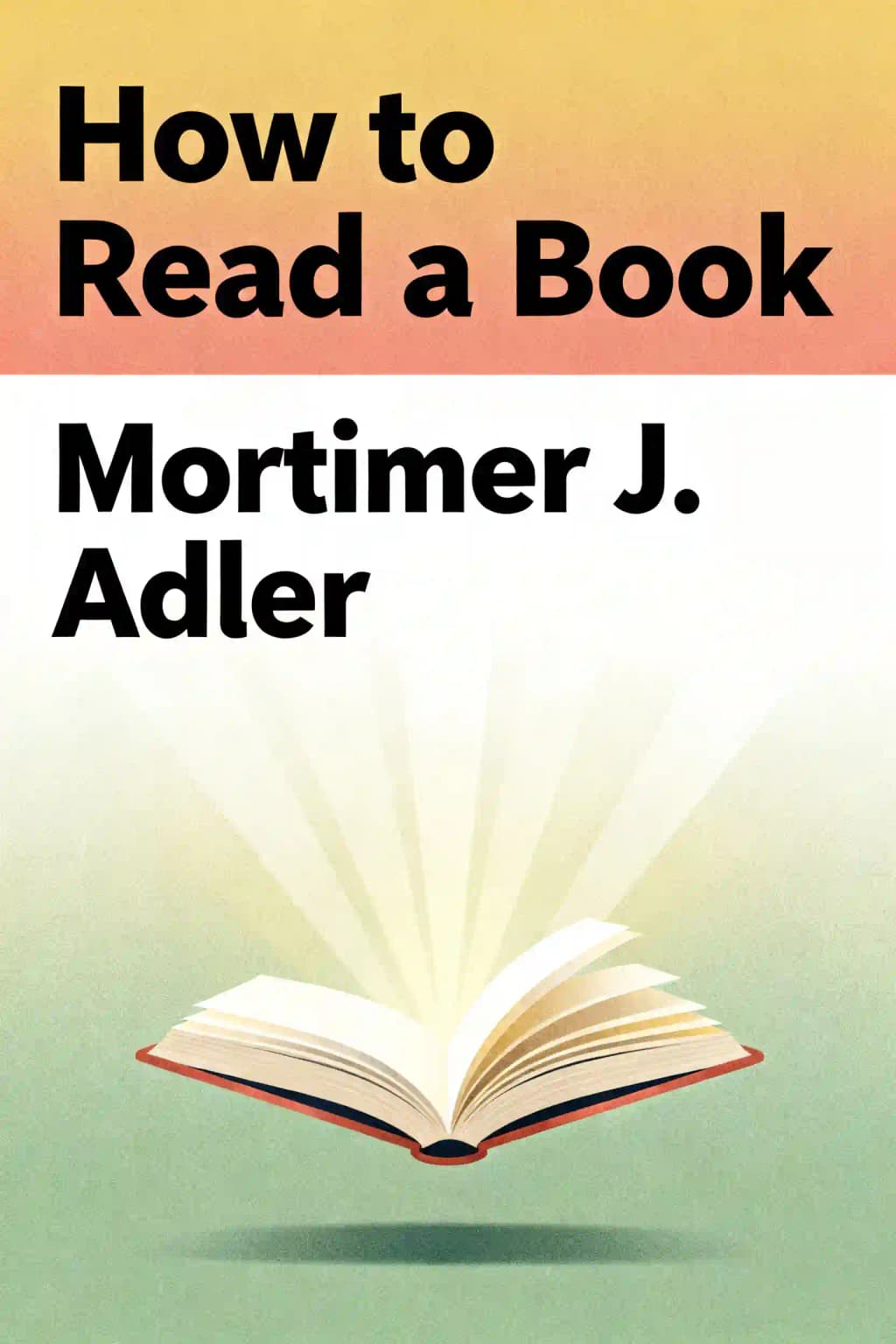
In an age of skimming and scrolling, Mortimer J. Adler's "How to Read a Book" stands as a revolutionary guide to the forgotten art of true reading. First published in 1940 and revised in 1972, this unexpected bestseller remains a favorite among intellectual heavyweights like Warren Buffett and Charlie Munger, who credit the book with transforming their approach to knowledge acquisition. The book's enduring popularity-selling over a million copies and translated into more than a dozen languages-speaks to our collective hunger for deeper understanding in an increasingly superficial information landscape. What makes this work so powerful is that it doesn't just teach you to read faster; it teaches you to read better, transforming the passive consumption of text into an active dialogue with some of history's greatest minds.
Chapitre 2
The Four Levels of Reading: A Stairway to Understanding
Reading is not a single skill but a complex hierarchy of abilities that build upon each other. Most of us stop developing our reading skills around sixth grade, creating an educational ceiling that limits our potential for deeper understanding. Adler's solution is a systematic approach to reading that recognizes four distinct levels:
Elementary Reading is what most of us learned in school-the basic ability to decode words and sentences. While this level is essential, it's merely the foundation. When we read at this level, we can answer the question "What does the page say?" but little more. Unfortunately, many adults never progress beyond this stage, limiting their ability to engage with complex ideas.
Inspectional Reading involves two crucial skills: systematic skimming and superficial reading. When skimming, you examine the title page, preface, table of contents, index, and publisher's blurb, then dip into pivotal chapters and the conclusion. This provides a "bird's eye view" of the book's structure and main arguments in just 15-30 minutes. Superficial reading means reading straight through difficult material without stopping for unfamiliar terms or puzzling passages. This counterintuitive approach prevents getting bogged down in details during first readings.
The genius of inspectional reading is that it solves the paradox many readers face: how can you know if a book deserves careful reading before you've read it? By quickly mapping a book's territory, you make informed decisions about whether and how to proceed with deeper reading. This approach also creates a mental framework that makes subsequent analytical reading more productive.
Analytical Reading is the level where true understanding begins. Here, you actively engage with a book through systematic questioning: What is the book about as a whole? What is being said in detail, and how? Is it true? What of it? This level demands that you "X-ray" the book to reveal its skeleton-the underlying structure supporting its more visible elements.
Syntopical Reading is the most complex level, involving the comparative reading of multiple books on the same subject. Rather than being guided by any single author's terminology or framework, the syntopical reader constructs their own analysis that may not exist in any individual source. This approach allows you to engage with the "Great Conversation" that has been ongoing across centuries, placing yourself in dialogue with the greatest minds in history.
The beauty of this framework is that each level contains and builds upon the previous ones. You can't be a good analytical reader without first mastering inspectional techniques, and syntopical reading requires proficiency at all lower levels. This hierarchical approach provides a clear path for continuous improvement in your reading skills.
Chapitre 3
The Art of Active Reading: Transforming Words into Understanding
The difference between reading that puts you to sleep and reading that transforms your understanding comes down to one crucial distinction: active engagement. Passive readers treat books as entertainment to be consumed; active readers approach books as conversations to be joined, bringing their full intellectual capacity to bear on the text. This engagement creates a dynamic interaction between reader and author that elevates the reading experience from mere consumption to genuine learning.
Active reading begins with marking up your books-underlining major points, using vertical lines in margins for emphasis, placing asterisks by crucial passages, numbering sequential points, writing questions in margins, and creating your own index on the blank pages. Different colors can serve different purposes: red for disagreements, blue for key concepts, green for practical applications. This physical engagement keeps your mind alert and creates a personalized roadmap of your intellectual journey through the text. When you return to the book months or years later, these marks become invaluable triggers for recalling your initial insights and reactions.
But physical marking is merely the outward sign of the mental work happening beneath the surface. The true essence of active reading is asking questions while you read-questions you must try to answer yourself. Reading above the elementary level consists of asking the right questions in the right order: What is the author's main argument? What evidence supports it? What assumptions underlie the reasoning? What counterarguments might exist? These questions transform passive absorption into active analysis.
Consider how differently active and passive readers approach a challenging paragraph. The passive reader might read it once, feel confused, and either give up or continue without understanding. The active reader, encountering the same difficulty, employs multiple strategies: breaking down complex sentences, identifying unfamiliar terms, relating ideas to previous knowledge, and creating mental models or diagrams. They might ask: What is the author trying to say here? How does this connect to earlier points? What examples might illustrate this idea? What analogies could make this clearer?
Active reading also requires coming to terms with the author-literally. A term is not merely a word but a word used unambiguously. For instance, when reading economics, "efficiency" has a specific technical meaning different from its everyday usage. When an author uses a word with one meaning and a reader interprets it differently, communication fails. True communication occurs only when writer and reader share the same meaning. This precision is especially crucial in expository writing, unlike poetry where ambiguity may be intentional and even desirable.
Finding the key words in a book-those the author uses in special ways-is essential to understanding. These important words can be identified in several ways: they're often the ones that give readers trouble; they may be emphasized through typographical devices like italics; they might be explicitly defined by the author; or they appear in crucial propositions. Creating a personal glossary of these terms helps build a foundation for deeper understanding.
The ultimate test of understanding is whether you can translate the author's propositions into your own words while remaining faithful to the original thought. If you can only repeat the author's exact phrasing, you haven't truly grasped the meaning. For example, don't just memorize "supply and demand determine price" - be able to explain how this works using real-world examples from your own experience. The surest sign of comprehension is the ability to provide concrete examples that illustrate the author's points and to apply the concepts in novel situations.
Chapitre 4
Reading as Conversation: The Art of Agreeing and Disagreeing
Reading is fundamentally a conversation between author and reader, though one conducted across time and space. The author speaks first through their written words, but the reader has the last word in interpretation and judgment. This dialogue, though asymmetrical, forms the basis of intellectual growth and knowledge transmission. After thoroughly understanding a book, a reader must decide whether to agree or disagree with it-a judgment that requires both intellectual etiquette and sophisticated critical thinking skills.
The most common mistake readers make is criticizing before achieving genuine understanding. We must be able to confidently say "I understand" before declaring "I agree," "I disagree," or "I suspend judgment." These three positions exhaust all possible critical stances. Many readers mistakenly identify criticism solely with disagreement, but reaching agreement requires equal critical judgment and careful consideration. Understanding must precede any critical position-to agree without understanding is inane and potentially dangerous; to disagree without understanding is impudent and intellectually dishonest.
When disagreeing with an author, there are only four constructive ways to do so, each requiring specific evidence and reasoning: First, you can argue that the author is uninformed (lacking crucial knowledge that would have affected their conclusions); second, that they are misinformed (asserting what is demonstrably not the case); third, that they are illogical (committing non sequiturs or internal contradictions); or fourth, that their analysis is incomplete (failing to address all crucial aspects of the problem). Each criticism must be specific, well-reasoned, and supported with concrete evidence.
Consider how this framework applies to significant works: Darwin's Origin of Species demonstrates how even groundbreaking works can be uninformed in certain aspects - Darwin lacked knowledge of Mendel's genetic discoveries, which would have provided a mechanical explanation for inheritance and strengthened his theory of natural selection. In Hobbes' Leviathan, we find logical inconsistencies when he first claims bodies in motion have no inherent qualities, then later argues that sensory qualities are simply motions of atoms in the brain - a clear contradiction in his materialist philosophy.
The fourth criticism-incompleteness-is often the most fertile ground for disagreement with great books, as even brilliant thinkers cannot exhaust all aspects of complex subjects. Aristotle's Politics, while masterful in analyzing Greek city-states, is incomplete because it fails to consider truly democratic constitutions based on universal suffrage or representative government - political innovations that would emerge centuries later. Similarly, Euclid's Elements, though revolutionary, lacks consideration of non-Euclidean geometry and alternative postulates about parallel lines that would later revolutionize mathematics and physics.
This systematic approach transforms disagreement from an adversarial battle to be won into a collaborative opportunity for learning and intellectual growth. The ultimate goal is not victory but truth, and the proper reader should be equally prepared to agree or disagree based solely on facts and evidence, not personal bias or emotional attachment to particular positions. When agreement feels like defeat, or disagreement like victory, it reveals an emotional rather than intellectual approach to reading - a common but problematic tendency that undermines genuine learning. The art of reading requires maintaining intellectual honesty while engaging in this complex conversation across time with history's greatest thinkers.
Chapitre 5
Different Books, Different Approaches: Adapting Your Reading Strategy
Just as you wouldn't use the same tool for every household repair, you shouldn't apply identical reading techniques to every type of book. Different categories of writing demand different approaches, and mastering these varied techniques is essential for effective reading comprehension and enjoyment.
Practical books-those concerned with problems that can be solved through action-require special consideration and methodical analysis. Unlike theoretical works that aim to help you understand reality, practical books guide you in operating within it. When reading practical books, you must identify both the author's objectives and the means they propose to achieve them. For example, a book on leadership might propose specific communication strategies or management techniques. Agreement with a practical book logically demands action-if you're convinced the ends are worthy and the means effective, you must act accordingly, or your agreement isn't genuine. This might mean implementing new habits, changing behaviors, or adopting new methods in your daily life.
Imaginative literature presents a distinct challenge and requires a more immersive approach. While expository books convey knowledge about experiences readers have had or could have, imaginative literature communicates an experience itself-one that can only be shared through reading. The most important rule for reading fiction is: Don't resist the effect that imaginative literature has on you. Unlike with expository works, where critical distance is valuable, imaginative literature requires surrendering to the experience it creates, allowing yourself to be transported into the fictional world completely.
When reading stories, read quickly and with total immersion, ideally in one sitting. Let the characters into your mind and heart; suspend your disbelief about events, whether you're exploring magical realms or realistic settings. Try to live in the characters' world rather than judging them by standards from your world. For plays, remember you're experiencing an incomplete work meant for the stage. After understanding what the play is about, imagine yourself directing it-position actors, determine how lines should be delivered, identify crucial moments. Consider how stage directions, lighting, and setting would enhance the dramatic effect.
History requires a more analytical and multi-faceted approach. While some historical facts can be established with reasonable certainty, their significance and causes remain debatable. The historian must either find or impose patterns on events and must make suppositions about why historical figures acted as they did. Because historians' theories affect their accounts, the first rule of reading history is to read multiple accounts of any event or period, especially those with practical significance to us. Compare different perspectives on the same historical event, considering the authors' backgrounds, potential biases, and the evidence they present.
Philosophy demands careful attention to the questions being asked and requires a systematic approach to understanding complex ideas. Unlike scientific questions that require experiments or historical questions that demand research, philosophical questions can only be answered through reflection and thought. The philosopher works with common human experience that is available to everyone, examining fundamental questions about existence, knowledge, ethics, and reality. What distinguishes great philosophers is not special knowledge but their ability to think more profoundly about ordinary experience and articulate universal truths about the human condition. When reading philosophy, focus on identifying the core arguments, understanding the premises, and evaluating the logical progression of ideas.
Chapitre 6
The Challenge of Scientific and Mathematical Reading
Modern scientific writing presents unique challenges for general readers. Until the late nineteenth century, scientific books were written for educated lay audiences by authors like Galileo, Newton, and Darwin, who took care to explain their ideas in accessible terms. Today, however, science is primarily written by experts for experts, with specialized knowledge requirements that exclude ordinary readers. This shift reflects both the increasing complexity of scientific knowledge and the professionalization of scientific disciplines.
When facing mathematics in scientific books, remember that you can read elementary mathematics better than you think. Mathematics is a language that can be learned like any other, with its own vocabulary, grammar, and syntax. It actually offers advantages over ordinary language - it deals with subjects that can be comprehended identically by different people and lacks emotional connotations when properly used. For example, the equation E=mc2 means exactly the same thing to everyone who understands it, whereas words like "energy" or "mass" might carry different connotations in everyday speech.
For scientific classics, focus on understanding the problems the scientists were trying to solve and their historical context. Following scientific development - seeing how facts, assumptions, principles and proofs interconnect - engages human reason at its most successful. For instance, when reading Darwin's "Origin of Species," understanding the agricultural and geological knowledge of his time helps illuminate why his observations about natural selection were so revolutionary. This historical study helps dispel science's apparent unintelligibility by revealing how scientific ideas emerged from specific questions and challenges.
When reading works like Newton's Principia, strategic skipping is often wise. Read the proposition statements, glance at proofs, read lemmas and corollaries, and focus on the scholiums where Newton makes his main points. For example, in the Principia, you might focus on Newton's three laws of motion and their implications rather than getting bogged down in the mathematical demonstrations. Remember that your primary obligation is to understand the problem, not become an expert in the subject matter. Look for the author's key insights and main conclusions, paying special attention to introductory passages and summaries that frame the work's central arguments.
The evolution of scientific communication also reflects changes in how knowledge is validated and shared within the scientific community. Modern papers often assume familiarity with previous research, specialized terminology, and standard methodologies in ways that historical scientific works did not. Understanding this context can help readers approach scientific texts with appropriate expectations and reading strategies.
Chapitre 7
The Syntopical Reader: Mastering Multiple Books on the Same Subject
The highest level of reading-syntopical reading-involves examining multiple books on the same subject simultaneously to develop a comprehensive understanding that transcends any single work. This challenging approach begins with recognizing when more than one book is relevant to a question and determining which books should be read. The difficulty lies in defining what constitutes the "same subject," as even works nominally about identical topics may approach their subjects from radically different angles. For instance, books about democracy might variously focus on its historical development, philosophical foundations, or practical implementation.
Syntopical reading involves five essential steps, each requiring careful attention and intellectual rigor. First, find relevant passages in the identified books, which demands efficient inspection reading to locate pertinent sections while avoiding time-consuming complete readings. Second, establish neutral terminology that encompasses all authors' vocabulary-resolutely refusing to accept any one author's terminology. This might mean creating your own terms to bridge different authors' expressions of similar concepts. For example, what one author calls "human nature," another might term "the human condition" or "human psychology."
The third step involves framing questions that all authors can be interpreted as answering, even when they didn't explicitly consider them. This requires creative interpretation and the ability to see implicit answers in explicit discussions. Fourth, define the issues by identifying where authors answer the same questions differently, mapping out the landscape of disagreement and consensus. Fifth, analyze the discussion by ordering questions to maximize understanding, creating a coherent framework for the dialogue between texts.
The fundamental paradox of syntopical reading is that you cannot read syntopically without knowing what books to read, yet you cannot know what to read without being able to read syntopically. Most readers need assistance to overcome this paradox, which is why reference tools like the Syntopicon (a topical index to the Great Books of the Western World) can be invaluable starting points. Other useful resources include specialized bibliographies, academic course syllabi, and expert recommendations in the field.
The rewards of syntopical reading are immense and multifaceted. By engaging with the "Great Conversation" across centuries, you develop a more nuanced understanding than any single author can provide. This method reveals how ideas evolve over time and how different thinkers build upon, challenge, or refute their predecessors. With perennial problems like justice, happiness, or the nature of knowledge, truth isn't found in any single answer but in the conflict of opposing answers. The solution consists in the ordered discussion itself, as the dialogue between different perspectives illuminates the complexity and depth of fundamental questions.
Through syntopical reading, readers become active participants in this ongoing intellectual dialogue, developing their own informed positions while understanding the historical and philosophical context of current debates. This approach transforms reading from a passive reception of information into an active engagement with the development of human thought.
Chapitre 8
Why Reading Matters: The Life and Growth of the Mind
The ultimate purpose of reading goes far beyond acquiring information or entertainment - it is fundamental to the development and sustenance of human consciousness. Unlike our bodies, which stop growing around age thirty and then gradually deteriorate, our minds have unlimited potential for growth throughout life. This remarkable human trait may be what truly distinguishes us from other animals, offering us the unique capacity for continuous intellectual evolution and self-renewal.
However, this cognitive advantage carries a serious risk - the mind can atrophy when not exercised, much like unused muscles waste away. Mental atrophy appears to be a "mortal disease," explaining why many people experience rapid decline shortly after retirement when external mental demands cease. Without internal resources for mental activity, they simply stop thinking. This phenomenon has been observed repeatedly in studies of retirees who fail to maintain intellectual engagement, showing marked cognitive decline within just a few years of leaving the workforce.
Television, radio, social media, and other entertainment sources are merely "artificial props" that create the illusion of mental activity through external stimuli. Like addictive substances, we develop tolerance and need increasingly more stimulation to achieve the same effect. When these external stimuli lose effectiveness, those lacking internal resources cease growing intellectually, morally, and spiritually - and when growth stops, decline inevitably begins. This passive consumption of media differs fundamentally from the active engagement required by reading.
The best books make readers wiser by providing deeper awareness of enduring human truths and problems that have no final solutions. They challenge our assumptions, force us to consider multiple perspectives, and engage our critical thinking faculties. At the apex of the reading pyramid are the truly great books - fewer than a hundred - that cannot be exhausted even by the most careful and repeated reading. Works like Plato's Republic, Shakespeare's plays, or Tolstoy's novels demonstrate this inexhaustible quality. The distinguishing characteristic of these timeless works is that they seem to "grow" with the reader. Upon returning to them months or years later, readers discover new insights and dimensions not noticed before. While the book hasn't changed, the reader has grown, yet the book remains perpetually challenging and revealing.
Active reading serves not just as advancement in career but as essential nourishment keeping our minds alive and growing. By mastering the art of reading, we gain not just knowledge but wisdom - not just information but understanding. We join a conversation that has been ongoing for millennia, adding our own thoughts to the great dialogue of human understanding. This engagement with ideas through text develops our capacity for sustained attention, complex reasoning, and empathetic understanding. In a world increasingly dominated by superficial engagement with ideas and shortened attention spans, the ability to read deeply and think critically becomes not just an intellectual advantage but a form of liberation - a way to maintain our intellectual independence and continue growing throughout our lives.