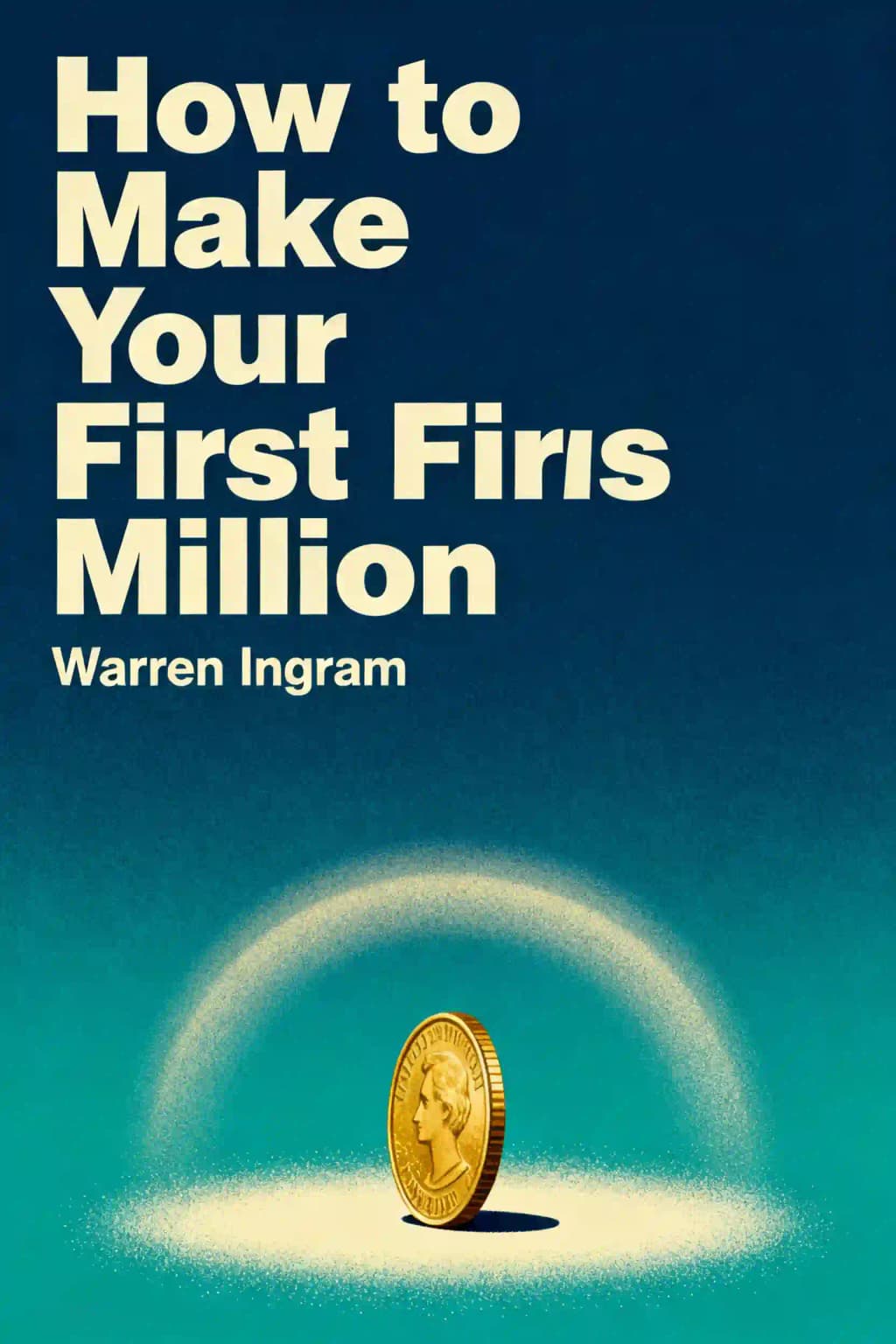
Unlock financial freedom with Warren Ingram's practical roadmap to wealth. South African investors swear by this guide that transformed ordinary savers into millionaires. "I'll be a millionaire by 28!" one reader declared. What's your deadline for joining the millionaire club?
Warren Ingram, author of the bestselling personal finance guide How to Make Your First Million, is an award-winning financial planner and celebrated authority on wealth-building strategies for everyday South Africans.
His work focuses on practical, accessible approaches to saving, investing, and financial discipline, distilled from his 20+ years as co-founder of Galileo Capital, where he oversees R5 billion in client assets.
A regular commentator on 702 and CapeTalk’s The Money Show and host of the Honest Money podcast, Ingram bridges complex financial concepts with actionable advice tailored to South Africa’s economic landscape. His other notable works include Become Your Own Financial Advisor and Global Investing Made Easy, both acclaimed for their no-nonsense frameworks.
Honored as South Africa’s Financial Planner of the Year (2011) and FPI Media Award winner (2013), Ingram’s guidance has empowered thousands to achieve financial independence. How to Make Your First Million remains a definitive roadmap for aspirational investors, consistently ranking among the country’s top personal finance titles.
How to Make Your First Million by Warren Ingram is a practical guide to achieving financial freedom through disciplined investing and wealth-building strategies. Written in plain English, it simplifies complex financial concepts, offering actionable steps for budgeting, saving, and investing—with a focus on the South African market. The book emphasizes long-term planning, case studies, and mindset shifts to help readers grow their wealth.
This book is ideal for beginners seeking to understand personal finance basics, South African investors looking for locally relevant advice, and anyone aiming to build wealth through systematic saving and compound interest. It’s particularly valuable for those intimidated by jargon-heavy financial literature.
Yes, reviewers praise its accessibility, relatable case studies, and practical tools for investing. However, some note overlaps with Ingram’s earlier works and the regional focus on South Africa, which may limit relevance for international readers.
Key principles include:
Ingram tailors advice to South Africa’s economic landscape, covering local investment vehicles, tax considerations, and retirement funds. This specificity makes the book a standout resource for residents navigating the country’s unique financial challenges.
Critics highlight repetitive content from Ingram’s prior books and an overemphasis on South African contexts. Some readers also desire more advanced strategies for mid-career professionals already familiar with basic investing.
Unlike U.S.-centric books, Ingram’s guide focuses on South Africa but shares similarities with global bestsellers like The Richest Man in Babylon in its emphasis on frugality and systematic saving. It’s less technical than textbooks but more actionable than motivational reads.
Real-life examples illustrate how ordinary individuals achieved financial milestones through disciplined investing. These stories demystify abstract concepts, showing tangible applications of Ingram’s strategies.
Yes! Readers report applying its principles to health, career, and personal growth. The book’s focus on vision-setting and incremental progress resonates beyond finance.
The core principles—budgeting, investing, and patience—remain timeless. Updated editions or companion resources may address recent economic shifts, but the foundational advice stays applicable.
Yes! Ingram outlines a three-step roadmap:
Ressentez le livre à travers la voix de l'auteur
Transformez les connaissances en idées captivantes et riches en exemples
Capturez les idées clés en un éclair pour un apprentissage rapide
Profitez du livre de manière ludique et engageante
Financial freedom begins with a clear, compelling vision.
Without a personal vision, you're like a boat with no steering.
Always do your current job brilliantly.
Consider becoming a revenue generator.
Budgeting is essential.
Décomposez les idées clés de How to Make Your First Million en points faciles à comprendre pour découvrir comment les équipes innovantes créent, collaborent et grandissent.
Découvrez How to Make Your First Million à travers des récits vivants qui transforment les leçons d'innovation en moments mémorables et applicables.
Posez vos questions, choisissez votre style d’apprentissage et co-créez des idées qui vous correspondent vraiment.

Cree par des anciens de Columbia University a San Francisco
"Instead of endless scrolling, I just hit play on BeFreed. It saves me so much time."
"I never knew where to start with nonfiction—BeFreed’s book lists turned into podcasts gave me a clear path."
"Perfect balance between learning and entertainment. Finished ‘Thinking, Fast and Slow’ on my commute this week."
"Crazy how much I learned while walking the dog. BeFreed = small habits → big gains."
"Reading used to feel like a chore. Now it’s just part of my lifestyle."
"Feels effortless compared to reading. I’ve finished 6 books this month already."
"BeFreed turned my guilty doomscrolling into something that feels productive and inspiring."
"BeFreed turned my commute into learning time. 20-min podcasts are perfect for finishing books I never had time for."
"BeFreed replaced my podcast queue. Imagine Spotify for books — that’s it. 🙌"
"It is great for me to learn something from the book without reading it."
"The themed book list podcasts help me connect ideas across authors—like a guided audio journey."
"Makes me feel smarter every time before going to work"
Cree par des anciens de Columbia University a San Francisco

Obtenez le resume de How to Make Your First Million en PDF ou EPUB gratuit. Imprimez-le ou lisez-le hors ligne a tout moment.
What separates those who achieve financial freedom from those who perpetually struggle? It's rarely luck, inheritance, or exceptional intelligence. The difference lies in having a compelling vision that pulls you forward when every fiber of your being wants to quit. Think about the early days of personal computing-Bill Gates didn't wake up obsessed with becoming a billionaire. He envisioned a computer on every desk when these machines were still room-sized monstrosities. Steve Jobs wanted powerful technology in everyone's hands, not just the elite. Their wealth emerged as a natural consequence of pursuing something larger than themselves. Your vision doesn't need to revolutionize an industry, but it must be vivid enough to sustain you through inevitable setbacks. Without this compass, you're adrift-a boat without steering, engine, or map. Research consistently shows that approaching retirement, most people value freedom over money itself. Yet simply running from something negative-a soul-crushing job, mounting debt-won't carry you far. You need positive goals worth working toward, detailed enough to feel real: Where will you live? What does your typical day look like? How much do you need to make this reality sustainable?
Grinding through work you despise makes wealth-building exponentially harder. When you hate your job, excellence becomes nearly impossible, leading to mediocrity and stagnant income. Passion isn't fluffy-it's practical fuel that naturally drives longer hours, persistence through obstacles, and deeper expertise. Charlie Munger suggests starting with elimination: cross off careers where you have zero natural talent. Malcolm Gladwell's research reveals world-class performers typically invest 10,000 hours before breakthrough success-something impossible when you're watching the clock. Always excel at your current role, however humble. Your reputation is built on observable performance. Consider becoming a revenue generator-someone who directly brings money into the organization. These people rarely get eliminated during downturns because they're demonstrably valuable. Better yet, leverage your time rather than selling it by the hour. If you can create assets-software, content, intellectual property-that generate returns even when you're not actively working, you've unlocked a different level of freedom.
The secret to successful investing is embarrassingly simple, which is why most people ignore it. Start with reality-based budgeting, saving at the beginning of each month before spending. Match investments to timeframes: for goals under three years, use money-market or fixed-deposit accounts. For horizons exceeding five years, embrace shares, which historically deliver three to four times cash growth. Exchange-traded funds (ETFs) offer the cheapest entry at just R300 monthly or R1,000 lump sum. Example: earning R19,000 monthly with R14,000 expenses, invest the R5,000 remainder. After building a six-month emergency fund, channel everything into share-based ETFs. Assuming 15% annual growth, your first million takes roughly eight years. Here's where mathematics becomes magical: your second million requires only three years and seven months, the third just two years and four months. Eventually, R5 million becomes R6 million in just 15 months. The hardest part is always the beginning-building that first foundation through delayed gratification and unwavering discipline.
South Africans revere property ownership, but the numbers reveal a different reality. From 1900 to 2014, residential property barely outpaced inflation by 1.9% annually, while shares beat inflation by 7.6% - a gap that compounds dramatically over decades. Hidden costs devastate returns: transfer duties, legal fees, agent commissions (2.5-5% of sale price), and maintenance averaging 1% of home value annually. You're also facing concentration risk - too much wealth in one asset - and liquidity risk. The Sea Point market depression in the mid-1990s proved properties don't convert to cash quickly when needed. The Herengracht Index, tracking Amsterdam property values across nearly 400 years, confirms this globally: residential real estate essentially tracks inflation rather than outperforming it. A paid-off home that costs money to maintain is a lifestyle asset, not an investment. Unless you plan to sell and live off proceeds or leverage its mortgage for income-generating assets, it's not working for you financially. For most people, listed property companies offer superior advantages: professionally managed portfolios, stock market liquidity, and yields typically 6-9% annually - outperforming residential property's 5-8%. Unless you're prepared to become a professional property investor, your capital likely works harder elsewhere.
Financial markets will always be turbulent, but successful investing demands patience and discipline. Build financial independence methodically: define your investment objective, commit to investing 20-33% of earnings monthly, choose assets based on your time horizon, and maintain consistency through automatic debit orders while resisting panic-selling. Asset allocation-how you distribute capital across shares, property, cash, and bonds-determines roughly 94% of your portfolio's movement. Most people should hold between 35% and 75% in shares. Less than 35% won't outpace inflation long-term. More than 75% is high-risk, especially if you'll need income from your capital. Long-term investors should view market declines as opportunities to buy quality assets at discount prices. Inflation poses a far greater threat-silently eroding purchasing power without dramatic headlines. Growth assets like shares and property companies are the only reliable inflation hedge. For goals beyond seven years without income needs, invest 75% in shares and 25% in cash. For five to seven years, consider 50% shares, 25% bonds or property, and 25% cash. For three years or less, keep everything in cash. Trading appeals to our desire for quick money but requires numerous decisions, each an opportunity for error. Real wealth accumulates after 10-15 years, with dividends comprising over half of total returns.
Jane turned R130,000 into R2.5 million using residential property and ETFs. Julia achieved financial independence by 40, investing one-third of her salary through the 2008 crash. Kevin built wealth renovating undervalued homes in good areas, living in them before selling. Shaun and Susan converted every former home into rental property. Jenny escaped an abusive marriage by secretly saving grocery money, eventually building a debt-free technology business. Tatiana, widowed with zero experience, purchased a financial services agency from her dining table-taking 22 years to save her first million rand, then just 10 more to add R10 million. Common patterns emerge: fear of dying shortly after retirement, stable marriages with shared goals, contentment with current lifestyle, parents who instilled saving ethics, meticulous planning for setbacks. Research shows women outperform men in investments by nearly 1% annually, checking portfolios 45% less frequently and making 20% fewer changes.
Successful people rarely advertise their work ethic, but consistent effort over long periods remains the common denominator among top performers. Jim Rohn's insight rings true: you become the average of the five people you spend most time with. When feeling stuck, examine your social circle - surrounding yourself with people who embody what you want to become accelerates change. Patience separates great investments from disasters. Media highlights spectacular wins or losses, overlooking investors who made sound decisions but sold too early. Index-tracking investments offer a simple, low-cost approach to wealth. Only 2 of 10 mutual funds beat the index long-term. Warren Buffett instructs his trustees to put 90% in a low-cost S&P 500 index fund. Good investing is boring, not entertaining. Borrowing to invest demands respect - treat it like explosives, powerful but dangerous. Ensure repayments are easily affordable and maintain liquid reserves. Financial setbacks made in good faith can be recovered; ethical mistakes cause permanent damage. The key to financial freedom is spending less than you earn and saving relentlessly - this accounts for 80% of success, while smart investing makes up 20%. Your first million isn't about luck. It's about clarity, consistency, and delaying gratification.