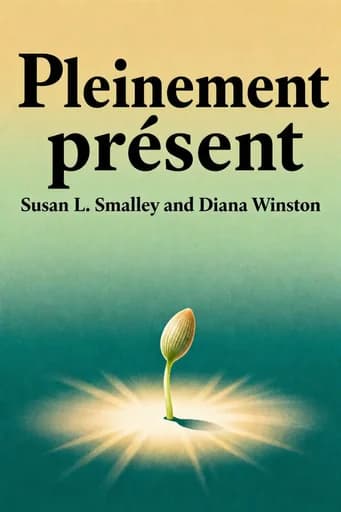
Discover the science and art of mindfulness with "Fully Present," the groundbreaking guide transforming workplace cultures and personal wellness practices nationwide. What if waiting in line became your most powerful mindfulness opportunity? Learn practical techniques that Fortune 500 companies now use to boost employee wellbeing.
Susan L. Smalley, PhD, and Diana Winston, co-authors of Fully Present: The Science, Art, and Practice of Mindfulness, are leading voices in secular mindfulness education. Smalley, a Professor Emerita of Psychiatry and founder of UCLA’s Mindful Awareness Research Center (MARC), bridges neuroscience and mindfulness, drawing from her anthropology background and decades of research on mental well-being. Winston, Director of UCLA Mindful and a former Buddhist nun, integrates contemplative traditions with modern practice, having taught mindfulness since 1993.
Their collaboration merges evidence-based science with accessible techniques for stress reduction, emotional regulation, and everyday awareness.
Winston’s The Little Book of Being further explores innate awareness, while Smalley’s work with the UCLA Bedari Kindness Institute amplifies her expertise in compassion-based research. Featured in The New York Times, LA Times, and academic programs worldwide, their frameworks power UCLA’s evidence-based Mindful Awareness Practices (MAPs) curriculum. Fully Present remains a cornerstone text for practitioners and educators, praised for its holistic approach to transforming mental health through mindful living.
Fully Present explores mindfulness as a science-backed tool to enhance well-being, blending research on brain-body impacts with practical meditation techniques. It teaches readers to apply mindfulness to everyday activities (like waiting in line or exercising) while explaining neuroplasticity and stress reduction. The second edition adds a new afterword updating key concepts.
This book suits beginners seeking an evidence-based introduction to mindfulness, stressed professionals aiming to improve focus, and therapists/educators wanting science-supported techniques. Its clear explanations of meditation’s biological effects make it valuable for skeptics and science enthusiasts alike.
Yes—it’s praised for balancing academic rigor with actionable steps, offering over 100 peer-reviewed insights from co-author Dr. Smalley’s UCLA research. The Library Journal calls it “one of the clearest introductions to mindfulness,” ideal for mastering stress management and emotional resilience.
Four pillars:
It details fMRI studies showing mindfulness shrinks the amygdala (fear center) and strengthens the prefrontal cortex (decision-making). For example, daily 10-minute meditations correlate with 14% cortisol reduction, per Smalley’s UCLA trials. Charts simplify neuroplasticity concepts for non-scientists.
While Tolle’s work focuses on spiritual philosophy, Fully Present emphasizes measurable outcomes—citing 23 clinical trials on anxiety reduction. It’s preferred by readers wanting structured practices over abstract ideas, though both stress present-moment awareness.
Some advanced practitioners find its exercises too basic, and the science-heavy sections may overwhelm casual readers. However, its 2022 update addresses gaps in digital-age mindfulness (e.g., tech distraction).
With 42% of U.S. adults reporting pandemic-induced anxiety (per CDC), its evidence-based coping strategies help address modern mental health crises. The afterword adds guidance for post-COVID resilience, making it a timely resource.
Drawing on her 100+ behavioral genetics studies at UCLA, Smalley decodes mindfulness’s DNA links—like how the 5-HTTLPR gene affects stress response malleability. This academic depth pairs with Diana Winston’s meditation-teaching expertise.
Smalley co-created UCLA’s Mindful Awareness Practices curriculum and authored 70+ Psychology Today articles on mindfulness-gender equality links. While Fully Present remains her flagship book, she’s contributed to journals like Nature Neuroscience on ADHD-mindfulness overlaps.
Ressentez le livre à travers la voix de l'auteur
Transformez les connaissances en idées captivantes et riches en exemples
Capturez les idées clés en un éclair pour un apprentissage rapide
Profitez du livre de manière ludique et engageante
Mindfulness illuminates our conceptual frameworks.
Mindfulness brings us back to what's actually happening right now.
We are creatures of habit, as science confirms.
The body serves as the gateway to mindfulness precisely because it always exists in the present moment.
Décomposez les idées clés de Fully present en points faciles à comprendre pour découvrir comment les équipes innovantes créent, collaborent et grandissent.
Découvrez Fully present à travers des récits vivants qui transforment les leçons d'innovation en moments mémorables et applicables.
Posez vos questions, choisissez votre style d’apprentissage et co-créez des idées qui vous correspondent vraiment.

Cree par des anciens de Columbia University a San Francisco
"Instead of endless scrolling, I just hit play on BeFreed. It saves me so much time."
"I never knew where to start with nonfiction—BeFreed’s book lists turned into podcasts gave me a clear path."
"Perfect balance between learning and entertainment. Finished ‘Thinking, Fast and Slow’ on my commute this week."
"Crazy how much I learned while walking the dog. BeFreed = small habits → big gains."
"Reading used to feel like a chore. Now it’s just part of my lifestyle."
"Feels effortless compared to reading. I’ve finished 6 books this month already."
"BeFreed turned my guilty doomscrolling into something that feels productive and inspiring."
"BeFreed turned my commute into learning time. 20-min podcasts are perfect for finishing books I never had time for."
"BeFreed replaced my podcast queue. Imagine Spotify for books — that’s it. 🙌"
"It is great for me to learn something from the book without reading it."
"The themed book list podcasts help me connect ideas across authors—like a guided audio journey."
"Makes me feel smarter every time before going to work"
Cree par des anciens de Columbia University a San Francisco

Obtenez le resume de Fully present en PDF ou EPUB gratuit. Imprimez-le ou lisez-le hors ligne a tout moment.
Imagine living in a world where your mind isn't constantly pulled between regrets of the past and anxieties about the future - where you can fully experience each moment as it unfolds. This is the promise of mindfulness, brilliantly explored in "Fully Present." In our hyper-connected yet paradoxically disconnected world, mindfulness offers a powerful antidote to the modern epidemic of distraction and anxiety. It's not just another self-help trend - it's a scientifically validated approach to living that bridges ancient contemplative traditions with cutting-edge neuroscience. As mindfulness practices gain mainstream acceptance (with over 14% of Americans now meditating regularly), we're witnessing a quiet revolution in how we relate to our minds, bodies, and each other.
Mindfulness exists in that fleeting moment of pure awareness before thinking begins - that instant when you simply perceive without judgment. While science can measure its effects, it cannot fully capture the lived experience, similar to how describing an apple's chemistry differs from tasting one. Research shows mindfulness as both a trait (stable individual differences) and a state (temporary condition). Brain imaging reveals trait mindfulness correlates with brain activity related to emotion regulation and attention. Regular practice creates measurable changes: stronger immune response, altered brain activity, increased gray matter in key regions, and modified gene expression. Most of us have experienced natural mindfulness - moments of full presence in nature, during creative activities, or in meaningful conversations. These experiences reveal our innate capacity for presence. In such moments, worries evaporate, senses awaken, and we feel deeply connected to ourselves and our surroundings. Mindfulness practice helps us access this natural state more consistently, transforming ordinary experiences into extraordinary ones through full attention.
Changing behavior is challenging because we're creatures of habit. Mindfulness reveals unconscious patterns that prevent change, creating space for choice - but developing mindfulness itself requires consistent practice. Four elements support successful practice: simple steps (starting with 5-10 minutes daily), a supportive environment, clear motivation, and repetition. Research shows attention changes can begin with just 20 minutes daily for five days, though benefits increase with more practice. Designate a quiet area and choose a time when you're most alert - many prefer mornings, while others meditate after work or during breaks. Our breath changes with emotions: shallow when anxious, deeper when relaxed. This vital process connects us to the world through oxygen exchange, yet we rarely notice it. Research shows breath patterns can accurately predict emotions. Breathing is central to mindfulness across cultures - even "spiritual" derives from the Latin word for "breathing." Recent studies show mindfulness practices can influence gene expression, with significant differences between longtime meditators and non-meditators. Like an anchor steadies a ship amid waves, the breath keeps our minds steady amid thoughts and emotions. When meditating, your mind will wander - this is normal. Consider this wandering as resistance training that builds your mindfulness "muscle." The key is returning attention to breath without self-criticism.
Your body is always in the present moment, even when your mind isn't. While thoughts time-travel to past and future, physical sensations exist only now. When you direct attention to bodily experience-the pressure of your feet, the weight of your hands-you automatically enter the present. Being mindful of your body means experiencing sensations directly rather than conceptually. True mindfulness involves experiencing sensations without stories or labels-noticing weight, pressure, tingling, or movement without judgment. Mindfulness transforms our often critical relationship with our bodies into one of kindness. We recognize self-critical thoughts as merely "stories" playing in our minds, not truths. By returning attention to physical sensations instead of judgments, we cultivate self-compassion. Beyond formal sitting practice, mindfulness integrates into daily life. Walking mindfully-feeling your footsteps and bodily sensations while moving-offers an accessible way to practice anywhere. The STOP practice (Stop, Take a breath, Observe what's happening, Proceed) provides a structure for remembering mindfulness throughout your day, helping you check in with your body regularly.

Have you noticed how focusing on pain often intensifies it? Over half of American adults suffer from chronic pain affecting their quality of life. While pain serves as our body's warning system, our relationship with it determines our suffering. Pain involves three systems: sensory discrimination (detecting stimuli), affective response (emotional reaction), and cognitive evaluation (thoughts about pain). Mindfulness alters these interactions by helping us observe what's actually happening rather than getting lost in our thoughts. By bringing curious attention to painful areas, we discover pain fluctuates rather than remaining constant. This insight alone can bring relief, as belief in pain's permanence often triggers fear and depression. Remember: "Pain is inevitable, but suffering is optional." Emotions evolved as physiological survival responses, with stronger neural connections flowing from emotional centers to thought centers than vice versa - explaining why logic often disappears during emotional arguments. Mindfulness helps us discern emotional states precisely, catching reactions before they escalate. The mindful approach involves recognizing emotions, feeling them fully, then letting them go - viewing emotions as "energy in motion" passing through us like weather patterns. RAIN provides a framework: Recognition (labeling your emotion), Acceptance (acknowledging emotions as natural), Investigation (attending to physical manifestations), and Non-identification (seeing emotions as temporary rather than defining you).

Harmonious relationships stem from mindful speaking and listening. Mindful speech is truthful, thoughtful, and unifying, reflecting our deeper values. Mindful listeners create understanding. Research shows this approach enhances learning, decision-making, and relationships while reducing conflict. Present-moment awareness cultivates wisdom and compassion that extend through our actions and relationships, helping us recognize our interconnectedness with others and the world. Initially, we experience only the "tip of the iceberg" of self-awareness. Through mindfulness practice, we uncover what drives our actions, gaining understanding and conscious choice. Eventually, we discover our fundamental interconnection with all beings and the planet - evident in DNA, ecosystems, interpersonal biology, and quantum physics.
Every increase in awareness requires letting go of past beliefs and habitual patterns. Through self-investigation, we develop intuitive understanding of awareness's infinite nature and our interconnectedness with all beings. In a world pulling us in countless directions, mindfulness brings us back to this moment - the only one we truly have. By cultivating present-moment awareness, we transform both our individual experience and our relationships with others. A more mindful society becomes kinder and more compassionate, beginning with each of us. Consistent practice develops our ability to experience difficult emotions without being overwhelmed - feeling anger without lashing out, fear without freezing, sadness without depression. This comes not from controlling emotions but from changing our relationship with them, creating space to respond wisely rather than react habitually. As mindfulness deepens, compassion naturally extends to ourselves and others. We recognize that harming others means harming ourselves. The ripple effects of individual practice extend beyond personal well-being to create positive change in families, workplaces, communities, and our shared world.