Chapitre 1
The Unfinished Symphony: Why We Abandon Our Goals and How to Change That
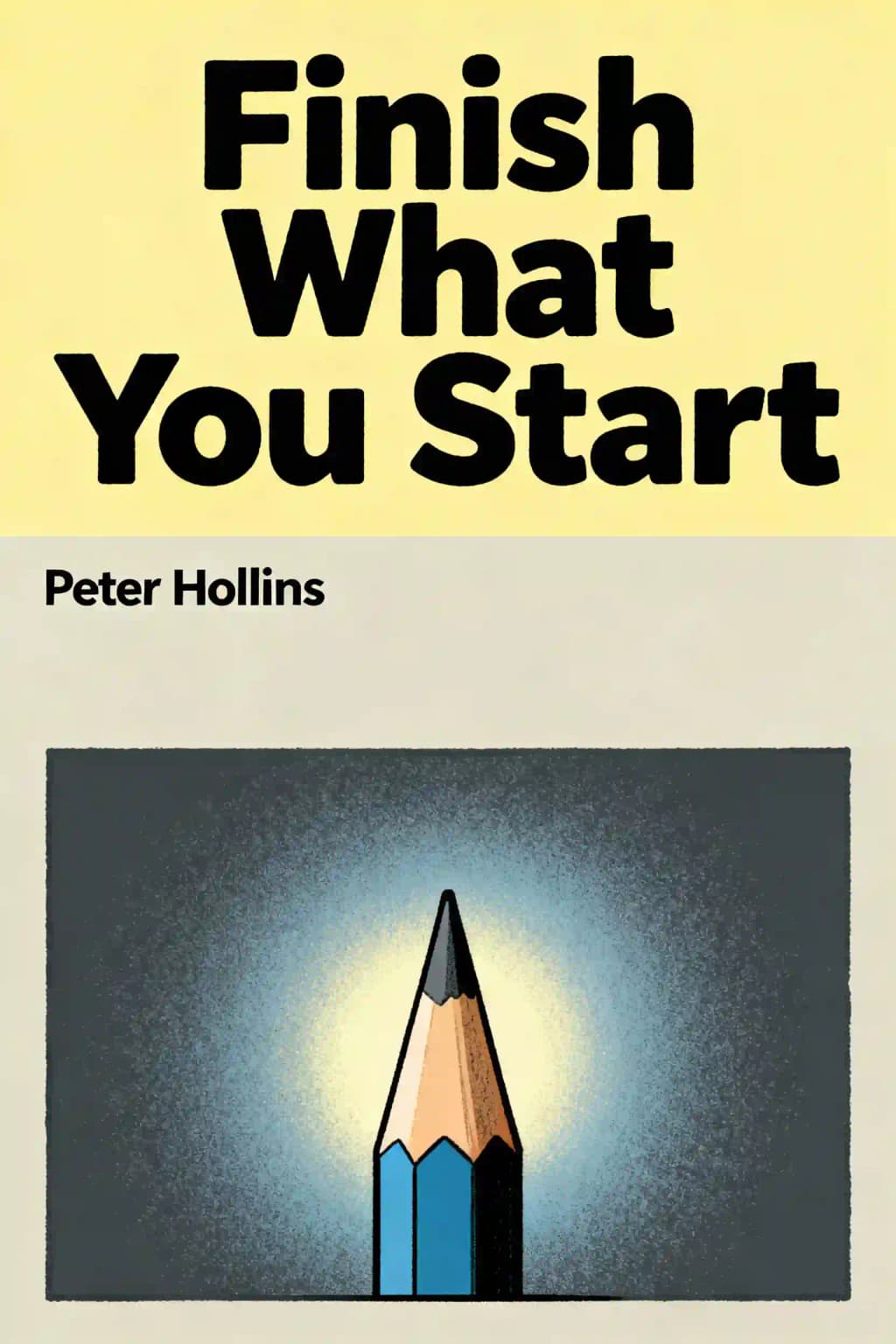
What if the difference between success and failure isn't talent or luck, but simply the ability to finish what you start? Peter Hollins' book "Finish What You Start" addresses the epidemic of abandoned projects, half-completed goals, and unrealized dreams that plague so many of us. This isn't just another productivity manual-it's a deep dive into the psychology of follow-through, backed by research and practical strategies that have transformed countless lives. The book has become a favorite among Silicon Valley executives and entrepreneurs like Tim Ferriss, who credits its principles for helping him complete his bestselling books. Beyond the business world, its techniques have been adopted by Olympic athletes and creative professionals who understand that consistent completion-not just brilliant beginnings-is the true marker of success. In a culture obsessed with starting new ventures, Hollins offers the refreshing counterpoint that finishing might actually be the most underrated skill of all.
Chapitre 2
The Four Pillars of Following Through
Following through isn't a single trait but a composite of four essential elements-like a Japanese anime robot formed from smaller individual parts. Each element corresponds to a body part in this metaphorical structure, working together to create the complete ability to finish what you start.
The head represents focus-the ability to direct your thoughts and actions toward a single goal, ensuring no effort is wasted. Without focus, you'll constantly shift between tasks, making minimal progress on many fronts rather than significant progress on what matters most.
The spine embodies self-discipline-the capacity to work when needed, even when you don't want to. This internal regulator keeps you on track despite temptations, distractions, or simple laziness. Self-discipline is what gets you to your desk when Netflix beckons.
The hands and feet symbolize action-the physical translation of intentions into real-world movement. Action is what takes you from Point A to Point B, turning abstract plans into concrete reality. Without action, even the most brilliant ideas remain trapped in your mind.
The heart represents persistence-the commitment to continue despite obstacles, setbacks, and the inevitable challenges that arise. Persistence keeps you firmly committed over time, refusing to abandon ship when the waters get rough.
Consider Esther, who dreamed of starting a home baking business. Despite taking two weeks off work to launch her venture, she became paralyzed by overthinking. She lacked focus to structure her time effectively, self-discipline to resist excessive leisure, action to begin the actual work, and persistence to push through initial challenges. Her business remained a fantasy because she couldn't follow through.
Why do we struggle so much with following through? Two primary culprits sabotage our efforts: inhibiting tactics and psychological roadblocks.
Inhibiting tactics include setting bad goals (too abstract or impossible), procrastination (delaying work until the last minute), succumbing to temptations and distractions, and poor time management. These self-sabotaging schemes misuse our time and effort, creating the illusion of productivity while preventing real progress.
Psychological roadblocks include laziness and lack of discipline, fear of judgment or failure, perfectionism stemming from insecurity, and lack of self-awareness about our true capacities. These internal mechanisms keep us trapped in comfortable inaction rather than risking the discomfort of growth.
The rewards of developing follow-through are substantial. You'll increase productivity, maximize opportunities, and realize your full potential. Your relationships improve as others learn they can rely on your word. Perhaps most valuable is the improved relationship with yourself-following through connects you intimately with your wants, needs, capacities, and fears, allowing you to take charge of your life rather than being enslaved by unconscious patterns.
Chapitre 3
Fueling Your Fire: The Science of Motivation
What drives us to finish what we start? While passion might ignite initial enthusiasm, it rarely sustains motivation through challenges. We need more reliable fuel sources-both external and internal.
External motivators use sources outside yourself to drive action. Accountability partners hold you responsible for commitments, creating external pressure to avoid disappointing them. Accountability groups prove even more effective by creating the possibility of "exponential shame" from multiple people. Financial investment creates motivation through the desire to avoid wasting resources-whether it's an expensive gym membership or hiring a coach. Self-bribery works by promising concrete rewards for completion, giving your present self something to look forward to.
These external motivations work primarily by helping you avoid pain-particularly negative social emotions like shame, guilt, or rejection. They push you away from consequences with fear rather than pulling you toward desired outcomes.
Internal motivators, by contrast, focus on what you want rather than what you're avoiding. These often prove more effective long-term because they tap into your deepest desires. To harness internal motivation, ask yourself revealing questions: What are you getting from this pursuit? How will your life change? How will your family benefit? What impact will you have on others? The more internal motivations you can articulate, the stronger your drive to finish.
Understanding opportunity cost is crucial for maintaining motivation. Following through always requires sacrifice-the time and effort that could go elsewhere. When opportunity costs feel too high, motivation falters. You can address this by either strengthening your motivation to outweigh the perceived costs or reducing the sacrifices required. Both approaches aim to tip the cost-benefit analysis in favor of completion.
Even the strongest motivators won't help if they're forgotten. Research from Psychological Science shows people follow through better when regularly exposed to motivational reminders. Katherine Milkman's research at the University of Pennsylvania demonstrated that visual cues significantly improved task completion-participants told to collect paperclips near a distinctive elephant statue remembered 74% of the time versus only 42% for those without the visual association.
The most effective reminders are distinctive and engage multiple senses. Rather than just posting sticky notes, create vivid, multi-sensory cues-perhaps a photo of your child in a frame scented with their shampoo to remind you of why you're working toward financial goals. Importantly, rotate and refresh these cues regularly so they don't fade into background noise.
Chapitre 4
Your Personal Rulebook: Creating a Follow-Through Manifesto
When faced with the choice between following through or giving up, having personal rules can eliminate the need for willpower by making decisions automatic. Mental models create a framework where the right decisions are already made for you, removing room for self-sabotage. A manifesto of personal rules serves as your guide at every fork in the road, pushing you in the right direction without depleting your limited willpower reserves.
Rule 1: Before giving up on any task, ask yourself: "If not for laziness or fear, would I be giving up?" This forces you to confront that you're not quitting due to lack of ability or talent, but simply taking the easy way out. When you face the uncomfortable truth that only fear or laziness stands between you and your goals, it becomes a powerful motivator to push through those barriers.
Rule 2: Focus on just three things per day-maximum. Being overwhelmed kills follow-through, so planning smartly means limiting your daily focus. Decide on your three priorities the night before so you can approach them logically rather than reacting emotionally. This rule requires learning to differentiate between truly important tasks versus merely urgent ones that create stress without priority.
Rule 3: Create a detailed code of conduct that establishes what you cannot do (limitations) and what you must do (requirements) each day. Write these down and post them visibly. Your rules should focus on creating either boundaries that prevent distraction or requirements that ensure progress. While you might not adhere perfectly to these rules every day, having five daily limitations and five reasonable requirements provides clarity and structure.
Rule 4: When facing the decision between quitting and persevering, reaffirm your intentions by asking three questions: "I want..." (stating your end goal and motivation), "I will..." (specifying the necessary actions), and "I won't..." (identifying behaviors that impede progress). Having these answers written down creates clarity and reinforces commitment.
Rule 5: When tempted to break discipline, ask yourself how you'll feel 10 minutes, 10 hours, and 10 days from now. This powerful technique forces you to connect with your future self who'll face the consequences of your current choices. At 10 minutes, pleasure might dominate with just a hint of shame; at 10 hours, regret typically takes over; at 10 days, you'll likely experience complete regret as the fleeting pleasure becomes meaningless.
Rule 6: When tempted by something harmful, wait just 10 minutes before giving in-often the urge passes or weakens. Similarly, when wanting to quit something beneficial, continue for just 10 more minutes. This removes the "immediate" from immediate gratification, building discipline incrementally. The beauty lies in its repeatability-once you've waited 10 minutes, you can always wait 10 more.
Together, these six rules form a practical system for maintaining discipline and ensuring follow-through, making decisions black and white rather than leaving room for rationalization and excuses.
Chapitre 5
The Mental Game: Mindsets That Ensure Completion
Follow-through is entirely mental, requiring cognitive effort especially when facing discouraging obstacles. A mindset-a set way of visualizing and approaching situations-can provide the will and motivation needed to persevere. Consider Gerald's story: despite entrepreneurial aspirations, his fear of discomfort and unwillingness to make sacrifices led him to abandon his dreams and settle for a job he hated simply because it felt comfortable. His refusal to adapt to discomfort or embrace the unknown prevented him from following through.
Mindset 1: It's Worthwhile. Three concepts drive perseverance: first, believing hard work leads to improvement-it's the essential prerequisite for success, not just luck. Second, having confidence that you belong and can thrive in your chosen environment-avoiding self-limiting beliefs that you're less capable than others. Third, understanding how your current actions connect to your larger goals-seeing the value in everything you do, even when gratification isn't immediate.
Mindset 2: Comfort with Discomfort. Success requires getting comfortable with discomfort, as following through inevitably involves unfamiliar territory. Many people avoid potential success simply to escape temporary discomfort-skipping extra work due to fatigue or avoiding networking because of nervousness. Deliberately stepping outside your comfort zone-learning new skills, meeting new people, practicing difficult actions until mastery-may feel uncomfortable but remains the only path to expanding your horizons and achieving meaningful success.
Mindset 3: Allow Learning. This mindset frames following through as a valuable learning opportunity. Giving up equals automatic failure, while finishing something allows you to evaluate your performance and gain crucial skills. You only truly learn certain lessons by seeing projects through to completion-otherwise, you miss the full picture of how things work. Even when you follow through and don't succeed, you gain invaluable knowledge about what doesn't work, which improves future attempts.
Mindset 4: De-Stress. Stress significantly undermines willpower and self-control. Research shows stressed individuals neglect healthy habits, struggle with emotional control, and abandon commitments. Combat this by dedicating at least 30 minutes daily to stress-reducing activities-meeting friends, reading, meditating, exercising-whatever helps you unwind. Particularly dangerous is "projection bias"-falsely assuming your current negative feelings will persist during future attempts to follow through, when in reality your emotional state constantly changes.
These four mindsets create the mental foundation necessary for consistent follow-through. They transform how you perceive challenges, making them opportunities rather than obstacles, and help you maintain momentum even when motivation wanes.
Chapitre 6
Breaking the Procrastination Cycle
Procrastination fundamentally stems from "time inconsistency"-humans valuing immediate gratification over long-term rewards. We essentially have two selves: a present self craving immediate rewards and a future self wanting long-term benefits. While planning for your future self is easy, only your present self can take action. Unfortunately, your present self prioritizes immediate rewards (like napping) over actions that benefit your future self (completing work projects).
Temptation bundling effectively combines present gratification with future benefits. Developed by behavioral economist Katy Milkman, this strategy involves pairing difficult but beneficial long-term behaviors with immediately pleasurable activities-like watching your favorite show only while exercising or enjoying chocolate only while working. Milkman's research found this approach motivated up to 51% of participants to exercise regularly, proving its effectiveness.
Another way to mitigate procrastination is breaking tasks into minuscule components. This makes the first step incredibly easy-which is crucial since taking that first step is the hardest part of overcoming procrastination. Think of procrastination as an enormous wall; collecting enough small pebbles eventually creates a step high enough to walk over it. Small increments involve two key parts: breaking tasks into manageable steps and starting with the easiest tasks first. While counterintuitive, tackling easy tasks first proves to your mind the task is possible, building momentum that makes harder tasks seem more attainable.
A final tactic is hypervigilance about what may go wrong-what Jim Collins calls "productive paranoia" in his book Great By Choice. Highly successful people like Bill Gates constantly plan for worst-case scenarios, which motivates them to work extremely hard to avoid these outcomes. Fear becomes a powerful motivator against procrastination, which thrives on boredom, complacency, and safety. Use this tactic sparingly though, as too much fear can drain and stress you.
Tackling procrastination is like pushing Sisyphus's stone-you can beat it back temporarily, but never fully eliminate it due to time inconsistency between our present and future selves. The key is finding strategies that work for your particular psychology and applying them consistently.
Chapitre 7
Creating Your Distraction-Free Zone
Contrary to popular belief, distractions undermine self-discipline rather than refresh it. Baba Shiv's Stanford study demonstrated this clearly: participants asked to remember a phone number chose chocolate cake over fruit 50% more often than undistracted participants. When distracted, we succumb to temptations without exercising willpower, choosing the path of least resistance.
To combat this, create a clean, distraction-free environment. A Cornell University study showed that simply placing temptations out of sight and reach significantly reduces consumption-participants ate fewer Hershey's Kisses when they were in opaque jars or placed six feet away. The principle "out of sight, out of mind" proves effective not by eliminating temptations completely, but by making them require more effort to access.
Most decision-making happens automatically, defaulting to whatever requires least effort. Leverage this default effect by structuring your environment to make disciplined choices easier than undisciplined ones. By placing unhealthy snacks out of sight and fruit in plain view, you instantly increase the probability of eating healthier. Putting a pull-up bar in your bathroom doorway makes exercise more automatic. These environmental changes save willpower by reducing clutter and distractions while optimizing choices based on the default effect.
When switching between tasks, your attention doesn't immediately follow-a residue remains stuck on the original task. Sophie Leroy's 2009 research "Why Is It So Hard to Do My Work?" demonstrates this effect clearly: people experiencing attention residue after switching tasks demonstrate poor performance on the next task. Stanford researcher Clifford Nass found that frequent multitaskers perform worse at filtering out irrelevant information and organizing their thoughts. The evidence is clear: multitasking isn't effective.
Singletasking means setting everything else aside and focusing solely on the current task. It requires purposefully tuning out all distractions-switching off notifications, ditching your phone, and keeping only one browser tab open at a time. For ideas that inevitably spring to mind during focused work, keep a Post-it nearby to quickly jot them down without breaking concentration.
Batching involves grouping similar tasks together to complete them efficiently. Take email management as an example. Constantly checking emails interrupts workflow and scatters focus. By batching emails-checking only at scheduled times like every two hours-you can maintain concentration on primary tasks without constant interruptions. Task-switching creates a mental burden, wasting energy and minutes regaining bearings each time. Batching allows you to stay in the same mindset, saving mental energy.
While everyone knows about to-do lists, the don't-do list is equally crucial. A don't-do list prevents energy dissipation on tasks that masquerade as priorities but actually undermine goals. Three categories belong on your don't-do list: tasks awaiting external input, tasks that don't add value, and tasks suffering from diminishing returns. By reducing the cognitive burden of tracking too many tasks, you free your mind to concentrate on what truly matters.
Colin Powell's 40-70 Rule suggests having between 40% and 70% of necessary information before taking action. Below 40%, you're shooting from the hip and likely to make errors. Above 70%, you risk analysis paralysis, missing opportunities while others move ahead. The 40-70 rule pushes you out of your comfort zone. While you need some preparation (40%), waiting for complete readiness (100%) guarantees inaction.
In our hyper-productive society, disconnecting completely can spark greater creativity and insight. Research by Professor Flavio Frohlich shows alpha waves enhance memory, creative thinking, and happiness-explaining why meditation features prominently in top performers' routines. Allowing your mind to wander without reaching for your phone creates space for the outlandish, creative daydreams that fuel innovation.
Chapitre 8
Avoiding the Fatal Traps of Follow-Through
Following through successfully means avoiding the deadly pitfalls that sabotage our progress. Like Michael, who expected his new freelance business to transform his life overnight, we often fall victim to unrealistic expectations and self-defeating patterns. The key is recognizing these pitfalls before they derail us completely.
False hope syndrome occurs when we drastically overestimate the changes we can make in our lives. We set unrealistic expectations about the speed, number, and ease of changes, then feel crushed by disappointment when reality doesn't match our fantasy. This disappointment creates a powerful backlash that often leaves us worse off than before we started. The solution isn't lowering our goals but adjusting our expectations to what's actually achievable, focusing on gradual progress rather than overnight transformation.
Overthinking masquerades as productivity but actually paralyzes us. When we consider too many options or research excessively, we fall victim to analysis paralysis. Barry Schwartz's "paradox of choice" shows that having more options actually increases anxiety and decreases our ability to decide. Like standing before a wall of printers at Walmart and becoming so overwhelmed that you either grab the first one you see or leave empty-handed, overthinking kills execution. The solution is to limit your choices, focus on a few key criteria, and take action-remembering that most decisions are reversible anyway.
Worry pulls us out of the present-where we have control-and fixates us on the future or past, where we have none. It makes us suffer twice: once during the worrying and again if the feared event actually happens. Worrying feels like preparation but is merely wasted motion, consuming energy that could be directed toward actual solutions. The antidote is focusing exclusively on what you can control in the present moment and adopting a mindset of action rather than fear.
Following through requires understanding your unique productivity style. Some thrive with detailed schedules while others need spontaneity; some need silence while others need social energy. When you work against your natural rhythms-like forcing yourself to be productive at 6 AM when you're naturally a night owl-you create unnecessary resistance. Beyond knowing your preferences, you must also diagnose why you're failing. Like Sherlock Holmes, deduce the true causes of your lack of follow-through rather than treating symptoms. Only by understanding the real source of your struggles can you apply the right solution.
Chapitre 9
Building Systems That Guarantee Results
Success requires more than just willpower-it demands systematic approaches that work even when motivation fails. Systems provide structure, consistency, and progress regardless of how you feel on any given day. Unlike goals which are singular achievements, systems are ongoing processes that carry you through multiple accomplishments and protect you from complete failure when you fall short of specific targets.
Tracking progress visually creates motivation by making you feel like you're winning. When people keep score, they perform better than when they're just practicing. Create a visible scoreboard by checking off completed tasks, celebrating small victories along the way, and establishing ultimate rewards for reaching major milestones. This system works because it transforms abstract progress into concrete achievements and creates friendly competition-even if only with your past performance.
Effective time management begins with establishing routines that dictate when specific tasks occur. Accurately assess how long activities truly take by timing yourself working at a comfortable, sustainable pace. Review daily tasks first thing each morning, account for appointments and business activities, and minimize distractions by focusing on one thing at a time. Set specific periods for recurring activities like checking emails rather than allowing them to interrupt your workflow throughout the day.
Every activity carries costs-whether monetary, emotional, or physical. Create systems that reduce the "costs" of productive behaviors while increasing the costs of unproductive ones. Make organization effortless through simple, inexpensive systems that save time and reduce stress. Conversely, make procrastination deliberately inconvenient by forcing yourself to climb stairs to engage in unproductive behaviors. The key is manipulating the effort equation: good habits should cost nothing while bad habits should cost a lot.
Gather everything you need for a project before starting to maintain momentum and eliminate interruptions. Find critical information and complete research in one go, allowing you to focus entirely on execution rather than resource-gathering. This preserves momentum-the state where completed goals build upon each other, making subsequent tasks easier. Before beginning, identify necessary team members, supplies, software, and even basic items like pens and paper. Additionally, identify potential obstacles beforehand to maintain team morale when challenges inevitably arise.
Chapitre 10
The Art of Consistent Completion
Following through is entirely mental, requiring specific mindsets: believing your work is worthwhile, becoming comfortable with discomfort, embracing completion as essential for learning, and recognizing how stress sabotages productivity. These mindsets create the foundation for consistent execution.
Procrastination stems from time inconsistency-our present self wants immediate gratification while our future self wants long-term rewards. Combat this through temptation bundling, starting with small steps to build momentum, and occasionally using productive paranoia as motivation.
Create a distraction-free environment by minimizing temptations and establishing default actions that lead to productivity. Embrace singletasking over multitasking, batch similar activities, and complement your to-do list with a don't-do list. Follow the 40-70 rule for decision-making, and schedule deliberate periods of doing nothing as essential mental recovery.
Avoid pitfalls like false hope syndrome (setting unrealistic expectations), overthinking (which paralyzes action), worrying (focusing on what you can't control), and working against your natural productivity style. Develop systems that provide structure and consistency: keep scoreboards to track progress, manage time effectively, lower transaction costs for productive behaviors, and gather all necessary resources before beginning work.
The ability to finish what you start isn't just a productivity hack-it's a life-changing skill that transforms potential into reality. By understanding the psychology of follow-through and implementing these practical strategies, you can bridge the gap between intention and completion, turning your dreams into accomplishments and your goals into achievements. The difference between those who succeed and those who merely dream isn't talent or luck-it's the consistent ability to follow through.