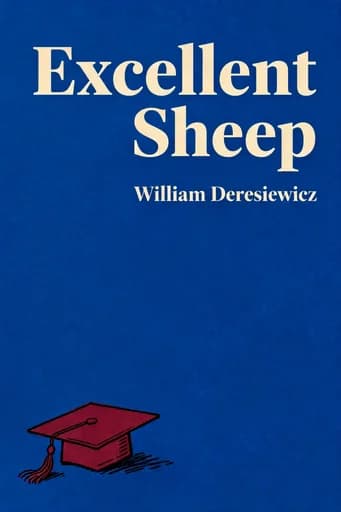
In "Excellent Sheep," Deresiewicz exposes how elite universities manufacture conformist achievers instead of independent thinkers. This controversial critique sparked nationwide debates about education's true purpose, challenging both parents and students to ask: Are prestigious credentials worth sacrificing authentic intellectual growth?
William Deresiewicz, bestselling author of Excellent Sheep: The Miseducation of the American Elite and the Way to a Meaningful Life, is an award-winning essayist and critic renowned for his incisive analysis of education, culture, and societal norms. A former English professor at Yale and Columbia universities, his work blends academic rigor with accessible critiques of elite institutions, informed by over a decade of teaching experience.
Deresiewicz’s expertise extends to themes of creativity and individuality, explored in his other notable works like The End of Solitude and The Death of the Artist, which examine the challenges facing modern creators.
Frequently featured in The New York Times, The Atlantic, and on platforms like The Colbert Report, Deresiewicz has cemented his role as a leading voice in cultural criticism. His essays, translated into 19 languages and anthologized in over 40 academic collections, reflect his ability to bridge scholarly insight with public discourse.
A three-time National Magazine Award nominee and recipient of the National Book Critics Circle’s Excellence in Reviewing citation, he also serves on boards for literary and educational organizations, including The Metropolitan Review and Tivnu: Building Justice. Excellent Sheep has become a cornerstone text in debates about education reform, solidifying Deresiewicz’s impact on contemporary thought.
Excellent Sheep critiques America’s elite education system, arguing it prioritizes credentials over intellectual curiosity, producing high-achieving but directionless students. Deresiewicz, a former Yale professor, exposes how Ivy League schools foster anxiety and conformity while neglecting self-discovery. The book advocates rethinking education’s purpose, emphasizing liberal arts and personal growth over transactional career prep.
Parents, educators, and students navigating elite colleges or questioning the education system’s pressures will find this book pivotal. It’s also vital for professionals in finance, consulting, or tech seeking to reassess their career choices. Deresiewicz’s insights resonate with anyone concerned about societal inequality and the loss of critical thinking in modern academia.
Key themes include:
Deresiewicz coins “excellent sheep” to describe elite students who excel academically but lack autonomy, blindly following societal expectations. The phrase originated from a student’s self-aware critique: “We’re all just, like, really excellent sheep?” It symbolizes the conflict between achievement and authenticity in hypercompetitive environments.
The book argues Ivies prioritize prestige and networking over education, creating a “conveyor belt” from affluent high schools to lucrative careers. Deresiewicz highlights how these institutions entrench inequality, admit legacy students over merit-based candidates, and fail to teach students to think critically or ethically.
He advocates:
Deresiewicz links rising anxiety and depression among students to relentless achievement pressure. He cites cases of burnout, perfectionism, and identity crises, arguing schools ignore emotional well-being while prioritizing grades and extracurriculars.
Some argue Deresiewicz overgeneralizes elite students’ experiences and underestimates systemic barriers to reform. Critics note his solutions (e.g., liberal arts focus) may not address economic realities driving vocational majors. Others contend he romanticizes past education models without acknowledging current complexities.
Both books dissect systemic flaws in elite institutions, but Excellent Sheep targets academia, while The Death of the Artist examines creative industries. Deresiewicz’s later work extends his critique of commodified success, showing parallels between education and cultural production under capitalism.
Notable lines include:
With AI reshaping careers and Gen Z questioning traditional success, the book’s critique of transactional education remains urgent. Its warnings about mental health and inequality align with current debates about student debt, remote learning, and corporate influence in academia.
The book urges parents to prioritize curiosity over rankings, resist “helicopter parenting,” and support unconventional paths. Deresiewicz advises fostering resilience and self-trust rather than pushing Ivy League admissions at all costs.
As a former Yale and Columbia professor, Deresiewicz combines academic rigor with firsthand experience of elite institutions’ flaws. His transition from insider to critic lends authenticity, while his essays in The Atlantic and NYT showcase his ability to translate complex ideas for broad audiences.
Ressentez le livre à travers la voix de l'auteur
Transformez les connaissances en idées captivantes et riches en exemples
Capturez les idées clés en un éclair pour un apprentissage rapide
Profitez du livre de manière ludique et engageante
We have a crisis of leadership in America because our elites are too good at following directions.
Students describe feeling like "machines with no life".
Each A is a temporary fix that quells anxiety.
The child becomes what parents need them to be.
They define themselves through superficial achievements.
Décomposez les idées clés de Excellent Sheep en points faciles à comprendre pour découvrir comment les équipes innovantes créent, collaborent et grandissent.
Condensez Excellent Sheep en indices de mémoire rapides mettant en évidence les principes clés de franchise, de travail d'équipe et de résilience créative.

Découvrez Excellent Sheep à travers des récits vivants qui transforment les leçons d'innovation en moments mémorables et applicables.
Posez n'importe quelle question, choisissez la voix et co-créez des idées qui résonnent vraiment avec vous.

Cree par des anciens de Columbia University a San Francisco
"Instead of endless scrolling, I just hit play on BeFreed. It saves me so much time."
"I never knew where to start with nonfiction—BeFreed’s book lists turned into podcasts gave me a clear path."
"Perfect balance between learning and entertainment. Finished ‘Thinking, Fast and Slow’ on my commute this week."
"Crazy how much I learned while walking the dog. BeFreed = small habits → big gains."
"Reading used to feel like a chore. Now it’s just part of my lifestyle."
"Feels effortless compared to reading. I’ve finished 6 books this month already."
"BeFreed turned my guilty doomscrolling into something that feels productive and inspiring."
"BeFreed turned my commute into learning time. 20-min podcasts are perfect for finishing books I never had time for."
"BeFreed replaced my podcast queue. Imagine Spotify for books — that’s it. 🙌"
"It is great for me to learn something from the book without reading it."
"The themed book list podcasts help me connect ideas across authors—like a guided audio journey."
"Makes me feel smarter every time before going to work"
Cree par des anciens de Columbia University a San Francisco

Obtenez le resume de Excellent Sheep en PDF ou EPUB gratuit. Imprimez-le ou lisez-le hors ligne a tout moment.
A Yale student once described himself and his peers as "excellent sheep"-brilliant, accomplished, and utterly lost. He'd aced every test, conquered every extracurricular, earned admission to one of the world's most prestigious universities. Yet something felt profoundly wrong. This wasn't just teenage angst or impostor syndrome. It was the recognition that he'd become exactly what the system demanded: flawless on paper, hollow inside. The phrase spread like wildfire across elite campuses because it named something everyone felt but few dared articulate. These weren't failures-they were success stories who'd discovered that success itself had become the problem.