Chapitre 1
The Call to Courage: Facing Our Fears and Finding Our Purpose
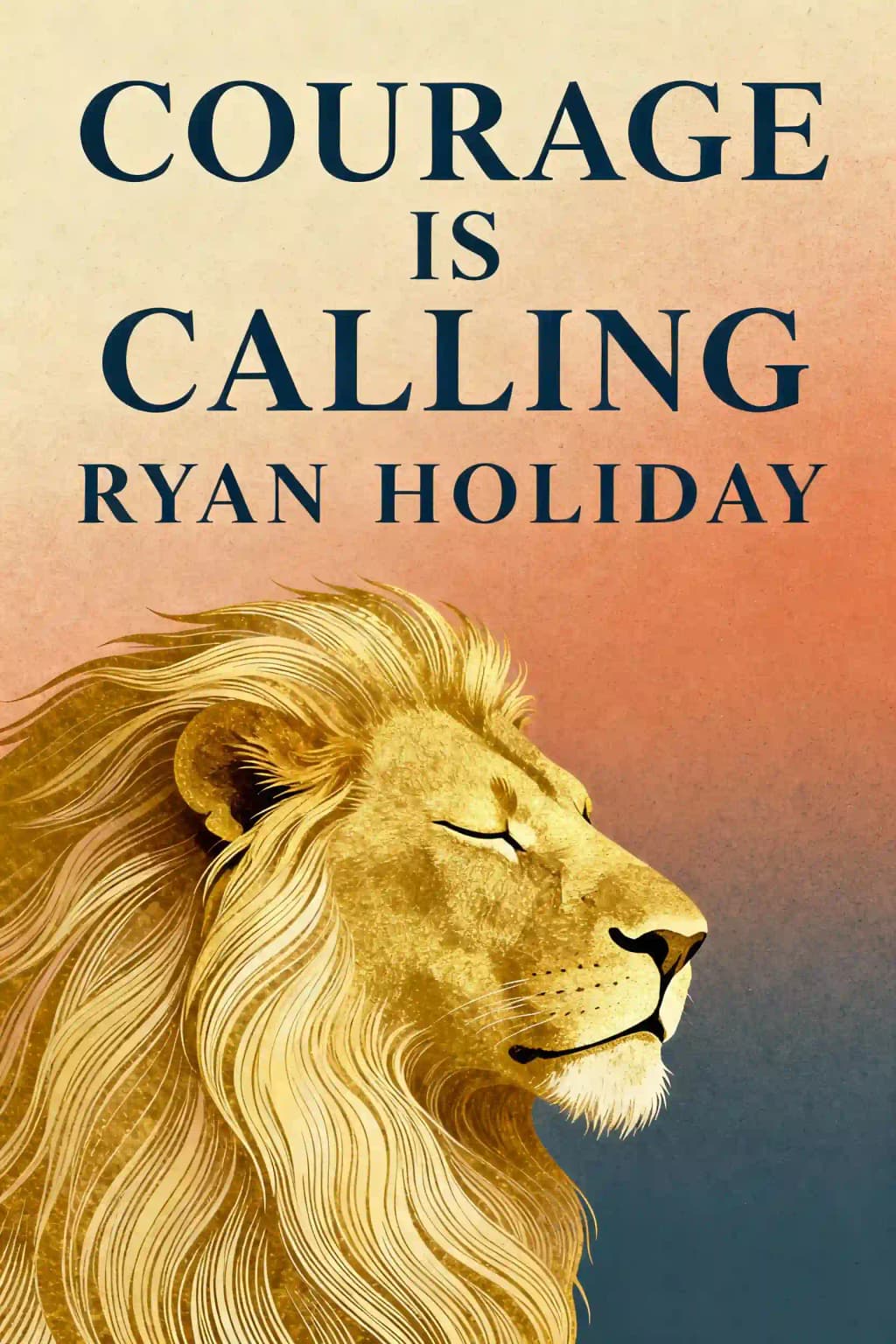
Ryan Holiday's "Courage Is Calling" has become a modern classic for those seeking to live more courageously in an increasingly fearful world. The book has resonated with everyone from business leaders to military commanders, with figures like General James Mattis praising its practical wisdom. As the first volume in Holiday's "Cardinal Virtues" series, it explores courage as the foundation upon which all other virtues stand. The book's popularity surged during the pandemic when many faced unprecedented challenges requiring newfound bravery. Drawing from ancient philosophy, particularly Stoicism, and illustrating with historical examples spanning from ancient Greece to modern America, Holiday presents courage not as an innate trait but as a skill we can develop through practice and commitment.
Chapitre 2
The Four Virtues: Our Moral Compass
Like Hercules at the crossroads, we face daily choices between the easy path and the right one. The ancient world recognized four cardinal virtues-Courage, Temperance, Justice, and Wisdom-as the foundation of a good life. These virtues function like a compass, guiding us through life's challenges from all directions, offering clear direction when modern life's complexities threaten to overwhelm us.
What makes these virtues so powerful is their universality and accessibility. They aren't reserved for the privileged few or those blessed with exceptional talents. Anyone, regardless of gender, physical strength, or intellectual capacity, can cultivate these virtues through practice and choice. A parent showing patience with a difficult child demonstrates temperance; a worker speaking up against unfair practices exhibits courage; a judge making an unpopular but fair ruling embodies justice; a student admitting ignorance and seeking to learn displays wisdom.
The word "cardinal" comes from the Latin "cardo," meaning "hinge"-these virtues are the pivotal points upon which a good life turns. They're interconnected yet distinct, each supporting and enhancing the others. Without courage, how could one maintain temperance when tempted, pursue justice when threatened, or seek wisdom when confused? Consider how justice requires both the wisdom to discern what's right and the courage to act on that knowledge, while temperance ensures our pursuit of justice doesn't become zealotry.
Aristotle emphasized that virtue isn't something we're born with but something we develop through action, like strengthening a muscle. We become courageous by doing courageous things, just as we become skilled at playing the piano through practice. Each time we choose virtue over vice, we strengthen our character and expand our capacity for future virtuous action. Small daily choices-like telling the truth when a lie would be easier, or standing up for someone being treated unfairly-gradually build our moral strength.
This ancient wisdom offers a refreshing alternative to modern self-help approaches that often focus on quick fixes or surface-level changes. While contemporary advice might emphasize techniques for stress management or career advancement, the cardinal virtues address the fundamental question of character. They provide a comprehensive framework for living well that has stood the test of time across cultures and centuries, from ancient Greece to modern boardrooms. They remind us that excellence isn't just about what we achieve but who we become through our choices and actions.
The practice of these virtues creates a positive feedback loop: as we act virtuously, we develop better judgment, which leads to better choices, which in turn strengthens our character. This transformation isn't just personal-it ripples outward, influencing our families, workplaces, and communities. In a world often focused on external metrics of success, the cardinal virtues redirect our attention to the internal qualities that make life truly worthwhile.
Chapitre 3
Why Courage Remains Rare in an Age of Abundance
Nothing is more universally admired than courage, yet nothing seems in shorter supply today. Unlike material resources that can be depleted, courage is infinitely renewable-available to each of us at any moment. So why does it remain so rare? In an era of unprecedented safety and comfort, our capacity for brave action seems paradoxically diminished, even as opportunities for meaningful change multiply.
We tell ourselves comforting lies: that now isn't the right time, that someone else will handle it, that courage is only for soldiers or activists. We convince ourselves that our small acts of bravery don't matter in the grand scheme. The modern workplace exemplifies this pattern - employees witness unethical behavior but remain silent, fearing career repercussions. Whistleblowers like Edward Snowden and Frances Haugen demonstrate how isolated voices can spark global conversations about privacy and social responsibility, yet such examples remain exceptional rather than routine.
Physical and moral courage are fundamentally the same-both require putting yourself at risk. Whether facing bodily harm or social ostracism, courage demands sacrifice and commitment. It means doing what others cannot or will not do. Consider Rosa Parks, whose famous bus protest wasn't a spontaneous act but the culmination of decades of smaller brave choices. She had spent years as an NAACP secretary, documenting civil rights violations and facing daily threats. Or Winston Churchill, whose political career featured countless moments where he chose principle over popularity, including his lonely voice warning about Nazi Germany when appeasement was the popular stance.
Courage calls to each of us differently but always from within. First, we're challenged to rise above our fears; next, to demonstrate bravery against overwhelming odds; and finally, to achieve heroism by risking ourselves for others. This progression isn't linear - sometimes small acts require more courage than grand gestures. A teenager standing up to bullies, a worker challenging toxic corporate culture, or a citizen confronting local corruption all demonstrate how everyday courage shapes our collective future. In a world often marked by ugliness and cruelty, courage creates moments of transcendent beauty.
The rarity of courage doesn't stem from its scarcity but from our reluctance to answer its call. We hesitate, rationalize, and wait for perfect conditions that never arrive. Modern life's emphasis on security and comfort can make courage seem unnecessary or foolish. Social media amplifies our fear of judgment while simultaneously showing us countless examples of courage from around the world. Yet courage remains available to anyone willing to choose it-a renewable resource waiting to be tapped by those who understand its power to transform both individual lives and the world around us. Each act of courage, no matter how small, creates ripples that inspire others and gradually reshape our social fabric.
Chapitre 4
Understanding Fear: The Enemy of Courage
What makes courage so rare? Fear-in all its manifestations-is the primary obstacle. The ancient Spartans built temples to fear not to worship it but to study it closely, to understand its power, and ultimately to master it. This approach reveals a crucial truth: the brave aren't fearless; they're distinguished by their ability to act despite their fears.
Florence Nightingale's journey illustrates this battle perfectly. For sixteen years, she struggled with her calling to nursing, paralyzed by her wealthy family's disapproval and Victorian society's expectations. Her parents weaponized emotion-her mother wept at her ambitions while her father raged. Despite knowing about the terrible health conditions of her time, where hospitals often increased mortality and thousands of soldiers died needlessly from disease, she initially let fear win.
Only after years of internal conflict did she finally declare, "I must take some things... they will not be given to me." Within a year, she was transforming field hospitals in Crimea under horrific conditions. Her triumph over fear enabled pioneering work that would revolutionize healthcare forever.
The Stoics distinguished between momentary fear (phantasiai-immediate, precognitive impressions) and letting fear become our state of being. As Faulkner put it, "Be scared. You can't help that. But don't be afraid." When Roosevelt faced the Great Depression, he recognized fear itself as the primary enemy that would only worsen the situation.
At the root of most fear is concern about others' opinions-a paralyzing worry that distorts reality. The paradox is that almost everything impressive or right was accomplished despite loud objections from the status quo. As Cicero advised, "Let other people worry over what they will say about you. They will say it in any case."
Our fears remain powerful because they're undefined-vague shadows without specifics. The Stoic practice of "fear setting" involves deliberately articulating our nightmares. By expecting and wrestling with what might happen, we make it less scary. When fear is defined, it can be defeated; when downside is articulated, it can be weighed against upside.
Perhaps most importantly, we must recognize that agency is an effective truth-believing you have no power makes it so. When Peter Thiel was outed by Gawker, powerful friends told him nothing could be done. Accepting this lack of agency became what Thiel calls "an effective truth." Fear determines what seems possible, but we always have a choice between asking, "What is going to happen to me?" and "What action am I going to take?"
Chapitre 5
Practical Steps to Overcome Fear
How do we practically overcome the fears that hold us back? First, we must attack fear logically, clearly, and empathetically. As Pericles told Athenians during war and plague, bravery means calmly breaking down what's before us to "learn the meaning of what is sweet in life and what is terrible, and then go out, undeterred, to meet what is to come."
The catastrophizing voice in our heads consistently underestimates our ability to handle challenges. We must investigate the facts and see what's really there-not what our fear hopes we'll see. As Ulysses S. Grant discovered throughout his military career, "There are always more of them before they are counted." Our obstacles, enemies, and critics are rarely as numerous as our minds make them seem.
When facing difficulties, focus on what's immediately in front of you rather than catastrophizing about all possible outcomes. Canadian astronaut Chris Hadfield, when suddenly blinded during a spacewalk, concentrated on the specific actions that could improve his situation. All energy spent fearing is energy not spent making things better.
We must also recognize that all worthwhile growth requires risk-a leap into the unknown. Reed Hastings had to risk his DVD-by-mail business to capture streaming's potential. The coward waits for certainty that never comes, while opportunity passes. As Florence Nightingale said, "Rather ten times, die in the surf, heralding the way to a new world, than stand idly on the shore."
Fear often points directly toward what we should do. When Theodore Roosevelt hesitated before inviting Booker T. Washington to dine at the White House in 1901, this very hesitation made him "ashamed" and compelled him forward. When something makes you hesitate-when you ask "what will people think?"-it often signals exactly what needs doing.
Perhaps most challenging is the courage to be yourself. Despite our unique DNA and experiences, fear drives us to conform rather than stand out. As Seneca advised, we don't need to rebel against everything-but internally, we must remain true to ourselves. The courage to be different enables us to see what others miss.
Finally, remember that asking for help takes strength, not weakness. As Marcus Aurelius wrote, "Don't be ashamed to need help. Like a soldier storming a wall, you have a mission to accomplish. And if you've been wounded and you need a comrade to pull you up? So what?" Sometimes the ask itself is the breakthrough that changes everything.
Chapitre 6
Answering the Call: The Path to Courage
Courage means managing and triumphing over fear-taking ownership when others have resigned themselves to fate. We can curse the darkness or light a candle; wait for rescue or save ourselves. Every hero faces this choice at their moment of truth.
Charles de Gaulle exemplifies this principle. As France fell to Germany in 1940, de Gaulle-a recently promoted brigadier general-fled to England, feeling "alone and deprived of everything." With no army, money, or authority, he broadcast on BBC: "I tell you nothing is lost for France!" Despite thirty assassination attempts against him and his equally courageous family, de Gaulle never wavered. He inspired the French Resistance of some 400,000 people who sabotaged occupiers and gathered intelligence. His courage proved contagious. After four long years, when Paris was liberated in August 1944, de Gaulle marched down the Champs-Elysees with more than a million French compatriots, having "acted alone until he was no longer alone."
Courage often requires just seconds of bravery: hitting send on an email, speaking up, volunteering, making a difficult decision. When presidential candidate John F. Kennedy called both the Georgia governor and Coretta Scott King after Martin Luther King Jr.'s arrest in 1960-while Nixon hesitated-these brief moments of courage won Kennedy the presidency by a razor-thin margin.
We can't merely hope to be brave when it matters; we must cultivate courage daily. By doing small scary things regularly-taking cold showers, speaking to difficult audiences, trying new experiences-we train ourselves to act courageously when the stakes are high. As William James wrote, we must "make our nervous system our ally instead of our enemy" through habit.
When facing adversity, remember Epictetus's advice: "This is what I've trained for, for this is my discipline." Preparation builds confidence, and confidence leads to courage. We must train before challenges come so that when they do, our training kicks in rather than our fear.
The French concept of petites actions applies to tackling enormous problems-start with small first steps that build momentum. Break down big problems by focusing on the piece in front of you. As Lincoln said, "He who does something at the head of one regiment will eclipse him who does nothing at the head of a hundred."
Finally, remember that courage is contagious. One person who knows what they're doing and isn't afraid can reinforce an entire army or calm widespread chaos. As the saying goes, "One man with courage makes a majority." Your courage will inevitably spread to others around you, transforming not just your own life but the lives of those around you.
Chapitre 7
The Courage to Stand Your Ground
True courage often means refusing to back down when principles are at stake. Frederick Douglass demonstrated this when, at seventeen, he fought back against his brutal overseer Edward Covey, battling him for two hours despite knowing that striking a white man meant death. This act of defiance transformed Douglass: "It was a glorious resurrection, from the tomb of slavery, to the heaven of freedom."
The seed of this courage had been planted years earlier when eight-year-old Douglass witnessed a slave named Nelly fiercely resisting punishment. After standing his ground against Covey, Douglass adopted the motto "You can kill me but you can't whip me," and was never whipped again. As Martin Luther King Jr. later said, "When we straighten our backs, we might be beaten-but we can't be ridden."
This principle applies beyond physical confrontation. When Roman senator Helvidius Priscus was commanded by Emperor Vespasian not to appear in the Senate, he refused to be intimidated. "It is in your power not to allow me to be a member of the senate," he replied, "but so long as I am, I must go in." Even when threatened with death, Helvidius maintained his integrity.
Commander Jeremiah Denton demonstrated similar defiance when forced to participate in a North Vietnamese propaganda broadcast. While answering questions, he blinked T-O-R-T-U-R-E in Morse code, using his captors' own platform against them. A Stoic says "Fuck you" to fate-they resist, they fight, they will not be made to do wrong under pressure.
Sometimes physical courage must protect moral courage. After testifying against corrupt NYPD officers, Frank Serpico faced intimidation from a fellow officer who threatened him with a switchblade. Instead of backing down, Serpico seized the man, pinned him down, and placed his loaded gun against the man's head, making it clear he wouldn't be intimidated. While such confrontations aren't ideal, sometimes they're necessary. Even Gandhi acknowledged: "Where there is only a choice between cowardice and violence, I would advise violence."
The courage to stand your ground also means owning your decisions. The commanders who ordered the disastrous charge of the Light Brigade could face enemy bullets but fled from criticism and blame. True courage means signing your name to everything you do. As Joan Didion observed, "The willingness to accept responsibility for one's own life is the source from which self-respect springs."
Finally, courage sometimes means the courage to leave-whether it's quitting dead-end jobs, abandoning failed projects, or walking away from unhealthy relationships. As Socrates discussed with Laches, courage isn't blind endurance but knowing when to stay and when to go.
Chapitre 8
The Highest Form of Courage: Heroism
If courage means putting yourself on the line, heroism means risking yourself FOR someone else or some larger cause. The Stoics called this "greatness of soul" (Megalopsuchia). As de Gaulle defined grandeur: "The road one takes to surpass oneself."
The 300 Spartans at Thermopylae exemplify this heroic spirit. When Xerxes attempted to bribe them, Leonidas declared, "For me to die for Greece is better than to be the sole ruler over the people of my race." Their sacrifice bought Greece critical time, shook Xerxes's confidence, and inspired their countrymen to resist. Their heroism wasn't mere courage but love-for each other, their country, and freedom itself.
True heroism springs from love, not defiance for its own sake. POW James Stockdale demonstrated this when he slashed his face to avoid being used for propaganda, then later slit his wrists to end the torture of his fellow prisoners. "This idea is you are your brother's keeper," Stockdale said, "That's the flip side of 'What's in it for me?'" The POWs' motto wasn't "United States" but "Unity over Self"-the foundation of heroic action.
Heroes elevate those around them. Florence Nightingale didn't just endure deprivation-she raised others from what was low. The Spartans at Thermopylae made Greece bigger through their sacrifice. De Gaulle willed France to stand tall at her lowest point. Heroes take what they have in surplus-courage, compassion, wisdom-and spread it to those who need it.
In moments of crisis, heroes don't hesitate-they act immediately without overthinking. Marines Jonathan Yale and Jordan Haerter, who had just met, stepped forward in unison to face an oncoming truck bomber while others fled. In just six seconds, they made their decision, raised weapons, fired, and gave their lives to save countless others. As General Kelly noted: "Not enough time to think about their families, their country, their flag... but more than enough time for two very brave young men to do their duty into eternity."
What elevates courage to heroism is purpose beyond personal achievement. Maya Moore exemplifies this distinction, walking away from basketball stardom at her peak-not for money or rest, but to free a man unjustly imprisoned (whom she later married). David Brooks calls this the "second mountain"-a purpose beyond personal achievement that drives truly heroic action.
Perhaps the bravest act is maintaining hope despite overwhelming evidence to abandon it. John Lewis, beaten unconscious for using a "Whites Only" waiting room and arrested 45 times during the civil rights movement, still found the capacity to forgive his attacker decades later. Anne Frank, hiding from Nazis, wrote of "work, love, courage and hope." This isn't naive optimism about quick solutions, but the deeper hope that sustained figures like Shackleton and de Gaulle through seemingly impossible circumstances.
Chapitre 9
The Personal Journey: From Fear to Courage
Courage isn't just one virtue-it's the backbone of all virtues. As C.S. Lewis wrote, it's "the form of every virtue at the testing point." Without courage, temperance, justice, and wisdom become impossible when challenged. Character becomes fate because what we believe determines what we'll do when tested.
True courage isn't about being unbreakable-it's about getting back up when broken. Hemingway wrote that "the world breaks every one and afterward many are strong at the broken places." Like kintsugi, the Japanese art of repairing broken pottery with gold, heroes transform their scars into something beautiful.
The author reflects on his own moral failings while working at American Apparel under controversial CEO Dov Charney. He compares himself to Seneca who wrote beautifully about courage while working for Nero. The experience taught him that failing to make hard decisions as circumstances change is cowardice. He describes how "lack of agency is contagious" at American Apparel, where employees passively watched Charney's behavior without taking action.
Later, when writing for the New York Observer, he refused to back down from publishing anti-Trump pieces despite pressure and threats. This experience taught him to listen to his inner voice and prioritize truth over popularity. He acknowledges that courage isn't just for battlefields but for everyday ethical decisions.
As Steinbeck noted in East of Eden, the Hebrew "timshel" ("thou mayest") captures our responsibility-we choose between cowardice and courage. The world wants to know: Can you be brave? Who and what will you be brave for? We repay the sacrifices of those who came before us by adding our own courageous acts to their legacy.
In the end, courage is both a personal virtue and a gift to others. It's something we cultivate within ourselves but ultimately express through our actions in the world. By facing our fears, answering our calling, standing our ground when necessary, and sometimes risking everything for something greater than ourselves, we not only transform our own lives but contribute to the ongoing human story of courage in the face of adversity.