Chapitre 1
When Death Becomes More Than a Diagnosis
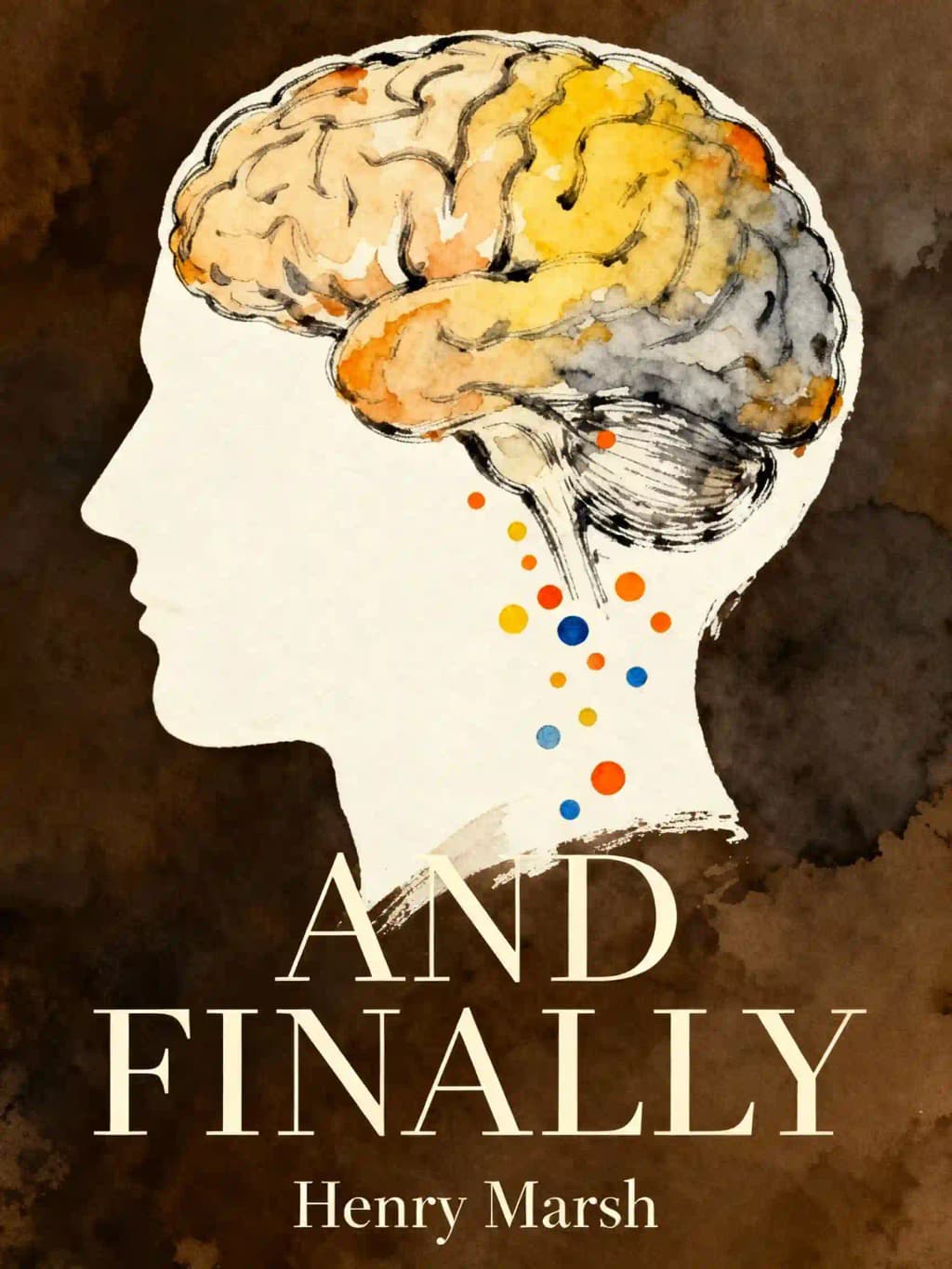
Henry Marsh's memoir "And Finally" arrives like a thunderclap in the medical literature landscape-a rare glimpse into what happens when the surgeon becomes the patient. Oprah Winfrey called it "a profound meditation on mortality that will change how you think about life itself," while The Guardian hailed it as "the most honest doctor's memoir you'll ever read." As a neurosurgeon who spent four decades witnessing suffering and death, Marsh now faces his own mortality with unflinching clarity after a prostate cancer diagnosis. The book has resonated deeply with healthcare professionals and patients alike, becoming a bestseller that bridges the gap between medical expertise and human vulnerability. In a culture that often avoids discussions of death, Marsh's willingness to confront it head-on has made this work particularly relevant in our post-pandemic world, where mortality has moved from abstract concept to lived reality for many.
Chapitre 2
The Shock of Becoming the Patient
For forty years, Henry Marsh inhabited the world of medicine as a neurosurgeon, living among fear, suffering, and death without truly considering what it would feel like when his turn came. Despite his medical background, his first confrontation with his own mortality came not through his cancer diagnosis but through a seemingly innocent brain scan he volunteered for out of curiosity and vanity.
When he finally viewed the scan months later, what he saw devastated him-his seventy-year-old brain appeared shrunken and withered, with ominous white spots indicating ischemic damage. He was staring at his own decay, death foretold in clinical images. The medical literature confirmed these white-matter changes were common with age, associated with stroke risk and possibly dementia. Though maintaining a "healthy lifestyle" might reduce dementia risk somewhat, no one escapes aging's effects.
The brain scan revealed a truth Marsh had long known professionally but never internalized personally: as we age, our brains physically shrink, eventually resembling shriveled walnuts. Yet remarkably, we feel we're still ourselves, unaware how much we've changed. With patients, he had routinely downplayed these changes, telling cheerful white lies regardless of reality. "Your brain looks very good for your age," he would say, understanding that hope remains among medicine's most precious medicines.
Twenty months after this initial confrontation with mortality through his brain scan, Marsh received his prostate cancer diagnosis. Despite experiencing worsening symptoms for years, he had delayed seeking help-thinking illness happened to patients, not doctors. What he had considered stoicism was actually fear, and his diagnosis shattered the deep-seated denial that had protected him throughout his medical career.
The symbolic power of mortality had long been part of his life-he had kept a human skull in his study for years, imitating Durer's famous painting. He had found it discarded when his hospital relocated, an old teaching specimen with practice burr holes. Yet after his cancer diagnosis, he no longer found this memento mori amusing and gave it away to a colleague for teaching. The abstract reminder of death had become too painfully concrete.
Chapitre 3
The Mystery of Consciousness and Aging
Throughout his career, Marsh witnessed how our understanding of the brain has evolved through metaphors reflecting the technology of each era. Early anatomists named brain parts after fruits and nuts. While Hippocrates placed the brain at the center of thought, Aristotle saw it merely as a blood cooler. As science progressed, metaphors shifted-from Descartes' hydraulic mechanisms to 19th century steam engines and telephone exchanges, to Freud's hydraulic language of repression, and finally to today's computer comparisons.
Yet all these metaphors ultimately fail to capture the brain's true nature. When struggling to rise in the morning, Marsh imagines his conscious self as a submarine surfacing on a deep ocean, deluding himself that he's steering when actually moved by currents and winds. But even this metaphor fails-his conscious and unconscious selves aren't separate entities but composed of the same 86 billion nerve cells.
The numbers describing the brain's complexity are as incomprehensible as astronomical distances-86 billion neurons with 125 trillion synapses, connected by 500,000 kilometers of "wiring." A cubic millimeter of cerebral cortex contains 100,000 nerve cells and a billion synapses. Each neuron functions as an input/output device with dendrites receiving signals and axons sending them, connecting to thousands of others and firing at variable rates. Adding to this complexity are 85 billion glial cells, once thought mere padding but now known to be crucial to brain function.
From this extraordinary dance of cells emerges thought, feeling, color, sound, pain, pleasure-and our sense of self. Yet science has no explanation for how these experiences arise from identical physical processes. As his brain shrinks with age, Marsh takes some comfort in knowing that mental abilities aren't solely determined by cell count. Babies have more synapses than adults, with development involving "synaptic pruning" as the brain is sculpted by experience, removing unused connections.
Watching his energetic granddaughters learning effortlessly, he envies their neural plasticity while he struggles with math lessons from his retired teacher neighbor. The contrast between their developing brains and his aging one becomes a poignant reminder of life's cycle.
Chapitre 4
The Pandemic, Memory, and Mortality
When the COVID-19 pandemic began, Marsh's diary shows he first mentioned coronavirus on February 23, 2020, exactly one month before England's lockdown. His initial concern focused on his wife Kate, who takes immunosuppressants for Crohn's disease. Like many, he oscillated between dismissal and panic-much as he would later do with his cancer diagnosis.
The lockdown itself brought an otherworldly experience-perfect spring weather, silent streets, clear skies filled with stars and birdsong-creating a sense of both sanctuary and profound loss. Looking at his home and garden, he felt the weight of mortality, knowing he would eventually leave it all behind as he moved toward old age and death. The unnaturally fine weather reminded him that nature was out of joint, foreshadowing worse to come.
In retirement, memories of former patients began appearing unexpectedly, like illuminated capitals in plain text. He recalled an Ecuadorian botanist with an incurable brain tumor who sent photographs of his beloved rainforest before eventually dying. After his cancer diagnosis, even more patient memories surfaced-some from thirty years prior-becoming reproachful ghosts. He realized how many patients must have felt anxious and abandoned, feelings he'd often overlooked in his career, and wished he could start again with greater compassion.
As a doctor, true empathy would make the work impossible-you'd feel everything your patients felt. Instead, you practice limited compassion without losing humanity. Worse than detachment is complacency, which leads to accepting bad results and stopping self-improvement. In meetings, "group think" often prevailed as mistakes got brushed aside. Even after retiring, attending Mortality meetings as the "wise old man" became difficult once he was a patient himself with his own ominous brain scan.
The simplest way to limit empathy is dividing people into "Us and Them." Marsh recalled being distressed as a medical student watching patients being demonstrated like specimens, particularly a young ex-soldier with an inoperable spinal tumor. After his cancer diagnosis, he dreamed of reconciling with their old family dog he'd once tormented-both of them now old, with bladder problems, approaching death. He woke feeling peaceful, wondering if acknowledging his neglect of patients might somehow save him.
Chapitre 5
The Art of Healing Spaces
Hospitals are fundamentally disempowering places that emphasize the gap between staff and patients. Marsh never truly understood this until meeting his anthropologist wife Kate, who pointed out how hospitals deny patients peace, rest, and dignity. The word "hospital" derives from Latin "hospes" meaning guest-originally charitable refuges in monasteries where religious services were as important as medical treatment.
Florence Nightingale revolutionized hospital design in the 19th century with tall ceilings and high windows based on the miasmatic theory of infection. Marsh's old workplace, Atkinson Morley's Hospital, was built on this human scale-just three stories high with fewer than 200 staff whom he all knew personally, creating a sense of belonging and tribal connection that made them efficient and responsible. When they moved to a massive new building, that intimacy was lost.
Throughout his career, Marsh fought to improve the sterile environment by creating healing gardens on previously forbidden balconies, installing landscape photographs, and making spaces more humane. Most hospitals remain horrible environments because enhancements aren't planned from the beginning, managers see hospitals as machines rather than healing spaces, and patients are treated as an underclass despite all the notices claiming dignity and respect.
This understanding became painfully personal when Marsh entered the Royal Marsden cancer hospital as a patient-a place where he'd once delivered lectures and sent his own patients. The hospital corridors were the typical bright, windowless passages found in all hospitals, with pathetic "Art" and admonitory notices on spotlessly clean walls. Yet he found unexpected beauty in the scanning department's wonderful skylight looking out onto rain-slicked roofs-a pleasantly philosophical waiting experience despite being surrounded by patients ravaged by chemotherapy and disease.
Chapitre 6
Facing the Cancer Diagnosis
Despite having prostatic symptoms for years-poor flow, urgency, and frequency-Marsh had postponed seeing a doctor until after lockdown. When he finally visited a private urologist, cycling to Harley Street while drinking water for the flow test, his colleague found his prostate "a little firm" and persuaded him to have a PSA test, though Marsh insisted he wouldn't want treatment unless necessary.
The PSA came back shockingly high at 127 (most cancer cases are below 20), with internet searches telling him most men with such high levels die within years. Walking six miles to the Royal Marsden cancer hospital afterward, he felt surprisingly sympathetic toward others rather than envious of their seemingly carefree lives. He told himself comforting stories that his high PSA was from cycling, but deep down knew better.
At the Marsden, after being weighed, measured (discovering he'd lost two inches in height), and performing another humiliating urine flow test, Marsh met his oncologist. The opening words-"Let me start by saying how sorry I am that we are meeting like this"-filled him with foreboding. The oncologist explained he would fast-track scans and estimated a 70% probability the cancer had already spread. When Marsh asked about cycling's effect on PSA, the doctor dismissed his hope: "You would have to bicycle a hundred miles on a very bumpy road to raise it by maybe one."
Marsh struggled with the dual role of being both doctor and patient, asking the oncologist to speak to him as a colleague while simultaneously wanting reassurance. When he asked about five-year survival chances, the doctor avoided percentages, saying merely "You needn't write your will for five years" and joking that if Marsh wrote one book yearly, he'd complete five more.
This interaction highlighted how patients want certainty while doctors can only offer probabilities-something Marsh had navigated himself when treating brain cancer patients, telling them they might be "unusually lucky" or "unusually unlucky" rather than giving stark percentages. When the consultation ended, Marsh mistakenly thought he would meet the rest of the team. Instead, he glimpsed the oncologist laughing with colleagues through an open door while a nurse dismissed him: "You can go." He realized he had crossed to the other side-just another old man with prostate cancer-with no right to expect special treatment.
Chapitre 7
The Emotional Journey Through Treatment
Facing his potentially terminal diagnosis, Marsh cycled through textbook stages of grief-though he never asked "Why me?" knowing as a doctor the simple answer was "Why not?" He experienced wild emotional swings-from lying awake longing to die just to end the fear of dying, to finding moments of acceptance. At seventy, he recognized his life was in many ways complete: his children were independent adults, he had three beloved granddaughters, and he'd enjoyed extraordinary privileges of education, travel and professional success.
To cope, he alternated between therapeutic projects-building a dollhouse, painting postcards of fairy tales for his granddaughters-and what his wife Kate calls "therapeutic catastrophizing," imagining worst-case scenarios in vivid detail. After an agonizing two-week wait for scan results (resolved only when he enlisted a colleague's help), the oncologist finally informed him there was no metastatic spread, offering a 90% chance of success with treatment, though cautioning about risk factors like his high PSA.
The treatment for his prostate cancer involved chemical castration through LHRH agonists that trick the brain into stopping testosterone production. This creates a complex hormonal cascade that ultimately halts testosterone production, shrinking prostate tumors by starving them of the hormone. Yet the cancer doesn't die-through Darwinian evolution, cells that don't require testosterone flourish while testosterone-dependent cells wither. When PSA levels rise again, the patient has developed "castrate-resistant prostate cancer," requiring chemotherapy which only temporarily slows progression.
The side effects of castration are numerous: breast development, weight gain around the waist, loss of body hair, impotence, decreased libido, muscle loss, osteoporosis. After a year of treatment, Marsh disliked seeing his eunuch-like body in the mirror. Many side effects are non-specific-headaches, fatigue, constipation-making patients vulnerable to the nocebo effect, feeling worse because they expect to. Depression is listed too, but as Marsh notes, who wouldn't be depressed facing castration and possible death?
Surprisingly, he didn't miss his libido or erections, almost glad to be free from them considering the adolescent misery and midlife madness they caused. Yet they also brought his greatest joy-having a family. When a sympathetic nurse checked his symptoms during radiotherapy, he joked the world would be better if all middle-aged men were on ADT. Yet without testosterone, he wouldn't have met Kate after his first marriage ended-she transformed his life and made him a better person.
Chapitre 8
The Right to Die with Dignity
During the first COVID lockdown, Marsh read Defoe's "Diary of the Plague Year," which describes people dying in both physical and spiritual agony. Unlike Defoe's contemporaries and most opponents of Assisted Dying, he doesn't believe in any afterlife or posthumous punishment. Scientific medicine has brought tremendous benefits but also a curse: dying has become prolonged, often in hospitals among strangers, with little dignity or autonomy.
Prostate cancer typically spreads to bones, causing severe pain and potentially paralysis if it reaches the spine. As a neurosurgeon, Marsh operated on many such cases-surgery doesn't prolong life but can preserve mobility. The decision-making is complex: operating while patients can still walk is worthwhile if they'll live at least six months, but useless once they're completely paralyzed. He remembers telling one seventy-year-old man, already completely paralyzed, that he would never regain independence.
After his cancer diagnosis, Marsh became desperate imagining his potential death. He has a "suicide kit" but worried it might fail, so he asked a doctor friend to help him when the time comes. Unlike most people, as a doctor he has access to an easier death than permitted by UK law. The current situation forces people into violent suicides or expensive trips to Swiss clinics like Dignitas.
Despite 80% public support, assisted dying legislation was defeated in Parliament in 2015. Opponents argue it would lead to vulnerable people being pressured into suicide-a hypothetical argument unsupported by evidence from countries where it's legal. The safeguards in those countries require independent verification that the person has mental capacity, isn't depressed, knows alternatives, and isn't being coerced. Assisted dying should be seen as part of palliative care, not opposed to it.
If patients can choose painkilling treatment that might hasten death, why can't they choose treatment that brings death swiftly? Critics point to the Netherlands as a "slippery slope," but the slight increase in assisted deaths there hasn't been replicated elsewhere-it's a matter of legal safeguards and cultural differences.
The dementia problem presents a particular challenge-assisted dying requires mental capacity, which dementia patients lose. Though the Netherlands allows advance directives for dementia cases, few doctors will implement them. Marsh wants this option for himself but recognizes the ethical complexity.
He finds it illogical that religious opponents of assisted dying believe in an afterlife yet oppose hastening the journey there. The claim that dying is "transcendent" seems distasteful-any transcendence is more likely experienced by witnesses than the dying. Our fear of death makes it difficult to see dying as a practical problem with legal solutions rather than something divinely ordained. Helping someone to a peaceful, chosen death is an act of care and love, not encouragement to die.
Chapitre 9
Legacy, Stories, and the Future
After completing radiotherapy, Marsh returned to the neurosurgical department where he'd been senior surgeon-not to treat patients but to teach. With his overseas work in Nepal, Ukraine and Albania halted by COVID, he was growing bored and finding it difficult to get out of bed in the mornings. Teaching the next generation of surgeons has always been integral to his identity as a surgeon. He takes more pride in the successful careers of surgeons he's trained than in his own patients-it's a privilege to be part of this tradition, where everything builds on the work of countless predecessors.
But returning has cost him his former detachment. When cases of old men with progressive paralysis from prostate cancer are presented, he feels sickening dread, knowing someday his name will be on those scans.
During COVID lockdowns, Marsh began telling bedtime stories to his three granddaughters via FaceTime and Zoom-a practice he's continued for years. His stories feature a Ukrainian girl named Olesya who lives with her Ukrainian aunt in England. In Olesya's bedroom is a magic door that opens only under a full moon at midnight, creating a moonlit pathway across her oak floorboards.
The door opens to Fairy Land, where Olesya embarks on various adventures-defeating an evil rain witch with magical tools from helpful animals, building bridges using engineering principles, and rescuing magical creatures. These stories evolved from simple quests to more complex narratives involving law, revolution, and technology. Though he missed opportunities to introduce concepts like natural selection, the stories served their purpose-entertaining his granddaughters while exploring imagination and narrative, which neuroscience suggests is fundamental to how humans construct reality.
A year after his cancer diagnosis, Marsh has joined what he calls the "underclass" of patients with treatable but likely incurable disease, living from scan to scan. Given his age, nothing has truly changed-he's approaching life's end regardless, though he struggles with his biological optimism that somehow death will be avoided.
If he must die from cancer rather than dementia (which he fears more), he hopes assisted dying becomes legal in time. Like many his age, he worries about the climate-ravaged world his granddaughters will inherit, though we must remain optimistic to avoid the worst outcomes.
Looking at a 1929 photograph of his mother and her siblings that hangs in his kitchen, he reflects on their unknown futures-his aunt becoming a Nazi, his uncle a Luftwaffe pilot, his mother a dissident who fled to England. Reading her memoir recently filled him with longing to speak with her again, understanding too late her survivor's guilt after escaping the Gestapo.
Only in old age does he understand himself and his past. We're like boats our parents launch, circling the world only to return to our starting harbor after they're gone. When physicists speak of "block time"-past, present and future existing simultaneously-he feels this profoundly as he faces his own mortality while gazing into his young mother's eyes in that photograph.
Chapitre 10
Finding Hope Beyond Cancer
Six months after completing his grueling radiotherapy regimen, Marsh received the news he'd been cautiously hoping for - his PSA levels had dropped dramatically to 0.1, the lowest measurable level. While his friends and family celebrated this as a definitive victory, Marsh's medical training left him clear-eyed about the statistics: a 75% probability of recurrence within five years. Though modern chemotherapy protocols could potentially extend his life significantly, he remained acutely aware of the uncertainty ahead. The momentary relief of his improved health markers was quickly overshadowed by global events that would reshape his perspective on both mortality and purpose.
Just ten days after receiving his encouraging medical news, Putin's forces invaded Ukraine, abruptly shifting Marsh's personal anxiety from his cancer prognosis to the fate of his beloved second home. Having spent three decades working in Ukraine's hospitals, training surgeons, and building deep friendships, the country had become an integral part of his identity and purpose. His daily calls to colleagues and friends in Lviv and Kyiv became a ritual, each conversation punctuated by the haunting sound of air-raid sirens. These calls brought back vivid memories of his mother's stories from World War II, creating a poignant parallel between generations facing the upheaval of war.
Despite the devastating impact on their lives, Marsh's Ukrainian friends displayed remarkable resilience, mirroring the same spirit he'd witnessed in his mother's generation. Their determination strengthened his own resolve to maintain hope and continue his work there, embodying his firm belief that surrendering to despair would only allow evil to prevail. He began making concrete plans for his return, viewing it not just as a personal goal but as an act of resistance against the darkness of both war and his own mortality.
This final chapter of Marsh's journey reveals a profound evolution in his relationship with death and purpose. His memoir transcends the typical narrative of a medical professional facing illness, instead offering a deeper meditation on finding meaning in life's most challenging circumstances. Whether he's meticulously crafting dollhouses for his granddaughters - each tiny detail a labor of love and legacy - or mentoring the next generation of neurosurgeons, Marsh demonstrates that purpose can flourish even in the shadow of mortality. His continued engagement with Ukraine, despite both personal and global uncertainties, exemplifies his core message: our impact extends far beyond our professional achievements or personal accomplishments.
The wisdom distilled from his experience suggests that true legacy lies not in the operations performed or the accolades received, but in the ripple effects of our connections - the stories we share, the wisdom we pass on, and the love we invest in others. These elements, Marsh concludes, are what truly survive us, living on in the memories and actions of those whose lives we've touched. His journey from feared surgeon to vulnerable patient to purposeful mentor illustrates that embracing our mortality might be the key to living more fully and meaningfully in whatever time we have.