Chapitre 1
Gods Among Us: The Mythic Landscape of America
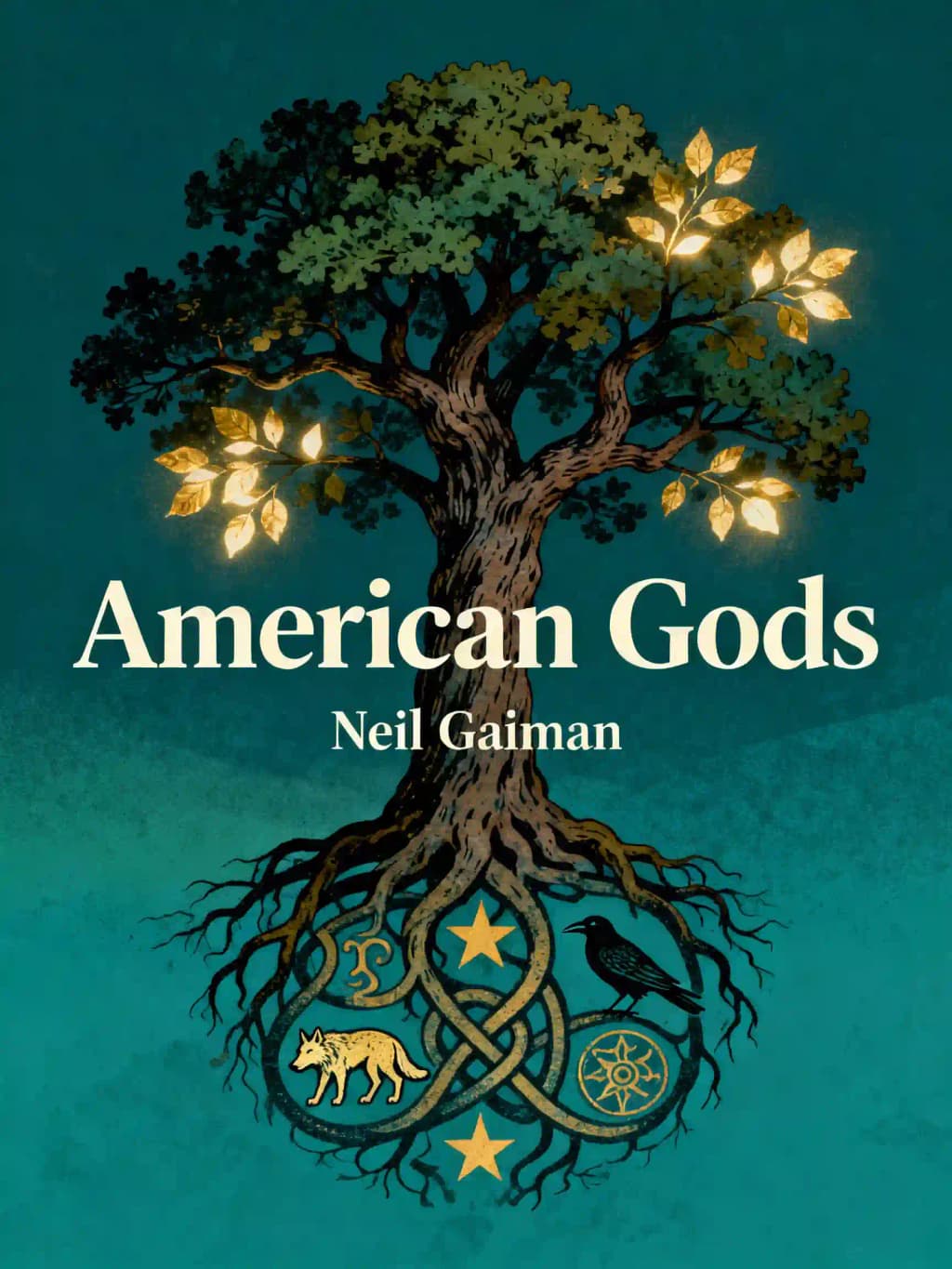
Neil Gaiman's "American Gods" isn't just another fantasy novel-it's a cultural phenomenon that has captivated readers worldwide since its publication in 2001. The book has collected an impressive array of literary honors including the Hugo, Nebula, Locus, and Bram Stoker Awards, cementing its status as a modern classic. Its popularity transcended traditional literary circles when it became the inaugural selection for "One Book, One Twitter" in 2010, uniting readers globally in conversation. Even the famously silent Teller (of Penn & Teller) broke his characteristic muteness to describe the novel as "sexy, thrilling, dark, funny and poetic." The book's cultural impact continues to grow, with HBO developing a television adaptation following the success of "Game of Thrones"-promising to bring Gaiman's unique vision of gods walking among us to an even wider audience.
Chapitre 2
The Shadow of Imprisonment: A Hero's Reluctant Beginning
Shadow Moon emerges from prison only to face devastating news-his wife Laura has died in a car accident. The timing couldn't be worse, just days before his scheduled release after serving three years for assault and robbery. His last days in prison are marked by unsettling dreams of thunderstorms and a growing sense of unease that seems to permeate the prison walls. As he travels home for the funeral through America's heartland, he encounters a mysterious, charismatic man who calls himself Mr. Wednesday. This enigmatic figure, with his glass eye and sharp wit, offers Shadow a job as his bodyguard and assistant, displaying an uncanny knowledge of Shadow's past and present circumstances. The job offer, made first on a plane and then sealed in a bar called Jack's Crocodile Bar, sets in motion a journey that will change Shadow's understanding of reality forever.
What makes Shadow such a compelling protagonist is his stoic acceptance of the increasingly bizarre events unfolding around him. He's a man who learned patience and restraint during his imprisonment, spending countless hours exercising both his body and mind, reading books from the prison library, and perfecting coin tricks. These qualities serve him well as he's thrust into a world where gods walk among mortals. His quiet strength and moral compass become his defining characteristics, even as the boundaries between the natural and supernatural blur around him. Despite witnessing impossible events - from coins pulled from thin air to resurrections - Shadow maintains a grounded perspective that makes the fantastic elements of the story more believable.
The early chapters establish a profound sense of loss and displacement. Shadow has lost not only his freedom but also his wife Laura and the future he had planned, including the job his best friend Robbie promised him at the gym. This emotional vacuum, amplified by the discovery of Laura's infidelity with Robbie himself, creates the perfect conditions for him to be drawn into Wednesday's mysterious agenda. There's a palpable emptiness to Shadow's existence that mirrors the hollowed-out spirituality of America itself-a theme that reverberates throughout the novel. His rootlessness reflects a larger American disconnection from traditional beliefs and cultural heritage.
Shadow's skills as a coin magician, learned during long prison hours, serve as both character detail and metaphor. His ability to make coins appear and disappear, particularly his mastery of the difficult "coin walk" across his knuckles, foreshadows his eventual role in a much larger sleight of hand. The coins also connect to ancient traditions of leaving coins for the dead, bridging modern practices with ancient beliefs in a way that encapsulates the novel's central concerns. His first trick for Wednesday, pulling a gold coin from nowhere, becomes particularly significant when we later learn about the role of belief and sacrifice in the world of gods. The silver Liberty dollar he receives from Wednesday becomes more than just payment - it becomes a talisman of protection and a symbol of the old ways persisting in modern America.
Chapitre 3
Old Gods in a New World: Divinity in Decline
The central conceit of "American Gods" is as brilliant as it is simple: gods exist because people believe in them. When immigrants came to America, they brought their deities with them-Odin, Anansi, Bast, Anubis, and countless others. But as belief in these ancient gods waned, they found themselves diminished, working mundane jobs and living ordinary lives among humans who no longer recognize them. This decline mirrors the real-world erosion of traditional beliefs in an increasingly secular and technological society.
Gaiman's portrayal of these fallen deities is masterful and multifaceted. Mr. Wednesday is actually Odin, the All-Father from Norse mythology, now reduced to running cons and gathering allies for one final battle. His character retains traces of the wisdom and cunning associated with his mythological origins, but these traits have been twisted into something darker and more desperate. Czernobog, once a feared Slavic god of darkness, works in a slaughterhouse, finding a grim echo of his former sacrificial rites in his daily labor. The Queen of Sheba has become Bilquis, a prostitute who literally consumes her clients in an act of worship, transforming ancient sacred sexuality into a means of survival. Mad Sweeney, once a proud Irish king and god, has devolved into a tall, drunken leprechaun obsessed with his lost golden coin. Each god retains echoes of their former glory while adapting to survive in a world that has largely forgotten them.
What makes these characters so compelling is their very human struggle with irrelevance. They face the same existential crisis many of us confront in our lives-the fear of becoming obsolete, of being replaced by something new. Their divine nature makes this struggle all the more poignant; these are beings who once commanded sacrifices and temples, now scraping by on the margins of society. The gods' diminishment is reflected in their physical appearances and circumstances: Odin's suit is shabby, Technical Boy's acne betrays his youth, and Media speaks through the cold glass of television screens.
The novel explores how these gods adapted to American soil, often transforming in the process. This speaks to the immigrant experience itself-the necessity of reinvention while maintaining connections to one's origins. Through these gods, Gaiman examines America's complex relationship with its immigrant heritage, showing how cultural traditions both persist and transform across generations. The gods serve as metaphors for the immigrant experience: some adapt and find new ways to survive, others cling desperately to old ways, while others fade away entirely, forgotten by their descendants who have embraced new American identities.
This theme extends beyond just the old gods to encompass the new American deities that have risen to replace them: Media, Technical Boy, and the god of globalization, Mr. World. These new gods represent America's modern obsessions-technology, celebrity culture, and global capitalism-highlighting how worship has not disappeared but rather shifted to new objects of devotion. The contrast between old and new gods creates a rich commentary on how societies evolve and what they choose to venerate.
Chapitre 4
New Gods Rising: Technology as Divinity
As the old gods fade, new deities have risen to take their place-gods of media, technology, globalization, and the digital age. These new gods manifest as the Technical Boy, a petulant digital deity; Media, who appears through television screens; and Mr. World, the personification of globalization. Unlike their ancient counterparts, these gods enjoy the fervent worship of modern Americans who sacrifice their time, attention, and identity to technology and entertainment. Their temples are smartphones and shopping malls, their prayers are clicks and shares, their offerings are personal data and screen time.
The Technical Boy, with his limousine that's bigger on the inside than the outside, represents the arrogance of technological progress. He's perpetually updating himself, shifting from a fat teenager surrounded by wires to a vaping, Silicon Valley-style tech prophet, dismissing the old gods as obsolete while failing to recognize the impermanence of his own position. His followers worship through coding, gaming, and endless software updates, treating each new technological advancement as a sacred revelation. Media appears as various television personalities - from Lucille Ball to David Bowie - seducing viewers through the screen and feeding on their attention. She promises intimacy through isolation, connection through screens, transforming passive consumption into a form of devotion. Mr. World embodies the homogenizing force of globalization, seeking to erase uniqueness in favor of universal sameness, turning local cultures into franchises and traditional markets into chain stores.
Gaiman brilliantly captures our modern devotion to these new forces through precise, familiar rituals. We check our phones hundreds of times daily-a form of prayer, each notification a call to worship. We structure our lives around television schedules and social media feeds-a type of ritual observance that shapes our daily routines more powerfully than any traditional religious practice. We surrender personal information to corporations-a kind of sacrifice that feeds these digital deities with data about our preferences, movements, and relationships. The novel asks us to consider what we've lost in this transition from old beliefs to new ones, from community gatherings to solitary scrolling, from shared stories to algorithmic feeds.
The conflict between old and new gods reflects real tensions in American society: rural versus urban, tradition versus progress, diversity versus homogeneity. The new gods promise connection but deliver isolation; they offer information but not wisdom; they provide entertainment but not fulfillment. Their power comes not from genuine devotion but from habit and addiction-a shallow form of worship that Gaiman suggests may ultimately prove unsustainable. As these gods battle for America's soul, they reveal the cost of our technological devotion: the loss of human connection, the erosion of cultural identity, and the transformation of sacred experiences into commodified transactions. The novel suggests that while we may have gained convenience and instantaneous gratification, we've sacrificed deeper forms of meaning and community that sustained previous generations.
Chapitre 5
Lakeside's Secrets: Small-Town America's Dark Heart
Midway through the novel, Shadow takes refuge in the seemingly idyllic town of Lakeside, Wisconsin. This picturesque community appears to be everything small-town America aspires to be-friendly neighbors, local businesses thriving despite economic downturns elsewhere, and a strong sense of community. The town's apparent immunity to the economic hardships affecting surrounding communities immediately strikes Shadow as peculiar, though he initially dismisses his suspicions in favor of the warmth and welcome he receives.
Gaiman masterfully uses Lakeside to explore the duality of American small-town life. The surface charm is meticulously detailed-the ice fishing contests that bring the community together, the carefully maintained historic buildings on Main Street, the community raffles that everyone participates in with enthusiasm, and the local diner where Chad Mulligan, the police chief, ensures every newcomer feels welcome. This facade of perfection, however, masks a terrible secret that becomes more sinister as layers of the town's history are peeled away. Each year, like clockwork, a child disappears during the coldest part of winter, a sacrifice to ensure the town's prosperity-a pattern so normalized that the townspeople have developed elaborate coping mechanisms to avoid confronting the truth.
The character of Hinzelmann emerges as the novel's most complex representation of this duality. As the town's beloved old-timer who regales visitors with historical tales and maintains the klunker car raffle, he initially appears to be the quintessential small-town character. His transformation into something far more sinister-an ancient kobold maintaining Lakeside's prosperity through centuries of human sacrifice-serves as a devastating revelation. His stories, once charming, take on a sinister edge as readers realize they're part of a carefully constructed mythology designed to conceal centuries of ritualistic murder.
Shadow's investigation into the disappearance of Alison McGovern becomes the thread that unravels Lakeside's carefully maintained illusion. Through careful observation and his unique outsider's perspective, he notices patterns the townspeople have learned to ignore: the mysterious klunker raffle, the way people avoid discussing certain topics, and the strange fact that missing children are never found. The discovery that these children's bodies are hidden in cars beneath the frozen lake's surface-preserved in winter and swallowed by the depths when spring arrives-creates a horrifying metaphor for buried truths.
This storyline serves as a powerful metaphor for the sacrifices demanded by the American dream, particularly in small communities struggling to maintain their identity in a changing world. The town's prosperity, maintained through unthinkable means, reflects darker aspects of American history-the exploitation and sacrifice of the vulnerable to maintain the comfort of the majority. Through Lakeside, Gaiman suggests that beneath America's most cherished ideals often lies a foundation of suffering that communities collectively choose not to acknowledge, raising uncomfortable questions about the true cost of prosperity and the moral compromises we make to maintain our preferred versions of reality.
Chapitre 6
The Coming Storm: Gathering for Ragnarok
As Shadow travels across America with Wednesday, they recruit old gods for an impending conflict with the new deities. This journey becomes a road trip through America's hidden spiritual landscape, revealing sacred places that exist alongside highways and tourist attractions. From the House on the Rock with its impossible carousel to the Center of America, these locations serve as nexus points where the divine and mundane intersect.
The gathering of gods for this final battle draws on the Norse concept of Ragnarok-the twilight of the gods where divine forces clash in a world-ending conflict. Wednesday frames the coming battle as an existential necessity: fight or fade away completely. His recruitment speeches appeal to the gods' pride and their desire for relevance in a world that has moved on without them.
Gaiman populates this journey with gods from dozens of traditions. We meet Czernobog with his blood-stained sledgehammer; Mr. Nancy (Anansi), the African trickster spider god; Easter, whose holiday has been co-opted by Christianity; and many others. Each represents a different facet of America's immigrant heritage and the spiritual traditions that came with those immigrants.
The road trip structure allows Gaiman to explore America's vastness and diversity. From frozen northern towns to southern backroads, from bustling cities to forgotten rural communities, Shadow and Wednesday traverse a landscape that is both familiar and strange. America itself becomes a character-young, powerful, and constantly reinventing itself, sometimes at the expense of its own history.
This section of the novel emphasizes the transient nature of American identity. Gods rise and fall, towns boom and bust, people arrive and depart. The only constant is change itself, a perpetual becoming that defines the American experience. Through this lens, the conflict between old and new gods isn't just about divinity-it's about America's ongoing struggle to define itself.
Chapitre 7
Behind the Curtain: The Great Con
The novel's central twist reveals that the conflict between old and new gods is actually an elaborate con orchestrated by Wednesday (Odin) and Loki (who appears as Mr. World). They've engineered the confrontation not to determine which pantheon will survive, but to feed on the power generated by divine sacrifice. The battle at Rock City isn't meant to crown a victor but to create a bloodbath that will empower Odin and Loki at the expense of both old and new gods.
This revelation transforms our understanding of the entire narrative. Wednesday isn't fighting to preserve tradition against the encroachment of modernity-he's exploiting both sides for personal gain. His apparent nobility masks a ruthless pragmatism. Like America itself, he reinvents himself as needed, adapting to changing circumstances while pursuing his own interests.
Shadow's role in this scheme becomes clear when he realizes he is Wednesday's son, making him a demigod whose sacrifice would be particularly powerful. The personal betrayal mirrors the larger deception, forcing Shadow to confront not just his parentage but his purpose. Has his entire journey been merely preparation for his own sacrifice?
Gaiman uses this twist to explore themes of manipulation and consent. The gods, both old and new, have been maneuvered into conflict without understanding the true stakes. Their willingness to fight reflects their desperation-the old gods facing irrelevance, the new gods fearing replacement by whatever comes next. This manipulation echoes political and social divisions in America, where conflict is often encouraged by those who stand to benefit from discord.
The con also speaks to American mythology itself-the stories we tell about our national character and purpose that sometimes mask less noble realities. Just as Wednesday's quest for justice conceals a grab for power, American ideals of freedom and opportunity have sometimes served as cover for exploitation and conquest. Gaiman suggests that understanding a culture requires looking beyond its self-mythology to the complex, often contradictory truths beneath.
Chapitre 8
Shadow's Vigil: Death and Rebirth on the World Tree
In one of the novel's most powerful sequences, Shadow agrees to hold Wednesday's vigil after the old god is killed. This involves being bound to a tree for nine days and nights-a direct parallel to Odin's sacrifice of himself to himself in Norse mythology, hanging from Yggdrasil, the World Tree, to gain wisdom.
During this ordeal, Shadow experiences a symbolic death. He journeys through the underworld, encountering figures from various afterlife traditions-Egyptian, Greek, Norse-reflecting America's spiritual diversity. This journey strips away his illusions and forces him to confront fundamental truths about himself and the conflict he's been drawn into.
The vigil transforms Shadow both literally and figuratively. He dies to his old self-the passive ex-convict who accepted whatever came his way-and is reborn with new purpose and agency. This transformation mirrors America's own capacity for reinvention, the national tendency to remake itself in times of crisis.
Shadow's suffering on the tree has religious overtones beyond Norse mythology. It evokes Christ's crucifixion and the Buddhist concept of enlightenment through suffering. By incorporating these diverse spiritual traditions, Gaiman suggests that America's religious landscape is more complex and syncretic than is often acknowledged.
When Shadow returns from death, he possesses new knowledge and perspective. He sees through Wednesday's scheme and understands what must be done to prevent the sacrifice of gods. His resurrection represents the possibility of transcending cycles of violence and exploitation-of choosing a different path than the one laid out by those who came before.
This section explores how wisdom comes through suffering and how transformation requires a kind of death. Shadow must surrender his old identity to discover his true nature and purpose. Similarly, America might need to let certain myths about itself die to address its contradictions and move toward a more authentic future.
Chapitre 9
America's Crossroads: Choosing a Different Path
The novel's climax occurs at Rock City, Tennessee, where the gods have gathered for their final battle. Shadow arrives just in time to expose Wednesday and Loki's scheme, revealing to both sides that they've been manipulated into mutual destruction. This intervention prevents the bloodbath and forces the gods to reconsider their conflict.
Shadow's speech to the assembled deities cuts to the heart of the novel's themes. He argues that America has room for all of them-old gods and new, traditional beliefs and modern innovations. The country's vastness can accommodate multiple truths, multiple ways of being. The either/or thinking that led to conflict can be replaced by both/and thinking that allows for coexistence.
This resolution suggests that America's strength lies not in homogeneity but in diversity, not in choosing between tradition and progress but in finding ways for them to coexist. Shadow rejects the false dichotomy presented by Wednesday and Mr. World, offering instead a vision of America big enough to contain contradictions.
After preventing the battle, Shadow returns to Lakeside to resolve the mystery of the missing children. He confronts Hinzelmann, exposing the sacrificial system that has maintained the town's artificial prosperity. This parallel resolution connects the divine conflict to human concerns, suggesting that the same choice faces ordinary Americans-whether to continue sacrificing the vulnerable for prosperity or to seek a more just arrangement.
The novel ends with Shadow traveling to Iceland, where he meets the original Odin-different from the American version he knew as Wednesday. This encounter emphasizes how gods change when they cross oceans, adapting to new cultures while maintaining connections to their origins. It suggests that identity-whether divine or human, individual or national-is not fixed but fluid, constantly being renegotiated through interaction with new environments and ideas.
Chapitre 10
The Enduring Mythology: American Gods' Cultural Legacy
"American Gods" has achieved remarkable staying power in the two decades since its publication. The 10th anniversary edition restored 12,000 words cut from the original manuscript, offering fans a deeper dive into Gaiman's mythic America. This "author's preferred text" provided expanded character development and additional vignettes, enriching an already complex narrative.
The novel's exploration of belief, immigration, and American identity remains as relevant today as when it was first published. Its central questions-What happens to gods when people stop believing in them? What new gods are we creating? What is sacrificed in the name of progress?-continue to resonate in our increasingly technological and divided society.
Gaiman's achievement lies in creating a work that functions simultaneously as an engaging road trip adventure, a meditation on faith in the modern world, and an exploration of American identity. By populating his America with gods from around the world, he acknowledges the nation's immigrant foundations while questioning its direction.
The book's legacy extends beyond literature. Its upcoming HBO adaptation promises to introduce these themes to new audiences. Its selection for "One Book, One Twitter" demonstrated its ability to generate meaningful conversation across diverse communities. Its multiple awards from both fantasy and horror organizations highlight its genre-crossing appeal.
Perhaps most significantly, "American Gods" changed how we think about fantasy literature's potential to address contemporary social issues. By using mythological frameworks to explore very real American tensions-between rural and urban, traditional and modern, diverse and homogeneous-Gaiman created a template for fantasy that engages directly with the complexities of our world rather than escaping from them.
The novel ultimately suggests that America itself is a kind of story-one being continuously written by all who live within its borders. Like Shadow, we have agency in determining what kind of story it will be. Will we choose conflict or coexistence? Exploitation or justice? A single dominant narrative or a tapestry of diverse voices? These questions remain as urgent now as when Gaiman first posed them, ensuring "American Gods" will continue to speak to readers for generations to come.