Chapitre 1
The Resilient Optimist: Finding Purpose Beyond Parkinson's
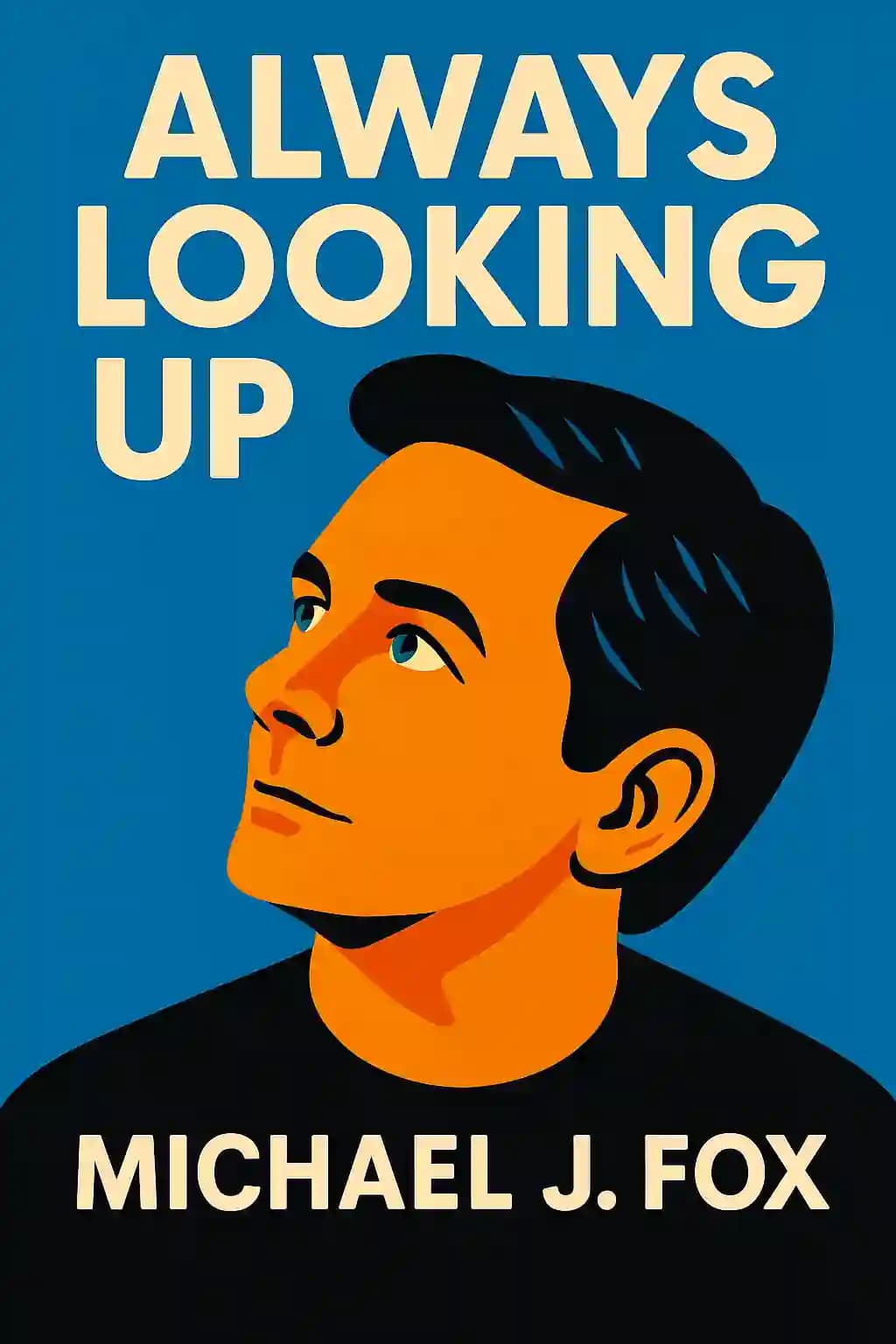
Michael J. Fox's journey from beloved actor to patient advocate represents one of Hollywood's most inspiring second acts. His memoir "Always Looking Up" isn't just a celebrity autobiography-it's a masterclass in resilience that has influenced millions, including Oprah Winfrey who called it "a testament to the power of optimism." The book's title works on multiple levels-yes, it's a self-deprecating height joke (Fox stands barely five-foot-five), but more importantly, it captures his philosophical approach to life's challenges. As Fox navigates the progressive symptoms of Parkinson's disease, he discovers that for everything this disease has taken, something of greater value has been given-a marker pointing him toward unexpected purpose and deeper connections.
Chapitre 2
When the Spotlight Fades: Reinvention After Fame
December 31, 1999, marked a pivotal moment in Michael J. Fox's life. While snorkeling in the pristine waters of St. John's, following a sea turtle through crystal-clear Caribbean waters, Fox emerged from the ocean, toweled off, and calmly informed his wife Tracy that he was leaving "Spin City"-effectively ending his acting career at its peak. Her response was simple yet profound: "Good," followed by a sandy embrace. The decision, though seemingly spontaneous, had been brewing since his Parkinson's diagnosis in 1991, as his symptoms progressively interfered with his physical performance. The tremors, once manageable through medication, had become increasingly difficult to mask on camera, often requiring multiple takes and clever editing to maintain the illusion of control.
The irony wasn't lost on Fox-just as he had mastered the emotional and intellectual dimensions of acting, his body was becoming an unreliable instrument. After decades of perfecting his craft, from his breakout role in "Family Ties" to the "Back to the Future" trilogy and beyond, he had developed an innate understanding of character development and timing that most actors spend a lifetime pursuing. The final episode of his run on "Spin City" mirrored his real-life situation with eerie precision. His character, Mike Flaherty, was leaving a job he loved, just as Fox himself was departing from the only career he'd known since age sixteen. The dialogue between Mike and Caitlin reflected Fox's relationship with Tracy-how much he drew strength from her unwavering belief in him when facing uncertainty.
The farewell episode was filmed in early 2000, marking the end of an era not just for Fox, but for television itself. On that final taping night, the studio was packed with press, network executives, Fox's family from Vancouver, and loyal audience members who had attended every recording. The atmosphere was electric with emotion, a mix of celebration and melancholy that permeated every corner of the set. His wife Tracy and co-star Gary David Goldberg spent most of the evening just offstage, both in tears as they witnessed this chapter closing. Cast members who had worked with Fox throughout his career made surprise appearances, turning the evening into an impromptu tribute to his impact on television.
For the curtain call, Fox wore Mike Flaherty's Fordham letterman's jacket, a symbolic gesture linking his character's journey with his own. He embraced each cast member individually, sharing private words of gratitude and friendship that had developed over years of collaboration. As Bruce Springsteen's "Glory Days" played-a sentimental yet ironic choice-the standing ovation lasted nearly ten minutes. That night when Tracy and Fox returned home, he didn't set the alarm for the first time in years-a small but significant acknowledgment that life was about to change dramatically. This moment marked not just the end of his acting career, but the beginning of his transformation into an advocate for Parkinson's research and a different kind of public figure.
Chapitre 3
Building a Foundation: From Actor to Advocate
When first diagnosed in 1991, Fox absorbed the blow privately, sharing his fears only with a small circle of friends and family. His public disclosure in 1998 came primarily from seeking relief from the strain of secrecy. This revelation connected him to a community of over a million Americans with Parkinson's, many living in isolation due to fear of being misunderstood or stigmatized.
Through online Parkinson's forums (where he used an invented name), Fox discovered how vastly different each person's experience with the disease could be-from symptoms to treatment effectiveness. These interactions highlighted his relative fortune: he had family support, financial security, and unlike 40% of PD patients, he didn't suffer from clinical depression. The contrast between his circumstances and those of many fellow patients ignited a sense of responsibility.
Within months of going public, Fox began connecting with Parkinson's organizations. A meeting with Joan Samuelson from the Parkinson's Action Network led to his first political involvement-testifying before a Senate subcommittee about federal funding disparities for Parkinson's research. The testimony of Dr. Gerald Fischbach, who suggested Parkinson's might be cured within 5-10 years with sufficient funding, energized Fox. Despite his lack of scientific qualifications, he became determined to create a streamlined private foundation to raise money and support underfunded scientists.
The foundation's philosophy was revolutionary in the nonprofit world. At their first planning meeting at Dreamworks' New York headquarters, Fox welcomed executive director Debi Brooks with unusual terms: "The last thing I want is for us to discuss our twentieth annual fundraiser. If that day comes, you're fired." They shared an urgency to achieve obsolescence. To the assembled CEOs and business leaders, Fox pitched a foundation fundamentally different from any existing one-not building an endowment but immediately deploying funds. "We're not setting up a bank," he explained. "When money comes in, it will go back out immediately."
This approach embraced risk, which these financial executives understood was necessary for transformative success. Within two weeks, the Michael J. Fox Foundation for Parkinson's Research received nonprofit certification, marking Fox's transition from acting career to a new direction with very specific purpose. The foundation's first "Fast Track" initiative drew two hundred applications from twenty countries, requesting over twenty million dollars-proof that the science was ahead of the money, and that they were officially in the race to find a cure.
Chapitre 4
The Political Battlefield: Fighting for Scientific Freedom
Fox's advocacy took a more contentious turn in 2006 when he decided to become politically proactive rather than reactive. Working with strategist John Rogers from his Manhattan office, they developed a focused campaign to support pro-stem cell candidates in the 2006 midterms. Their goal wasn't partisan-they sought a veto-proof majority by supporting candidates who favored stem cell research, regardless of party affiliation. They committed to being a single-issue operation, avoiding other political topics to maintain clarity of message.
The campaign targeted close races where candidates had clear differences on stem cell research, particularly focusing on Senate contests. The Missouri race between Claire McCaskill and Jim Talent especially captured their attention, as the state was also voting on a stem cell ballot initiative. Their first campaign stop was St. Louis in early October, where despite unseasonable heat and Fox's visible symptoms during interviews, he connected with McCaskill and delivered his first stump speech.
When the campaign ads Fox filmed were finalized, campaign staff were ecstatic about their effectiveness. The focus group numbers were "through the roof." Initially puzzled by this reaction to what seemed like straightforward ads, Fox eventually realized the "special effect" was his physical condition itself. His visible tremors and dyskinesias communicated what words alone couldn't-the human cost of blocking research. What viewers saw was just a thirty-second snapshot of his constantly changing symptoms, which had become so integrated into his daily life that he rarely focused on them.
This visibility soon drew unexpected fire. Radio host Rush Limbaugh devoted much of a broadcast to attacking Fox personally, claiming he was "faking" or "exaggerating" his symptoms in the campaign ads to manipulate voters' emotions. The situation presented an immediate dilemma for Fox's upcoming interviews. As he prepared, feeling physically good that morning with his medication working well, he wondered if appearing too "normal" would inadvertently validate Rush's accusations. He refused to manufacture symptoms to prove he wasn't manufacturing symptoms.
Following the Limbaugh controversy, media requests flooded in from every direction. On the CBS Evening News with Katie Couric, Fox struggled physically-sweating under too many layers of clothing, shaking uncontrollably, and fighting what he calls a "central body tremor" that feels like someone grabbed his spine and was waving him like a flag. When Katie asked if he could have waited to film the ad when his dyskinesias were less pronounced, Fox explained the unpredictability of symptoms and redirected the conversation: "We're not interested in being exhibitionists with our symptoms or asking for pity... We're just resolved to get moving with this science. It's been a long time. It's not a time-neutral situation."
During their conversation, Fox's tremors dislodged his microphone clip. Without breaking eye contact or interrupting their dialogue, Katie calmly reached over and refastened it-a simple kindness that allowed him dignity while making important points. By taking the high road rather than responding with inflammatory rhetoric, Fox shifted the tone of the debate. The segment boosted CBS's ratings significantly, and despite looking physically compromised, Fox felt relieved. As he told Katie, "It's not pretty when it gets bad... but I've had enough years of people thinking I was pretty, and teenage girls hanging my picture on the wall. I'm over that now."
Chapitre 5
Faith Beyond Religion: Finding Meaning in Uncertainty
Fox views faith as an aspect of optimism, a cousin to hope. Though he avoids theological arguments, he considers himself spiritual rather than religious. He adheres to an ethical code informed by major monotheistic principles like the Golden Rule and several Commandments, but has never been "a consistent and obedient disciple of any one big 'F' Faith." For Fox, understanding has always been the antidote to fear, whether confronting alcoholism or Parkinson's disease. "Respecting it, however, doesn't mean tolerating it. And you can only vanquish an enemy you respect, have fully sized up, and weighed by every possible measure."
His spiritual journey led him to unexpected places, including a profound connection to Jewish culture despite not being born Jewish. Fox married Tracy, who is Jewish, and they're raising their children in the Jewish faith. Their three oldest children have had bar and bat mitzvahs. Through Rabbi Josh Davidson, Fox learned about tikkun olam ("repairing the world"), a principle of Judaism that aligned with his advocacy for stem cell research. The rabbi explained that Jewish tradition encourages scientific advancement, viewing stem cell research as embodying "the mitzvah of healing."
When Fox's son Sam was born in 1989, naming him came unexpectedly easily. This led to Fox's first major parenting decision: circumcision. Despite Tracy's progressive hesitations about "ritual mutilation," Fox advocated for connecting Sam to his Jewish heritage: "You're Jewish, so he's Jewish. He's part of a culture and a continuum that I can't even pretend to understand or fully appreciate." Years later, nine-year-old Sam independently requested to attend Hebrew school. The family joined Central Synagogue in New York, only to learn days later that the historic 1872 landmark building had burned down during renovations. Rabbi Peter Rubinstein promised the congregation they would rebuild-a metaphor that wasn't lost on Fox.
At Sam's bar mitzvah celebration, Fox wasn't originally scheduled to speak. When Sam changed his mind and asked Fox to say a few words, Tracy suggested he tell "the bike story." Fox recalled how Sam was never interested in sports despite his attempts to engage him. However, when seven-year-old Sam still hadn't learned to ride a bicycle, Fox insisted on teaching him. After failed attempts on gravel and pavement, they stumbled upon a baseball field with perfect base paths-solid enough for stability but soft enough for safe falls. Sam quickly mastered riding around the bases, and when he ventured into the outfield and fell, he got up grinning, eager to continue finding his own path. Fox concluded his bar mitzvah speech knowing he didn't need to explain the symbolism to anyone present.
Chapitre 6
The Family Anchor: Marriage in the Face of Adversity
On his twentieth wedding anniversary, Fox reflects that contrary to what people might assume, the years since his diagnosis haven't diminished his marriage but rather enriched it in unexpected ways. While others see Tracy in a caretaker role, she adamantly refuses this label, maintaining their relationship as equal partners. Fox explains that "the greatest challenge she faces is not having a Parkinson's patient for a husband, it's having me for a husband," acknowledging that his personality quirks and stubborn independence often present bigger challenges than his medical condition.
Their marriage has grown stronger through complexity, evolving into something deeper than their early Hollywood romance. "The more complicated it gets, the more it seems to bring out the best in us," Fox observes, noting how they've developed an intricate dance of mutual support that goes far beyond patient and caregiver. Fox candidly acknowledges how unprepared he was for his diagnosis, describing his earlier life as "working more than I needed to, worrying more than I liked to admit, and drinking more than anyone should." The diagnosis forced both of them to reevaluate their priorities and relationship dynamics, leading to profound personal growth.
The positive changes they've made together far outweigh what Parkinson's has taken away. They've developed new routines, found unexpected moments of joy, and discovered strength neither knew they possessed. Their shared sense of humor has become a crucial tool for navigating difficult moments, with Tracy often finding ways to lighten tense situations with well-timed wit.
A particularly revealing moment occurred seven years after 9/11, when Fox attended a Columbia University event featuring presidential candidates Barack Obama and John McCain discussing public service. Seated among celebrities like Leonardo DiCaprio and Usher, Fox experienced a severe Parkinson's episode - uncontrollable shaking, with his legs "freaking out" and his body sweating profusely. While Fox tried to maintain his composure in this high-profile setting, Tracy recognized his distress immediately. Without drawing attention, she attempted various subtle interventions to help him through the episode, eventually leading him out during a break despite his characteristic reluctance to leave.
Fox reflects deeply on how Tracy has become "an expert at folding back the flaps, tipping it over, and easing me out" of the box Parkinson's puts him in. This metaphor speaks to their evolved partnership, where Tracy's understanding of his needs goes beyond mere physical assistance to encompass emotional support and preservation of his dignity. Their relationship has developed its own language of support, with unspoken signals and shared understanding that allows them to navigate challenging situations seamlessly.
Their partnership has evolved to meet each new challenge with grace and determination, finding strength in vulnerability and connection in difficulty. What might appear from outside as burden has become, for them, a deepening of commitment and understanding that transcends conventional marriage. They've discovered that their shared struggles have created a unique bond, stronger than their initial romantic connection, built on trust, resilience, and unwavering mutual support.
Chapitre 7
Parenting Through Uncertainty: Lessons for the Next Generation
Fox reflects on the delusions of first-time parents, comparing it to "every bride on her wedding day is Grace Kelly before she realizes that maybe she didn't marry a prince." He shares a frightening parenting mistake when they failed to properly secure Sam's car seat, finding him upside down but unharmed in the footwell after a drive. While they obsessed over this incident as new parents, Fox notes they'd handle it much more calmly with their fourth child.
Fox contrasts his own free-range childhood-where he collected injuries including a fractured skull-with the overprotective approach they initially took with Sam. He observes that Sam gained more independence when the twins arrived, as parental attention was necessarily divided. Fox describes his children's individual paths: Aquinnah as a passionate ballerina, Schuyler finding her identity through sports rather than dance, and Esme as a creative free spirit with "cockamamie" schemes.
He reflects that children are "more like jukeboxes" than instruments-parents can "put in your two bits" but "they're going to play their own tune." While he finds joy in their accomplishments, Fox acknowledges the hardest part of parenting is watching children suffer through illness or disappointment, knowing you can't take away their pain: "You can only be present, be aware, be responsive, be compassionate, and love that child with everything you have."
In June 1997, just before his thirty-sixth birthday, Fox prepared for a sixteen-day cross-country trip with his son Sam, his friend John, and John's two children. As he struggled to assemble a model boat (an early birthday gift meant for him to enjoy with Sam), Fox confronted his limitations from Parkinson's disease. The frustration of failing at this simple task made him question whether he could handle the ambitious road trip. Despite his doubts, Fox meticulously planned every detail of their journey from New York to Malibu-a stark contrast to his pre-Parkinson's spontaneity.
The trip represented more than just adventure; it was about helping Sam navigate life's changes, from the arrival of his twin sisters to Fox's progressing disease, while creating lasting father-son memories. When Sam inevitably asked "Are we there yet?" while crossing Wyoming, Fox pulled over and turned it into an existential teaching moment, having the kids explore their immediate surroundings-teaching them all that "We are where we are. If we keep moving, we'll be someplace else. We'll know when we get there."
Chapitre 8
A Week in the Life: The Four Pillars in Action
Eight years after retiring from Spin City, Fox reflects on how thoroughly his post-acting life has been filled with the Fox Foundation, patient advocacy, political activism, spiritual exploration, and family life. He notes that if he'd made a list of everything he'd hoped to accomplish in this "second-act odyssey," he would have sold himself short. A representative week shows how the four pillars of his life-work, politics, faith, and family-continue to sustain him.
On Friday, October 31, 2008, Fox describes playing Dwight, a wheelchair-bound former extreme sports enthusiast, on Denis Leary's show "Rescue Me." Despite the physical challenges of portraying a paraplegic while managing his own Parkinson's symptoms ("I'm a human whirligig"), Fox embraces the opportunity. Though Dwight's bitter worldview contrasts sharply with Fox's, he connects with the character through shared experiences of loss and life rearrangement.
The following day, Fox attends synagogue alone to observe the Yahrzeit (memorial) for his sister Karen, who passed away a year earlier. Arriving a week early by mistake, he stays for a bar mitzvah service of someone he doesn't know. When the time comes to recite Kaddish, Fox whispers his sister's name alongside the others being memorialized.
On Sunday, Fox and his daughter Esme cheer on Team Fox runners at the New York City Marathon. With Esme on his shoulders enthusiastically ringing a cowbell, they join foundation staff and supporters to encourage the 135 competitors wearing Team Fox colors. Actor Ryan Reynolds, whose father has Parkinson's, stops for hugs and later raises over $100,000 for the foundation.
Monday brings Esme's birthday celebration at her favorite West Side Italian restaurant. Tracy carries a homemade birthday cake across town because of Esme's peanut allergies, requiring careful vigilance similar to their recent Halloween candy sorting.
On Election Day, Fox votes early, joining a historic turnout. He reflects on how difficult it was for stem cell research opponents to run against hope in 2006, and now in 2008, this collective hope has prevailed.
Wednesday finds Fox at the Michael J. Fox Foundation's annual fundraiser, playing his cherished Les Paul guitar alongside Pete Townshend and Roger Daltrey of The Who. "This is almost worth getting Parkinson's for!" he announces to the thousand guests. By spring 2009, the foundation will have funded nearly $200 million in Parkinson's research, making it the leading private organization of its kind.
In the early hours of Thursday morning, Fox is home with his family. After Tracy falls asleep, he begins his regular night wandering-the extra medication needed for the performance has left him with dyskinesias. He shuffles through the apartment, checking emails, eventually making his careful way to bed, silently thanking Tracy for the warmth-the latest of millions of thank-yous over their life together. Despite his doctor's warnings about medication causing vivid dreams, Fox has never noticed much difference. He's always dreamt big.
Chapitre 9
The Optimist's Manifesto: Hope as a Radical Act
Throughout "Always Looking Up," Fox transforms what could have been a narrative of loss into one of discovery. His journey from beloved actor to patient advocate represents a profound shift in identity and purpose. What emerges is not a story about Parkinson's disease, but about the human capacity for reinvention and meaning-making in the face of unwanted change.
Fox's optimism isn't blind positivity or denial-it's a hard-won perspective that acknowledges difficulty while refusing to be defined by it. "Optimism is a choice," he writes, "but it's not simply a matter of attitude-it's how we engage with the world." This engagement manifests through his foundation's innovative approach to research funding, his political activism for scientific freedom, his spiritual exploration across traditions, and his evolving roles as husband and father.
Perhaps most remarkably, Fox has maintained his sense of humor throughout his journey. Whether making height jokes, describing his dyskinesias as making him look "like a beach ball on a boat deck," or finding the comedy in life's most challenging moments, his laughter in the face of adversity becomes its own form of resistance.
The foundation's success-funding nearly $200 million in research and becoming the leading private organization in Parkinson's research-stands as testament to what focused hope can accomplish. By demanding accountability, information sharing, and collaboration, Fox has helped reshape how medical research is conducted and funded.
"Always Looking Up" ultimately offers a radical proposition: that our greatest challenges may contain our greatest opportunities. As Fox writes, "For everything this disease has taken, something of greater value has been given-sometimes just a marker that points me in a new direction that I might not otherwise have traveled." In embracing this perspective, Fox provides not just inspiration but a practical philosophy for navigating life's inevitable difficulties-always looking up, not just physically due to his height, but metaphorically toward possibility rather than limitation.