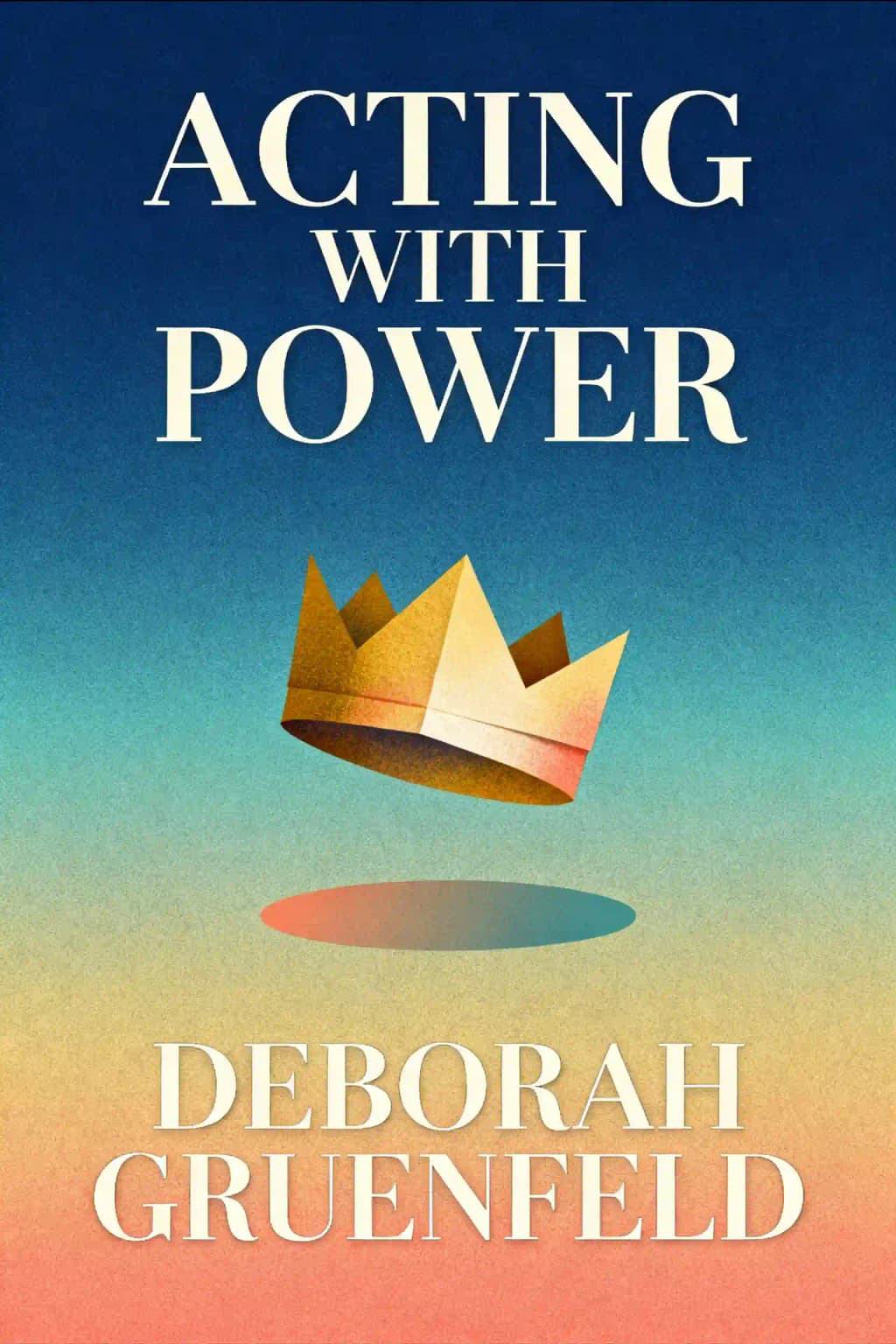
Discover why power isn't about status but how you play your role. Stanford professor Deborah Gruenfeld's acclaimed work challenges conventional wisdom: What if acting powerful matters more than being powerful? A favorite among ambitious professionals seeking authentic influence without changing who they are.
Deborah H. Gruenfeld, author of Acting with Power: Why We Are More Powerful Than We Believe, is a renowned social psychologist and Stanford Graduate School of Business professor specializing in power dynamics, leadership, and organizational behavior.
With a PhD in psychology from the University of Illinois and a master’s in journalism from NYU, she merges rigorous academic research with accessible insights into how social structures shape behavior. Her groundbreaking theory of power as a disinhibiting force, developed with collaborators at UC Berkeley, underpins this exploration of authority, influence, and group dynamics.
Gruenfeld co-directs Stanford’s Executive Program for Women Leaders and has taught power and leadership strategies to Fortune 500 executives and entrepreneurs worldwide. Her work has been featured in The Wall Street Journal, The New Yorker, and The Washington Post, and she serves on the boards of LeanIn.Org and Stanford’s Center for the Advancement of Women’s Leadership.
A frequent keynote speaker, Gruenfeld translates decades of research into actionable frameworks used by institutions like Google and Goldman Sachs. Acting with Power distills her expertise into a guide for redefining authority in professional and personal contexts, cementing her status as a leading voice in organizational psychology.
Acting with Power explores power as a dynamic social resource shaped by roles and relationships. Drawing from theater principles, Gruenfeld shows how to authentically embrace leadership roles by "playing high" (asserting authority) or "playing low" (building trust). The book argues power isn’t about status but using influence responsibly to solve group problems.
Aspiring leaders, managers, and professionals navigating workplace hierarchies will benefit most. It’s also valuable for social psychology enthusiasts or anyone struggling with imposter syndrome. Gruenfeld’s actionable advice helps readers leverage existing power to protect teams, elevate others, and drive collective goals.
Yes – it combines 25+ years of Stanford research with practical acting techniques to demystify power dynamics. Readers praise its fresh perspective on using power ethically rather than acquiring it, with strategies applicable to both professional and personal relationships.
Gruenfeld compares social interactions to theatrical performances, where power flows through scripted roles. Like actors, professionals must master emotional detachment to handle criticism, embody leadership personas, and adapt to shifting group dynamics without taking conflicts personally.
Playing high involves asserting authority through decisive actions, clear boundaries, and formal communication. Playing low focuses on building trust via humility, active listening, and collaborative problem-solving. Gruenfeld advises strategically alternating between these modes based on situational needs.
Yes – Gruenfeld reframes imposter syndrome as a mismatched role perception. By treating leadership roles as temporary "performances" requiring rehearsal rather than innate traits, individuals can overcome self-doubt and grow into responsibilities.
Unlike dominance-focused approaches, Gruenfeld emphasizes power’s relational nature. The book prioritizes group impact over personal advancement, merging social psychology research with actor training methods rarely seen in business literature.
Some readers note the concepts require repeated application to master, and the acting metaphor may feel contrived in corporate settings. However, most praise its research-backed reframing of power as a learnable skill rather than a fixed trait.
Gruenfeld’s Stanford studies on disinhibition and power – including how authority reduces perspective-taking – underpin the book’s core thesis. Her work demonstrates that power dynamics transform behavior unconsciously, necessitating intentional role management.
Absolutely – it teaches how to project competence in promotions, negotiate salaries strategically, and mentor others without seeming overbearing. The “power as service” mindset helps candidates frame achievements as team contributions rather than self-promotion.
Ressentez le livre à travers la voix de l'auteur
Transformez les connaissances en idées captivantes et riches en exemples
Capturez les idées clés en un éclair pour un apprentissage rapide
Profitez du livre de manière ludique et engageante
Power isn't a personal attribute or possession-it's fundamentally social and contextual.
Power isn't a feeling-we're often miscalibrated about our own power.
Power isn't primarily for personal gain but for solving group problems.
Body language matters as much as words, perhaps more.
Lasting power comes from advancing shared goals.
Décomposez les idées clés de Acting with Power en points faciles à comprendre pour découvrir comment les équipes innovantes créent, collaborent et grandissent.
Condensez Acting with Power en indices de mémoire rapides mettant en évidence les principes clés de franchise, de travail d'équipe et de résilience créative.

Découvrez Acting with Power à travers des récits vivants qui transforment les leçons d'innovation en moments mémorables et applicables.
Posez n'importe quelle question, choisissez la voix et co-créez des idées qui résonnent vraiment avec vous.

Cree par des anciens de Columbia University a San Francisco
"Instead of endless scrolling, I just hit play on BeFreed. It saves me so much time."
"I never knew where to start with nonfiction—BeFreed’s book lists turned into podcasts gave me a clear path."
"Perfect balance between learning and entertainment. Finished ‘Thinking, Fast and Slow’ on my commute this week."
"Crazy how much I learned while walking the dog. BeFreed = small habits → big gains."
"Reading used to feel like a chore. Now it’s just part of my lifestyle."
"Feels effortless compared to reading. I’ve finished 6 books this month already."
"BeFreed turned my guilty doomscrolling into something that feels productive and inspiring."
"BeFreed turned my commute into learning time. 20-min podcasts are perfect for finishing books I never had time for."
"BeFreed replaced my podcast queue. Imagine Spotify for books — that’s it. 🙌"
"It is great for me to learn something from the book without reading it."
"The themed book list podcasts help me connect ideas across authors—like a guided audio journey."
"Makes me feel smarter every time before going to work"
Cree par des anciens de Columbia University a San Francisco

Obtenez le resume de Acting with Power en PDF ou EPUB gratuit. Imprimez-le ou lisez-le hors ligne a tout moment.
Power isn't something we possess-it's something we perform. This revolutionary insight from Stanford professor Deborah Gruenfeld transforms how we understand influence in our daily lives. Despite her 25+ years researching power dynamics at the highest levels, Gruenfeld admits she still sometimes carries that childhood feeling of powerlessness. This paradox reveals a profound truth: power isn't an internal state but a social role we play on life's stage. We're all actors performing in different contexts, sometimes leading, sometimes supporting. The most effective people recognize which role they're in and perform it deliberately rather than reactively. When we understand power as performance rather than possession, we gain the freedom to step into our roles more effectively-whether we're running a meeting, negotiating a raise, or managing family dynamics. The question isn't "Do I have power?" but rather "What role am I playing in this scene, and how can I perform it well?"