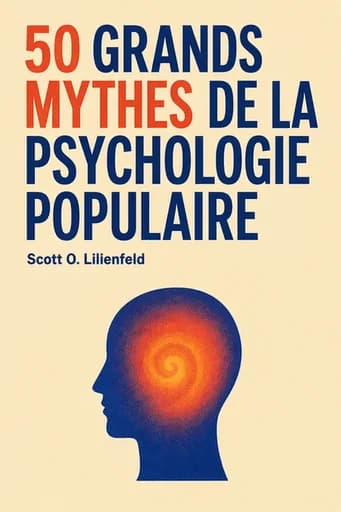
Debunking the psychological myths you've always believed. "50 Great Myths of Popular Psychology" shatters misconceptions with evidence-based clarity that's transformed academic thinking. Think you use only 10% of your brain? Cornell's Thomas Gilovich calls this myth-buster "an incredible resource" for separating psychological fact from fiction.
Ressentez le livre à travers la voix de l'auteur
Transformez les connaissances en idées captivantes et riches en exemples
Capturez les idées clés en un éclair pour un apprentissage rapide
Profitez du livre de manière ludique et engageante
Did you know that we use far more than 10% of our brains? Or that opposites don't actually attract? These are just two of the countless psychological myths that permeate our culture, shaping how we understand ourselves and others. These aren't just harmless misconceptions-they can lead to poor life decisions with real consequences. Someone who believes we repress painful memories might waste years searching for nonexistent childhood traumas. Those convinced that happiness depends primarily on external circumstances may look outside rather than inside themselves for fulfillment. Why do these myths persist so stubbornly? Our minds are naturally vulnerable to psychological misconceptions through several mechanisms. We notice and remember when two things co-occur (like strange behavior during a full moon) while ignoring when they don't, creating illusory correlations. We infer causation from mere correlation, assuming that if A and B are related, A must cause B. We reason by representativeness, believing things that look similar must be meaningfully connected-like graphologists claiming widely-spaced handwriting indicates a need for interpersonal distance. And media portrayals frequently exaggerate psychological phenomena for dramatic effect, while many myths contain kernels of truth that have been greatly overstated.
Décomposez les idées clés de 50 Great Myths of Popular Psychology en points faciles à comprendre pour découvrir comment les équipes innovantes créent, collaborent et grandissent.
Condensez 50 Great Myths of Popular Psychology en indices de mémoire rapides mettant en évidence les principes clés de franchise, de travail d'équipe et de résilience créative.

Découvrez 50 Great Myths of Popular Psychology à travers des récits vivants qui transforment les leçons d'innovation en moments mémorables et applicables.
Posez n'importe quelle question, choisissez la voix et co-créez des idées qui résonnent vraiment avec vous.

Cree par des anciens de Columbia University a San Francisco
"Instead of endless scrolling, I just hit play on BeFreed. It saves me so much time."
"I never knew where to start with nonfiction—BeFreed’s book lists turned into podcasts gave me a clear path."
"Perfect balance between learning and entertainment. Finished ‘Thinking, Fast and Slow’ on my commute this week."
"Crazy how much I learned while walking the dog. BeFreed = small habits → big gains."
"Reading used to feel like a chore. Now it’s just part of my lifestyle."
"Feels effortless compared to reading. I’ve finished 6 books this month already."
"BeFreed turned my guilty doomscrolling into something that feels productive and inspiring."
"BeFreed turned my commute into learning time. 20-min podcasts are perfect for finishing books I never had time for."
"BeFreed replaced my podcast queue. Imagine Spotify for books — that’s it. 🙌"
"It is great for me to learn something from the book without reading it."
"The themed book list podcasts help me connect ideas across authors—like a guided audio journey."
"Makes me feel smarter every time before going to work"
Cree par des anciens de Columbia University a San Francisco

Obtenez le resume de 50 Great Myths of Popular Psychology en PDF ou EPUB gratuit. Imprimez-le ou lisez-le hors ligne a tout moment.