Ship Stability: Understanding Gravity and Buoyancy Forces
Explore the fundamentals of ship stability and the invisible tug-of-war between gravity and buoyancy that keeps massive cargo ships upright on the ocean.
Bestes Zitat aus Ship Stability: Understanding Gravity and Buoyancy Forces
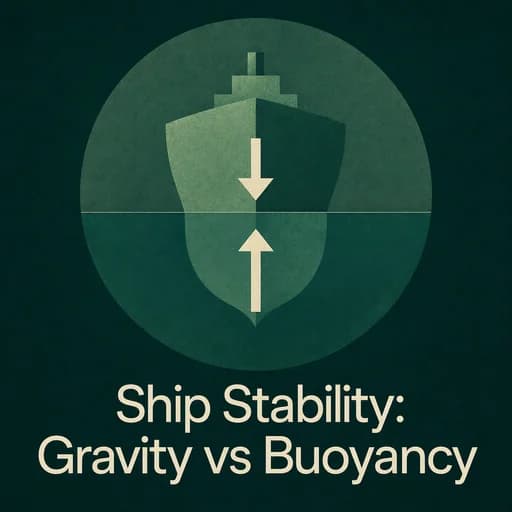
The dance between the Centre of Gravity and the Centre of Buoyancy determines whether a ship is a safe, stable home for its sailors or a dangerous liability prone to capsizing. Understanding these points is the foundation of all maritime safety.
Generated by Miles
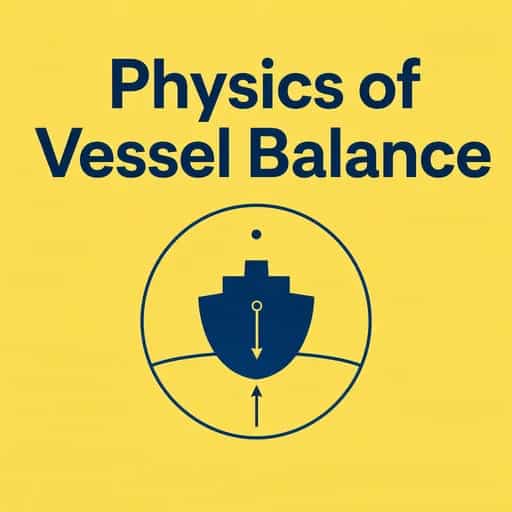
A memorization-focused lesson on ship stability concepts: Centre of Gravity (G), Vertical Centre of Gravity (VCG), and Centre of Buoyancy (B), focusing on core definitions and their differences. Include the attached source: Centre of Gravity (G) The centre of mass, the point from which the whole weight of a body (such as a vessel) and everything in it acts vertically downward Vertical Centre of Gravity (VCG) Centre of the weight distribution in a vessel and the point through which the force of gravity is assumed to act vertically downward Centre of Buoyancy (B) The centre of gravity of the immersed volume. Point through which the force of buoyancy supporting the vessel acts vertically upwards.


Häufig gestellte Fragen
The Centre of Gravity, often referred to as G, is the fundamental point where the entire weight of the vessel is concentrated. This includes the weight of the hull, engines, cargo, and crew. In marine engineering, understanding G is essential because it represents the single spot where gravity pulls the ship downward toward the center of the earth, acting as a primary force in the vessel's stability.
The Centre of Buoyancy, known as B, is the center of the underwater portion of the ship where the water exerts upward pressure against the hull. This buoyancy force pushes the vessel toward the sky, opposing the downward pull of gravity. The interaction and positioning between the Centre of Buoyancy and the Centre of Gravity are what ultimately determine if a ship remains upright or rolls over.
Massive cargo ships stay upright due to a complex internal architecture and the balance of two opposing forces: gravity and buoyancy. Naval architecture ensures that the tug-of-war between the downward force at the Centre of Gravity and the upward force at the Centre of Buoyancy is carefully managed. This engineering balance allows the steel titans to remain stable even when shifting ocean waves hit the hull.
Von Columbia University Alumni in San Francisco entwickelt
BeFreed vereint eine globale Gemeinschaft wissbegieriger Menschen


"Instead of endless scrolling, I just hit play on BeFreed. It saves me so much time."


"I never knew where to start with nonfiction—BeFreed’s book lists turned into podcasts gave me a clear path."


"Perfect balance between learning and entertainment. Finished ‘Thinking, Fast and Slow’ on my commute this week."
"Crazy how much I learned while walking the dog. BeFreed = small habits → big gains."
"Reading used to feel like a chore. Now it’s just part of my lifestyle."

"Feels effortless compared to reading. I’ve finished 6 books this month already."
"BeFreed turned my guilty doomscrolling into something that feels productive and inspiring."

"BeFreed turned my commute into learning time. 20-min podcasts are perfect for finishing books I never had time for."
"BeFreed replaced my podcast queue. Imagine Spotify for books — that’s it. 🙌"

"It is great for me to learn something from the book without reading it."
"The themed book list podcasts help me connect ideas across authors—like a guided audio journey."
"Makes me feel smarter every time before going to work"
Von Columbia University Alumni in San Francisco entwickelt
BeFreed vereint eine globale Gemeinschaft wissbegieriger Menschen
"Instead of endless scrolling, I just hit play on BeFreed. It saves me so much time."
"I never knew where to start with nonfiction—BeFreed’s book lists turned into podcasts gave me a clear path."
"Perfect balance between learning and entertainment. Finished ‘Thinking, Fast and Slow’ on my commute this week."
"Crazy how much I learned while walking the dog. BeFreed = small habits → big gains."
"Reading used to feel like a chore. Now it’s just part of my lifestyle."
"Feels effortless compared to reading. I’ve finished 6 books this month already."
"BeFreed turned my guilty doomscrolling into something that feels productive and inspiring."
"BeFreed turned my commute into learning time. 20-min podcasts are perfect for finishing books I never had time for."
"BeFreed replaced my podcast queue. Imagine Spotify for books — that’s it. 🙌"
"It is great for me to learn something from the book without reading it."
"The themed book list podcasts help me connect ideas across authors—like a guided audio journey."
"Makes me feel smarter every time before going to work"
"Instead of endless scrolling, I just hit play on BeFreed. It saves me so much time."
"I never knew where to start with nonfiction—BeFreed’s book lists turned into podcasts gave me a clear path."
"Perfect balance between learning and entertainment. Finished ‘Thinking, Fast and Slow’ on my commute this week."
"Crazy how much I learned while walking the dog. BeFreed = small habits → big gains."
"Reading used to feel like a chore. Now it’s just part of my lifestyle."
"Feels effortless compared to reading. I’ve finished 6 books this month already."
"BeFreed turned my guilty doomscrolling into something that feels productive and inspiring."
"BeFreed turned my commute into learning time. 20-min podcasts are perfect for finishing books I never had time for."
"BeFreed replaced my podcast queue. Imagine Spotify for books — that’s it. 🙌"
"It is great for me to learn something from the book without reading it."
"The themed book list podcasts help me connect ideas across authors—like a guided audio journey."
"Makes me feel smarter every time before going to work"
"Instead of endless scrolling, I just hit play on BeFreed. It saves me so much time."
"I never knew where to start with nonfiction—BeFreed’s book lists turned into podcasts gave me a clear path."
"Perfect balance between learning and entertainment. Finished ‘Thinking, Fast and Slow’ on my commute this week."
"Crazy how much I learned while walking the dog. BeFreed = small habits → big gains."
"Reading used to feel like a chore. Now it’s just part of my lifestyle."
"Feels effortless compared to reading. I’ve finished 6 books this month already."
"BeFreed turned my guilty doomscrolling into something that feels productive and inspiring."
"BeFreed turned my commute into learning time. 20-min podcasts are perfect for finishing books I never had time for."
"BeFreed replaced my podcast queue. Imagine Spotify for books — that’s it. 🙌"
"It is great for me to learn something from the book without reading it."
"The themed book list podcasts help me connect ideas across authors—like a guided audio journey."
"Makes me feel smarter every time before going to work"

![[4f2a36af-2afa-4ae2-a9cf-6182af648714:c0000] Centre of Gravity (G) The centre of mass, the point from … p1-1](/_next/image?url=https%3A%2F%2Fd1y2du6z1jfm9e.cloudfront.net%2Fassets%2Fpodcast%2Fblue.png&w=1024&q=50)