LLM Research and Why Next-Token Prediction Works
AI models seem like magic, but they are actually probability engines. Learn how transformer architecture and scaling laws turn simple math into reasoning.

Bestes Zitat aus LLM Research and Why Next-Token Prediction Works
It’s interesting to think about how much of what we perceive as 'intelligence' is actually just very sophisticated statistical mapping. We’ve moved past the 'vibe coding' era where we just threw prompts at a wall to see what stuck; now, we’re building with precision.
Generated by Carl
AI research fundamentals and llm

Häufig gestellte Fragen
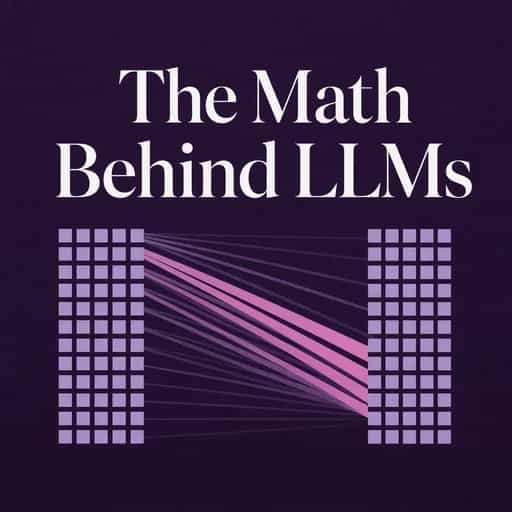
Large Language Models use a mechanism called self-attention, introduced in the 2017 "Attention Is All You Need" paper. Instead of reading text linearly from left to right, the model looks at every word in a sentence simultaneously. It performs a "weighted search" where it assigns attention scores to surrounding words to determine context. For example, if the words "river" or "overflowed" appear near the word "bank," the model’s math assigns a high attention score to those terms, dynamically "coloring" the vector for "bank" to reflect its geographic meaning rather than a financial one.
Tokens are the numerical units that a model processes, but they are not always equivalent to whole words. Modern models use sub-word tokenization, such as Byte-Pair Encoding (BPE), to break words into smaller building blocks. For instance, a complex word like "unbelievable" might be split into "un," "believ," and "able." This allows the model to understand prefixes, suffixes, and technical jargon it may not have encountered during training, while keeping the total vocabulary size manageable for the computer.
Hallucinations occur because Large Language Models are fundamentally probability engines rather than truth engines. When generating text, the model calculates a probability distribution for the next most likely token based on patterns learned from the internet. If a fake name or an incorrect fact has a high statistical probability within a specific context, the model will select it with the same confidence as a factual statement. Researchers note that this is a limit of logic; the same creativity that allows a model to write poetry also allows it to accidentally invent plausible-sounding fiction.
In-Context Learning refers to a model's ability to learn a new task or style from examples provided directly in a chat prompt, even though its underlying weights (its "brain") are not being updated. This happens through the self-attention mechanism, where the model treats the user's examples as a temporary "landscape" to follow. Some researchers believe the model is simply navigating to a specific "skill" it already learned during pre-training, while others suggest the Transformer's math is powerful enough to simulate a mini-learning algorithm internally during a single response.
The shift from chatbots to agents represents a move from simple interaction to autonomy. While a chatbot waits for a prompt and provides a single response, an agent is given a high-level goal, such as "plan a business trip." The agent then uses its reasoning capabilities to break that goal into a series of independent steps, such as searching for flights, checking a calendar, and executing bookings. This requires more advanced "agentic workflows" and "verifiable rewards" to ensure the AI's autonomous actions are functionally reliable and accurate.
Von Columbia University Alumni in San Francisco entwickelt
"Instead of endless scrolling, I just hit play on BeFreed. It saves me so much time."


"I never knew where to start with nonfiction—BeFreed’s book lists turned into podcasts gave me a clear path."


"Perfect balance between learning and entertainment. Finished ‘Thinking, Fast and Slow’ on my commute this week."
"Crazy how much I learned while walking the dog. BeFreed = small habits → big gains."
"Reading used to feel like a chore. Now it’s just part of my lifestyle."

"Feels effortless compared to reading. I’ve finished 6 books this month already."
"BeFreed turned my guilty doomscrolling into something that feels productive and inspiring."

"BeFreed turned my commute into learning time. 20-min podcasts are perfect for finishing books I never had time for."
"BeFreed replaced my podcast queue. Imagine Spotify for books — that’s it. 🙌"

"It is great for me to learn something from the book without reading it."
"The themed book list podcasts help me connect ideas across authors—like a guided audio journey."
"Makes me feel smarter every time before going to work"
Von Columbia University Alumni in San Francisco entwickelt
"Instead of endless scrolling, I just hit play on BeFreed. It saves me so much time."
"I never knew where to start with nonfiction—BeFreed’s book lists turned into podcasts gave me a clear path."
"Perfect balance between learning and entertainment. Finished ‘Thinking, Fast and Slow’ on my commute this week."
"Crazy how much I learned while walking the dog. BeFreed = small habits → big gains."
"Reading used to feel like a chore. Now it’s just part of my lifestyle."
"Feels effortless compared to reading. I’ve finished 6 books this month already."
"BeFreed turned my guilty doomscrolling into something that feels productive and inspiring."
"BeFreed turned my commute into learning time. 20-min podcasts are perfect for finishing books I never had time for."
"BeFreed replaced my podcast queue. Imagine Spotify for books — that’s it. 🙌"
"It is great for me to learn something from the book without reading it."
"The themed book list podcasts help me connect ideas across authors—like a guided audio journey."
"Makes me feel smarter every time before going to work"
"Instead of endless scrolling, I just hit play on BeFreed. It saves me so much time."
"I never knew where to start with nonfiction—BeFreed’s book lists turned into podcasts gave me a clear path."
"Perfect balance between learning and entertainment. Finished ‘Thinking, Fast and Slow’ on my commute this week."
"Crazy how much I learned while walking the dog. BeFreed = small habits → big gains."
"Reading used to feel like a chore. Now it’s just part of my lifestyle."
"Feels effortless compared to reading. I’ve finished 6 books this month already."
"BeFreed turned my guilty doomscrolling into something that feels productive and inspiring."
"BeFreed turned my commute into learning time. 20-min podcasts are perfect for finishing books I never had time for."
"BeFreed replaced my podcast queue. Imagine Spotify for books — that’s it. 🙌"
"It is great for me to learn something from the book without reading it."
"The themed book list podcasts help me connect ideas across authors—like a guided audio journey."
"Makes me feel smarter every time before going to work"
"Instead of endless scrolling, I just hit play on BeFreed. It saves me so much time."
"I never knew where to start with nonfiction—BeFreed’s book lists turned into podcasts gave me a clear path."
"Perfect balance between learning and entertainment. Finished ‘Thinking, Fast and Slow’ on my commute this week."
"Crazy how much I learned while walking the dog. BeFreed = small habits → big gains."
"Reading used to feel like a chore. Now it’s just part of my lifestyle."
"Feels effortless compared to reading. I’ve finished 6 books this month already."
"BeFreed turned my guilty doomscrolling into something that feels productive and inspiring."
"BeFreed turned my commute into learning time. 20-min podcasts are perfect for finishing books I never had time for."
"BeFreed replaced my podcast queue. Imagine Spotify for books — that’s it. 🙌"
"It is great for me to learn something from the book without reading it."
"The themed book list podcasts help me connect ideas across authors—like a guided audio journey."
"Makes me feel smarter every time before going to work"