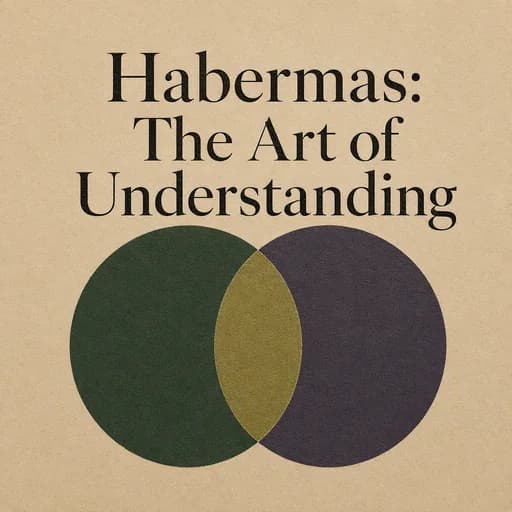
Habermas and the Art of Understanding: Communicative Action Explained
Explore Jürgen Habermas's The Theory of Communicative Action. Learn the difference between success-oriented and understanding-oriented action in modern society.
Bestes Zitat aus Habermas and the Art of Understanding: Communicative Action Explained
The danger of modernity is not that we have become too rational, but that we have become 'rationally one-sided,' prioritizing the 'system' of money and power over the 'lifeworld' of shared meaning and humanity.
Generated by Rochelle
An overview of Habermas's Theory of Communicative Action, covering core concepts like the lifeworld, communicative rationality, and the ideal speech situation.






Häufig gestellte Fragen
In his influential 1981 work, Jürgen Habermas explores how language serves as the essential glue holding society together. He argues that within our speech lies a spark of reason that allows us to reach genuine agreements rather than just following logical instructions. This theory suggests that seeking mutual understanding is a powerful defense against being treated like a cog in a machine by modern systems and technology.
Habermas distinguishes between two ways of interacting: success-oriented action and understanding-oriented action. Success-oriented action is strategic and manipulative, where you treat others as objects to get what you want. In contrast, understanding-oriented action focuses on reaching a genuine agreement where reasons and values actually matter. This distinction is central to his social theory and philosophy of language, highlighting how we choose to move through the world.
Habermas suggests that while we are more connected than ever through technology, many people feel invisible or frustrated by systems that ignore their values. By engaging in communicative action—speaking with the goal of being truly understood—we tap into a 'non-foundational universal' spark of reason. This act of seeking genuine agreement is presented as a radical way to maintain our humanity in a world dominated by strategic, success-oriented systems.
Von Columbia University Alumni in San Francisco entwickelt
"Instead of endless scrolling, I just hit play on BeFreed. It saves me so much time."


"I never knew where to start with nonfiction—BeFreed’s book lists turned into podcasts gave me a clear path."


"Perfect balance between learning and entertainment. Finished ‘Thinking, Fast and Slow’ on my commute this week."
"Crazy how much I learned while walking the dog. BeFreed = small habits → big gains."
"Reading used to feel like a chore. Now it’s just part of my lifestyle."

"Feels effortless compared to reading. I’ve finished 6 books this month already."
"BeFreed turned my guilty doomscrolling into something that feels productive and inspiring."

"BeFreed turned my commute into learning time. 20-min podcasts are perfect for finishing books I never had time for."
"BeFreed replaced my podcast queue. Imagine Spotify for books — that’s it. 🙌"

"It is great for me to learn something from the book without reading it."
"The themed book list podcasts help me connect ideas across authors—like a guided audio journey."
"Makes me feel smarter every time before going to work"
Von Columbia University Alumni in San Francisco entwickelt
"Instead of endless scrolling, I just hit play on BeFreed. It saves me so much time."
"I never knew where to start with nonfiction—BeFreed’s book lists turned into podcasts gave me a clear path."
"Perfect balance between learning and entertainment. Finished ‘Thinking, Fast and Slow’ on my commute this week."
"Crazy how much I learned while walking the dog. BeFreed = small habits → big gains."
"Reading used to feel like a chore. Now it’s just part of my lifestyle."
"Feels effortless compared to reading. I’ve finished 6 books this month already."
"BeFreed turned my guilty doomscrolling into something that feels productive and inspiring."
"BeFreed turned my commute into learning time. 20-min podcasts are perfect for finishing books I never had time for."
"BeFreed replaced my podcast queue. Imagine Spotify for books — that’s it. 🙌"
"It is great for me to learn something from the book without reading it."
"The themed book list podcasts help me connect ideas across authors—like a guided audio journey."
"Makes me feel smarter every time before going to work"
"Instead of endless scrolling, I just hit play on BeFreed. It saves me so much time."
"I never knew where to start with nonfiction—BeFreed’s book lists turned into podcasts gave me a clear path."
"Perfect balance between learning and entertainment. Finished ‘Thinking, Fast and Slow’ on my commute this week."
"Crazy how much I learned while walking the dog. BeFreed = small habits → big gains."
"Reading used to feel like a chore. Now it’s just part of my lifestyle."
"Feels effortless compared to reading. I’ve finished 6 books this month already."
"BeFreed turned my guilty doomscrolling into something that feels productive and inspiring."
"BeFreed turned my commute into learning time. 20-min podcasts are perfect for finishing books I never had time for."
"BeFreed replaced my podcast queue. Imagine Spotify for books — that’s it. 🙌"
"It is great for me to learn something from the book without reading it."
"The themed book list podcasts help me connect ideas across authors—like a guided audio journey."
"Makes me feel smarter every time before going to work"
"Instead of endless scrolling, I just hit play on BeFreed. It saves me so much time."
"I never knew where to start with nonfiction—BeFreed’s book lists turned into podcasts gave me a clear path."
"Perfect balance between learning and entertainment. Finished ‘Thinking, Fast and Slow’ on my commute this week."
"Crazy how much I learned while walking the dog. BeFreed = small habits → big gains."
"Reading used to feel like a chore. Now it’s just part of my lifestyle."
"Feels effortless compared to reading. I’ve finished 6 books this month already."
"BeFreed turned my guilty doomscrolling into something that feels productive and inspiring."
"BeFreed turned my commute into learning time. 20-min podcasts are perfect for finishing books I never had time for."
"BeFreed replaced my podcast queue. Imagine Spotify for books — that’s it. 🙌"
"It is great for me to learn something from the book without reading it."
"The themed book list podcasts help me connect ideas across authors—like a guided audio journey."
"Makes me feel smarter every time before going to work"






![[cbcde1ab-519e-4db5-a50b-5c1f728f3611:c0000] Master The Art Of Conversation (Using Psychology) p1-1](/_next/image?url=https%3A%2F%2Fd1y2du6z1jfm9e.cloudfront.net%2Fassets%2Fpodcast%2Fyellow.png&w=1024&q=50)