AI Logic: Why Chatbots Code Well but Fail at Math and Facts
Explore why AI models excel at coding but struggle with math and facts. IBM Research Scientist Marina Danilevsky discusses LLM challenges and training data gaps.
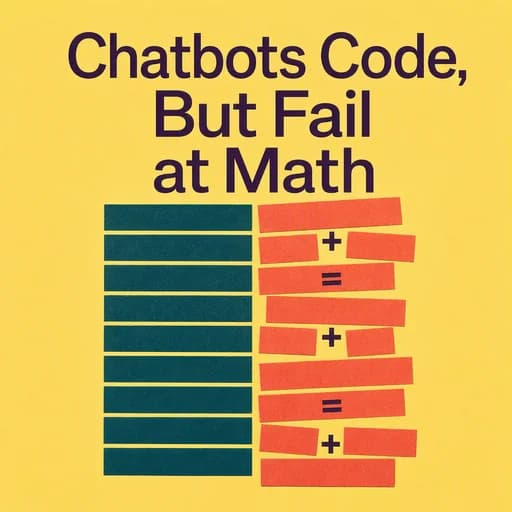
Bestes Zitat aus AI Logic: Why Chatbots Code Well but Fail at Math and Facts
These models aren't 'thinking'—they’re just really, really good at guessing what word comes next, and that is a massive problem if you need actual, grounded truth.
Generated by muskan
An exploration of why AI excels at writing code while struggling with math, focusing on the tension between probabilistic next-token prediction and symbolic reasoning. Use the concept of Retrieval-Augmented Generation (RAG) from the attached IBM source to explain how grounding models in external frameworks can help bridge this logic gap.



Häufig gestellte Fragen
Marina Danilevsky is a Senior Research Scientist at IBM Research who explores the fundamental limitations of Large Language Models. She highlights a significant gap in AI logic, noting that while chatbots can generate functional code in seconds, they often fail at basic factual questions. Her research emphasizes that these models are not truly thinking but are instead predicting the next word based on their training data, which leads to confident but incorrect answers.
Large Language Models often act like a toddler with a calculator because they rely on predicting the next word rather than understanding logic or grounded truth. According to Marina Danilevsky, a major challenge is that their information is constantly going out of date. Because they are stuck in training data from years ago, they may provide objectively wrong answers, such as misidentifying which planet has the most moons, with total confidence.
The primary LLM challenges identified by Marina Danilevsky at IBM Research include the lack of source attribution and the tendency for information to become outdated. These models prioritize word prediction over actual logic, which results in 'hallucinations' where the AI provides incorrect facts. This creates a massive problem for users who require grounded truth, as the models cannot distinguish between their training data and current, objective reality.
Von Columbia University Alumni in San Francisco entwickelt
BeFreed vereint eine globale Gemeinschaft wissbegieriger Menschen


"Instead of endless scrolling, I just hit play on BeFreed. It saves me so much time."


"I never knew where to start with nonfiction—BeFreed’s book lists turned into podcasts gave me a clear path."


"Perfect balance between learning and entertainment. Finished ‘Thinking, Fast and Slow’ on my commute this week."
"Crazy how much I learned while walking the dog. BeFreed = small habits → big gains."
"Reading used to feel like a chore. Now it’s just part of my lifestyle."

"Feels effortless compared to reading. I’ve finished 6 books this month already."
"BeFreed turned my guilty doomscrolling into something that feels productive and inspiring."

"BeFreed turned my commute into learning time. 20-min podcasts are perfect for finishing books I never had time for."
"BeFreed replaced my podcast queue. Imagine Spotify for books — that’s it. 🙌"

"It is great for me to learn something from the book without reading it."
"The themed book list podcasts help me connect ideas across authors—like a guided audio journey."
"Makes me feel smarter every time before going to work"
Von Columbia University Alumni in San Francisco entwickelt
BeFreed vereint eine globale Gemeinschaft wissbegieriger Menschen
"Instead of endless scrolling, I just hit play on BeFreed. It saves me so much time."
"I never knew where to start with nonfiction—BeFreed’s book lists turned into podcasts gave me a clear path."
"Perfect balance between learning and entertainment. Finished ‘Thinking, Fast and Slow’ on my commute this week."
"Crazy how much I learned while walking the dog. BeFreed = small habits → big gains."
"Reading used to feel like a chore. Now it’s just part of my lifestyle."
"Feels effortless compared to reading. I’ve finished 6 books this month already."
"BeFreed turned my guilty doomscrolling into something that feels productive and inspiring."
"BeFreed turned my commute into learning time. 20-min podcasts are perfect for finishing books I never had time for."
"BeFreed replaced my podcast queue. Imagine Spotify for books — that’s it. 🙌"
"It is great for me to learn something from the book without reading it."
"The themed book list podcasts help me connect ideas across authors—like a guided audio journey."
"Makes me feel smarter every time before going to work"
"Instead of endless scrolling, I just hit play on BeFreed. It saves me so much time."
"I never knew where to start with nonfiction—BeFreed’s book lists turned into podcasts gave me a clear path."
"Perfect balance between learning and entertainment. Finished ‘Thinking, Fast and Slow’ on my commute this week."
"Crazy how much I learned while walking the dog. BeFreed = small habits → big gains."
"Reading used to feel like a chore. Now it’s just part of my lifestyle."
"Feels effortless compared to reading. I’ve finished 6 books this month already."
"BeFreed turned my guilty doomscrolling into something that feels productive and inspiring."
"BeFreed turned my commute into learning time. 20-min podcasts are perfect for finishing books I never had time for."
"BeFreed replaced my podcast queue. Imagine Spotify for books — that’s it. 🙌"
"It is great for me to learn something from the book without reading it."
"The themed book list podcasts help me connect ideas across authors—like a guided audio journey."
"Makes me feel smarter every time before going to work"
"Instead of endless scrolling, I just hit play on BeFreed. It saves me so much time."
"I never knew where to start with nonfiction—BeFreed’s book lists turned into podcasts gave me a clear path."
"Perfect balance between learning and entertainment. Finished ‘Thinking, Fast and Slow’ on my commute this week."
"Crazy how much I learned while walking the dog. BeFreed = small habits → big gains."
"Reading used to feel like a chore. Now it’s just part of my lifestyle."
"Feels effortless compared to reading. I’ve finished 6 books this month already."
"BeFreed turned my guilty doomscrolling into something that feels productive and inspiring."
"BeFreed turned my commute into learning time. 20-min podcasts are perfect for finishing books I never had time for."
"BeFreed replaced my podcast queue. Imagine Spotify for books — that’s it. 🙌"
"It is great for me to learn something from the book without reading it."
"The themed book list podcasts help me connect ideas across authors—like a guided audio journey."
"Makes me feel smarter every time before going to work"

![[c52af992-85db-4d23-b4a5-01818164d9db:c0000] The full-length interview with Elon Musk | The Economist p1-1](/_next/image?url=https%3A%2F%2Fd1y2du6z1jfm9e.cloudfront.net%2Fassets%2Fpodcast%2Fyellow.png&w=1024&q=50)
![[c52af992-85db-4d23-b4a5-01818164d9db:c0002] The full-length interview with Elon Musk | The Economist p1-1](/_next/image?url=https%3A%2F%2Fd1y2du6z1jfm9e.cloudfront.net%2Fassets%2Fpodcast%2Fblue.png&w=1024&q=50)
![[a48d98ac-788d-4fb4-b201-5e1aec379a48:c0002] The Uncomfortable Truth About AI “Reasoning” | World Science Festival p1-1](/_next/image?url=https%3A%2F%2Fd1y2du6z1jfm9e.cloudfront.net%2Fassets%2Fpodcast%2Fgreen.png&w=1024&q=50)