Kapitel 1
The Language That Never Sits Still: A Journey Through Words in Motion
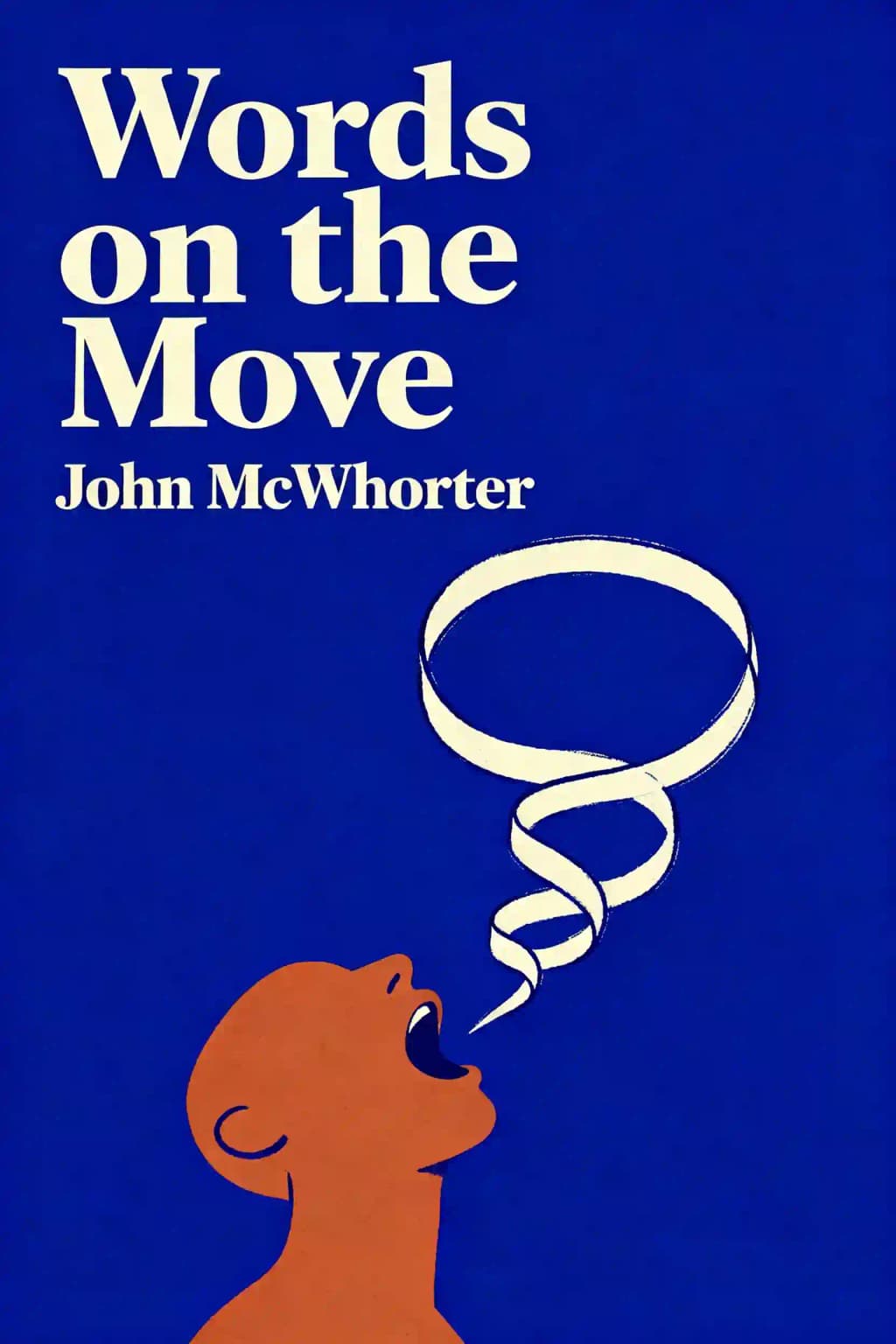
Language isn't just a tool we use-it's alive. While most of us imagine words as fixed entities with stable meanings, John McWhorter's "Words on the Move" reveals a startling truth: language is in constant motion, evolving beneath our awareness like a living organism. This book has become a favorite among linguists and word enthusiasts alike, with figures like Stephen Fry calling it "utterly fascinating" and Neil deGrasse Tyson praising its ability to make linguistics accessible. McWhorter's approach has revolutionized how we understand everyday speech, showing that what many consider "errors" or "sloppiness" are actually natural evolutionary processes that have shaped language for millennia. As polarizing debates about "proper English" rage on social media, this book offers a refreshing perspective: language change isn't decay-it's life itself.
Kapitel 2
The Human Face of Language: How Words Express Our Inner Lives
Language does far more than convey information-it expresses our humanity. Just as Western art evolved to capture individual expression, language has always been ahead of this curve, with words naturally shifting from objective meanings toward subjective feelings. This movement from the concrete to the personal represents one of language's most fundamental patterns, reflecting how deeply intertwined language is with human emotional and social experience.
Consider how we use "well" at the beginning of sentences. It doesn't add factual content but expresses attitude-politely acknowledging what someone said before offering a different view. When someone says "Well, that's not exactly how I remember it," they're not just contradicting but cushioning their disagreement. Words like these belong to what linguists call "pragmatics" rather than "semantics," functioning as modal pragmatic markers (MPMs) that express personal stance rather than objective meaning. Other examples include phrases like "I mean," "you know," and "sort of," which serve similar social functions.
This shift toward subjectivity happens constantly across languages and time periods. The word "must" originally expressed external commands ("You must obey") but evolved to indicate personal certainty ("This must be the place"). "Rather" meant "earlier" before shifting to express preference ("I'd rather stay home"). Even basic words like "pretty" began describing physical beauty before becoming degree modifiers ("pretty good"). McWhorter identifies four primary functions these personal markers serve, creating the acronym FACE: Factuality, Acknowledgment, Counterexpectation, and Easing-representing much of what makes human conversation distinctly human.
Words like "literally" exemplify this evolution in dramatic fashion. Originally meaning "by the letter," it extended to metaphorical usage as early as the 18th century as speakers sought stronger ways to express sincerity. Today's complaints about its "misuse" ignore centuries of natural semantic development. Similarly, "totally" evolved from meaning "completely" to becoming a warm acknowledgment of others' perspectives ("That's totally what I was thinking!"). Even seemingly modern expressions like "I know, right?" serve as agreement markers that create social connection rather than conveying new information. The phrase "actually" has undergone a similar transformation, moving from indicating factual reality to often signaling gentle contradiction.
These patterns aren't random innovations but reflect fundamental human qualities that emerge across cultures and languages. Factuality markers fulfill our commitment to truth and our need to indicate degrees of certainty. Acknowledgment stems from our theory of mind-our ability to understand and respond to others' mental states. Counterexpectation helps us highlight what stands out against our expectations, allowing us to express surprise or emphasis. Easing creates comfort in social interaction by softening potential conflicts and maintaining relationships. Together, these elements transform mere speaking into genuine human connection-the difference between data transfer and conversation. This explains why even artificial intelligence, despite mastering grammar and vocabulary, often struggles to replicate the natural flow and emotional resonance of human dialogue.
Kapitel 3
When Words Drift: The Natural Evolution of Meaning
Words rarely maintain their original meanings over time. They naturally evolve through implications that gradually become core meanings, with stability being the exception rather than the rule. This process happens as each generation interprets implications as essential meanings, often transforming words so dramatically that their original meanings become unrecognizable.
Consider "silly," which began as Old English "slig" meaning "blessed" and evolved through a series of implications: blessed -> innocent -> deserving pity -> weak -> foolish. This transformation wasn't planned but emerged naturally through usage patterns. Similarly, "minority" began as a purely numerical term but has transformed in American English to specifically refer to Black and Latino people, regardless of actual population proportions.
These changes involve significant elements of chance. Words like "merry" evolved from meaning "short" to "pleasant" through implication (short things being pleasant because many things go on too long), while the same Proto-Indo-European root "mregh" became "brakhion" (upper arm) in Greek, then transformed into both "pretzel" and "bra" through different linguistic pathways.
Shakespeare's language illustrates how dramatically meanings shift. When Macbeth speaks of Duncan's "virtues" that "will plead like angels" against "the deep damnation of his knocking-off," modern audiences miss that "knocking-off" simply meant killing. About 10% of Shakespeare's vocabulary has completely changed meaning, creating significant barriers to understanding for modern audiences.
Even corporate speak like "What's the ask?" continues English's thousand-year tradition of transforming verbs into nouns. These aren't mere substitutions but new terms with distinct connotations. "Solution" carries schoolroom associations inappropriate for business settings, while "solve" feels clean and direct.
The "euphemism treadmill"-where terms created for objectivity inevitably acquire negative associations and require replacement-is another natural consequence of how words evolve. "Home relief" gave way to "welfare" which yielded to "cash assistance" as each term accumulated unintended connotations. This isn't evidence of political correctness gone mad but simply words behaving as they always have-collecting associations through lived experience.
Kapitel 4
From Words to Grammar: The Lifecycle of Language Elements
Words don't just change meaning-sometimes they lose independence entirely, becoming parts of new words or grammatical elements. This transformation process, called grammaticalization, represents another fundamental pattern in language evolution. It's a fascinating journey that reveals how living languages continuously reinvent themselves through predictable patterns.
The phrase "used to" demonstrates this process perfectly. Though spelled with the word "use," its pronunciation ("yoosta" not "yoozed to") and function reveal it's become something entirely different. "Used to" began as the verb "use" meaning "to have the habit of"-as in Thomas Casberd's 1550 record that he "has used to set his cart in the street." Over time, this meaning generalized beyond deliberate habits to any ongoing past state, even for inanimate objects that couldn't possibly have "habits" ("My cello used to have a richer sound"). Similar transformations can be seen in phrases like "going to" becoming "gonna" for future events, or "want to" becoming "wanna" in casual speech.
When words become grammatical tools, they undergo profound transformation. They lose emphasis in speech, getting mumbled rather than accented, and often experience what linguists call "phonetic reduction." The suffix -ly in words like "slowly" began as "like" (pronounced "leek"), but through constant use lost its accent and final consonant until it became merely a grammatical marker. Similarly, -hood in "childhood" originated from an Old English word "hod" meaning "condition." Other examples include the word "very," which derives from the Latin "verus" meaning "true," and "just," which comes from the Latin "iustus" meaning "righteous" or "fair."
The final stage in grammaticalization can be complete disappearance. After becoming an unaccented appendage to other words, these grammatical markers may eventually wear away entirely. This happened with English verbs, which in Old English all ended with -an (similar to German's -en endings). Over time, the -n dropped off, leaving just a vulnerable vowel sound that eventually disappeared completely during the Middle English period. French demonstrates a similar pattern, where Latin word endings gradually eroded, leading to silent consonants at the ends of many modern French words.
If grammatical endings constantly wear away, how does language maintain its grammar? First, not all grammatical elements erode equally-those essential for meaning persist longer than less crucial ones. For instance, plural markers tend to be more resilient than gender markers. Second, and crucially, new grammatical elements are continuously being created through grammaticalization. As older forms wear away, speakers coax new words into becoming grammar-like English using "to" to mark infinitives after the -an ending disappeared. Modern examples include the emergence of "because + noun" ("because science") and the use of "like" as a discourse marker, showing how grammaticalization continues to shape contemporary language.
This cycle of grammatical innovation and erosion ensures that languages maintain their expressive power while constantly evolving. The process can be observed in action across many languages, from the development of future tense markers from motion verbs ("going to") to the creation of new prepositions from body parts (like "back of" or "in front of").
Kapitel 5
The Shifting Sounds: How Pronunciation Evolves
English spelling creates a major obstacle to understanding how sounds actually work. Letters aren't sounds in any meaningful way-the same letter can represent multiple sounds (the 'u' in cute, cut, and put) while the same sound can be spelled various ways (as in free, these, leaf, field, seize, key, machine).
Vowels exist in an open field within our mouths, not fixed positions but moving entities that can occupy countless possible locations. Each language uses only a fraction of these possibilities. Vowels move because people are imperfect mimics, with each generation subtly altering pronunciations. While language contact can influence these shifts, vowel drift occurs naturally even in isolation.
The Northern Cities Shift explains why people in places like upstate New York say "keh-it" instead of "cat." Their vowels have systematically shifted-the "bat" vowel moved upward toward "bet," while "baht" moved to fill the vacant "bat" position. This creates a chain reaction where someone might pronounce "the cat on the block" more like "the keh-it on the black."
The Great Vowel Shift of the fifteenth and sixteenth centuries provides compelling evidence of this process. English spelling appears so chaotic largely because it preserves pronunciations from before this historical shift occurred. Words like "mate" were once pronounced "MAH-tay" before evolving to "maht" and eventually to today's pronunciation, while the spelling remained unchanged. These systematic vowel movements created a beautiful, almost mathematical pattern where sounds were pushed from one position to another, explaining oddities like why "food," "good," and "flood" don't rhyme despite similar spelling.
Even century-old pronunciations sound strange to modern ears. William Henry P. Phyfe's late 19th-century pronunciation guide reveals how dramatically American English has changed. He recommended "dahnt," "hahnt," and "tahnt" for daunt, haunt, and taunt, and "lahndry" for laundry. Word stress patterns have also shifted dramatically-Phyfe advocated con-TEM-plate instead of CON-template, melo-DRA-ma instead of MEL-o-drama, and EX-quisite rather than ex-QUIS-ite.
Kapitel 6
When Words Mate: The Creation of New Vocabulary
Words don't exist in isolation-they constantly interact and blend together in a dynamic linguistic ecosystem. Though we separate them with spaces in writing, natural speech contains no such gaps, creating a fluid stream where words naturally blend and influence each other. This proximity leads to fascinating instances of blending and sharing, ultimately creating entirely new vocabulary that enriches our language.
Word blending creates new vocabulary through a process linguists call "lexical blending" - when existing words mate and reproduce. Historical examples like "flush" (from "flash" meeting "gush") and "twirling" (combining "twisting" and "whirling") have ancient origins dating back centuries. Modern media and digital communication have dramatically accelerated the adoption of playful coinages like "palimony" (pal + alimony), "staycation" (stay + vacation), "brunch" (breakfast + lunch), and "hangry" (hungry + angry) through constant repetition and artificial community exposure. Social media particularly excels at spreading these linguistic innovations globally within days.
Old English demonstrated remarkable creativity in word formation, particularly by combining the negative particle "ne" with verbs: "ne + have" became "nave," "ne + am" became "nam." Modern English preserves this ancient pattern in commonly used words like "none" (ne + one), "never" (ne + ever), "neither" (ne + either), and the peculiar expression "willy-nilly" (will + nill). Our modern contractions like "isn't," "haven't," and "won't" continue this tradition of efficient negative combinations.
The transformation of verbs into nouns in English often follows a distinctive stress pattern called noun-verb stress differentiation. When verbs become nouns, the accent frequently shifts backward: someone who re-BELS becomes a REB-el, things you re-CORD go on REC-ord, and what you per-MIT becomes a PER-mit. This "Backshift" phenomenon serves as a linguistic marker indicating when a word transitions from describing an action to naming "a thing." Contemporary examples include how words like "super-MARKET" in 1950s films evolved into "SUPER-market" as the concept became familiar and standardized.
When words mate to form compounds, they often undergo gradual transformation that obscures their original components. In everyday terms like "policeman" and "fireman," the unaccented "-man" naturally evolves into a fuzzy "mun" through regular use and enunciational wear. More dramatic examples show how both elements can blur beyond recognition-"cupboard" becomes "cubberd" with no practical connection to cups or boards, "breakfast" loses its original meaning of breaking a fast, and "daisy" completely conceals its poetic origin as "day's eye." Modern examples include "goodbye" (from "God be with you") and "fortnight" (from "fourteen nights").
The evolution of compound words sometimes results in linguistic efficiency through reduction. The second word in a compound may eventually drop off entirely, leaving the first word to assume the complete meaning. "Pizza pie" simplified to just "pizza"-a term that would have seemed foreign to Americans before World War II. Similar patterns appear in technology terms, where "cellular PHONE" became "CELL phone" and eventually just "cell," and "electronic mail" condensed to "email." This process of reduction continues today with terms like "cryptocurrency" becoming simply "crypto" and "influencer marketing" shortening to "influencer."
Kapitel 7
The Impact of Writing on Language Perception
Our conception of language is profoundly influenced by writing, which appears fixed and permanent compared to the fluid nature of speech. This creates a persistent illusion that language should remain constant and unchanging. Writing systems have actually served as a powerful brake on language change throughout history. Consider that Shakespeare, writing in Early Modern English, would have found the Old English of 600 years before his time completely incomprehensible - it would have seemed as foreign as German or Dutch does to modern readers. Yet we can still largely understand Shakespeare's works 400 years later, primarily because widespread literacy and standardized printing emerged after his time and helped stabilize the language.
However, English has undergone more significant changes since Shakespeare's era than many realize. Modern audiences attending Shakespeare's plays without preparation or annotation often struggle with the text, confused by words whose meanings have shifted dramatically over centuries. "Brave" meant showy or flashy rather than courageous, "silly" meant blessed or innocent rather than foolish, and "awful" meant inspiring awe rather than terrible. Even works from the 19th century like Moby-Dick contain vocabulary whose meanings differ substantially from current usage - "wonderful" indicated something strange or marvel-inducing rather than pleasant, "pitiful" meant "showing pity" rather than pathetic, and "nervous" meant vigorous rather than anxious. These semantic shifts demonstrate how even seemingly stable written language continues to evolve.
The much-debated modern usage of "like" serves as a perfect case study of language's constant evolution. Even in its traditional form, "like" underwent dramatic transformations - it originated from the Old English word "lic" meaning "body," which was part of "gelic" ("with the body of") meaning "similar to." This gradually shortened to just "like" through regular processes of linguistic change. The word also transformed into the common suffix "-ly" (as in "quickly" from "quick-like" or "friendly" from "friend-like"), showing how a single word can spawn multiple grammatical functions.
Modern English has developed three distinct new uses of "like," each serving a specific grammatical function: 1) "reinforcing like" that emphasizes factuality while acknowledging counterexpectation ("I opened the door and it was, like, her!" - indicating surprise while confirming truth); 2) "easing like" that softens potentially unwelcome statements or hedges assertions ("This is, like, the only way to make it work" - reducing the force of absolute statements); and 3) "quotative like" for reporting speech or thoughts ("And she was like, 'I didn't even invite him'" - marking reported discourse). Far from being mere verbal tics of youth culture, these uses have become established grammatical elements, similar to modal markers found in other languages such as Japanese particles or German modal verbs. This evolution mirrors historical patterns where concrete words gradually acquire abstract grammatical functions, demonstrating how living languages continuously adapt to serve new communicative needs.
Kapitel 8
Embracing Language Change: Beyond Prescriptivism
While linguists recognize that all language variations are valid, they don't advocate abandoning standards for formal contexts. The key is shedding contempt for different speech patterns while acknowledging certain forms are more appropriate in specific settings. Young people should learn when to minimize "like" in formal speaking, as its association with tentativeness will persist despite its grammatical legitimacy. This mirrors how we adjust our clothing choices for different occasions - what works for a beach party differs from what's expected in a boardroom.
The evolution of language reflects social changes and needs. Consider how "text" became a verb, how "google" transformed from a company name to a universal verb for online searching, or how "literally" acquired a figurative meaning through widespread usage. Each change represents not a degradation but an adaptation to new communicative needs.
We should treat language standards as matters of fashion rather than morality-sometimes you need to tuck in your shirt (or your "likes"), but casual speech isn't inherently wrong. The fury some harbor over language usage may be the last permissible open classism, channeling tribalist impulses with disproportionate rage over minor constructions like singular "their." This prejudice often masks deeper social biases, as seen in reactions to African American Vernacular English or regional dialects.
Meanwhile, language continues evolving-"all" becoming a quotative marker ("and he was all, 'no way'"), "no" being used to agree by negating implied contradiction ("Did you sleep through your alarm?" "No, literally"), and "based off of" replacing "based on" for younger speakers. Digital communication has accelerated these changes, introducing new conventions like intentional misspellings ("smol" for "small") and acronyms that become spoken words (LOL, IRL).
Rather than viewing these changes as desecrations like Jonathan Swift did with shortened "-ed" endings, we should embrace language as something always becoming, never still-a living parade rather than a tableau frozen in time. Historical examples prove this point: Shakespeare's English would have seemed corrupt to Chaucer, and Chaucer's would have been barely recognizable to speakers of Old English.
Language lives through constant change, not despite it. By embracing this reality, wonder replaces disgust, curiosity replaces condemnation, and overall, we have a lot more fun with the words that connect us. Each generation's linguistic innovations contribute to the rich tapestry of expression, from new slang terms to creative compounds and metaphors. Maybe some prefer their language pressed dry like flowers in books, but most seek life-and life, by definition, means growth, change, and evolution. This natural progression ensures language remains relevant and vital for each new generation of speakers.
Kapitel 9
The Living Legacy: Why Language Change Matters
McWhorter's exploration of language evolution isn't merely academic-it has profound implications for how we understand human communication and identity. Language change reflects the fundamental human drive toward expression, connection, and adaptation. The words we use today carry the DNA of countless generations before us, each adding their own subtle modifications. Consider how "goodbye" evolved from "God be with you," or how "nice" once meant "foolish" before gradually shifting to its current positive meaning.
Understanding language as a living system rather than a fixed code helps us approach linguistic differences with curiosity rather than judgment. The teenager using "like" in innovative ways is participating in the same evolutionary process that transformed Old English into the language of Shakespeare and then into modern English. What we now consider proper English would be barely recognizable to speakers from a millennium ago. Regional accents, slang, and emerging grammatical patterns aren't corruptions but continuations of language's natural lifecycle. For instance, the word "literally" gaining a figurative meaning, while controversial, follows historical patterns of words developing intensifier functions.
This perspective also helps us understand why attempts to freeze language in time inevitably fail. From the French Academy's efforts to preserve "pure" French to English teachers marking students down for split infinitives, prescriptive approaches fight against the very nature of language itself. Even Noah Webster's attempts to standardize American spelling only partially succeeded - many of his proposed changes, like "wimmen" for "women," never caught on. Words will continue their journey from concrete to abstract, from objective to subjective, from independent to grammatical-not because speakers are careless but because language itself is dynamic.
By recognizing language as something that moves rather than something that sits still, we gain a deeper appreciation for the rich tapestry of human communication. Modern innovations like emoji and internet slang represent the latest chapter in humanity's ongoing experiment with expression. Text speak, far from destroying language, adds new layers of nuance and meaning. The next time you hear someone complain about language "errors," remember that today's mistakes are tomorrow's standard usage-and that this process has been unfolding for as long as humans have been speaking. Just as "thou" gave way to "you," and "whom" is gradually disappearing from everyday speech, language isn't broken; it's evolving exactly as it should.
This natural evolution extends beyond vocabulary to grammar and syntax. The ongoing shift from "whom" to "who" in questions, the increasing acceptance of "they" as a singular pronoun, and the emergence of new verbal constructions like "I'm gonna" all demonstrate how language adapts to serve its speakers' needs. Each generation leaves its linguistic fingerprint, contributing to an ever-evolving system that remains both efficient and expressive.