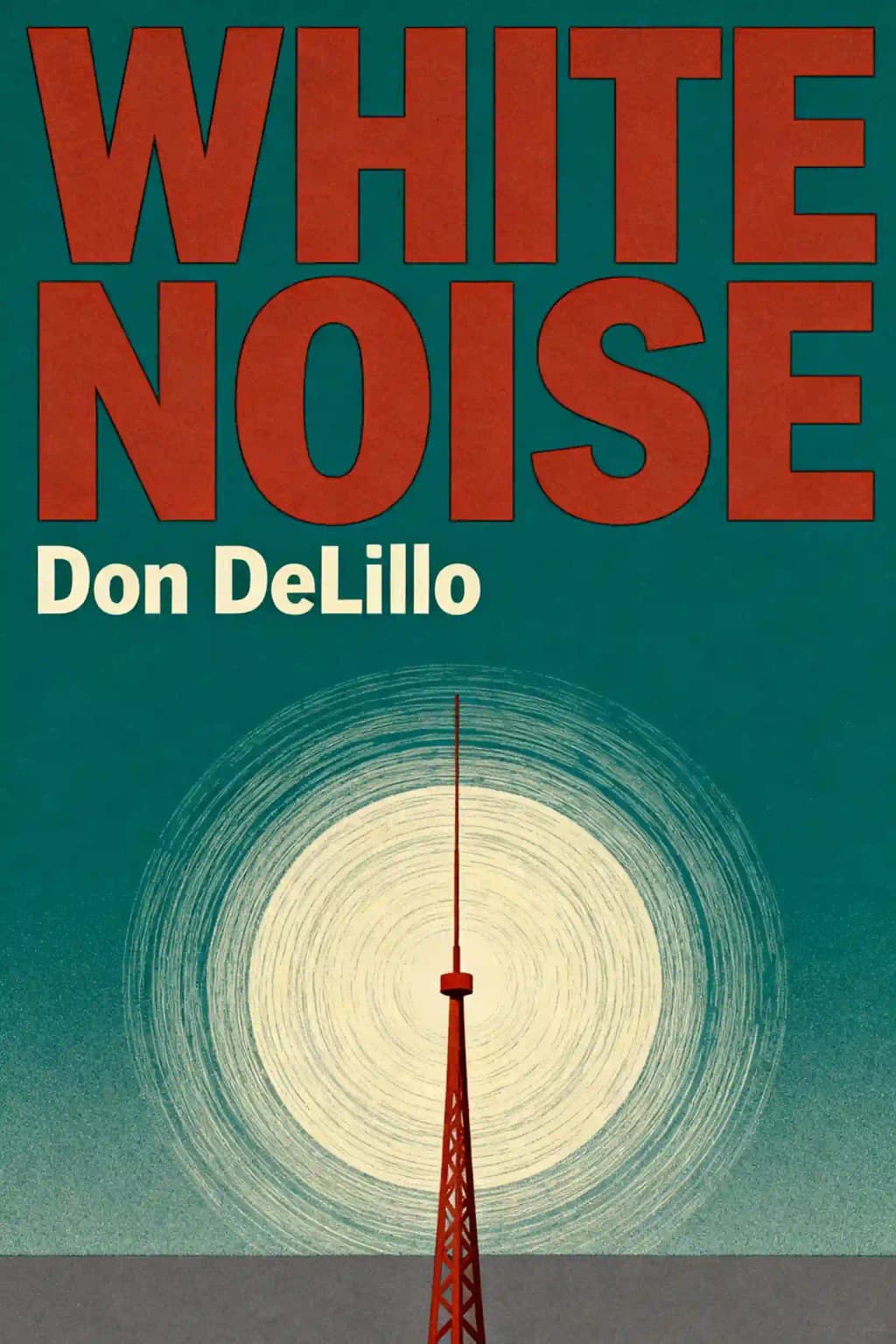
DeLillo's postmodern masterpiece explores suburban America's existential dread amid consumer culture and information overload. This National Book Award winner captivated Noah Baumbach enough to direct its Netflix adaptation starring Adam Driver - proving why Time magazine crowned it among America's greatest novels.
Donald Richard DeLillo is the critically acclaimed author of White Noise and one of America's most influential postmodernist novelists. Born in the Bronx in 1936 and educated at Fordham University, DeLillo examines consumerism, mass culture, technology, and mortality through darkly satirical fiction that dissects contemporary American life.
White Noise, published in 1985, brought him mainstream recognition and won the National Book Award, cementing his reputation as a master of literary fiction exploring modern anomie and media saturation.
DeLillo's other landmark works include Underworld, an epic Cold War masterpiece; Libra, a fictional exploration of the JFK assassination; and Mao II, which earned the PEN/Faulkner Award. Often compared to Thomas Pynchon, he has received prestigious honors including the Jerusalem Prize, the PEN/Saul Bellow Award, and the Library of Congress Prize for American Fiction. White Noise topped bestseller lists upon release and remains a defining work of postmodern American literature, continuing to resonate with readers exploring the anxieties of contemporary existence.
White Noise by Don DeLillo follows Jack Gladney, a college professor specializing in Hitler Studies, as he navigates mundane family life and existential fears in 1980s America. The novel explores themes of death anxiety, consumerism, and media saturation through three sections, culminating in an "Airborne Toxic Event" that disrupts Jack's suburban routine and exposes his family's deepest fears about mortality, technology, and the overwhelming noise of modern existence.
White Noise by Don DeLillo is ideal for readers interested in postmodern literature, social satire, and philosophical fiction. The novel appeals to those fascinated by critiques of American consumer culture, media obsession, and existential themes. Readers who enjoy intellectually stimulating narratives with dark humor, distinctive prose, and commentary on technology's impact on society will find Don DeLillo's examination of late 20th-century anxieties particularly compelling and thought-provoking.
White Noise by Don DeLillo remains highly relevant decades after its 1985 publication. The novel offers prescient insights into media saturation, information overload, and technological anxiety that resonate strongly today. Don DeLillo's precision prose, sharp social commentary, and unique blend of satire with genuine tenderness create a distinctive reading experience. The book's exploration of death anxiety, consumer culture, and modern existence makes it essential reading for understanding contemporary American literature.
White Noise by Don DeLillo was published in 1985 during the late Cold War era. The novel captures the rise of mass media, especially television, and burgeoning consumer culture of the 1980s. Don DeLillo's work reflects anxieties about environmental threats, technological advancement, and the commodification of knowledge. Often considered DeLillo's "breakthrough" work, White Noise established him as a major voice in postmodern American literature and won the National Book Award.
The Airborne Toxic Event in White Noise is a catastrophic chemical spill caused by a train crash that forces Jack Gladney's family to evacuate their town. This central plot event serves as a metaphor for invisible environmental threats and modern industrial dangers. The event transforms the characters' perception of reality, making abstract fears about death and contamination suddenly concrete. It represents how technology and progress create pervasive, often invisible dangers in contemporary society.
"All plots tend to move deathward" is Jack Gladney's spontaneous pronouncement in White Noise by Don DeLillo that encapsulates the novel's central theme. This quote suggests that all narratives and human endeavors inevitably move toward mortality as their ultimate destination. Don DeLillo uses this phrase to explore how death shadows every aspect of life, meaning-making, and storytelling. The statement reflects the book's philosophical examination of how death anxiety pervades contemporary existence.
The main theme of White Noise by Don DeLillo is the pervasive fear of death in modern American life. The novel explores how consumer culture, media saturation, and technology create constant distractions from mortality while simultaneously amplifying death anxiety. Don DeLillo examines how characters attempt to cope with existential dread through shopping, information consumption, and pharmaceutical solutions like the fictional drug Dylar, revealing how contemporary society commodifies even our deepest fears.
Jack Gladney is the first-person narrator of White Noise by Don DeLillo, a college professor who founded the Department of Hitler Studies. Jack represents the modern intellectual grappling with profound existential anxiety beneath a veneer of academic authority. His character embodies the contradictions of contemporary life—he analyzes historical atrocities professionally while struggling with mundane fears about death, health, and his wife Babette's fidelity. Jack's journey reveals how postmodern existence creates anxiety despite material comfort.
Dylar is a fictional experimental drug in White Noise by Don DeLillo designed to eliminate the fear of death. Jack's wife Babette secretly participates in drug trials and has an affair with project manager Willie Mink to obtain Dylar. The drug represents society's attempt to pharmaceutical solutions for existential problems and the commodification of human experience. Don DeLillo uses Dylar to satirize how modern culture seeks technological fixes for fundamental aspects of the human condition.
White Noise by Don DeLillo critiques consumerism by showing how shopping and brand consumption become substitutes for authentic meaning and identity. Don DeLillo presents supermarket scenes as almost religious experiences, with characters finding comfort in product names and packaging. The novel suggests a "consume or die" mentality pervades American culture, where personal identity becomes inseparable from consumer choices. The constant litany of brand names and products creates a hypnotic effect that mirrors consumer culture's overwhelming presence.
White Noise by Don DeLillo employs hyper-realistic dialogue that sounds naturalistic yet philosophically elevated, with characters speaking in pronouncements and lists. Don DeLillo uses repetition of brand names, symptoms, and phrases to create an incantatory effect that mirrors information overload. The novel maintains ironic detachment and dark satire while exploring serious themes. DeLillo's precise, rhythmic prose blends intellectual discourse with moments of genuine tenderness, creating what readers describe as realistic absurdity.
White Noise by Don DeLillo faces criticism for its dense philosophical dialogue that some readers find overly academic or pretentious. Critics note the novel's detached, ironic tone may create emotional distance from characters, making it challenging to connect deeply with their experiences. Some argue Don DeLillo's satire of consumer culture becomes repetitive, and the emphasis on postmodern themes overshadows narrative momentum. However, these stylistic choices are intentional elements of DeLillo's postmodern approach to contemporary American life.
Erlebe das Buch durch die Stimme des Autors
Verwandle Wissen in fesselnde, beispielreiche Erkenntnisse
Erfasse Schlüsselideen blitzschnell für effektives Lernen
Genieße das Buch auf unterhaltsame und ansprechende Weise
Who will die first?
This place recharges us spiritually.
Everything was fine.
Media as meaning-maker and media as destroyer.
Reality itself becomes mediated.
Zerlegen Sie die Kernideen von White Noise (31942) in leicht verständliche Punkte, um zu verstehen, wie innovative Teams kreieren, zusammenarbeiten und wachsen.
Destillieren Sie White Noise (31942) in schnelle Gedächtnisstützen, die die Schlüsselprinzipien von Offenheit, Teamarbeit und kreativer Resilienz hervorheben.

Erleben Sie White Noise (31942) durch lebhafte Erzählungen, die Innovationslektionen in unvergessliche und anwendbare Momente verwandeln.
Fragen Sie alles, wählen Sie die Stimme und erschaffen Sie gemeinsam Erkenntnisse, die wirklich bei Ihnen ankommen.

Von Columbia University Alumni in San Francisco entwickelt
"Instead of endless scrolling, I just hit play on BeFreed. It saves me so much time."
"I never knew where to start with nonfiction—BeFreed’s book lists turned into podcasts gave me a clear path."
"Perfect balance between learning and entertainment. Finished ‘Thinking, Fast and Slow’ on my commute this week."
"Crazy how much I learned while walking the dog. BeFreed = small habits → big gains."
"Reading used to feel like a chore. Now it’s just part of my lifestyle."
"Feels effortless compared to reading. I’ve finished 6 books this month already."
"BeFreed turned my guilty doomscrolling into something that feels productive and inspiring."
"BeFreed turned my commute into learning time. 20-min podcasts are perfect for finishing books I never had time for."
"BeFreed replaced my podcast queue. Imagine Spotify for books — that’s it. 🙌"
"It is great for me to learn something from the book without reading it."
"The themed book list podcasts help me connect ideas across authors—like a guided audio journey."
"Makes me feel smarter every time before going to work"
Von Columbia University Alumni in San Francisco entwickelt

Erhalten Sie die White Noise (31942)-Zusammenfassung als kostenloses PDF oder EPUB. Drucken Sie es aus oder lesen Sie es jederzeit offline.
In the fictional town of Blacksmith, Jack Gladney has built his academic reputation as North America's foremost Hitler scholar-despite not speaking German. This professional insecurity mirrors his deeper fear: death. Jack shares this existential dread with his fourth wife Babette, as they preside over their blended household of children from various marriages. There's Heinrich, Jack's intellectually precocious fourteen-year-old; Denise, Babette's vigilant eleven-year-old who monitors her mother's health habits like a miniature FDA agent; sensitive Steffie; and toddler Wilder, whose pre-linguistic existence represents a purer form of being. Their home buzzes with the white noise of modern life-television chatter, radio announcements, kitchen debates about camels and environmental toxins. These ordinary family dynamics reveal how deeply information anxiety has penetrated everyday existence. Jack and Babette frequently ask each other, "Who will die first?"-a question that moves beyond theoretical when Jack is exposed to a mysterious chemical during an environmental disaster. Their approaches to mortality-Jack's academic immersion in Hitler, Babette's secret participation in an experimental drug trial-show how profoundly death anxiety shapes their identities and choices.