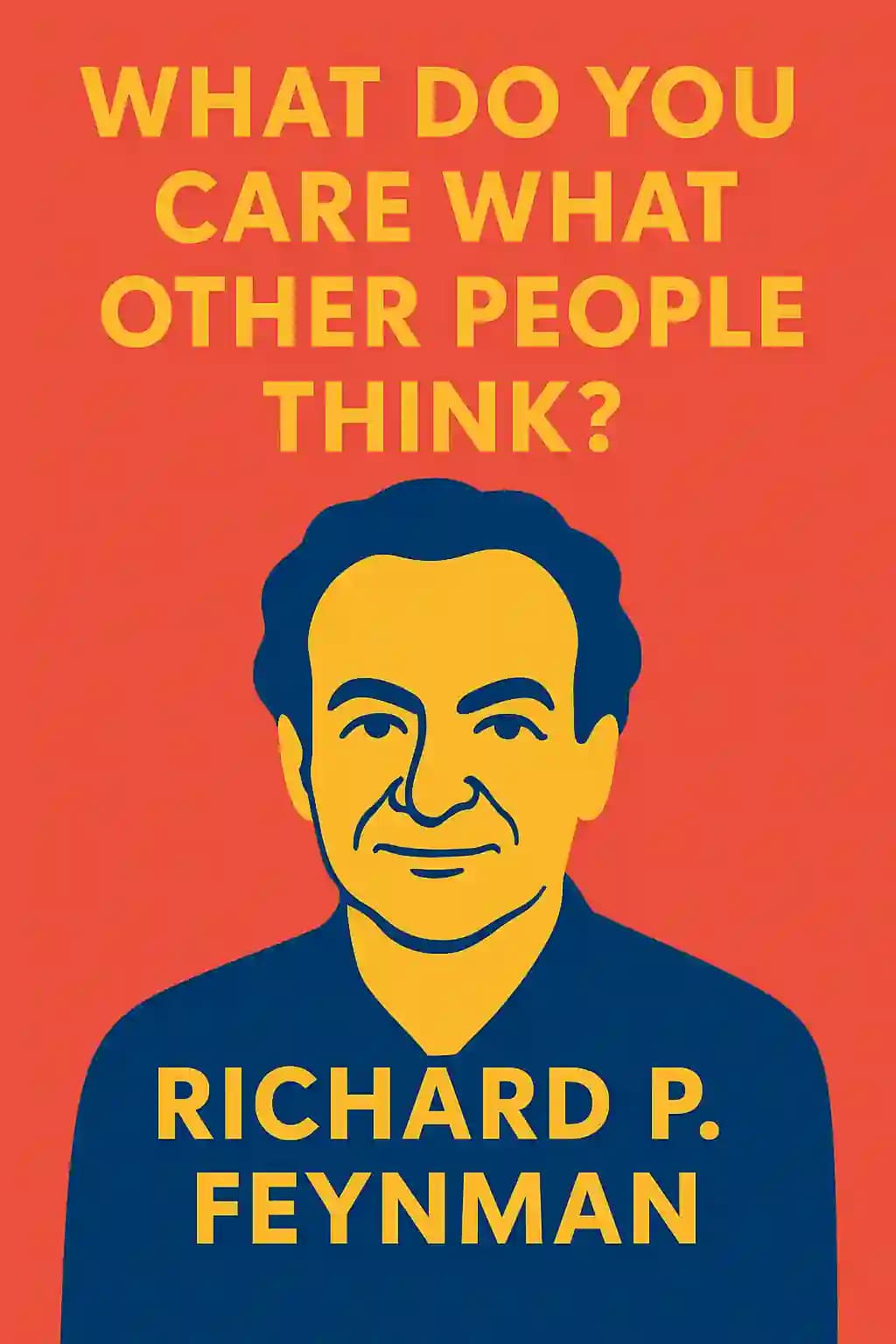
Nobel physicist Richard Feynman's final memoir explores scientific integrity, personal loss, and his famous Challenger disaster investigation. Beyond bestseller status, it reveals how one man's unflinching curiosity changed NASA forever with a simple O-ring experiment that exposed fatal bureaucratic flaws.
Richard Phillips Feynman (1918–1988), Nobel Prize-winning physicist and author of What Do You Care What Other People Think?, combines scientific brilliance with storytelling wit in this autobiographical work exploring curiosity, critical thinking, and human connection. Known for revolutionizing quantum electrodynamics and popularizing physics through accessible lectures, Feynman’s insights stem from his work on the Manhattan Project, his Nobel-winning research, and his pivotal role investigating the 1986 Challenger disaster.
The book’s blend of personal anecdotes and scientific philosophy mirrors his iconic Surely You’re Joking, Mr. Feynman!—another autobiographical classic summarized on our platform.
A gifted educator, Feynman’s The Feynman Lectures on Physics remains a global standard for physics education, while his BBC documentaries and lectures on quantum phenomena cemented his status as a master science communicator. His concept of “cargo cult science” and emphasis on intellectual integrity continue to influence researchers and educators. What Do You Care What Other People Think? has been translated into 18 languages and inspired multiple film adaptations, underscoring Feynman’s enduring cultural impact as both a scientific trailblazer and storyteller.
What Do You Care What Other People Think? combines personal memoirs and scientific inquiry, chronicling Richard Feynman’s experiences from his transformative relationship with his first wife, Arlene, to his pivotal role in investigating the 1986 Space Shuttle Challenger disaster. The book emphasizes curiosity, integrity, and the interplay between vulnerability and truth-seeking, framed by Feynman’s signature humor and unconventional approach to life.
This book is ideal for readers interested in scientific curiosity, autobiographical storytelling, or leadership lessons. Fans of Feynman’s earlier work (Surely You’re Joking, Mr. Feynman!), STEM enthusiasts, and those seeking insights into navigating bureaucracy with principled skepticism will find value in its blend of personal and professional anecdotes.
The title derives from a phrase Feynman’s first wife, Arlene, used to challenge his self-consciousness. Her mantra, “What do you care what other people think?”, shaped his lifelong commitment to intellectual honesty and authenticity, themes central to the book’s exploration of love, loss, and scientific rigor.
Feynman served on the Rogers Commission, where he identified the cause of the Challenger explosion: O-ring failure due to cold temperatures. His famous demonstration using ice water and a clamp highlighted NASA’s oversight of engineering risks, underscoring his advocacy for transparency over bureaucratic compliance.
Feynman’s anecdotes illustrate how these principles guided his scientific and personal life.
While both books blend humor and science, What Do You Care… delves deeper into emotional themes like grief and love, particularly through Feynman’s marriage to Arlene. It also focuses more on his later career, including the Challenger investigation, offering a mature reflection on his earlier adventures.
These quotes encapsulate Feynman’s ethos of truth-seeking.
Some critics note the book’s fragmented structure, shifting between personal stories and technical accounts. Others argue it lacks the levity of Feynman’s earlier work, though this reflects its more introspective tone.
His marriage to Arlene—despite her terminal illness—frames the book’s exploration of love and resilience. Her influence on his rejection of social conformity recurs in his scientific work, illustrating how personal relationships informed his intellectual boldness.
The book’s themes of ethical decision-making, scientific integrity, and balancing empathy with skepticism remain vital in fields like tech, healthcare, and leadership. Feynman’s critique of institutional complacency resonates in today’s debates on accountability.
Feynman recounts professional setbacks (e.g., initial Challenger resistance) and personal loss (Arlene’s death), showcasing resilience through adaptive problem-solving and emotional honesty. His stories reject shame, framing failure as a catalyst for growth.
Erlebe das Buch durch die Stimme des Autors
Verwandle Wissen in fesselnde, beispielreiche Erkenntnisse
Erfasse Schlüsselideen blitzschnell für effektives Lernen
Genieße das Buch auf unterhaltsame und ansprechende Weise
The first principle is that you must not fool yourself—and you are the easiest person to fool.
Fall in love with some activity, and do it! Nobody ever figures out what life is all about, and it doesn't matter. Explore the world. Nearly everything is really interesting if you go into it deeply enough.
Study hard what interests you the most in the most undisciplined, irreverent and original manner possible.
nobody knows why it's true.
What do you care what other people think!
Zerlegen Sie die Kernideen von What Do You Care What Other People Think? (Library Edition) in leicht verständliche Punkte, um zu verstehen, wie innovative Teams kreieren, zusammenarbeiten und wachsen.
Destillieren Sie What Do You Care What Other People Think? (Library Edition) in schnelle Gedächtnisstützen, die die Schlüsselprinzipien von Offenheit, Teamarbeit und kreativer Resilienz hervorheben.

Erleben Sie What Do You Care What Other People Think? (Library Edition) durch lebhafte Erzählungen, die Innovationslektionen in unvergessliche und anwendbare Momente verwandeln.
Fragen Sie alles, wählen Sie die Stimme und erschaffen Sie gemeinsam Erkenntnisse, die wirklich bei Ihnen ankommen.

Von Columbia University Alumni in San Francisco entwickelt
"Instead of endless scrolling, I just hit play on BeFreed. It saves me so much time."
"I never knew where to start with nonfiction—BeFreed’s book lists turned into podcasts gave me a clear path."
"Perfect balance between learning and entertainment. Finished ‘Thinking, Fast and Slow’ on my commute this week."
"Crazy how much I learned while walking the dog. BeFreed = small habits → big gains."
"Reading used to feel like a chore. Now it’s just part of my lifestyle."
"Feels effortless compared to reading. I’ve finished 6 books this month already."
"BeFreed turned my guilty doomscrolling into something that feels productive and inspiring."
"BeFreed turned my commute into learning time. 20-min podcasts are perfect for finishing books I never had time for."
"BeFreed replaced my podcast queue. Imagine Spotify for books — that’s it. 🙌"
"It is great for me to learn something from the book without reading it."
"The themed book list podcasts help me connect ideas across authors—like a guided audio journey."
"Makes me feel smarter every time before going to work"
Von Columbia University Alumni in San Francisco entwickelt

Erhalten Sie die What Do You Care What Other People Think? (Library Edition)-Zusammenfassung als kostenloses PDF oder EPUB. Drucken Sie es aus oder lesen Sie es jederzeit offline.
A Nobel Prize winner who played bongo drums in strip clubs. A physicist who picked locks at Los Alamos during the Manhattan Project. A professor who turned down prestigious awards because he despised ceremony. Richard Feynman embodied a radical truth: brilliance doesn't emerge from following the crowd - it flourishes when you stop caring what others think. This memoir isn't a conventional autobiography. It's a manifesto for intellectual independence, woven through intimate stories of love, loss, and the relentless pursuit of understanding. From childhood walks in the woods to investigating the Challenger disaster, Feynman demonstrates that the most profound insights come not from memorizing facts but from asking uncomfortable questions. His life challenges our deepest assumptions about success, knowledge, and what it means to live authentically in a world obsessed with conformity.