Kapitel 1
The Battle Within: Confronting the Resistance to Your True Calling
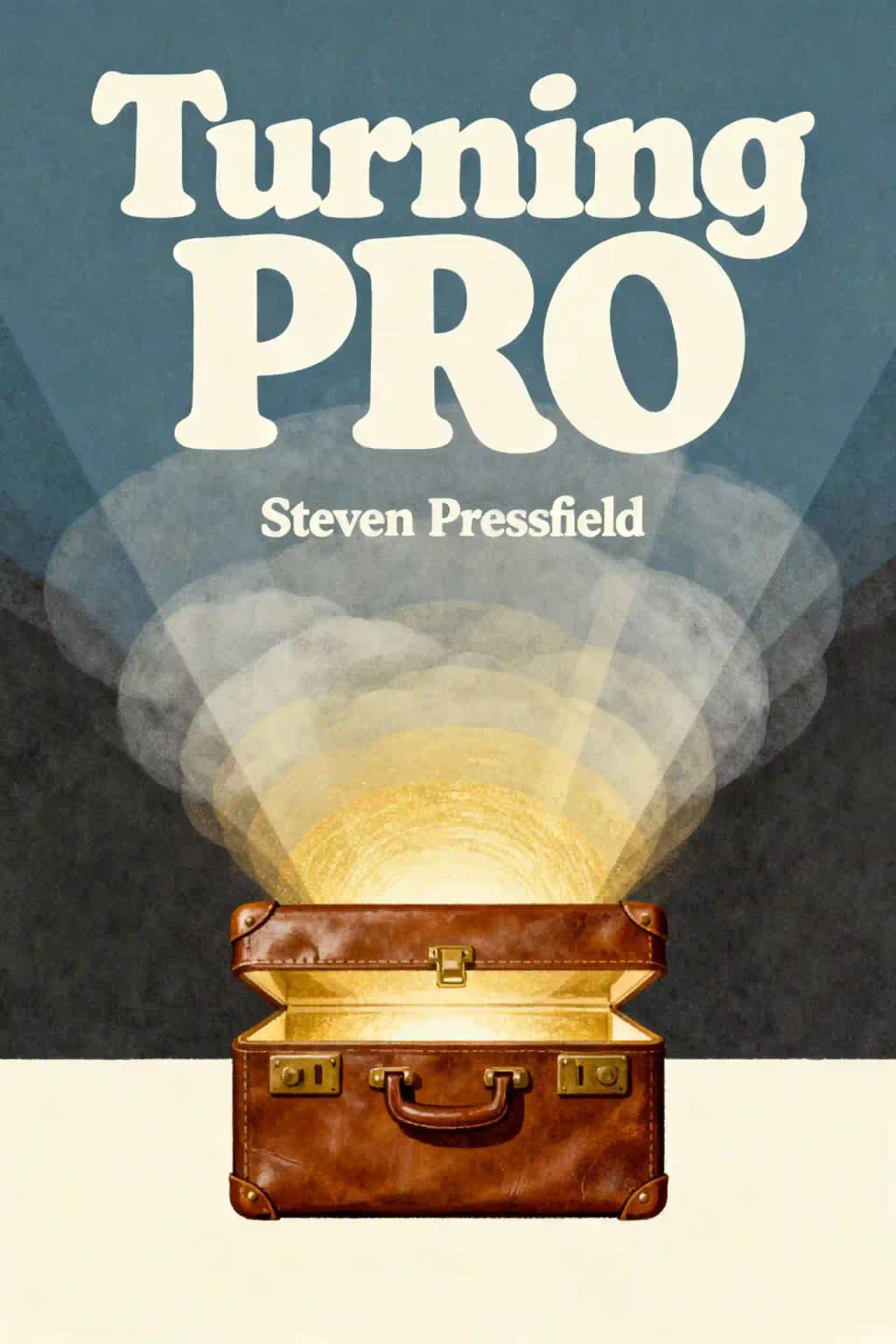
Steven Pressfield's "Turning Pro" has become a modern bible for creatives struggling to overcome their inner demons. Since its publication in 2012, this compact manifesto has helped countless artists, entrepreneurs, and dreamers break through their self-imposed limitations. Tim Ferriss calls it "the kick in the ass you need when you're stuck," while Seth Godin considers it essential reading for anyone serious about their craft. What makes this book so powerful isn't just its tough-love approach, but how it frames creative struggles not as personal failings but as a universal battle we all face. Whether you're writing your first novel, launching a business, or simply trying to live more authentically, Pressfield's message is clear: the path to excellence begins when you decide to stop running from your true calling.
Kapitel 2
The Amateur's Prison: Understanding What Holds Us Back
The human condition is defined by self-awareness - and often, self-hatred. As Jon Stewart once quipped about a self-recognizing robot: "When it learns to hate what it sees, it will have achieved full humanity." This uncomfortable truth lies at the heart of Pressfield's philosophy. When we despise ourselves, society typically offers two solutions: the therapeutic model (we're "sick" and need "treatment") or the moralistic model (we've done something "wrong" and need punishment).
Pressfield proposes a third framework: amateur versus professional. Our suffering stems not from sickness or moral failure but from living as amateurs - avoiding our true calling through distraction, addiction, and self-sabotage. The solution isn't therapy or penance, but a fundamental shift in identity.
What exactly is an amateur? The amateur isn't evil or crazy. Like Luke Skywalker, they harbor noble aspirations and dreams. They're brave, inventive, and good-hearted. The amateur is you and me - before we make the decision to face our fears.
The amateur lives in perpetual terror - fear of failure, success, looking foolish, poverty, loneliness, and death. But most fundamentally, they fear tribal exclusion. The amateur believes turning pro means risking rejection from their community, being left alone to die. This primal fear keeps them paralyzed, unable to pursue their true calling.
This paralysis manifests as an obsession with external validation. The amateur's identity is seated in their ego, yet that ego is too weak to define itself. They permit others to determine their worth, becoming imprisoned by what they believe they ought to think, look like, and be. This desperate need for approval prevents them from becoming authentic.
As Pressfield writes: "The amateur permits fear to stop him from acting." The consequences feel so monumental that paralysis seems the safer choice. The amateur would rather live with the pain of unfulfilled potential than risk judgment for pursuing their dreams.
Kapitel 3
Shadow Careers: The Art of Self-Deception
When we're terrified of embracing our true calling, we often pursue what Pressfield calls a "shadow career" - a metaphor for our real vocation. The shadow career has a tantalizingly similar shape to our true calling, but with no real risk. If we fail at it, the consequences feel meaningless.
Pressfield's own shadow career was driving tractor-trailers. In his late twenties and early thirties, he drove trucks up and down the East Coast, later cross-country. He was deadly earnest about making his life as an over-the-road trucker. What he was really doing was running away from writing.
"Trucking felt like a shadow version of writing," he explains. "It was powerful, manly, interesting, never boring. It was honest labor with salt-of-the-earth men." He loved "the road" because it always took you somewhere. But this was self-delusion. The road was taking him nowhere. He wasn't writing books or facing his demons. He was spectating at life through a windshield, traveling farther from where he needed to go and who he needed to become.
This pattern appears everywhere: the Ph.D. student in Elizabethan studies who really wants to write plays; the person living the drugs-and-booze half of a musician's life without writing music; the corporate lawyer who dreams of becoming a novelist. If you're dissatisfied with your current life, ask yourself what it's a metaphor for. That metaphor will point toward your true calling.
Shadow careers aren't benign diversions - they're active forms of self-sabotage. The longer we cleave to them, the farther we drift from our true purpose, and the harder it becomes to find our way back. We travel in circles, never arriving at our destination. This repetitive nature makes the shadow life tedious and soul-crushing, like a personalized version of hell.
Kapitel 4
The Addiction Connection: Understanding Our Self-Destructive Patterns
Have you ever noticed that addicts are often extremely interesting people? While addiction itself is excruciatingly boring and predictable, the addict is frequently colorful and fascinating. Their story reads like a novel, packed with drama, conflict, and intrigue.
Pressfield proposes a radical theory: addiction is not simply a pathology but a shadow version of our true calling. Our addictions are our callings themselves, only encrypted and incognito. They are metaphors for our best selves, coded versions of our higher aspirations.
The pre-addictive individual experiences a calling - to art, to service, to honorable sacrifice. We feel a positive aspiration, a vision of the higher, realized self we might become. This intimation is followed immediately by the apparition of Resistance: fear, self-doubt, self-sabotage. When we can't stand these feelings, we obliterate them with an addiction.
The addiction becomes the shadow version, the evil twin of our calling to service or art. That's why addicts are simultaneously interesting and boring - they're interesting because they're called to something unique that we can't wait to see them manifest. They're boring because they never do the work.
Consider someone addicted to love - constantly migrating from one passionate, all-consuming affair to the next, always in agony. Such a person might be gifted in multiple domains - music, photography, athletics - yet use romantic drama to produce incapacity, leaving their talents unexplored and unrealized.
All addictions share two primary qualities: they embody repetition without progress, and they produce incapacity as a payoff. This incapacity releases us from the agonizing imperative of identifying and bringing into existence the dreams of our noblest heart. It's a form of self-inflicted wounding - what military personnel call "malingering," shooting oneself in the foot to avoid charging into machine-gun fire.
Kapitel 5
The Pain of Being Human: What We're Really Running From
The Gnostics believed exile was the essential condition of humanity. Both the artist and the addict wrestle with this exile - an acute sensitivity to separation that they seek to overcome. The pain of being human is being suspended between two worlds, unable to fully enter either. We're called to the upper realm but tied to the temporal dimension of instincts and passions. This duality creates a perpetual tension that manifests in various forms of creative and destructive behaviors.
Ancient wisdom traditions across cultures have recognized this fundamental split in human nature. The Greeks spoke of Apollo versus Dionysus, reason versus passion. Eastern philosophies describe the struggle between higher consciousness and base desires. This universal theme appears in literature, religion, and art across millennia, suggesting a deep truth about the human condition.
As Pressfield writes in "Killing Rommel": "Irish despair knows no remedy - the complaint lies not with circumstances but with existence itself. Death! How could a benevolent Deity gift us with life, only to set such a cruel term upon it?" This existential anguish isn't unique to the Irish - it's the universal human condition. We're all angels imprisoned in vessels of flesh, struggling with the knowledge of our mortality while yearning for the eternal.
The addict and the artist respond differently to this pain. The addict seeks to escape human suffering by transcending it through chemicals or anesthetizing it completely. This can take many forms beyond substance abuse - compulsive shopping, endless scrolling, workaholism - any behavior that numbs rather than confronts the underlying pain. The artist takes a different approach - reaching the upper realm through labor and love, transforming suffering into meaning.
By "artist," Pressfield means not just painters or writers, but also the lover, holy man, engineer, mother, warrior, inventor, singer, sage, and voyager. Anyone who creates rather than consumes, who builds rather than destroys. The artist seeks to call down the magic of Plato's sphere of perfect love, truth, justice, and beauty, creating the closest simulacra possible through labor and luck. This might manifest as a painting, a well-raised child, a breakthrough scientific discovery, or an act of compassion.
This pursuit produces, for the artist, peace of mind. Not the peace of escape or oblivion, but the peace that comes from confronting our demons and transforming them into something beautiful and meaningful. It's the difference between running from shadows and learning to dance with them. The artist's way requires courage - facing the void rather than hiding from it - but offers authentic satisfaction rather than temporary relief. Through creative work, we bridge the gap between our earthly and divine natures, finding purpose in the very tension that defines our existence.
Kapitel 6
The Turning Point: Moments That Change Everything
Turning pro is a monumental, life-overturning decision usually made only in the face of overwhelming fear. Often it's something we've avoided for years until events compel us to change. Like Pearl Harbor or 9/11, we never forget where we were when it happened.
For Pressfield, the moment came in New York decades ago. He was driving a cab for twenty dollars a night while avoiding his real work. One night in his cheap sublet, he forced himself to sit with his Smith-Corona typewriter for two hours, producing only trash. Afterward, he washed ten days of dishes and realized he was whistling. Something had shifted.
"Though I hadn't written anything good-and might not for years-what mattered was that I had finally sat down and done my work," he writes. "I had turned a corner. I would be okay from there on."
Singer-songwriter Rosanne Cash describes a similar epiphany in her memoir "Composed." While recording "King's Record Shop," she had a dream where she sat with Linda Ronstadt and an elderly man named Art, who dismissed her as a dilettante. This brutal awakening exposed her artistic shortcomings and sparked a transformation. She changed her approach to songwriting, improved her vocal technique through training, and developed a deeper commitment to her craft.
These breakthroughs feel like hell in the moment. They strip away self-delusion, exposing us naked. We see ourselves plainly, and it's not pretty. The essence of epiphany is losing our cherished self-delusions, which hurts, but what we gain is truth. Our bullshit falls away and the scales drop from our eyes.
After an epiphany, we possess two powerful allies we didn't have before: reality and humility. We also gain a third force-shame-which can produce the final element needed to change our lives: will.
Kapitel 7
The Professional Mindset: A New Way of Being
When we turn pro, everything becomes simple - not easier, but clearer in its demands and direction. We stop running from our fears and instead structure our hours to confront them head-on. We plan our activities with deliberate intention to accomplish specific aims. This fundamental shift changes our days completely - from when we rise (often earlier than before), when we sleep (at consistent times), what we do and don't do (eliminating distractions), what we read (material that serves our growth), and what we eat (fuel for sustained energy). Even our bodies change, adapting to new routines and demands with improved posture, sharper focus, and greater stamina.
The professional displays courage not just in embracing scary roles or making sacrifices of time and family, but above all in confronting her own doubts and demons. While linebackers and Army Rangers enter combat as part of teams, artists and entrepreneurs go into battle alone, facing blank canvases, empty pages, or market uncertainties with only their resolve as company. They learn to recognize resistance in its many forms - procrastination, self-doubt, rationalization - and develop strategies to push through these barriers daily.
A professional is ruthless with herself but also compassionate, understanding that sustainable growth requires balance. Watching a famous horse trainer work with thoroughbreds, Pressfield was surprised by the gentleness of the approach. Rather than harsh discipline, the sessions felt like play - a dance of mutual respect and understanding. The trainer explained: "A horse is ten times more sensitive than the most sensitive person you know. A thoroughbred is a naked nervous system. I want my horses to love the track, not be compelled to run." This wisdom applies equally to nurturing our creative spirit and professional practice.
Unlike the amateur who wastes energy dwelling in the past or anxiously anticipating the future, the professional lives fully in the present moment. When Stephen Sondheim creates, he thinks of nothing else - he's completely immersed, losing himself in the work and the moment. This state of flow becomes more accessible with practice and dedication. The professional defers gratification, deeply understanding that Krishna's wisdom applies to creative work: we have the right to our labor but not to the fruits of our labor. This detachment from outcomes, while maintaining complete commitment to the process, becomes a source of strength.
Perhaps most importantly, the professional doesn't wait for inspiration to strike. While we're nothing without the Muse, the professional knows she prizes labor and dedication above theatrical seeking of her favors. The professional shows up every day, creating the conditions for inspiration through consistent practice and preparation. When the Muse sees his butt in the chair - day after day, regardless of mood or circumstance - she will deliver. This reliability, this steadfast commitment to showing up, becomes the foundation of professional success, transforming sporadic bursts of creativity into sustainable, productive work habits.
Kapitel 8
The Practice: Transforming Work Into Ritual
A professional mindset serves dual purposes: as discipline to overcome Resistance and self-sabotage, but also as the counterintuitive path to accessing creative magic. Like a monk glimpsing God through stillness, the professional accesses flow and brilliance through ordinary, workmanlike dedication. The humble produces the sublime.
When we work for the work itself alone, our pursuit transforms into something loftier: a practice. Like the Marine who endures hardship but belongs to a noble brotherhood, we discover meaning beyond external validation.
A practice involves following a rigorous regimen to elevate mind and spirit. It implies ritual engagement-the dedicated, daily exercise of commitment and focused intention aimed at mastery but also communion with something greater than ourselves. A practice connects us to the divine through disciplined dedication.
A practice requires a sacred space. Looking at artists' workspaces reveals common elements: order, commitment, passion, love, intensity, beauty, and humility. A practice also has a time-like monks who mount the steps to the zendo at the same hour each morning, establishing temporal consistency builds powerful energy. When we convene day after day in the same space at the same time, we generate an energy of intention and commitment that the goddess recognizes and rewards.
A practice has an intention. When Stevie Wonder sits at his piano, he's not there to mess around-he's there to work. The 10,000 Hour Rule requires not just practice but focused practice with clear intention. Our artistic intention must be to get better, go deeper, work closer to the bone.
We come to a practice as warriors, students, and in humility. Like the sword master entering the fighting floor, we face our real enemy within. The professional, like the monk in meditation, confronts the same monsters as Perseus or St. George. We bring intention and intensity to our practice, but never ego. The space of practice is sacred, belonging to the goddess.
Kapitel 9
Trusting the Mystery: The Professional's Leap of Faith
The professional trusts that the Muse always delivers, embracing uncertainty as a fundamental part of the creative process. Patricia Ryan Madson's "What's in the Box?" exercise, a cornerstone of improv training, teaches students a profound lesson about creative trust. When performers pantomime opening an imaginary box, they discover that their minds invariably conjure something - whether mundane or extraordinary. This exercise directly confronts the paralyzing fear of emptiness, of having nothing to offer. The Muse may surprise us with unexpected contents, but the box is never truly empty.
This deep trust enables professionals to work beyond their perceived limitations. Writers routinely create characters who are more brilliant, more witty, or more profound than themselves because they're accessing something far greater than their conscious minds. Scientists report breakthrough insights arriving in dreams; composers hear entire symphonies in their heads; painters see completed works before touching brush to canvas. This realm beyond intellect - where instinct, intuition, and imagination converge - is the professional's true workshop. Pressfield notes that his best writing often feels channeled rather than crafted, emerging from a place he can't consciously access. Many artists report similar experiences of 'flow states' where time disappears and work seems to create itself.
The amateur falls into the perfection trap, believing conditions must be ideal before beginning. The professional recognizes this as Resistance in disguise. Personal crisis? Keep writing. Divorce? Keep composing. Financial troubles? Keep shooting film. Athletes play through pain, warriors fight despite fear, and artists create through chaos. The professional acknowledges difficulties but doesn't grant them power to stop the work. Like a doctor in an emergency room, they treat the symptoms and continue functioning.
In Africa, Pressfield witnessed a powerful demonstration of shamanic authority when a Masai spiritual leader directed his entire tribe to abandon their newly-established camp and move just 200 yards uphill. The tribe complied without question, trusting their shaman's perception of unseen forces. This episode raises provocative questions about different ways of knowing. What if their worldview - one that acknowledges invisible energies and influences - contains profound truth? As artists, we practice our own form of shamanism, attempting to bridge seen and unseen realms, battling internal demons while seeking divine inspiration. We serve something larger than ourselves, following creative impulses that often defy rational explanation.
Rabbi Mordecai Finley's interpretation of Kabbalistic wisdom provides another framework for understanding this dynamic. The yetzer hara (shadow self) corresponds to what Pressfield calls Resistance - a powerful internal force that will employ any means necessary to prevent us from manifesting our authentic potential. The soul (neshama) attempts to guide us toward truth and actualization, but this opposing force creates interference, much like static disrupting a radio signal. The Kabbalists developed specific practices to access higher consciousness through disciplined application of mind and will. Their concept of mussar - spiritual and ethical self-development - parallels Pressfield's notion of turning pro, both representing paths to transcend internal obstacles and access deeper creative truth.
Kapitel 10
The Hero's Return: Why Your Work Matters
In the end, all this enterprise and sacrifice is for the audience. And we are the audience. In the hero's journey, the wanderer returns home after years of exile and suffering, bringing a gift for the people. That gift isn't just raw material but ore refined into gold by the hero/artist's skilled and loving hands. Like the mythological heroes who descended into the underworld and returned with elixirs of wisdom, artists transform their personal struggles into universal truths.
You are that artist. Pressfield would gladly pay to experience the treasure you've refined from your pain, vision, and imagination. We all need it as we struggle in the trenches of our own lives. Whether you're writing a novel, composing music, building a business, or creating art, your work speaks to the collective human experience. Your unique perspective and voice can illuminate paths for others who face similar challenges. The hero wanders, suffers, returns - this ancient pattern repeats in every meaningful creative endeavor.
This is the ultimate message of "Turning Pro": your work matters profoundly. The world needs what only you can create, not as a platitude but as a practical truth. Your struggle has meaning beyond personal satisfaction - it contributes to humanity's ongoing dialogue with itself. Your pain can be transformed into something beautiful and necessary, just as countless artists before you have transformed their wounds into works that heal others. But first, you must make the decision to stop running, to face your fears, to turn pro. This isn't a one-time choice but a daily recommitment to your craft.
The journey won't be easy. You'll face Resistance every day for the rest of your life, in forms both subtle and overwhelming. But now you'll have the mindset and tools to overcome it - the professional habits, the structured routine, the unwavering commitment to showing up. You'll have a practice that sustains you through difficult times, anchoring you when doubt and fear threaten to overwhelm. You'll have the courage to trust the mystery, to work over your head, to play hurt when necessary, understanding that these challenges are not obstacles but essential parts of the creative process.
Most importantly, you'll have your self-respect. You'll be living in alignment with your true calling, no longer hiding in shadow careers or numbing yourself with addictions. The amateur seeks comfort; the professional seeks growth. You'll be the person you were always meant to be - not because of talent or luck, but because you made the choice to honor your calling. This transformation isn't just about creating art; it's about becoming whole, about fulfilling the contract you made with your highest self. When you turn pro, you step into the hero's journey, and your return enriches not just your life, but the lives of all who encounter your work.