Kapitel 1
The Ancient Art of Effortless Effectiveness
Have you ever found yourself trying too hard at something, only to find that the harder you try, the worse you perform? Perhaps you've experienced the frustrating paradox of insomnia-the more desperately you try to fall asleep, the more alert you become. Or maybe you've noticed how romantic prospects seem to appear only when you stop actively looking for them. These common experiences all point to a profound paradox that has fascinated philosophers for millennia.
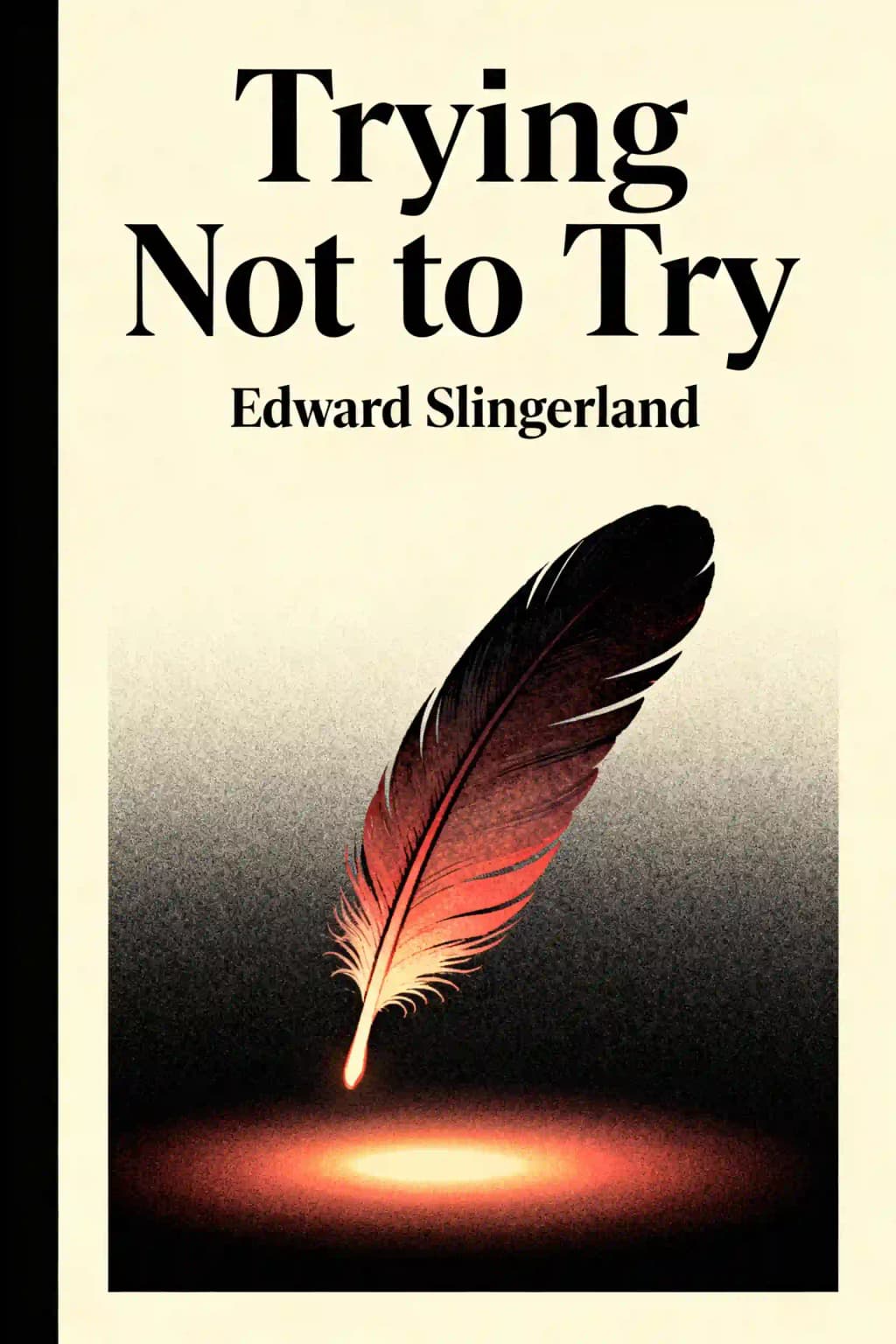
In "Trying Not to Try," Edward Slingerland explores this universal human dilemma through the lens of ancient Chinese philosophy and modern cognitive science. The book has garnered praise from psychologists, neuroscientists, and cultural critics alike, with figures like Daniel Pink calling it "a revelation." Its insights have influenced everyone from Silicon Valley executives seeking peak performance to mindfulness practitioners looking to deepen their practice. At its core lies a deceptively simple question that resonates across cultures and throughout history: how can we achieve spontaneity through effort?
Kapitel 2
The Paradox of Wu-Wei: Effortless Action
The ancient Chinese concept of wu-wei (pronounced "ooo-way") literally means "no trying" or "no doing," but it represents a profound state of mind where action becomes effortless while maintaining perfect effectiveness. People in wu-wei operate in a zone where conscious effort dissolves, yet they produce extraordinary results-whether creating masterful art, navigating complex social dynamics, or executing physical movements with supernatural precision. This state represents the ultimate integration of body, emotions, and mind in spontaneous, flowing action.
Consider Butcher Ding, a character from ancient Chinese texts who dismembers an ox with such effortless grace that Lord Wenhui stands transfixed by his artistry. After decades of practice, Ding explains that he no longer sees the ox with his eyes but encounters it with his spirit, following natural patterns and spaces without conscious deliberation. "My blade has remained sharp for nineteen years because it passes only through spaces between joints," he explains. When confronting challenging sections, he slows down, observes with heightened awareness, and the ox "simply falls apart." This story illustrates how mastery transcends mechanical technique to become an almost mystical communion with one's craft.
The woodcarver Qing exemplifies another dimension of wu-wei through his creation of bell stands so sublime that observers attribute them to supernatural forces. His preparation involves deep meditation and fasting until his mind achieves perfect stillness, releasing all attachment to his body and worldly concerns. In this heightened state, he ventures into forests, perceiving completed bell stands within living trees, seeing their inherent potential. "All I have to do is apply my hand to the job and it's done," he explains, describing a process where execution becomes merely the physical manifestation of an already-complete mental vision.
Modern neuroscience has begun to illuminate the biological basis for these ancient insights. Brain imaging studies of jazz musicians during improvisation reveal a fascinating pattern: their lateral prefrontal cortex, responsible for conscious control and self-monitoring, shows reduced activity, while the anterior cingulate cortex, which monitors conflicts and errors, remains vigilant. This creates a unique neural state of relaxed alertness-the brain maintains background awareness while allowing unconscious expertise to flow unimpeded. Athletes call this "being in the zone," artists refer to it as "being in the flow," but all describe the same phenomenon of effortless mastery.
This scientific understanding reinforces why our "adaptive unconscious" proves so remarkably effective-evolution has gradually shifted most decision-making to automatic systems because they operate with superior speed and reliability. Peak performance emerges when conscious thought steps aside, allowing deeply embedded habits and implicit knowledge to express themselves naturally. This explains why overthinking often impairs performance in everything from sports to public speaking, while trusted intuition frequently leads to superior outcomes. The paradox of wu-wei suggests that true mastery isn't about exerting more control, but about learning when to let go and trust in the wisdom of our cultivated unconscious capabilities.
Kapitel 3
The Power of De: Charismatic Virtue
Alongside wu-wei, the ancient Chinese recognized a second concept: de (pronounced "duh"), typically translated as "virtue," "power," or "charismatic power." De represents the outward manifestation of inner harmony, serving as a visible signal that someone has achieved the state of wu-wei. For rulers and leaders, de was considered to have an almost magical effect, allowing them to spread political order and social harmony effortlessly. On a personal level, de makes others naturally like, trust, and feel deeply relaxed around you, creating an authentic connection that transcends conscious effort.
We're naturally attracted to people in wu-wei because spontaneous behavior is inherently difficult to fake, making unselfconscious people seem authentic and trustworthy. This can be observed in countless daily interactions - from how we can instantly sense when someone's smile is forced versus genuine, to how we're drawn to people who seem genuinely comfortable in their own skin. Even in professional settings, we can detect when a presenter truly knows their material versus when they're merely reciting memorized content. This attraction has deep evolutionary roots - humans have developed sophisticated neural mechanisms to detect sincerity because successful cooperation requires trust, and genuine trust can only emerge from authentic commitment.
De manifests as a kind of magnetic charisma that cannot be consciously manufactured or artificially created. The ancient Chinese used several metaphors to illustrate this concept. One famous example is the empty boat that doesn't provoke anger when it bumps into yours, unlike a boat with a helmsman who should "know better." Similarly, the person with de moves through the world without arousing animosity or resistance, their actions appearing as natural as flowing water. Their presence remains formidable and commanding - like perfectly trained fighting roosters whose complete relaxation and freedom from concern makes others instinctively maintain a respectful distance.
This fundamental principle explains numerous social paradoxes: why trying too hard to be attractive often makes you unattractive, why forced leadership often creates resistance, and why the most charismatic people are typically those who seem least concerned with their effect on others. We see this in successful performers who become most compelling when they forget about the audience, or in leaders who inspire greatest loyalty when focused on their mission rather than their image. The central paradox of de is that it can only be acquired by someone not consciously seeking it - it emerges naturally from authentic self-cultivation and inner harmony rather than external manipulation or strategic calculation.
In modern contexts, de can be observed in effective teachers who inspire without forcing, business leaders who influence through presence rather than power, and individuals whose genuine passion naturally draws others to their cause. The concept remains relevant because it captures a fundamental truth about human interaction: true influence comes from authentic being rather than calculated doing.
Kapitel 4
Carving and Polishing: The Confucian Approach
How does one achieve this elusive state of wu-wei? Early Chinese thinkers developed several strategies, beginning with the Confucian approach of "carving and polishing" the self through rigorous training and cultural immersion. This metaphor of sculpting suggests that achieving effortless virtue requires careful, deliberate refinement of one's natural tendencies.
Confucius believed proper behavior required deliberate cultivation, not casual naturalness. When confronted with Yuan Rang's lounging posture, Confucius harshly rebuked him for lacking respect, even striking him with his staff. This incident illustrates how seriously Confucius took the matter of proper deportment - even seemingly minor breaches of etiquette indicated deeper character flaws. For Confucius and his follower Xunzi, wu-wei could only be achieved through strenuous effort to reshape our natural tendencies according to cultural ideals, much like a craftsman carefully shapes raw material into a refined work of art.
The Confucian solution to the limits of conscious control is domestication-channeling our wild impulses rather than constantly restraining them. Unlike Plato's charioteer always pulling the reins, Confucians aim to download conscious goals into the unconscious self, transforming effortful action into wu-wei. This happens naturally when learning complex skills like driving, playing an instrument, or mastering calligraphy: initially requiring intense focus, but gradually shifting control to automatic brain processes as we practice. The process mirrors how an apprentice slowly internalizes the movements and intuitions of their craft.
Modern neuroscience provides compelling evidence for this transformation. Brain imaging confirms this transition-as skill increases, brain activity actually drops and fewer regions remain involved. Expert performers show less mental effort than novices, despite achieving superior results. The Confucian Way requires intensive training until consciously learned processes become embodied and automatic. Through ritual and learning, practitioners reshape their desires and emotions, "trimming" excessive feelings while strengthening underdeveloped ones like moral courage and appropriate reverence.
Unlike Freud, who saw civilization as creating inevitable tension between our instincts and social demands, the Confucian ideal envisions perfect harmony between the self and society. Through intensive study, ritual practice, and cultural immersion, Confucian learning "enters his ear, becomes firm in his heart-mind, spreads out through his four limbs," transforming the gentleman's very physiology. At this advanced stage, the sage "gives free rein to his desires" yet remains perfectly aligned with civilized norms-no willpower needed. This transformation extends beyond mere behavior to encompass emotions, bodily dispositions, and even facial expressions.
However, the Confucian path faces a fundamental paradox: how can one consciously cultivate spontaneity? The danger of becoming a "village poseur" - someone who merely performs rituals mechanically - looms large. As Confucius notes regarding filial piety, "Nowadays 'filial' means simply being able to provide one's parents with nourishment. But even dogs and horses are provided with nourishment. If you are not respectful, wherein lies the difference?" True cultivation must transform both outer behavior and inner disposition, achieving genuine rather than affected virtue. This challenge of authentic transformation remains central to Confucian practice.
The ultimate goal is to reach a state where proper conduct flows naturally from within, like water finding its course. This requires years of dedicated practice in the arts, rituals, and classical texts that embody cultural wisdom. Only through this thorough immersion can one hope to achieve the seamless integration of conscious intention and spontaneous action that characterizes true wu-wei.
Kapitel 5
Embracing the Uncarved Block: The Laozian Alternative
In direct opposition to Confucian cultivation stands the philosophy of Laozi (the "Old Master"), who advocated returning to an uncarved, natural state. Like Confucius, Laozi saw his age as corrupt, characterized by social inequities and superficial consumerism. But unlike Confucius, who prescribed more cultural refinement, Laozi believed less culture was the answer.
Laozi contrasts "the belly" with "the eye" in a powerful metaphor for human desire. The belly represents our modest basic needs-simple food, water, shelter, and basic pleasures-while the eye constantly gets us into trouble by spotting distant things we don't have but immediately want. For Laozi, the very act of socially labeling things as "beautiful" or "good" distorts our natural judgment. "When everyone in the world knows that the beautiful is 'beautiful,' it is then ugly," he claims.
Modern psychological research on "verbal overshadowing" supports Laozi's insight. Studies show that forcing people to analyze and verbalize their preferences for jams or posters actually impairs their judgment and satisfaction. Laozi identified two forces that lead us away from wu-wei: the negative effect of thinking and verbalizing on our ability to simply experience life, and our insatiable desires that grow endlessly.
For Laozi, conscious effort and striving are the root of human suffering. He describes a fall from grace where humanity declined from an original state of unselfconscious wu-wei perfection. First came those who were "benevolent" but felt compelled to act in the world. Next emerged the "righteous" person-sanctimonious and self-congratulatory. Finally came those obsessed with ritual propriety, forcing empty forms onto others and replacing genuine feeling with hypocritical display.
The Laozi advocates undoing rather than doing, unwinding the mind and body by shedding book learning and artificial desires. The goal is relaxing into perfect nondoing (wu-wei) and unselfconsciousness. One should "take away from himself day by day" to reach a state where nothing is consciously valued, returning to "naturalness" (ziran) like an uncarved block stripped of socialization's paint.
Yet the Laozi's vision reveals a fundamental paradox in its instrumental approach to wu-wei. In passages about rivers and seas ruling valleys by "putting themselves below," we see advice that seems designed to help rulers gain power through strategic humility: "If you desire to rule over people, you must put yourself below them." This creates tension between appearing humble to gain strength and the text's insistence on sincerity. How can one sincerely not want benefits while pursuing them?
Kapitel 6
Cultivating the Sprouts: Mencius's Middle Path
Mencius, a follower of Confucius, proposes a middle path between excessive effort and total abandonment of cultivation. He illustrates this with the story of the "man from Song" who, impatient with his slowly growing grain sprouts, pulled on them to speed their growth, only to kill them. This parable targets both those who try too hard and those who make no effort at all in moral development.
Mencius was deeply influenced by Laozi's celebration of naturalness while remaining committed to Confucian values. His unique approach attempted to reconcile these seemingly contradictory philosophies by focusing on nurturing innate moral tendencies rather than imposing morality from outside.
The Mohists, followers of Mozi, rejected the Confucian emphasis on emotional training and tradition in favor of rational calculation. They advocated reorganizing society based solely on maximizing material wealth, population, and social order. Mencius countered that psychological realism is crucial to ethics. If morality demands the impossible, people will abandon it entirely-like pulling too hard on sprouts kills them.
Mencius argued that humans naturally care more about family than strangers, and morality must work with this reality. For him, abstract thought lacks the motivational power of embodied emotions. Rather than teaching logic and self-control, education should nurture our "four sprouts"-innate moral tendencies that, when properly cultivated, develop into virtues.
Unlike Laozi's static metaphor of the uncarved block, Mencius employs the dynamic image of sprouts requiring cultivation. True naturalness isn't primitive stasis but the proper development of innate tendencies. Wu-wei is an achievement requiring training, but we begin with moral inclinations that, like wheat sprouts, grow into virtues with proper care.
Mencius demonstrates this cultivation process in his famous exchange with King Xuan of Qi. When the king claims he's incapable of goodness, Mencius reminds him of his compassion for an ox being led to slaughter. By helping the king recognize this sprout of empathy, Mencius shows that the king's failure isn't inability but refusal to extend this natural compassion to his people.
Yet Mencius's solution raises a troubling question: if these virtuous tendencies are truly natural, why do they require so much effort to manifest? When confronted by a disciple who admits he'd rather "sit around eating millet all day" than pursue virtue, Mencius insists the problem isn't inability but lack of effort: "What is the difficulty? All you have to do is try at it!" This explanation feels unsatisfying. If moral inclinations are truly innate, why are they so elusive?
Kapitel 7
Going with the Flow: Zhuangzi's Radical Freedom
Zhuangzi, the early Daoist thinker, presents a radical alternative to both Confucian self-cultivation and Mohist rationalism. Through his unlikely friendship with the logician Huizi, Zhuangzi illustrates the limitations of rigid thinking. When Huizi complains about receiving unusably large gourds, Zhuangzi chides him for categorical inflexibility-the inability to see beyond culturally defined uses for objects, calling him "a clod when it comes to thinking big!"
Zhuangzi sees the primary barrier to wu-wei as being dominated by the "mind"-what we'd call the cold-cognition system. This traps people in rigid social categories and narrow instrumental reasoning, preventing them from seeing the world clearly and flowing with it.
For Zhuangzi, true liberation comes from forgetting the self and social values entirely. Unlike Confucians or Mohists who pride themselves on being "right," the sage "illuminates things by means of Heaven," recognizing that "'this' is also a 'that'" and "'that' is also a 'this.'" His exemplars-butchers, woodcarvers, ferrymen-remain embedded in civilization but maintain a distinctive openness, representing a diverse group from society's margins.
The key to achieving wu-wei is to "fast the mind"-not abstaining from food but emptying oneself of preconceptions. As "Confucius" tells Yan Hui in one of Zhuangzi's dialogues: "Listen with your qi" rather than ears or mind. This emptying creates receptivity, allowing the vital force to connect directly with Heaven. When Yan Hui grasps this teaching, he experiences instant enlightenment: "It's as if my self has never actually existed."
Zhuangzi's insights about performance anxiety are strikingly confirmed by modern psychological research on "choking." External pressures-demands for good performance, concerns about reputation-cause people to consciously focus on activities better handled by the unconscious. The result is paradoxical: the more you try, the worse you do. In one experiment, experienced Pac-Man players performed significantly worse when monetary rewards were introduced.
While the Zhuangzi offers a beautiful vision of individual wu-wei, it contains a fundamental tension. Zhuangzi claims humans must shed their "human essence"-the tendency to make right/wrong distinctions-to attain wu-wei. Yet this creates a paradox: if Heaven gave us consciousness and the ability to make distinctions, why would these qualities be flaws to overcome?
Kapitel 8
Living with Paradox: Modern Applications
After examining four early Chinese strategies for attaining wu-wei, we're left with a fundamental paradox: how can we consciously try to be spontaneous? This paradox of wu-wei-trying not to try-stubbornly resists solution. Like the mythical Hydra, it grows two heads for every one cut off, becoming a defining issue for all East Asian religions and appearing across world traditions.
The paradox exists because the virtues people value center on who you are, not just what you do-they're about stable inner states and commitment to shared values that enable large-scale societies to function. Wu-wei is both inherently difficult to achieve and a powerful signal of trustworthiness once attained.
Different strategies suit different people. Those with conservative personalities generally emphasize tradition, authority, and discipline. Liberals typically have a more optimistic view of human nature, valuing autonomy and flexibility. These inclinations appear to have genetic bases, explaining why no single strategy ever dominates for long.
Different phases of life may also call for different approaches. Carving and polishing might work better earlier in life or when learning something new, while the sprout or letting-go approach might be more appropriate as one ages. Traditional Chinese sometimes were Confucians when employed as officials but Daoists when sent to the countryside.
The pursuit of happiness or pleasure often backfires when approached directly. Psychologists have found that both active monitoring of pleasure and deliberate intention to enjoy an activity actually decrease enjoyment-initially supporting Laozi's "do nothing" approach. However, complete absence of introspection leaves us unable to recognize what truly brings joy.
For moral development, great literature serves a crucial function by exercising our "virtuous dispositions." Thomas Jefferson defended novels in his collection by noting how witnessing acts of charity or gratitude-even imaginatively-strengthens our desire to perform similar acts. Films and theater can similarly inspire empathy and increase generosity.
Guided meditation also helps develop compassion. Expert meditators show amplified emotional responses in brain regions associated with empathy, suggesting compassion can be strengthened through practice. Simple practices like performing random acts of kindness, volunteering, or keeping gratitude journals can strengthen our moral sprouts and increase happiness.
Kapitel 9
The Embodied Path to Spontaneity
Western thought has long privileged disembodied rationality, creating a false dichotomy between mind and body while neglecting the crucial role of embodied spontaneity. Traditional moral frameworks, whether based on rigid rule-following or utilitarian calculations, attempt to reduce complex human behavior to simplified models. While intellectually appealing, these approaches prove psychologically unworkable and fail to capture the nuanced reality of lived human experience.
Recent scientific research has begun validating what practitioners of embodied wisdom have long known. Cognitive scientists increasingly recognize that human intelligence is fundamentally embodied - we don't simply think with our brains, but with our entire physical being. Our primary mode of understanding comes through emotionally-grounded "knowing how" rather than abstract "knowing that." We're evolutionarily designed for action and interaction, not purely cerebral contemplation. While abstract thinking remains valuable for identifying patterns and analyzing data, reducing human decision-making to mathematical formulas oversimplifies our nature. Our thought processes are intrinsically tied to emotion-laden, embodied images and metaphors that often operate below conscious awareness.
Early Chinese philosophers demonstrated remarkable insight into this embodied nature of human cognition. Rather than emphasizing abstract theoretical frameworks, they developed sophisticated practices for training the whole person through physical exercises, vivid visualization techniques, musical cultivation, ritualized behavior, and meditation practices. Their educational approach aimed to transform mere intellectual knowledge into deeply embodied wisdom - what they called "somatic understanding." This involves incorporating principles so thoroughly that they become second nature, accessible without conscious deliberation. Modern education could benefit from this more holistic, experiential approach that engages body, emotions, and intellect together.
The modern psychological concept of "flow" shares important features with wu-wei, though with key differences. While flow often emphasizes challenge and skill-matching, wu-wei can manifest in simple, everyday activities - from mindful dish-washing to playing with children. What matters is full absorption in meaningful activity rather than difficulty per se. This form of value-grounded spontaneity generates de - a natural attractiveness or charisma that paradoxically diminishes when deliberately pursued. De arises from subtle bodily signals of genuine engagement rather than calculated attempts to impress.
The fundamental paradox of wu-wei persists - how can we try not to try? Yet this tension itself contains wisdom. While we can't force spontaneity, we can create conditions that allow it to emerge naturally. This involves learning to balance effort with ease, recognizing when we're pushing too hard or getting lost in overthinking. The ancient Chinese understood that moments of effortless flow become available when we develop the wisdom to work with rather than against our embodied nature. Their insights offer not a guaranteed formula for spontaneity, but a sophisticated framework for understanding human flourishing that remains remarkably relevant to contemporary challenges of finding authenticity and ease in an increasingly artificial and striving-oriented world.