When life hits hardest, Robert Schuller's systematic "Possibility Thinking" framework transforms despair into action. This motivational classic - quoted by Floyd Mayweather and Julian Edelman - offers concrete strategies that feel like "having your own personal cheerleader" during life's toughest battles.
Robert Harold Schuller (1926-2015) is the author of Tough Times Never Last, But Tough People Do and was an influential American televangelist, pastor, and motivational speaker known for pioneering modern mega-church ministry. Born on a farm in Iowa during the Great Depression, Schuller's personal experience with hardship shaped his philosophy of positive thinking and resilience—the core themes of this self-help classic.
In 1955, with just $500, he founded Garden Grove Community Church in California, famously beginning services at a drive-in movie theater. His innovative approach led to the iconic Crystal Cathedral and the launch of Hour of Power in 1970, one of television's first weekly church broadcasts. At its peak, the program reached an estimated 20 million viewers worldwide, becoming the most-watched hour-long church service globally.
Schuller authored over 30 books, with six making the New York Times bestseller list. His message of "possibility thinking" influenced countless pastors, business leaders, and individuals seeking to overcome adversity.
Tough Times Never Last, But Tough People Do by Robert H. Schuller is a motivational guide to overcoming adversity through faith, positive thinking, and resilience. Published in 1984, the book teaches readers how to transform difficult circumstances into opportunities for personal growth by developing mental toughness and possibility thinking. Schuller combines biblical principles with practical strategies to help people navigate financial hardship, personal loss, career setbacks, and emotional challenges.
Robert H. Schuller (1926-2015) was an American pastor, televangelist, and bestselling author who founded the Crystal Cathedral and the internationally broadcast Hour of Power television program. Starting his ministry in a California drive-in theater with just $500, Schuller built a congregation that reached millions worldwide. His personal experience overcoming poverty during the Great Depression and rebuilding after setbacks made him a credible voice on resilience and faith-based success.
Tough Times Never Last, But Tough People Do is ideal for anyone facing difficult life transitions, including career setbacks, financial struggles, health challenges, or emotional crises. The book resonates with readers seeking faith-based guidance combined with practical psychology, entrepreneurs rebuilding after failure, and individuals looking to develop mental toughness. Schuller's optimistic, Christian-centered approach particularly appeals to those who value spiritual resilience alongside actionable strategies for overcoming adversity.
Tough Times Never Last, But Tough People Do remains relevant in 2025 as a timeless guide to resilience during economic uncertainty, workplace disruption, and personal challenges. While some readers may find Schuller's positive thinking philosophy overly simplistic, the book's core principles about mental toughness, faith, and reframing adversity continue to resonate. The accessible writing style and practical frameworks make it valuable for anyone seeking encouragement during difficult transitions, though readers preferring secular or research-based approaches may want to supplement with contemporary psychology texts.
Tough Times Never Last, But Tough People Do centers on twelve principles for overcoming adversity, including possibility thinking, faith as small as a mustard seed, and refusing to let circumstances define your future. Schuller teaches that tough-minded faith combined with tender-hearted compassion enables resilience. Key principles include asking "What would I attempt if I knew I could not fail?", developing unwavering belief in positive outcomes, and viewing problems as opportunities for growth rather than permanent obstacles.
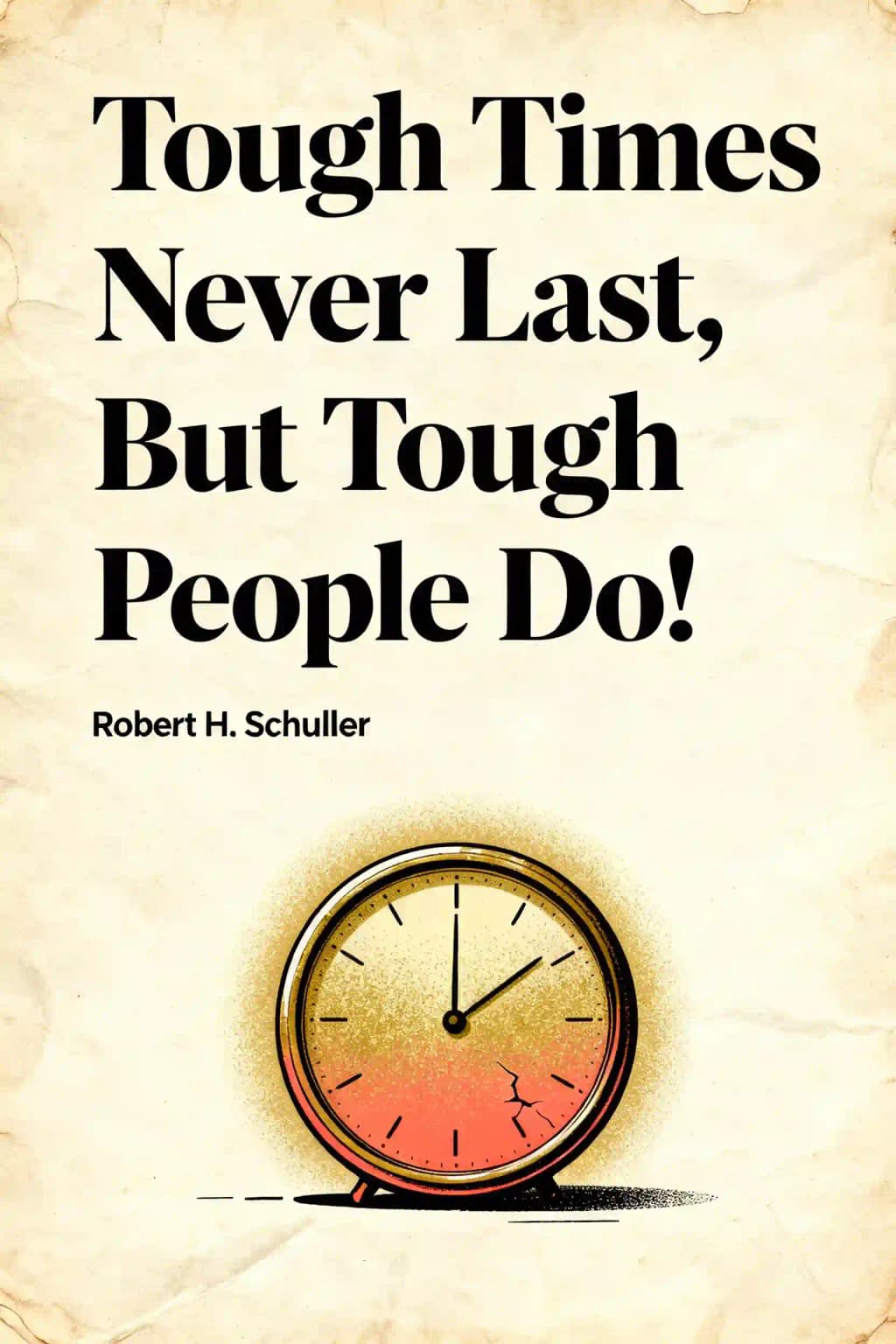
The phrase "tough times never last, but tough people do" encapsulates Robert H. Schuller's philosophy that temporary difficulties are inevitable but need not be permanent, while inner resilience builds lasting character. Schuller argues that circumstances are transient, but the mental toughness developed through adversity creates enduring strength. This mindset encourages readers to focus on developing personal resilience rather than waiting for external conditions to improve, emphasizing that challenges are temporary seasons, not permanent states.
Tough Times Never Last, But Tough People Do provides specific strategies for navigating career transitions and financial crises through possibility thinking and faith-based action. Schuller teaches readers to reframe job loss or business failure as opportunities for reinvention rather than defeat. The book offers practical steps including setting incremental goals, maintaining optimism despite circumstances, seeking creative solutions, and leveraging faith to overcome fear. Schuller's own experience starting with $500 demonstrates how resourcefulness and positive thinking can rebuild from financial hardship.
Robert H. Schuller's possibility thinking philosophy encourages asking "What would I attempt to do if I knew I could not fail?" rather than focusing on obstacles. This approach transforms limiting beliefs by envisioning success before addressing barriers. Schuller taught that possibility thinking combined with faith as small as a mustard seed enables individuals to move mountains and achieve seemingly impossible goals. The philosophy emphasizes starting with the desired outcome, believing in success, and maintaining optimism while taking practical action toward goals.
The most iconic quote from Tough Times Never Last, But Tough People Do is the title itself: "Tough times never last, but tough people do"—reminding readers that resilience outlasts adversity. Another famous Schuller quote asks, "What would you attempt to do if you knew you could not fail?"—challenging readers to dream beyond their fears. These quotes emphasize that temporary difficulties should not define permanent identity, and that faith-driven boldness enables extraordinary achievement despite circumstances.
Critics argue that Tough Times Never Last, But Tough People Do oversimplifies complex problems through excessive optimism and may dismiss legitimate structural barriers to success. Some readers find Schuller's prosperity gospel undertones problematic, suggesting the book implies faith alone guarantees material success. Mental health professionals note the approach may minimize clinical depression or trauma requiring professional intervention. Additionally, critics point out that positive thinking without addressing systemic inequalities can blame individuals for circumstances beyond their control, making the philosophy less applicable to marginalized communities.
Tough Times Never Last, But Tough People Do remains applicable to 2025 workplace challenges including AI disruption, layoffs, remote work transitions, and career pivots. Schuller's principles about reframing adversity as opportunity help professionals navigate technological unemployment and industry shifts. The book's emphasis on continuous learning, adaptability, and maintaining optimism during uncertainty translates to modern career resilience. Possibility thinking encourages workers to reimagine their skills for emerging industries rather than viewing automation as a threat, making Schuller's 1984 wisdom surprisingly relevant to contemporary workforce transformation.
Books similar to Tough Times Never Last, But Tough People Do include:
Erlebe das Buch durch die Stimme des Autors
Verwandle Wissen in fesselnde, beispielreiche Erkenntnisse
Erfasse Schlüsselideen blitzschnell für effektives Lernen
Genieße das Buch auf unterhaltsame und ansprechende Weise
Tough times never last, but tough people do.
Let your hopes, not your hurts, shape your future.
Impossible situations can become possible miracles.
I'd rather attempt to do something great and fail than attempt to do nothing and succeed.
Zerlegen Sie die Kernideen von Tough Times Never Last, But Tough People Do in leicht verständliche Punkte, um zu verstehen, wie innovative Teams kreieren, zusammenarbeiten und wachsen.
Destillieren Sie Tough Times Never Last, But Tough People Do in schnelle Gedächtnisstützen, die die Schlüsselprinzipien von Offenheit, Teamarbeit und kreativer Resilienz hervorheben.

Erleben Sie Tough Times Never Last, But Tough People Do durch lebhafte Erzählungen, die Innovationslektionen in unvergessliche und anwendbare Momente verwandeln.
Fragen Sie alles, wählen Sie die Stimme und erschaffen Sie gemeinsam Erkenntnisse, die wirklich bei Ihnen ankommen.

Von Columbia University Alumni in San Francisco entwickelt
"Instead of endless scrolling, I just hit play on BeFreed. It saves me so much time."
"I never knew where to start with nonfiction—BeFreed’s book lists turned into podcasts gave me a clear path."
"Perfect balance between learning and entertainment. Finished ‘Thinking, Fast and Slow’ on my commute this week."
"Crazy how much I learned while walking the dog. BeFreed = small habits → big gains."
"Reading used to feel like a chore. Now it’s just part of my lifestyle."
"Feels effortless compared to reading. I’ve finished 6 books this month already."
"BeFreed turned my guilty doomscrolling into something that feels productive and inspiring."
"BeFreed turned my commute into learning time. 20-min podcasts are perfect for finishing books I never had time for."
"BeFreed replaced my podcast queue. Imagine Spotify for books — that’s it. 🙌"
"It is great for me to learn something from the book without reading it."
"The themed book list podcasts help me connect ideas across authors—like a guided audio journey."
"Makes me feel smarter every time before going to work"
Von Columbia University Alumni in San Francisco entwickelt

Erhalten Sie die Tough Times Never Last, But Tough People Do-Zusammenfassung als kostenloses PDF oder EPUB. Drucken Sie es aus oder lesen Sie es jederzeit offline.
Life has a way of sorting people like potatoes on a rough road-the strongest rise to the top. This sorting process reveals extraordinary resilience hidden within ordinary people. Consider Broadway star Mary Martin who, approaching seventy, survived a devastating car accident that killed her manager. Despite multiple broken ribs and a punctured lung, she maintained her characteristic optimism. Or Benno Fischer, who survived a Nazi concentration camp by trading bread rations for soup when others did the opposite, later reuniting with his beloved Ann against impossible odds. Then there's John Prunty, "the roadrunner man," who transformed his life after becoming a quadriplegic in a scaffolding accident. Rather than surrendering to despair, he embraced what he called the "three Ds": desire, dedication, and determination. Through this mindset, he turned what could have been a millstone into a milestone. Perhaps most touching is the story of Schuller's daughter Carol, who lost her leg in a motorcycle accident. She refused to be defined by her disability, joining a softball team with the attitude: "When you hit home runs, you don't have to run." Her determination eventually led her to win a gold medal in skiing qualifiers. What separates these individuals from others facing similar circumstances? Not the absence of pain, but their response to it. They demonstrate that resilience isn't about avoiding life's storms but learning to dance in the rain.