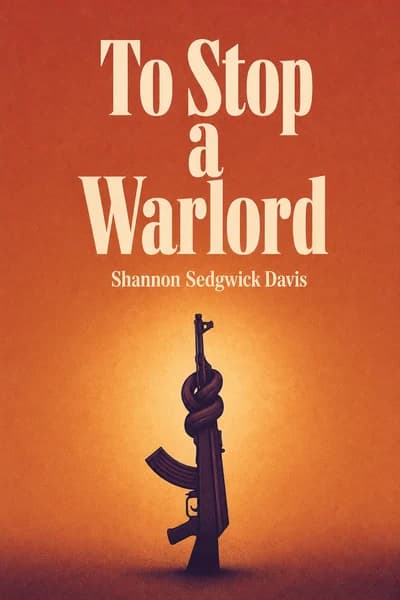
One woman's audacious mission to stop Joseph Kony's brutal Lord's Resistance Army. Endorsed by Desmond Tutu and Richard Branson, this memoir reads like a thriller while challenging conventional peacekeeping methods. What happens when you hire mercenaries to achieve humanitarian goals?
Shannon Sedgwick Davis, author of To Stop a Warlord, is a renowned human rights advocate and philanthropic leader specializing in conflict resolution and atrocity prevention.
As CEO of the Bridgeway Foundation, she pioneered innovative strategies to combat global violence. This work draws from her legal training at Baylor Law School and prior roles as Vice President of Geneva Global and Director of Public Affairs at International Justice Mission.
Her book chronicles the true story of dismantling Joseph Kony’s Lord’s Resistance Army, reflecting her two-decade career in international justice and peacekeeping. Davis’s expertise has been featured on NBC’s TODAY, PBS NewsHour, and TEDxSanAntonio.
Her awards include the Navy SEAL “Fire in the Gut” Award and the 2022 International Citizen of the Year honor. She serves on the advisory council of The Elders, founded by Nelson Mandela, and boards of organizations like charity: water. To Stop a Warlord became a national bestseller, solidifying her reputation as a visionary in humanitarian action.
To Stop a Warlord chronicles Shannon Sedgwick Davis’s real-life mission to dismantle Joseph Kony’s Lord’s Resistance Army (LRA) through an unprecedented alliance between activists, nonprofits, and military forces. This memoir blends geopolitical strategy with human stories, detailing covert operations like Operation Merlin while exploring themes of justice, moral courage, and collaborative problem-solving in conflict zones.
This book appeals to human rights advocates, nonfiction thriller enthusiasts, and readers interested in grassroots peacebuilding. Its blend of frontline journalism and strategic insights makes it ideal for those studying conflict resolution, international law, or ethical leadership.
Yes—it combines memoir, investigative reporting, and geopolitical analysis into a gripping narrative. Davis’s firsthand account of building cross-sector partnerships to combat Kony’s atrocities offers unique perspectives on modern activism. 100% of author proceeds support conflict zone civilians.
Unlike fiction, Davis’s story emphasizes real-world diplomatic hurdles and the incremental nature of social change. The book details logistical challenges like building early warning networks and negotiating with regional governments—nuances often glossed over in dramatized accounts.
As CEO of Bridgeway Foundation and former International Justice Mission director, Davis combines legal expertise with humanitarian pragmatism. Her experience rescuing trafficked children and advising philanthropists informs the book’s balanced approach to ethical dilemmas.
While praised for its candidness, some note the limited exploration of post-conflict challenges. Davis focuses more on stopping Kony than analyzing long-term recovery—a deliberate choice to maintain narrative momentum.
The book argues that complex crises require coalition-building, contrasting with lone-hero tropes. Davis highlights tense negotiations between NGOs, Ugandan forces, and Congolese communities to show collective action’s power.
Davis provides frameworks for effective philanthropy, emphasizing measurable impact over idealism. The book’s proceeds fund civilian protection programs, offering readers direct participation in its mission.
Pair with The Wizard of the Nile (Matthew Green) for deeper LRA context, or Beyond the Sand and Sea (Ty McCormick) for parallel stories of grassroots activism. Davis’s work also aligns with Malala Yousafzai’s advocacy memoirs.
Erlebe das Buch durch die Stimme des Autors
Verwandle Wissen in fesselnde, beispielreiche Erkenntnisse
Erfasse Schlüsselideen blitzschnell für effektives Lernen
Genieße das Buch auf unterhaltsame und ansprechende Weise
"Boss, it's time to bet the farm."
"We're picking up the pieces and patching up victims. It's like we're just putting Band-Aids on bullet holes."
"Take my life. I'm not taking his."
David's sensitivity to horror gradually numbed as a survival mechanism.
"We're not being true to our mission statement."
Zerlegen Sie die Kernideen von To Stop a Warlord in leicht verständliche Punkte, um zu verstehen, wie innovative Teams kreieren, zusammenarbeiten und wachsen.
Destillieren Sie To Stop a Warlord in schnelle Gedächtnisstützen, die die Schlüsselprinzipien von Offenheit, Teamarbeit und kreativer Resilienz hervorheben.

Erleben Sie To Stop a Warlord durch lebhafte Erzählungen, die Innovationslektionen in unvergessliche und anwendbare Momente verwandeln.
Fragen Sie alles, wählen Sie die Stimme und erschaffen Sie gemeinsam Erkenntnisse, die wirklich bei Ihnen ankommen.

Von Columbia University Alumni in San Francisco entwickelt
"Instead of endless scrolling, I just hit play on BeFreed. It saves me so much time."
"I never knew where to start with nonfiction—BeFreed’s book lists turned into podcasts gave me a clear path."
"Perfect balance between learning and entertainment. Finished ‘Thinking, Fast and Slow’ on my commute this week."
"Crazy how much I learned while walking the dog. BeFreed = small habits → big gains."
"Reading used to feel like a chore. Now it’s just part of my lifestyle."
"Feels effortless compared to reading. I’ve finished 6 books this month already."
"BeFreed turned my guilty doomscrolling into something that feels productive and inspiring."
"BeFreed turned my commute into learning time. 20-min podcasts are perfect for finishing books I never had time for."
"BeFreed replaced my podcast queue. Imagine Spotify for books — that’s it. 🙌"
"It is great for me to learn something from the book without reading it."
"The themed book list podcasts help me connect ideas across authors—like a guided audio journey."
"Makes me feel smarter every time before going to work"
Von Columbia University Alumni in San Francisco entwickelt

Erhalten Sie die To Stop a Warlord-Zusammenfassung als kostenloses PDF oder EPUB. Drucken Sie es aus oder lesen Sie es jederzeit offline.
Joseph Kony had been terrorizing Central Africa for over two decades-killing more than 100,000 people, abducting 30,000 children, and turning them into weapons of war. Governments stumbled. International organizations debated. The UN peacekeepers, despite their numbers, seemed paralyzed. And then there was Shannon Sedgwick Davis-a mother from Texas who decided she'd had enough. Not a soldier, not a diplomat, just a woman who read a report about massacred children while rocking her newborn son and thought: someone has to do something. So she did. She assembled an unlikely coalition of military contractors, humanitarian workers, and private funders to do what the world's most powerful institutions couldn't-or wouldn't. What followed was a years-long mission that challenged every assumption about who gets to fight for justice and what's possible when ordinary people refuse to accept the unacceptable.