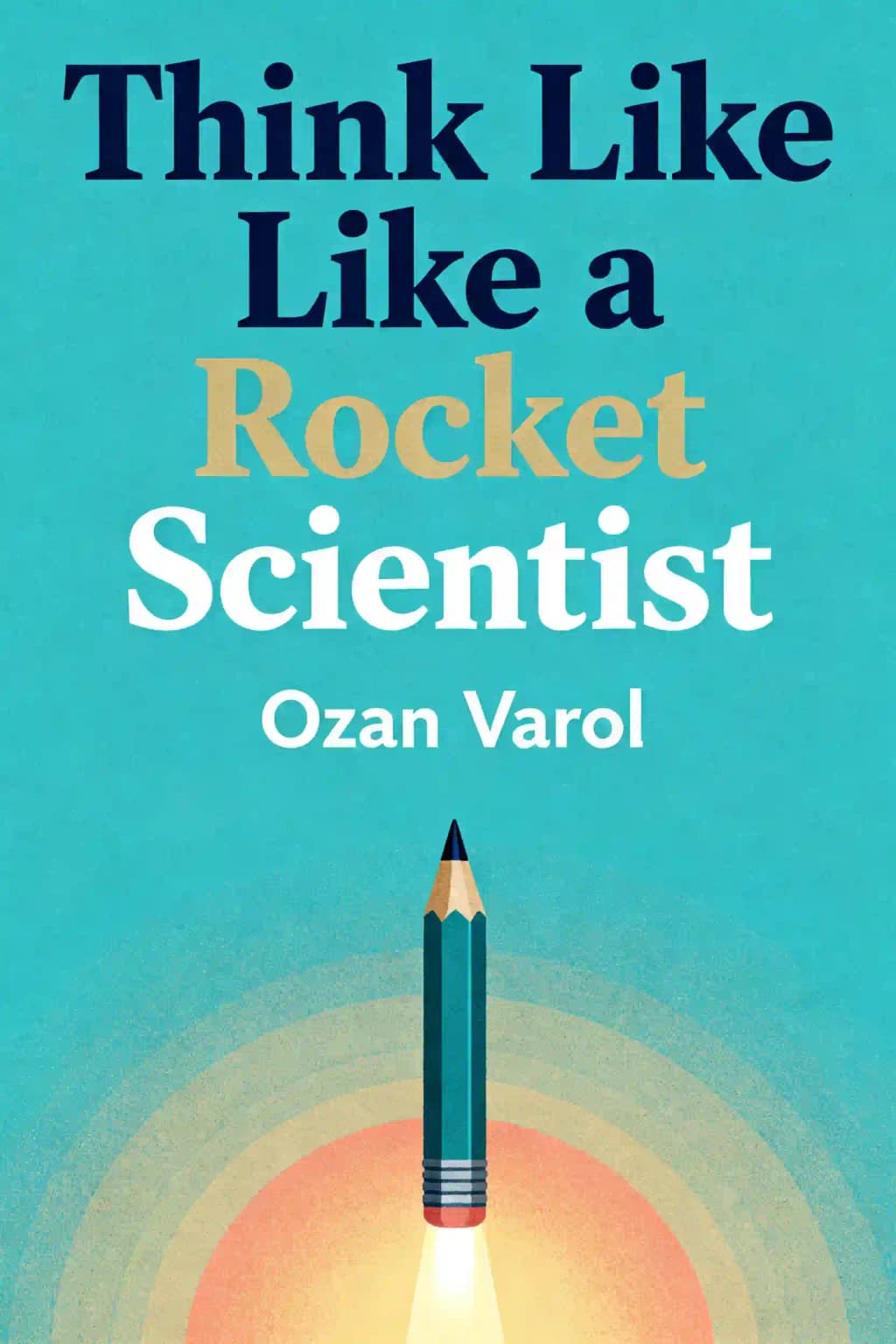
Transform your thinking with "Think Like a Rocket Scientist" - Adam Grant's #1 leadership pick of 2020. Discover why Bill Gates, Microsoft, and Google X embrace Varol's counterintuitive strategies. What problem-solving secrets do rocket scientists know that you don't?
Ozan Varol is the #1 bestselling author of Think Like a Rocket Scientist: Simple Strategies You Can Use to Make Giant Leaps in Work and Life and a globally recognized expert in creative problem-solving. A Turkish-American rocket scientist turned award-winning professor, Varol worked on NASA’s 2003 Mars Exploration Rovers mission before pivoting to teach constitutional law and innovation at Lewis & Clark Law School.
His book merges his aerospace expertise with practical frameworks for overcoming complacency, tackling uncertainty, and reimagining possibilities—themes rooted in his journey from Istanbul to Cornell University and beyond.
Varol’s contrarian insights appear in the Wall Street Journal, TIME, BBC, and CNN, and his work is celebrated by thought leaders like Adam Grant and Susan Cain. He amplifies his ideas through a popular weekly newsletter and keynote speeches for organizations like Microsoft, Google, and Salesforce. His other books—including Awaken Your Genius and The Democratic Coup d’État—have been translated into 25 languages, with Think Like a Rocket Scientist named one of Amazon’s top 20 business books of the year.
Think Like a Rocket Scientist teaches nine strategies from rocket science to solve complex problems in work and life. It covers principles like first-principles thinking, embracing uncertainty, and learning from failure, using examples from NASA’s Mars missions. The book aims to help readers tackle ambitious goals, innovate under pressure, and reframe challenges as opportunities.
This book is ideal for entrepreneurs, leaders, and anyone pursuing ambitious goals. It’s particularly valuable for those navigating uncertainty, leading teams, or seeking breakthroughs in business, careers, or personal growth. Ozan Varol’s insights are tailored to innovators who want to think creatively and overcome seemingly impossible obstacles.
The book translates NASA’s problem-solving methods into business strategies, such as prototyping ideas quickly, fostering cultures that reward risk-taking, and using “backcasting” (working backward from goals). Varol emphasizes adaptability, resilience, and systematic experimentation to drive innovation in fast-paced environments.
These quotes underscore the book’s themes of curiosity, creative thinking, and reframing setbacks.
While Atomic Habits focuses on incremental behavior change, Varol’s book emphasizes moonshot thinking and tackling existential challenges. Both advocate experimentation, but Think Like a Rocket Scientist leans more on systemic innovation and overcoming high-stakes obstacles, making it ideal for leaders and disruptors.
Some reviewers note the principles overlap with other innovation-focused books. Others suggest the NASA anecdotes, while inspiring, may feel less relatable to non-technical readers. However, the book is widely praised for its actionable strategies and engaging storytelling.
Varol’s experience on NASA’s Mars Rover missions grounds the book in real-world problem-solving. His transition from rocket science to law and academia provides a unique lens for connecting scientific rigor to everyday challenges, enhancing the book’s practicality.
Yes. The book’s frameworks help readers approach career transitions, negotiate challenges, and stand out in competitive fields. Techniques like probabilistic thinking and scenario planning equip professionals to make data-driven decisions in uncertain environments.
In an era of rapid technological change and global uncertainty, the book’s focus on adaptive thinking and resilience remains critical. Its lessons align with modern demands for agility in AI-driven industries, remote work, and crisis management.
Backcasting involves reverse-engineering success by starting with an end goal and identifying steps to achieve it. NASA used this method for moon missions, and Varol explains how businesses can apply it to strategic planning, product launches, and long-term vision-setting.
The book includes practical exercises like “premortem” analysis (anticipating failures before they happen) and “constraint removal” brainstorming to unlock creative solutions. These tools help readers implement rocket-science thinking in real-world scenarios.
Erlebe das Buch durch die Stimme des Autors
Verwandle Wissen in fesselnde, beispielreiche Erkenntnisse
Erfasse Schlüsselideen blitzschnell für effektives Lernen
Genieße das Buch auf unterhaltsame und ansprechende Weise
Our certainty-obsessed culture values confident assertions over nuanced understanding.
Knowledge can become a vice rather than a virtue.
Simplicity is sophisticated.
Zerlegen Sie die Kernideen von Think Like a Rocket Scientist in leicht verständliche Punkte, um zu verstehen, wie innovative Teams kreieren, zusammenarbeiten und wachsen.
Destillieren Sie Think Like a Rocket Scientist in schnelle Gedächtnisstützen, die die Schlüsselprinzipien von Offenheit, Teamarbeit und kreativer Resilienz hervorheben.

Erleben Sie Think Like a Rocket Scientist durch lebhafte Erzählungen, die Innovationslektionen in unvergessliche und anwendbare Momente verwandeln.
Fragen Sie alles, wählen Sie die Stimme und erschaffen Sie gemeinsam Erkenntnisse, die wirklich bei Ihnen ankommen.

Von Columbia University Alumni in San Francisco entwickelt
"Instead of endless scrolling, I just hit play on BeFreed. It saves me so much time."
"I never knew where to start with nonfiction—BeFreed’s book lists turned into podcasts gave me a clear path."
"Perfect balance between learning and entertainment. Finished ‘Thinking, Fast and Slow’ on my commute this week."
"Crazy how much I learned while walking the dog. BeFreed = small habits → big gains."
"Reading used to feel like a chore. Now it’s just part of my lifestyle."
"Feels effortless compared to reading. I’ve finished 6 books this month already."
"BeFreed turned my guilty doomscrolling into something that feels productive and inspiring."
"BeFreed turned my commute into learning time. 20-min podcasts are perfect for finishing books I never had time for."
"BeFreed replaced my podcast queue. Imagine Spotify for books — that’s it. 🙌"
"It is great for me to learn something from the book without reading it."
"The themed book list podcasts help me connect ideas across authors—like a guided audio journey."
"Makes me feel smarter every time before going to work"
Von Columbia University Alumni in San Francisco entwickelt

Erhalten Sie die Think Like a Rocket Scientist-Zusammenfassung als kostenloses PDF oder EPUB. Drucken Sie es aus oder lesen Sie es jederzeit offline.
A former NASA engineer once watched a rocket explode on the launchpad, representing years of work and millions of dollars vaporizing in seconds. Yet within hours, the team was already analyzing what went wrong, excited about what they'd learned. This counterintuitive response reveals something profound: the world's most successful problem-solvers don't fear failure - they harness it. Rocket science isn't just about spacecraft and equations; it's a mindset for navigating uncertainty, reframing impossible problems, and turning setbacks into breakthroughs. These principles aren't reserved for PhDs in lab coats. They're tools anyone can use to transform how they approach challenges, whether launching a business, changing careers, or simply making better decisions in everyday life.