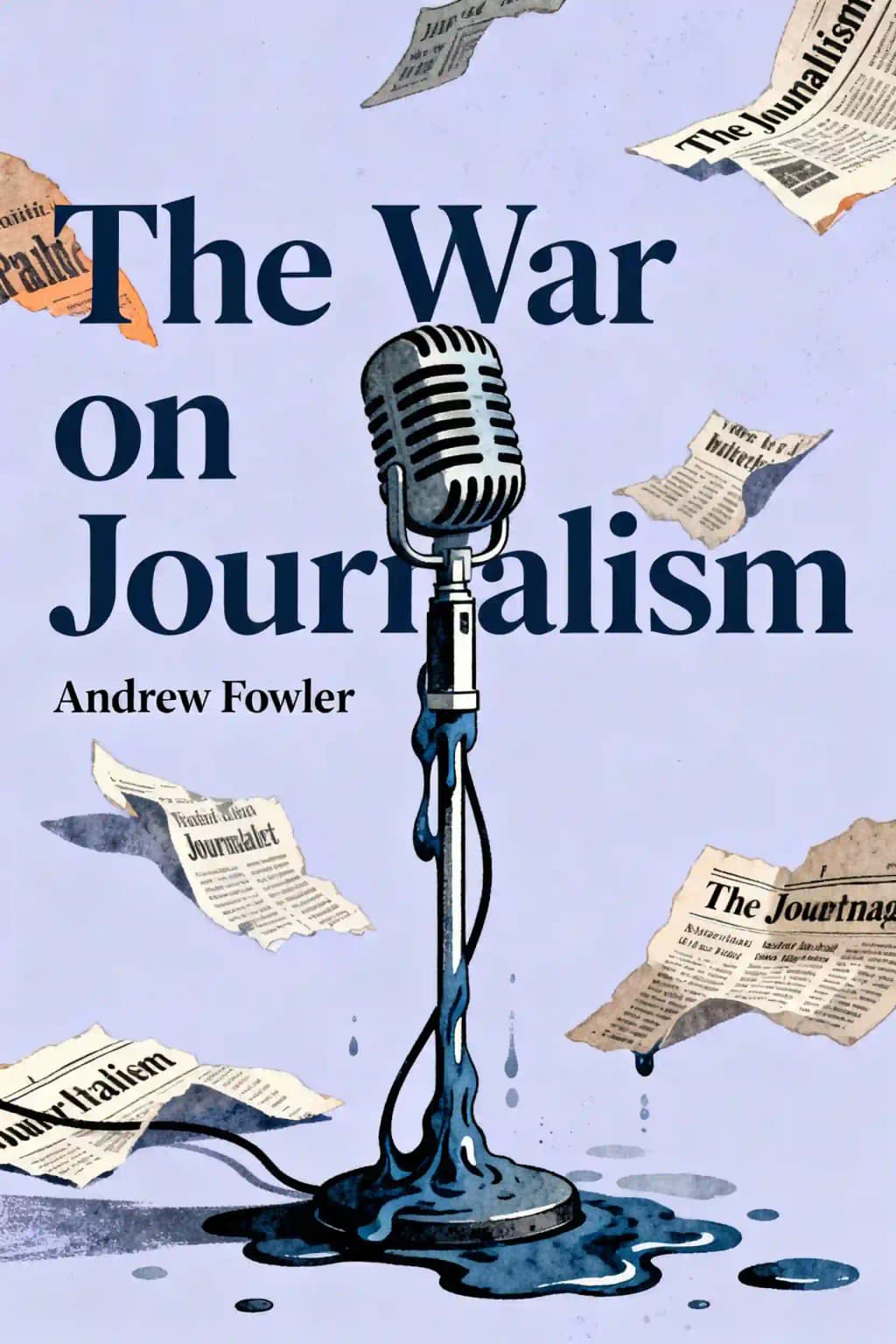
The War on Journalism
Media Moguls, Whistleblowers and the Price of Freedom
Überblick über The War on Journalism
In "The War on Journalism," investigative veteran Andrew Fowler exposes how governments silence truth-seekers in our post-Snowden world. What's the real cost when whistleblowers are hunted and media moguls control the narrative? Democracy's watchdogs are under fire - and we're all paying the price.

Kernthemen in The War on Journalism
- mass surveillance
- press freedom
- intelligence agency interference
- whistleblower protection
- media collusion
Zitate aus The War on Journalism
The internet as a democracy.
Journalism weakened at precisely the moment it was needed most.
The US Administration would never again interfere in the domestic political processes of Australia.
The internet's birth coincided with Daniel Ellsberg's Pentagon Papers leak in 1971.
The War on Journalism has become a cultural phenomenon.
Personen in The War on Journalism
- Edward SnowdenWhistleblower who exposed global NSA surveillance
- Harold WilsonBritish PM targeted by an MI5 smear campaign
- Gough WhitlamAustralian PM dismissed after challenging the US
- Glenn GreenwaldJournalist who published Snowden's revelations
- Chapman PincherJournalist used by MI5 for media collusion
Über den Autor
Über den Autor von The War on Journalism
Andrew Fowler, award-winning investigative journalist and author of The War on Journalism, has spent decades exposing threats to press freedom and government transparency. A former reporter for the ABC’s Foreign Correspondent and Four Corners, Fowler began his career covering the IRA bombing campaign for the London Evening News and later served as chief of staff for The Australian.
His expertise in documenting institutional overreach stems from landmark investigations, including his New York Festival Gold Medal–winning 2010 interview with Julian Assange, later expanded in his bestselling book The Most Dangerous Man in the World (2011, updated 2020).
Fowler’s work bridges journalism and academia, with roles lecturing at Australian and UK universities and contributions to academic papers on media ethics. His critiques of surveillance and censorship extend through Shooting the Messenger: Criminalising Journalism (2017) and Nuked: The Submarine Fiasco that Sank Australia’s Sovereignty (2024). A United Nations Peace Prize recipient, Fowler’s reporting continues to shape global debates on accountability and democratic integrity.
Zusammenfassung von The War on Journalism herunterladen
Erhalten Sie die The War on Journalism-Zusammenfassung als kostenloses PDF oder EPUB. Drucken Sie es aus oder lesen Sie es jederzeit offline.
FAQ zu diesem Buch
The War on Journalism investigates the decline of mainstream media, exposing how corporate greed, government surveillance, and self-censorship eroded press freedom. Andrew Fowler traces the impact of whistleblowers like Chelsea Manning and Edward Snowden, while critiquing media giants like the BBC, The Washington Post, and Rupert Murdoch’s News of the World for prioritizing power over truth. The book warns of draconian laws silencing dissent and urges a reckoning for democratic accountability.
Journalists, media students, and advocates of press freedom will find this book essential. It’s also critical for readers interested in government transparency, corporate influence on news, and the ethical challenges facing modern journalism. Fowler’s insider perspective, drawn from decades at ABC’s Four Corners, offers valuable insights for those analyzing media’s role in democracy.
Yes—it’s a compelling expose of journalism’s crisis, blending investigative rigor with firsthand accounts. Fowler’s analysis of high-profile cases like WikiLeaks and phone-hacking scandals provides a stark warning about media consolidation and state overreach. Its relevance grows amid rising distrust in institutions and debates over “fake news”.
- Corporate Influence: Media moguls prioritizing profit over public interest.
- Whistleblowers: How Manning and Snowden disrupted traditional journalist-source dynamics.
- Government Overreach: Laws criminalizing leaks and spying on citizens.
- Self-Censorship: Journalists avoiding controversial stories to protect careers.
Fowler argues outlets like the BBC and The New York Times became complicit by cozying up to power, accepting manipulated leaks, and avoiding hard-hitting investigations. He highlights layoffs, editorial timidity, and the rise of “chicken shit editors” who kowtow to political or corporate pressures.
Whistleblowers like Snowden and Manning are portrayed as catalysts for transparency, challenging the collusive relationship between governments and journalists. Their leaks exposed systemic abuses but also triggered retaliatory laws targeting press freedom.
Fowler examines Murdoch’s News of the World phone-hacking scandal as emblematic of unethical tabloid culture. He ties Murdoch’s power to broader trends of sensationalism and political manipulation, undermining journalistic integrity.
The book urges revitalizing investigative reporting, protecting whistleblowers, and resisting restrictive laws. Fowler advocates for decentralized, independent media to counterbalance corporate and state control.
Like The Most Dangerous Man in the World (on Julian Assange), this book critiques institutional power but focuses specifically on media’s decline. Both emphasize the tension between national security narratives and public accountability.
Some argue Fowler oversimplifies media history or downplays digital platforms’ role in disrupting traditional models. Others note the book’s dense case studies may overwhelm casual readers.
With governments globally enacting surveillance laws and media layoffs accelerating, Fowler’s warnings about censorship and corporate capture remain urgent. The book’s themes resonate amid AI-driven disinformation and declining trust in institutions.
It refers to the legal, financial, and ethical costs of defending press independence. Fowler warns that without radical reform, democracies risk becoming “unchallenged and unaccountable” regimes.





