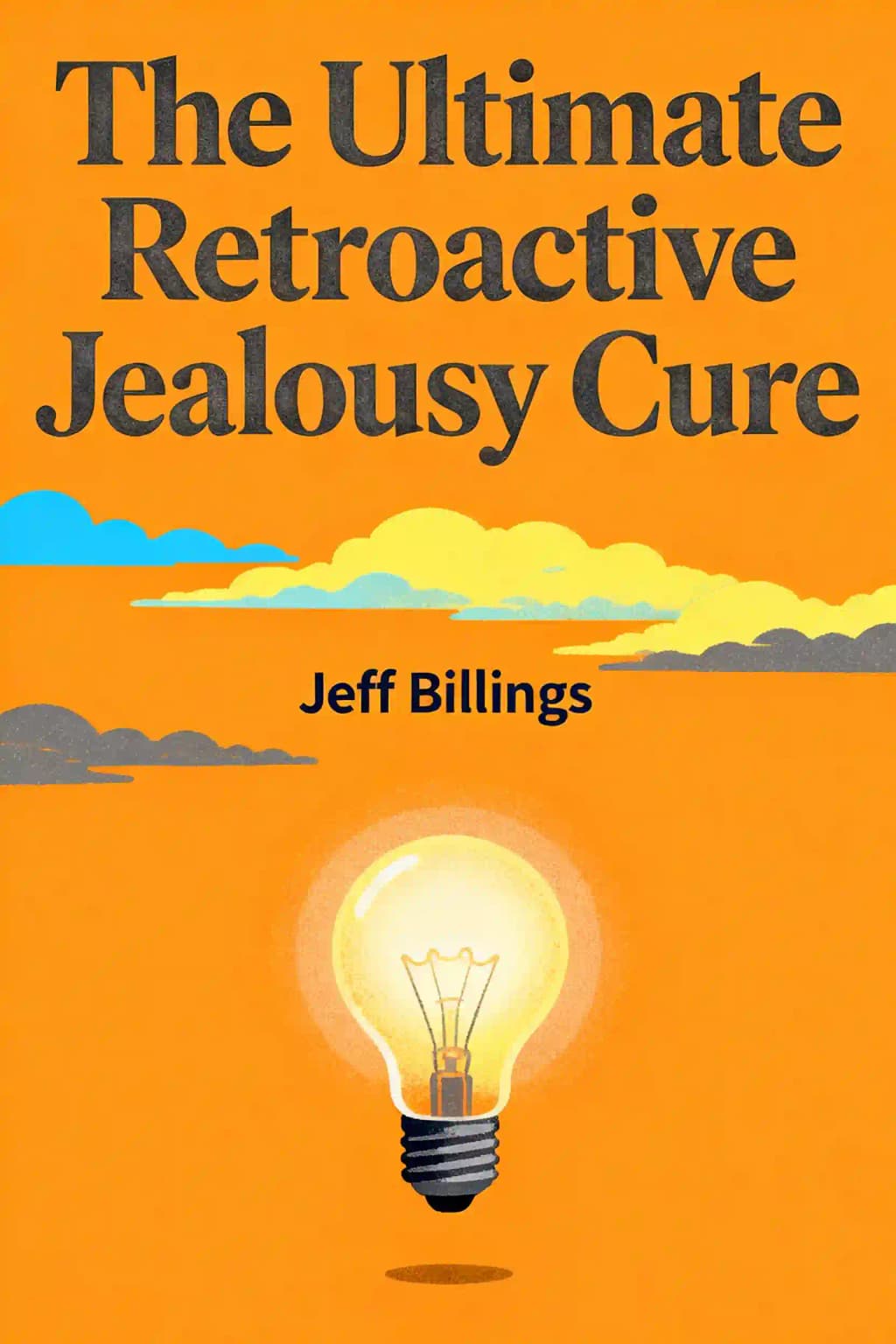
Trapped by your partner's past? "The Ultimate Retroactive Jealousy Cure" offers a revolutionary 12-step program that's transformed countless relationships. While written for monogamous couples, relationship expert Kathy Labriola confirms its techniques work universally - even in polyamorous partnerships. Stop suffering, start living.
Jeff Billings is the self-help expert and bestselling author of The Ultimate Retroactive Jealousy Cure, a guide to overcoming obsessive jealousy in relationships. Specializing in mental health and emotional well-being, Billings founded RetroactiveJealousyCrusher.com, a platform offering evidence-based strategies that blend cognitive-behavioral techniques with practical relationship advice.
His work has been featured in Huffington Post, Mogul, and FemaleFirst, establishing him as a trusted voice in modern psychology. A multi-published author, Billings also wrote How To Stop Being Jealous Of Your Partner’s Past In 12 Steps and hosts courses praised for their actionable, step-by-step frameworks.
Born in New Hampshire and based in England, he draws on his academic research and firsthand client experiences to address attachment disorders. His methods are endorsed by mental health professionals and have been translated into multiple languages, helping thousands reclaim emotional stability in partnerships.
The Ultimate Retroactive Jealousy Cure by Jeff Billings provides a 12-step plan to eliminate obsessive jealousy about a partner’s past relationships. It teaches readers to reframe negative thoughts, master emotional triggers, and focus on building trust in the present. The book combines cognitive behavioral techniques with mindfulness practices to break the cycle of retroactive jealousy.
This book is ideal for individuals struggling with intrusive thoughts about their partner’s romantic or sexual history. It’s also valuable for couples therapists seeking actionable strategies to help clients, or anyone interested in improving emotional resilience in relationships.
The 12 steps include identifying triggering emotions, reframing past narratives, practicing mindfulness, and building self-confidence. Key tactics involve redirecting mental energy toward the present and adopting gratitude exercises to reduce comparison. Specific methods like journaling and cognitive restructuring are detailed as tools for long-term healing.
Jeff Billings emphasizes accepting triggers without resistance and using them as opportunities for growth. The book teaches readers to dissect why certain memories cause distress and replace irrational beliefs with evidence-based affirmations. Techniques like “thought diffusion” help separate emotions from factual reality.
Billings draws from his personal battle with retroactive jealousy and years of research in cognitive psychology. He founded Retroactive Jealousy Crusher, a platform helping thousands since 2016, and authored complementary resources like the Overcoming Retroactive Jealousy 101 course.
Yes, the book includes exercises like timeline analysis (comparing past vs. present relationship value), trigger logs, and guided visualizations. Daily mindfulness routines and partner communication scripts are provided to reinforce emotional stability.
Unlike broad relationship books, it specifically targets retroactive jealousy through structured, step-by-step protocols. It avoids vague platitudes by focusing on root causes—like insecurity and fear of comparison—and offers neuroscience-backed solutions to rewire thought patterns.
The book addresses complex scenarios, including past infidelity, by teaching readers to differentiate between past actions and current trust. It provides frameworks to rebuild security without dismissing valid concerns, emphasizing mutual transparency and boundary-setting.
Some reviewers note the steps require consistent effort over weeks, which may challenge those seeking quick fixes. Others mention the focus on individual healing over couples’ therapy, though the strategies are adaptable for joint use.
Billings’ methods complement therapy by offering self-guided tools, making it cost-effective for those unable to access professional help. However, he advises combining the book with therapy for severe cases involving trauma or OCD tendencies.
Yes, the book integrates principles from cognitive behavioral therapy (CBT), acceptance and commitment therapy (ACT), and attachment theory. Billings cites studies on jealousy’s psychological roots and the efficacy of mindfulness in emotional regulation.
Readers report reduced anxiety, improved relationship satisfaction, and greater emotional independence. The program aims to transform jealousy into self-awareness, fostering resilience against future triggers and enhancing overall mental well-being.
Erlebe das Buch durch die Stimme des Autors
Verwandle Wissen in fesselnde, beispielreiche Erkenntnisse
Erfasse Schlüsselideen blitzschnell für effektives Lernen
Genieße das Buch auf unterhaltsame und ansprechende Weise
Retroactive jealousy has ruined countless relationships.
Your thoughts begin to control you rather than the reverse.
Exes aren't threats; they're symbols representing what you fear.
Retroactive jealousy reveals more about you than about your partner.
The moral high ground you take forms a large part of your suffering.
Zerlegen Sie die Kernideen von The Ultimate Retroactive Jealousy Cure in leicht verständliche Punkte, um zu verstehen, wie innovative Teams kreieren, zusammenarbeiten und wachsen.
Erleben Sie The Ultimate Retroactive Jealousy Cure durch lebhafte Erzählungen, die Innovationslektionen in unvergessliche und anwendbare Momente verwandeln.
Fragen Sie alles, wählen Sie Ihren Lernstil und gestalten Sie Erkenntnisse, die wirklich zu Ihnen passen.

Von Columbia University Alumni in San Francisco entwickelt
"Instead of endless scrolling, I just hit play on BeFreed. It saves me so much time."
"I never knew where to start with nonfiction—BeFreed’s book lists turned into podcasts gave me a clear path."
"Perfect balance between learning and entertainment. Finished ‘Thinking, Fast and Slow’ on my commute this week."
"Crazy how much I learned while walking the dog. BeFreed = small habits → big gains."
"Reading used to feel like a chore. Now it’s just part of my lifestyle."
"Feels effortless compared to reading. I’ve finished 6 books this month already."
"BeFreed turned my guilty doomscrolling into something that feels productive and inspiring."
"BeFreed turned my commute into learning time. 20-min podcasts are perfect for finishing books I never had time for."
"BeFreed replaced my podcast queue. Imagine Spotify for books — that’s it. 🙌"
"It is great for me to learn something from the book without reading it."
"The themed book list podcasts help me connect ideas across authors—like a guided audio journey."
"Makes me feel smarter every time before going to work"
Von Columbia University Alumni in San Francisco entwickelt

Erhalten Sie die The Ultimate Retroactive Jealousy Cure-Zusammenfassung als kostenloses PDF oder EPUB. Drucken Sie es aus oder lesen Sie es jederzeit offline.
Ever found yourself at 3 AM, wide awake and tormented by vivid images of your partner with someone from their past? That nagging unease, those repetitive thoughts that intensify the more you try to suppress them - welcome to retroactive jealousy. This psychological phenomenon has destroyed countless relationships and stolen innumerable hours of peace from otherwise happy couples. What makes retroactive jealousy so insidious is how it transforms normal, healthy relationships into emotional battlegrounds where the enemy isn't even present - they exist only in your mind. Imagine feeling jealous of someone your partner dated five years before meeting you - someone who may have moved across the country or even married someone else. Logically, you know these feelings make no sense, yet they persist with frightening intensity. This isn't just garden-variety insecurity; it's a specific form of obsessive thinking that can escalate into relationship-threatening behavior like constant questioning, social media stalking, and emotional withdrawal.
Our obsession with a partner's romantic history isn't merely a personal failing - it's hardwired into our evolutionary psychology. Men and women experience retroactive jealousy differently, reflecting ancient reproductive strategies. Men typically fixate on sexual infidelity, fearing investment in another man's offspring - a prehistoric concern now manifesting as irrational jealousy. Women tend to worry more about emotional infidelity, fearing attachments that could lead to abandonment, as historically, women needed reliable partners to raise children. Retroactive jealousy begins when you learn something about your partner's past that doesn't align with your expectations. This mismatch triggers an emotional response that can spiral out of control. The equation is straightforward: Expectation minus Reality equals Emotional Response. Ironically, stronger emotional attachments make you more susceptible to retroactive jealousy. These negative emotions fuel repetitive, intrusive thoughts about their past relationships that likely bear little resemblance to reality. Your mind creates worst-case scenarios, playing "mini movies" of their former love life. This pattern resembles OCD - the more you try to stop thinking about these scenarios, the more powerful they become. Your attempts to stop the thoughts actually reinforce the neural pathways that keep them alive.
At the core of retroactive jealousy lie two powerful emotions: fear and judgment. The primary fear isn't about the past - it's about losing your partner in the future. Those intrusive thoughts about their past are manifestations of your worst fears about tomorrow. Your partner's exes aren't actual threats; they're symbols of what you fear might happen again. You worry that if your partner remembers past lovers fondly, they're not completely "yours," suggesting you might not fully satisfy them. This triggers your brain's amygdala, releasing stress chemicals harmful to your health. The second emotion is judgment. You find yourself looking down on your partner's past choices. Men often view a partner's past sex life as "slutty," while women might question their partner's previous relationship choices. This judgment can poison daily interactions - you might watch your partner doing something mundane and suddenly feel bitter anger about their past. Retroactive jealousy reveals more about you than your partner. Those suffering from it tend to compare themselves unfavorably to ex-lovers, fueling fears that "better" lovers might steal your partner away. When you possess genuine self-confidence, retroactive jealousy becomes nearly impossible. The solution lies in building authentic self-confidence through both thoughts and actions. Create a personal statement highlighting your qualities and why your partner loves you. Then identify specific insecurities and tackle them through concrete actions. Remember that your partner chose you - not their exes - for good reasons.
Trust issues form the foundation of retroactive jealousy, though they often remain hidden. When judging your partner's past, you're assuming their history defines who they are today-that they haven't evolved since those experiences. The solution is shifting focus from negative aspects of their past to positive present realities. Your mind erroneously connects past with present, creating the false narrative that previous behavior predicts future infidelity. Understanding that free will is largely an illusion helps overcome retroactive jealousy. Our choices emerge from unconscious brain activities-a complex mix of genetics, upbringing, experiences, and circumstances. Your partner couldn't have made different choices given who they were then, just as they're authentically themselves with you now. To build trust, deliberately observe your partner in social situations with attractive people. Rather than acting on jealous emotions, simply observe them, which diminishes their intensity over time. Notice their actual behavior-likely demonstrating loyalty and commitment-rather than projecting fears onto innocent interactions. Their present reality speaks far more truth than your fears about their past.
Overcoming retroactive jealousy requires stopping four harmful behaviors that perpetuate the problem: First, stop researching retroactive jealousy online. Initial education helps, but endless forum browsing keeps the issue prominent in your mind, reinforcing neural pathways associated with jealousy. Second, stop snooping through your partner's personal accounts, photos, or messages. This invasion destroys trust while feeding your obsession with information you'll inevitably misinterpret. Third, stop interrogating your partner about their past. These questions aren't about closure; they're feeding your obsession with details that will only torment you further. Each question signals insecurity while bringing ex-lovers from the back of your partner's mind to the front. Finally, stop dwelling on jealous thoughts when they arise. Instead, practice awareness by recognizing these thoughts, then deliberately replacing them with positive images of you and your partner together. When jealous thoughts emerge during recovery, don't fight them directly. Acknowledge their presence without judgment, then gently redirect your attention to something positive about your current relationship. This mindfulness practice weakens neural connections supporting jealousy while strengthening those associated with appreciation and contentment.

The final path to freedom involves a fundamental choice: will you dwell in negativity or consciously choose happiness? This isn't about denying feelings but taking responsibility for your focus and emotional state. Each morning, appreciate finding your partner, being in a loving relationship, and recognize that your mind often creates problems where none exist. Two powerful remedies against retroactive jealousy are laughter and music. Genuine laughter increases immune-boosting cells while decreasing stress hormones. Music produces positive physical changes that boost immunity and reduce stress. Create a playlist of upbeat songs with positive messages and listen to at least three tracks daily - dancing is strongly encouraged! Maintain perspective about your situation. Despite feeling tormented by your partner's past, your life is remarkably privileged compared to most humans throughout history. The odds of you being born were approximately one in 400 trillion. Is it worth wasting your precious time obsessing over your partner's past when you've already won life's greatest lottery? Your partner is here now, choosing you every day. Their history isn't a threat - it's simply the path that led them to you. Embrace the present and release the ghosts of relationships past. They have power only if you give it to them.