Kapitel 1
Stories That Shape Our Reality
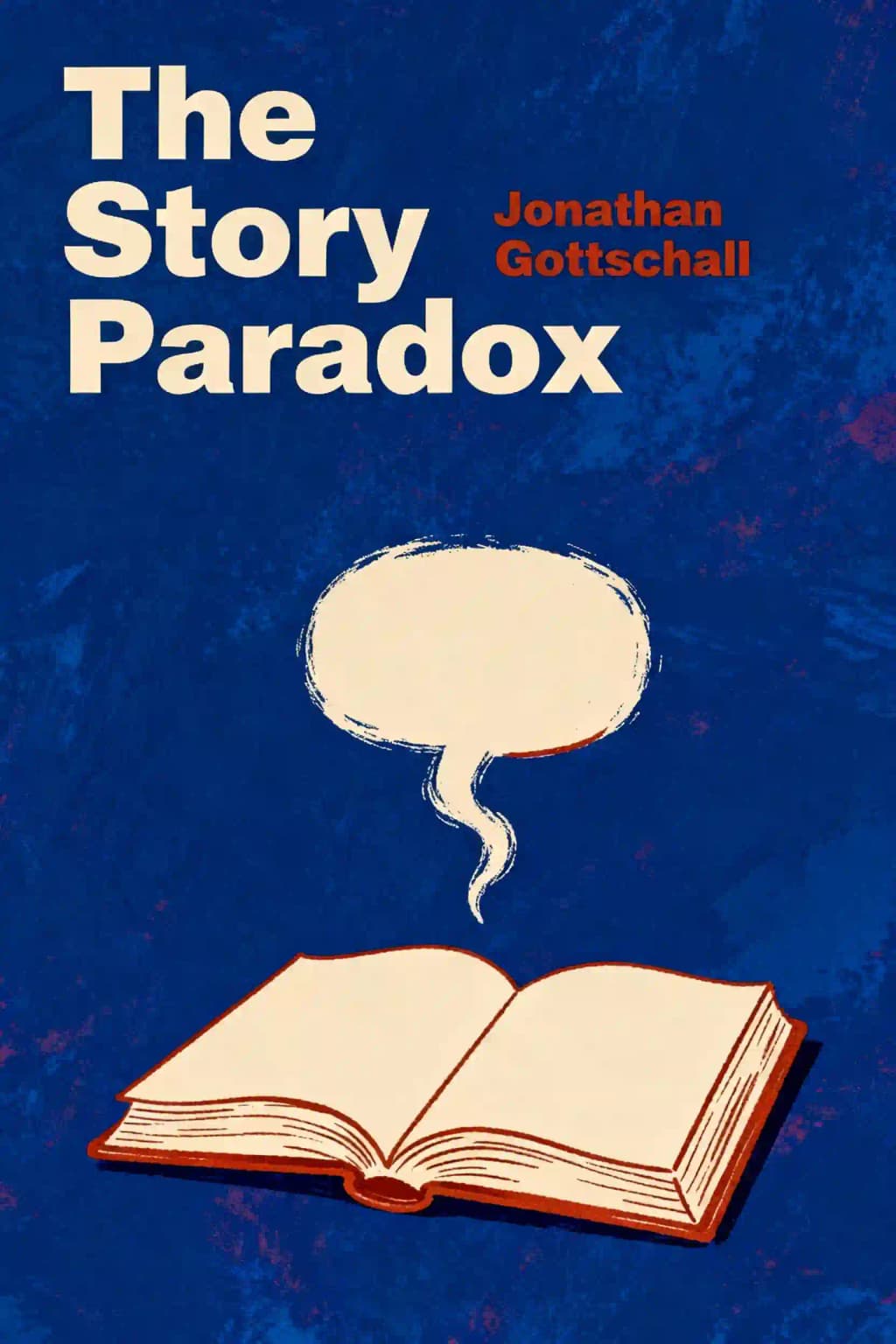
Have you ever wondered why you're drawn to stories, even when you know they're not real? Why we spend hours watching fictional characters face imaginary challenges? The answer lies in the profound insight at the heart of Jonathan Gottschall's "The Story Paradox." Stories aren't just entertainment-they're the primary force shaping human civilization, for better and worse. As a Harvard-educated literature professor and bestselling author, Gottschall has spent his career exploring how narratives influence our minds. His work has garnered praise from Steven Pinker and been featured in The New York Times and The Atlantic. In this revelatory book, he argues that storytelling is humanity's "essential poison"-vital for our survival yet potentially toxic when misused. From political polarization to religious conflicts, from conspiracy theories to social media bubbles, Gottschall reveals how our narrative addiction both elevates and endangers our species. Let's explore the paradoxical power of stories to unite and divide us.
Kapitel 2
The Storyteller's Invisible Power
When Gottschall asks his students how much time they spend with stories, they initially estimate just a few hours weekly. But when calculating actual time spent consuming narratives-from books and TV to social media and video games-they discover they spend over five hours daily in "storyland," more than any other activity. Nielsen studies suggest Americans spend nearly twelve hours daily consuming media. We devote enormous portions of our lives to stories, raising a fundamental question: why do we care so much about fiction and the fake struggles of pretend people?
The answer lies in how stories physically affect us. When we read about a character's fight-or-flight response-like a girl fleeing through dark woods from a threatening man-our bodies mirror these reactions. Our heart rate elevates, breathing increases, pupils dilate, and stress hormones flood our system. Brain scans would show we're not merely observing her danger-our brains activate as though we ourselves are the girl in peril.
This profound connection to stories isn't unique to modern humans. In 1947, photographer Nat Farbman captured Khoisan hunter-gatherers in the Kalahari Desert, showing an elder spinning tales for children. The famous photo "The Storyteller" reveals not just cultural diversity but shared humanity-particularly our universal love of narrative. Humans are storytelling animals, living in stories all day and dreaming in them all night. Evolution shaped our minds for story so they could be shaped by story-the perfect solution for transmitting cultural wisdom.
Among hunter-gatherers worldwide, storytellers enjoy high status; the Agta people of the Philippines value skilled storytellers even above skilled hunters. Similarly, our society lavishes fame and fortune on fiction makers rather than those who keep us alive-the doctors, farmers, and sanitation workers-revealing our deep reverence for the masters of make-believe.
Our relationship with fictional characters reveals what researchers Clifford Nass and Byron Reeves call "the media equation": Media = Real Life. Though adults know television characters aren't real, we still react emotionally as if they were. Our brains evolved in the Stone Age without exposure to realistic simulations, so we process convincing media as reality. This extends to parasocial interactions-reacting to fictional characters as real people, even associating actors with their roles.
These fictional relationships powerfully shape real-world attitudes. Studies show that when straight viewers watch likable gay characters on shows like "Will and Grace," they develop empathy that transfers to real-world attitudes. This "parasocial contact" works similarly for racial prejudice-making "faux black friends" through shows like "Blackish" reduces bias more effectively than diversity training. The rapid 40-point increase in support for same-sex marriage since 1996 may owe significantly to these fictional relationships.
Stories also provide escape from our own tedious mental company. Our minds constantly wander with an endless inner voice-what Gottschall calls "the Great Loquacity"-that we identify as ourselves despite having little control over it. Research shows we're often unhappier during mind-wandering than when this voice is silenced. In one tragicomic study, two-thirds of men chose painful electric shocks over sitting quietly with their thoughts for ten minutes. When absorbed in narrative, our hyperactive minds achieve a mindful presence that takes meditators years to develop.
Kapitel 3
The Dark Side of Narrative
When people hear that Plato wanted to banish poets from society, they're bewildered-what could be more harmless than poetry? But by "poets," Plato meant all fiction makers, whom he condemned as professional liars intoxicating the public with emotion while smuggling in dangerous ideas. Though his solution was extreme, Plato identified a real problem: our blindness to stories' power. We think stories are weak when they're strong, frivolous when they're serious.
In 1957, Americans panicked over claims that marketers were using "subliminal advertising" to plant unconscious desires. James Vicary claimed his experiment flashing "Eat popcorn" messages during movies dramatically increased concession sales. The Washington Post called it "the most appalling assault upon the human brain yet concocted by civilized man." But Vicary later admitted fabricating his data, and decades of research failed to make subliminal messaging work.
Ironically, while Americans feared subliminal manipulation, a genuine method of bypassing conscious defenses was hiding in plain sight: storytelling. Today, "storytelling" has become business's favorite buzzword, with companies hiring Chief Storytelling Officers and MBA programs teaching narrative techniques. Marketers celebrate stories not just for creating joy and connection, but explicitly as "Trojan horses" smuggling messages past mental defenses.
Stories work by triggering powerful emotions-what Plato called the enemy of his idealized logical mind (logistikon). We choose stories specifically for the emotions they'll generate-comedies for laughter, horror for fear, tearjerkers for sadness. The Latin root of "emotion" (emovere) means "to move"-emotions literally move us to action. This emotional power makes storytelling far more persuasive than rational argument, which often backfires when challenging deeply held beliefs.
For a story to persuade, however, it must first be good. Tommy Wiseau's notoriously awful film "The Room" demonstrates this principle perfectly. Despite spending millions to create a drama about how women are untrustworthy "demon-bitches," the film's spectacular incompetence undermines its misogynistic message. Instead of persuading viewers, it became a cult comedy phenomenon.
A story's persuasive power depends entirely on "narrative transportation"-the spell that pulls audiences into the storyworld. Research confirms that stories with implicit messages persuade more effectively than those with obvious agendas. When audiences detect manipulation, they resist. By forcing us to figure out meaning ourselves, skilled storytellers make us feel we've discovered their ideas independently.
Top storytellers understand this confrontational reality. Joan Didion called writing "an aggressive, even hostile act" where authors impose their views on readers through "the tactic of a secret bully." Novelist John Gardner similarly described storytellers as "secret propagandists" with unparalleled power to "enslave." Both emphasize the word "secret"-effective persuasion must be sneaky and indirect.
The Trojan horse metaphor perfectly captures storytelling's deceptive power. In Virgil's version, the Greeks left behind Sinon, a storyteller who convinced the Trojans that the wooden horse was an offering to Athena that would bring divine favor if brought inside the walls. Without his persuasive tale, the horse would likely have been burned. The Trojan horse isn't a metaphor for story's power to do good-it's an engine of war holding brutal holocaust in its belly, symbolizing story's ready weaponization by con artists, propagandists, cult leaders, and demagogues.
Kapitel 4
The Viral Power of Narrative
What makes stories spread? As Leo Tolstoy brilliantly defined it, art is emotional infection. Strong stories generate strong emotions that dissolve our skepticism. Research confirms emotion drives virality-the more intense the emotional experience, the more likely a story will be shared repeatedly. Particularly effective are "activating emotions" like rage and anxiety that physically arouse us, versus "deactivating emotions" like contentedness that incline us toward inaction.
Christianity's explosive spread from twenty powerless believers to the Roman Empire's official religion in just 330 years demonstrates narrative's viral power. Christianity triumphed through several advantages built into its narrative structure. Unlike Judaism or Roman paganism, Christianity was inherently missionary-making sharing the gospel a holy obligation, similar to coding in chain letters. It was also fantastically intolerant-while Roman gods didn't mind sharing worship, the Judeo-Christian God tolerated no rivals.
Christianity's emotional power also drove its spread. While its heaven seemed bland, its hell stories were vividly terrifying-ordinary sinners faced eternal torments like blasphemers hanging by tongues over flames or adulterers suspended by genitals. The religion's present-tense immediacy and end-times urgency created a compelling "hard sell"-Jesus could return at any moment, making conversion an urgent necessity to avoid eternal torture.
We're experiencing a similar pandemic of conspiratorial thinking today, with nearly half of Americans believing in Area 51 conspiracies, JFK assassination plots, and other paranoid narratives. These aren't "theories" but stories-powerful narratives that cause reason to malfunction.
While psychologists study the building blocks of conspiracy belief, they often miss the simplest explanation: conspiracy stories are thrilling fictional narratives. They spread faster than truth because they're perfectly crafted to captivate our imaginations, while debunkers face the killjoy task of proving there is no story. This dynamic explains why false information outcompetes truth on social media-good stories beat good facts.
The flat earth movement illustrates this perfectly. Originating with Samuel "Parallax" Rowbotham (1816-1884), who claimed Earth was young, stationary and pancake-flat, the movement has gained new life through digital media. YouTube alone recommended flat Earth videos hundreds of millions of times, creating converts who experience their "awakening" like taking the red pill in The Matrix-discovering everything they believed is false and shadowy forces control reality.
For secular flat earthers, the experience resembles taking the red pill in The Matrix-discovering everything you believed is false and shadowy forces control reality. Flat Earth conventions function like LARPing events where participants play heroic investigators, except with complete suspension of disbelief. Inside this narrative, they're not social outcasts but unrecognized geniuses exposing history's greatest fraud-making it nearly impossible to extract them from this ego-gratifying story.
Kapitel 5
The Universal Grammar of Stories
Our paradoxical relationship with happy endings reveals a curious truth: we crave them but can't stand to linger in them. In blockbusters like A Quiet Place, the triumphant resolution lasts mere seconds before credits roll. Data scientist David Robinson analyzed 112,000 fiction plots and concluded the average human story follows one pattern: "Things get worse and worse until at the last minute they get better." Even fairy tales rush through happiness with "happily ever after." This suggests narrative psychology has a sadomasochistic bent-we need to dwell in struggle to feel satisfaction, then quickly escape once happiness arrives, usually straight into another story of conflict.
Storytelling's mirror distorts reality by systematically amplifying conflict while minimizing harmony. Despite Steven Pinker's research showing human life improving by almost every metric, our "hell-in-a-handbasket" intuition persists because storytelling filters out good news while magnifying the bad. Journalism, despite its noble self-image as problem-finder, is trapped inside storytelling's universal grammar. There's little market for news per se-only for drama. Good news makes bad drama.
The extreme negativity of news has serious consequences: while fiction consumers tend to believe in a "nice world" where things turn out well, news consumers develop pessimism and hopelessness. News miscalibrates us, suggesting the world is an unsolvable mess requiring strongman solutions.
Two little girls playing princesses in their backyard reveals storytelling's universal grammar-not just a survival tale but a moral structure pitting good against evil. The tigers aren't just hungry animals but "mean" villains, while the princesses represent love, cooperation, and sacrifice. This children's game demonstrates how stories simultaneously weave us together and tear us apart by generating both love and hate, community and enemies, empathy and callousness.
While real life outcomes are heavily determined by luck, satisfying stories carefully control luck's role-allowing it to precipitate events but rarely determine outcomes. Harry Potter wouldn't defeat Voldemort by the villain slipping on a banana peel. Storytellers who rely on improbable coincidences for resolution (deus ex machina) are considered lazy. As novelist Steven James advises, "Coincidence is necessary to get a story started but often deadly at the end."
This applies across genres-even business narratives ignore luck's determinative power in favor of clear causes for success or failure. Stories obsessively focus on moral questions, with most following a "man in a hole" pattern where protagonists confront some form of darkness. If stories are mostly about anything, it's justice-our appetite for tales where characters get what they deserve is cross-cultural and timeless.
A large-scale study of Victorian novels revealed a sharply polarized fictional universe where protagonists sought cooperation and common good while antagonists pursued selfish domination. This "agonistic structure" reflects ancient hunter-gatherer morality, where balancing individual desires with group needs was essential. The ideal protagonist sacrifices self-interest for collective welfare when necessary, while antagonists put themselves first. This creates a blueprint for compelling villains: selfish, exploitative individuals who threaten social order and provoke righteous indignation.
Kapitel 6
Stories That Unite and Divide
The Rwandan genocide of 1994 saw Hutus slaughter 800,000 Tutsis with medieval brutality. Ten years later, a soap opera called "New Dawn" designed to promote healing showed the power of stories as empathy machines. Research confirmed the show helped listeners see "the other" as like themselves, increasing interethnic trust. Such findings support broader research showing stories can reduce prejudice and build empathy-from children reading Harry Potter to Lynn Hunt's argument that novels catalyzed the human rights revolution by teaching people to empathize across social boundaries.
However, despite our story-saturated age, we haven't seen a corresponding explosion of harmony. This contradiction exists because stories serve both sides: they can heal divides but also create them. The Rwandan genocide itself was fueled by propaganda stories depicting Tutsis as verminous invaders. Stories generate empathy selectively-often reinforcing rather than blurring us-them boundaries.
Contrary to popular belief, the worst violence isn't always committed by low-empathy psychopaths. The suicide bomber acts from intense empathy for his in-group, driven by historical narratives, religious myths, and conspiracy theories. Stories generate selective empathy that often reinforces rather than dissolves boundaries between groups. By dividing characters into heroes and villains, stories create moral blindness toward whoever occupies the antagonist role.
Our storytelling fixation on social conflict shapes human nature in troubling ways. Stories naturally divide the world into "us" (protagonists) and "them" (antagonists), defining the in-group mainly in opposition to villainous others. This creates what Fritz Breithaupt calls "empathetic sadism"-our emotional enjoyment when the good guy punishes the bad.
Though storytelling evolved to bind small tribal communities together, it can't adapt to modern multicultural nations containing vast multitudes of unrelated people. Our narrative psychology still carves people into tribes and sets them against each other, just as it did when demonizing people across the river made evolutionary sense. The more a tribe imagines itself surrounded by enemies, the more powerfully it clings together-as historian Carl Deutsch wryly noted, "A nation is a group of people united by a mistaken view of the past and a hatred of their neighbors."
Philosopher Alex Rosenberg boldly claims that "historical narratives are wrong"-not just some, but all of them. While we may know factual details about past events, history becomes unreliable when we weave these facts into explanatory narratives about why things happened and what they mean. Our collective historical memories, cobbled together from school lessons, movies, and hazy recollections, are most suspect of all.
Like other forms of storytelling, the most successful histories impose the universal story grammar on the disorder of the past, giving us good guys locked in struggle with bad guys, with life-and-death stakes. These compelling narratives often draw groups together in opposition to one another, mobilizing "ethnic, linguistic, and religious groups... by their proprietary narrative histories of mistreatment" into the mistreatment of others.
Kapitel 7
The End of Shared Reality
Gottschall fundamentally challenges our self-conception as Homo sapiens (wise person), arguing that we're primarily rationalizing animals who craft narratives to justify our beliefs and actions. Psychologists Hugo Mercier and Dan Sperber propose that rationality evolved not as a tool for determining objective truth, but as a sophisticated social instrument-functioning as both a sword for attacking opposing viewpoints and a shield for defending our own positions in social discourse. This evolutionary perspective helps explain why humans are remarkably skilled at finding flaws in others' arguments while remaining blind to weaknesses in their own reasoning.
Narrative serves as a cognitive framework that simplifies our complex world by imposing order and meaning, but this simplification comes at a cost. We typically defend our narratives with "half-blind vigor" because losing them threatens our fundamental sense of reality-it feels like "gravity suddenly switching off." Rather than constructing our narratives through careful rational analysis of facts, we largely inherit stories that colonize our minds early in life, which then act as powerful filters determining what we accept as fact and what we reject as false.
This phenomenon was starkly illustrated during the 2021 Capitol riot, where identical footage generated radically different interpretations: progressive viewers saw evidence of racist double standards in policing, conservatives saw overwhelmed officers doing their best, while others perceived either patriotic protest or sinister conspiracy. The human mind, Gottschall argues, "abhors a story void" much like nature abhors a vacuum. When confronted with chaos or ambiguity, we automatically impose pre-existing narrative templates onto events, often unconsciously manufacturing evidence to support our preferred interpretation while dismissing contradictory information.
Modern research in behavioral genetics suggests our political orientations are 30-50% determined by genetic factors, with the remainder shaped by environmental influences and the narratives we encounter during development. This finding challenges the common belief that our worldviews are purely products of rational deliberation, revealing instead that our personal ideological tendencies are largely predetermined by factors outside our conscious control.
The notion of free will itself comes under scrutiny through neuroscientific research. Studies using brain imaging technology can detect neural activity indicating decisions seconds before subjects become consciously aware of their choices-suggesting our brains determine actions before we experience the sensation of "deciding." This aligns with broader psychological research showing that human behavior is predominantly driven by subconscious processes rather than conscious deliberation.
While many resist this "unfree will" concept because it challenges our subjective experience of agency, Gottschall suggests accepting it could paradoxically improve ethical behavior by fostering greater compassion and reducing self-righteous entitlement. If free will doesn't exist as commonly conceived, then the traditional notion of villainy becomes problematic-people's actions are more products of circumstance than pure evil.
Gottschall introduces the concept of "storyverse" to describe the mental, emotional, and imaginative space created by our consumed narratives. While people share physical reality, they increasingly inhabit radically different narrative worlds-evident in the stark contrast between Fox News and MSNBC viewers, or between mainstream news consumers and those immersed in conspiracy theories like QAnon.
The rise of social media, rather than creating Marshall McLuhan's envisioned "global village" or Mark Zuckerberg's connected world, has coincided with what Gottschall calls "an explosive amplification of negativity in human affairs." Unlike previous eras where storytelling was inherently communal-whether around campfires or television sets-modern individuals consume unprecedented quantities of narrative content in isolation, often through personal devices and earbuds.
This transition from communal storytelling to mass broadcasting to today's algorithmic narrowcasting represents what Gottschall warns is a dangerous social experiment. Story, once "the great uniter" that brought communities together around shared narratives, has become "the great divider," driving people toward ideological extremes rather than drawing them toward common ground. This fragmentation of our shared narrative space poses significant challenges for social cohesion and democratic discourse.
Kapitel 8
Finding Our Way Forward
While Plato was wrong about many things, his desire for a world governed by reason rather than emotional storytelling remains compelling. But the solution isn't to assault story itself-attempts to control storytelling have created history's worst dystopias. Instead, we need to strengthen science as the counterbalance to story, as science exists precisely to test which narratives about reality are true and which are false.
Unfortunately, our truth-telling institutions are failing. Academia and journalism, which should serve as arbiters in democracy's story wars, suffer from extreme ideological bias. In journalism, registered Democrats outnumber Republicans 4:1, while in academia the imbalance is even worse-history departments show a 33.5:1 ratio of liberals to conservatives. This homogeneity creates echo chambers where viewpoints become increasingly extreme without moderating counterarguments.
We're entering an age of "deepfakes" where any evidence can be convincingly fabricated. This infocalypse threatens democracy itself, as misinformation consistently outperforms truth online. Studies show false narratives spread faster and wider than factual ones, as demonstrated during COVID-19. Social media platforms have become narrative-distribution machines exploiting our natural attraction to dark, divisive content.
Fifteen thousand years ago, someone braved dangerous cave passages to create two clay bison sculptures deep underground in what's now France. This prehistoric art-making reveals humans as naturally art-addicted creatures willing to risk their lives for storytelling. These ancient sculptures likely had religious significance, with footprints showing entire communities came to experience the story. This demonstrates how deeply ingrained our storytelling instincts are-even stories buried in darkness will draw people to risk everything to reach them.
We must recognize ourselves as Homo fictus as much as Homo sapiens. We need interdisciplinary narrative psychology research combining humanities with science. Meanwhile, we must develop personal suspicion about the moralistic simplifications in stories-especially those we tell ourselves. Like checking our own breath, we must learn to sniff our stories for exaggerations and fabrications, exercising executive control over our automatic narrative processes.
Our circumstances mirror Plato's: pandemic, decades-long wars, demagogues leading populist movements, ethnic and class tensions, declining confidence in civilization, rising foreign powers, and existential threats. We share with Plato's dread of a post-truth world where people stop seeing the same reality, making it impossible to unite against common problems.
We need charitable rules for navigating divisive stories: hate the story, not the storyteller, and don't despise those who fall for it. Though controlling our storytelling instincts will be difficult, this challenge is our call to adventure. Stories will always be with us-they're essential to human nature. But by understanding their power, we can harness them to unite rather than divide, to enlighten rather than deceive, and to build a future where our shared stories bring us together rather than tear us apart.