Kapitel 1
When Myth Speaks: The Timeless Wisdom of Joseph Campbell
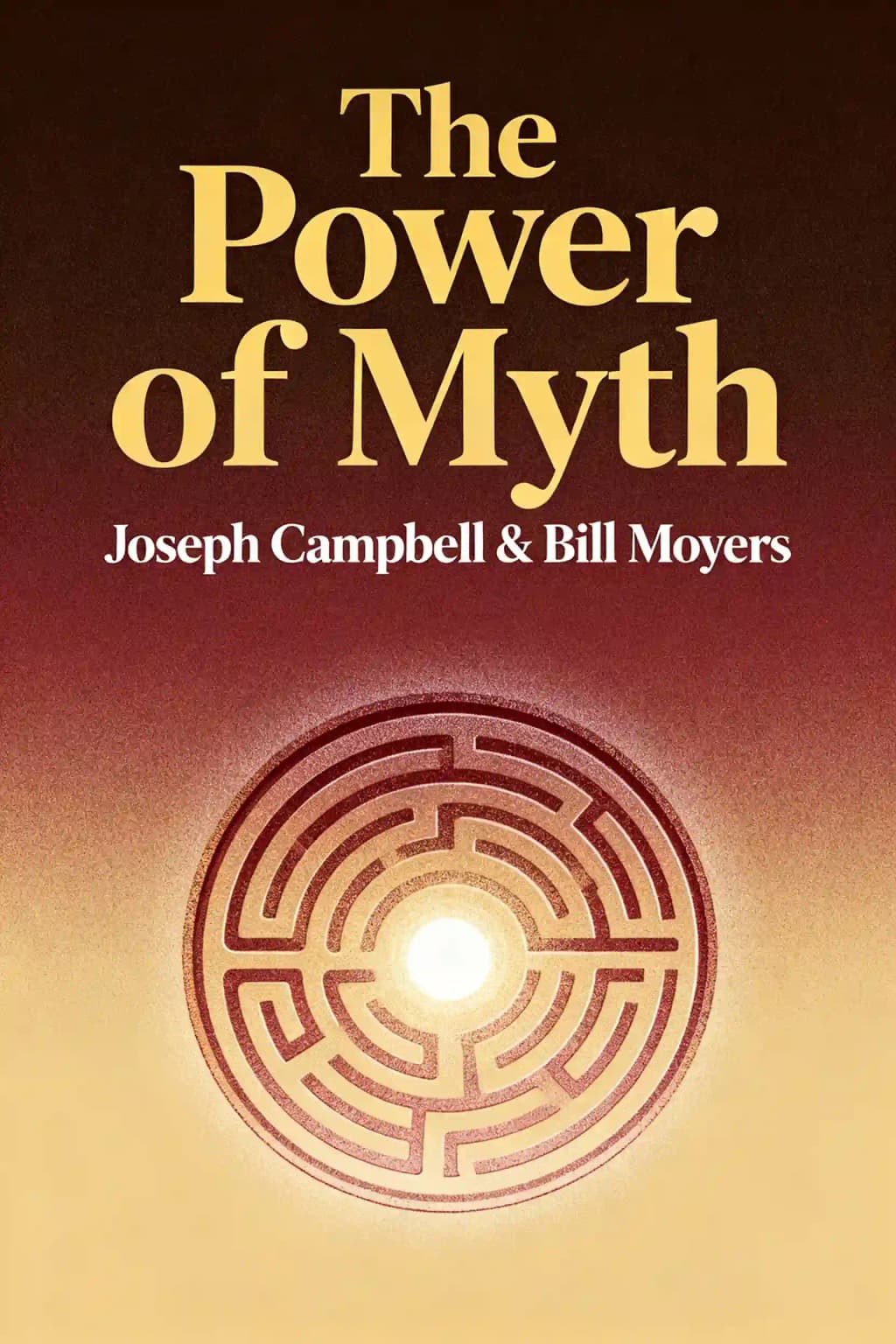
Have you ever wondered why Star Wars resonates so deeply across generations? Or why ancient stories from disparate cultures share striking similarities? Joseph Campbell's "The Power of Myth" holds these answers and more. This groundbreaking work-originally a series of interviews between Campbell and journalist Bill Moyers at George Lucas' Skywalker Ranch in 1985-86-has profoundly shaped our cultural understanding of storytelling and human experience. The book has sold millions of copies worldwide and remains on university syllabi decades after publication. Campbell's insights directly influenced George Lucas's creation of Star Wars, and his phrase "follow your bliss" became a cultural touchstone. Even celebrities like Oprah Winfrey cite Campbell's work as transformative in their understanding of purpose and meaning. Through these conversations, Campbell invites us to recognize the mythic dimensions of our own lives-not as escapism, but as the very pathway to discovering what it means to be fully human in a universe of wonder.
Kapitel 2
The Living Language of Myth in Modern Times
Mythology isn't just ancient stories-it's the essential teaching tool for navigating human life under any circumstances. Campbell argues that Western mythology, rooted in biblical traditions from the first millennium BCE, no longer aligns with our understanding of the universe or human dignity. Our inherited stories position humans as masters rather than participants in the natural world, creating a dangerous separation between humanity and nature.
What we need now is a new mythology that addresses the planet as a whole rather than specific peoples or regions. This planetary myth would still address the timeless themes all myths tackle: how individuals mature from dependency through adulthood to death, and how we relate to society and the cosmos. Campbell suggests that seeing Earth from space-without national boundaries-could become the central symbol for this emerging mythology.
This perspective isn't entirely new. Campbell shares Chief Seattle's profound 1852 letter responding to the U.S. government's inquiry about purchasing tribal lands: "The earth does not belong to man, man belongs to the earth. All things are connected like the blood that unites us all. Man did not weave the web of life, he is merely a strand in it."
The wisdom in these words reflects the kind of consciousness we need today-one that recognizes our fundamental connection to the natural world rather than our dominion over it. When we see ourselves as "coming out of the earth" rather than placed upon it, we begin to understand that we are the earth's consciousness, its eyes and voice. This shift in perspective isn't just philosophical-it's essential for our continued existence on this planet.
Kapitel 3
Beyond Duality: Embracing Life's Paradoxes
At the heart of mythology lies a profound paradox: God as "the ultimate mystery of being is beyond thinking." Campbell illustrates this with the Buddha's statement that the ultimate "both is and is not; neither is, nor is not"-transcending our categories of being and nonbeing.
To demonstrate this perspective, Campbell shares a story from the Upanishads about the god Indra, who grows proud after defeating a monster and decides to build a magnificent palace. When a blue-black boy (actually Vishnu) appears, he reveals the endless cycle of universes-each containing countless Indras who rise and fall. The boy explains how innumerable Brahmas sit on cosmic lotuses, opening and closing their eyes to create and destroy worlds. Even the ants parading across the floor are "former Indras" who once thought "What a good boy am I" before falling again.
When an old yogi (revealed as Shiva) appears with a chest marked by a circle of hair-explaining that one hair falls out each time an Indra dies-the humbled Indra abandons his palace plans to become a yogi. However, his queen intervenes, and the priest advises Indra to embrace his role as "a manifestation of the mystery of Brahma in the field of time" rather than withdrawing from the world.
This story illuminates Campbell's view that each of us is "the Indra of our own life," with the choice to either withdraw from the world or participate fully in both achievement and love. The challenge is to engage with life while maintaining awareness of its ultimate mystery.
Campbell confronts the inherent suffering in life directly: "Life is, in its very essence and character, a terrible mystery-this whole business of living by killing and eating." Yet he affirms life exactly as it is: "It's great just the way it is. And you are not going to fix it up." He rejects the Zoroastrian division of good and evil that influenced Judaism and Christianity, explaining that in other traditions, good and evil are relative to perspective. The horror of life is "simply the foreground of a wonder" that must be embraced.
The difficulty lies in our tendency to affirm life conditionally, wanting it to match our idealized vision. True heroism means participating "courageously and decently, in the way of nature, not in the way of personal rancor." In the field of time, everything exists in dualities-good/evil, male/female, past/future-but from the transcendent perspective, these distinctions dissolve. As Heraclitus said, "for God all things are good and right and just, but for man some things are right and others are not."
Have you ever wondered why we struggle to accept life as it is? Perhaps it's because we're constantly trying to impose our own rules upon it. Campbell reminds us that we must "say yes to this miracle of life as it is, not on the condition that it follow your rules. Otherwise, you'll never get through to the metaphysical dimension."
Kapitel 4
Sacred Spaces: Finding Bliss in a Modern World
Campbell explains that sanctifying the landscape is a fundamental function of mythology. The Navaho identify sacred mountains in each direction, with their hogans facing east and the central fireplace connecting to the gods through smoke. The dwelling becomes "an icon, a holy picture" where "wherever you are, you are related to the cosmic order."
This concept feels increasingly distant in our modern world. Yet Campbell emphasizes our need for sacred places in contemporary life-a room or hour where worldly concerns are suspended, where creative incubation can occur. This "bliss station" provides the "thou feeling" that traditional peoples had for their entire world.
While Mexico City was built over Tenochtitlan's temple, and American settlers named places after biblical or classical sites, Campbell laments that true sacred places rarely exist in modern cities where financial towers dominate. He contrasts this with Chartres Cathedral, where the spiritual still informs daily life and connects visitors to cosmic principles through symbolic architecture and ritual.
Campbell's famous advice-"follow your bliss"-emerges from this understanding of sacred space and time. He contrasts the man from Sinclair Lewis's Babbitt who "never did the thing he wanted to in all his life" with his own path of following inner passion despite external pressures. Even during the Depression, Campbell found joy pursuing his intellectual interests without money.
Bliss comes from connecting to sat-chit-ananda (being-consciousness-bliss)-the Sanskrit concepts representing "the jumping-off place to the ocean of transcendence." While religious traditions often defer bliss to the afterlife, Campbell insists "bliss is now"-available in this life to those who follow their authentic path.
When following your bliss, Campbell describes experiencing "invisible hands" of support: "If you do follow your bliss you put yourself on a kind of track that has been there all the while, waiting for you... you begin to meet people who are in the field of your bliss, and they open doors to you." The waters of eternal life are accessible wherever you are, if you're following your bliss.
Have you found your bliss station? That space-physical or temporal-where you can reconnect with what truly matters? In our hyperconnected world, creating such sanctuaries becomes not just a luxury but a necessity for spiritual and psychological well-being.
Kapitel 5
The Hero's Journey: A Map for Living
Campbell explores the hero's journey as a universal path already mapped by heroes throughout time. Rather than facing the adventure alone, we can follow "the thread of the hero path" to discover unexpected treasures: where we expect abomination, we find divinity; where we think to slay others, we transform ourselves; where we journey outward, we discover our center; and where we feel isolated, we connect with all existence.
The hero's journey begins with someone who feels something is lacking or has been taken from them, prompting a cycle of departure and return. This pattern mirrors our psychological development from childhood dependency to adult responsibility-a fundamental transformation requiring "a death and resurrection." Even birth itself represents a heroic transformation.
Campbell emphasizes that heroism isn't limited to men; mothers are equally heroic in giving themselves over to the life of another, with Aztec culture placing mothers who died in childbirth in the same heaven as warriors killed in battle. The hero's trials test whether they truly possess the courage and capacity for their task, ultimately leading to transformation of consciousness when one stops thinking primarily about self-preservation.
Different types of hero journeys exist-those thrust upon us and those we seek out, like the Celtic hunter following a deer into an unknown forest. The hero's adventure symbolically manifests their character-the adventure one gets is the one they're ready for. Even reluctant heroes like Star Wars' Han Solo discover heroic qualities they didn't know they possessed when faced with opportunities for sacrifice.
Campbell contrasts ancient heroic environments with our modern mechanistic world. He references Ortega y Gasset's analysis of Don Quixote as the last medieval hero, who faced windmills instead of giants as the world became spiritually unresponsive. Our modern interpretation through physical sciences and behavioristic psychology has "squeezed the freedom of human will out of modern life." Modern sedentary existence lacks the physical engagement of earlier times, leading to a "life-extinguishing" drudgery and middle-age crises.
Yet Campbell isn't against technology, citing Daedalus who successfully "flew the middle way" while his son Icarus fell. The hero's path is "like the edge of a razor," requiring balance between enthusiasm and mindful control. In our time, when two-thirds of students in a Brooklyn high school survey wanted to be "celebrities" without understanding the need for self-sacrifice to achieve something meaningful, we need heroes as "constellating images" that counter tendencies toward separation.
All heroes sacrifice their own needs for others, often seeing their accomplishments misunderstood by followers. From the hero's sacrifice comes "a new life, a new way of being of becoming" that may benefit others rather than the hero personally. Despite life's inevitable end, Campbell rejects nihilism, quoting Pindar: "When there comes as a gift of heaven a gleam of sunshine, there rests upon men a radiant light and, aye, a gentle life."
Kapitel 6
The Evolving Hero: From Monster-Slayer to Spiritual Guide
Heroes evolve as cultures evolve, from early monster-slayers who shaped wilderness into civilization to spiritual founders who bring new ways of being. Campbell draws parallels between Moses ascending the mountain to receive laws, Buddha's enlightenment under the bo tree, and Jesus's forty days in the desert. Each follows the heroic pattern of "departure, fulfillment, return."
The archetypal hero founds something new-a religion, city, age, or way of life-by leaving the old to quest for a "seed idea" with transformative potential. Even founding one's authentic life requires a heroic quest rather than mere imitation of others.
Stories serve different purposes at different life stages. Fairy tales help children navigate developmental thresholds, especially the transition to adulthood. For girls, the stories often address resistance to womanhood, while boys must actively "intend to be a man" and "disengage from mother." As we age, we need "sturdier mythology" like the crucifixion that speaks to eternal life transcending earthly pain.
While cosmological myths may become outdated in our scientific age, Campbell insists the "story of the spiritual quest" remains eternally relevant. The inward journey described in his book The Hero with a Thousand Faces still applies because "the inward life of man is exactly the same" despite our changed world.
The hero's return with transformative wisdom often meets resistance from a world unprepared to receive it. A "secondary hero" is needed "to revitalize the tradition" who "reinterprets the tradition and makes it valid as a living experience today instead of a lot of outdated cliches." While religious heroes like Buddha, Mohammed, and Jesus brought back "the wonder of God," their teachings often become reduced to rigid theological codes, transforming the fluid poetry of mythology into literal prose.
Campbell recognizes George Lucas's Star Wars as effective modern mythology, with terms like "the Force" and "the dark side" resonating with young viewers. The film's power lies in presenting abstract principles of good and evil rather than specific historical conflicts. Darth Vader represents the modern threat of dehumanization-"a robot, a bureaucrat, living not in terms of himself but in terms of an imposed system." The hero's journey involves learning to maintain humanity within the system rather than being flattened by it.
When Luke Skywalker turns off his computer and trusts his feelings in the climactic battle, he exemplifies choosing heart over "intentional power." The Force represents "the power and energy of life," connecting to Campbell's concept of the world navel-the sacred creative center that "surrounds us, penetrates us, binds the galaxy together."
Kapitel 7
Facing Our Dragons: The Inner Battle
Campbell explores the hero's journey through the "belly of the whale" motif. When heroes encounter the unconscious, they have two options: either be swallowed by the monster (like Jonah) and undergo transformation through a "night-sea journey" where they learn to handle dark powers, or overcome and kill the monster (like Siegfried with the dragon) and absorb its power. Either way, the hero must reconnect with natural powers beyond conscious control.
Campbell warns that consciousness must serve the body's humanity rather than control it, or one risks becoming like Darth Vader-someone who has "gone over to the consciously intentional side." The true journey involves facing our inner dragons-our ego attachments to what we think we want or believe-which limit our potential and keep us from expanding into larger relationships.
His guidance for the hero's journey is simple yet profound: "Follow your bliss." The dragon represents our ego binding us to limited possibilities-what we think we can afford, believe, or love. Our Western dragons symbolize greed, hoarding treasures without purpose, unlike the vital Chinese dragons that yield bounty.
Campbell explains that mythology teaches us to accept death as an aspect of life rather than its opposite. "The conquest of fear yields the courage of life," he says, describing this as the cardinal initiation of heroic adventure. He recalls Native American warriors riding into battle crying "What a wonderful day to die!" This represents the mythological wisdom that we must constantly die to our achieved selfhood to continue growing. True heroism comes from fearlessly accepting the cycle of life and death.
To illustrate this, Campbell recounts the tale of Sir Gawain and the Green Knight, where Gawain accepts a challenge that tests his loyalty, temperance, and courage. The story shows that the path to fulfillment lies between the perils of desire and fear.
Campbell describes Nietzsche's parable of spiritual transformation from Thus Spake Zarathustra. First comes the camel, representing childhood's obedient burden-bearing. The loaded camel transforms into a lion, whose task is to slay the dragon called "Thou shalt"-the accumulated societal rules. When the dragon is dead, the lion becomes a child, moving from its own nature like "a wheel impelled from its own hub." This final stage represents life lived by inner impulse rather than external rules, a return to "Eden before the Fall."
Each person must intuitively know when they're ready for independence, just as baby birds know when to fly. Campbell suggests that genuine art students recognize when they've learned what their teachers can offer and are ready for their own creative flight. Some teachers facilitate this transition while others resist it.
Kapitel 8
The Great Goddess: Reclaiming the Sacred Feminine
Campbell introduces the concept of the Great Goddess, whose myths teach compassion for all living beings and reverence for earth as the Goddess's body. While father symbolism dominates some religions, mother symbolism was primary in many ancient traditions. The mother is "a more immediate parent" since we're born from her. In agricultural societies, woman magic and earth magic were considered the same-the human woman gives birth and nourishment just as the earth does.
In Goddess religions, the female represents maya-what Kant called "the forms of sensibility." The Goddess embodies time and space themselves, while the mystery beyond her transcends all pairs of opposites. "Everything you can think of, everything you can see, is a production of the Goddess."
Campbell describes watching a scientific film about protoplasm that revealed to him this flowing, creative force of life taking different forms-from grass to cows, birds to fish-all manifestations of the same primordial substance, each with "its own intentions, its own possibilities," which is where meaning emerges. This living energy is what the Indians recognize as the informing life of all things, the earth itself.
Despite scientific discoveries, Campbell believes myth is returning. He points to scientists using terms like "morphogenetic field"-the field that produces forms-which is precisely what the Goddess represents. This concept helps us distinguish between our physical bodies and the energy that animates them.
Western civilization began in the great river valleys where Goddess worship flourished. This changed with invasions beginning in the fourth millennium B.C., bringing warrior gods like Zeus and Yahweh. The key archetypal event was Babylon's god Marduk defeating Tiamat, the All-Mother Goddess. Though she was already the universe, Marduk dismembered her and fashioned the world from her body, symbolizing male political power supplanting feminine creative power.
Yet the Goddess persisted in Hellenistic times and returned through the Virgin Mary in Catholicism, with cathedrals named Notre Dame. Campbell traces the Madonna archetype to Egyptian mythology, specifically Isis nursing Horus. He recounts the complex story of Osiris's murder by his brother Seth, Isis's search for her husband's body, and her eventual conception of Horus from Osiris's corpse-illustrating the theme that "out of death comes life." This divine mother with her child became the model for the Christian Madonna.
Campbell explains how early Christian fathers intentionally adopted these ancient images, noting that Jesus's birth date was placed on the winter solstice (December 25), the same as the Persian God of light, Mithra. The symbols represent death to animal nature and birth to spiritual nature.
Kapitel 9
Love's Transformative Power: Beyond Social Rules
Campbell elaborates on the rules of courtly love, explaining that love shouldn't operate alone but in cooperation with other virtues. He identifies the five main virtues of the medieval knight: temperance, courage, love, loyalty, and courtesy. Courtesy represents respect for societal decorum, preventing any single function from dominating the whole system.
In the medieval courtly love tradition, women established the rules of engagement. The technical term for a woman granting herself was "merci," which might range from minimal permission to full giving in love. Women tested potential lovers for a "gentle heart"-the capacity for compassion (mitleid in German, meaning "suffering with"). A man needed to demonstrate he could suffer for love, proving it wasn't mere lust.
The troubadours weren't trying to destroy marriage or the Church but to sublimate life into a spiritual plane of experiences through individual commitment. Their discovery was the importance of individual experience-not love in general, but love for that one specific person. This love creates an "electric thing" and sometimes "agony" that can only be healed by "the weapon that delivered the wound."
Connecting this to the Grail legend, Campbell describes the Grail as representing "the fulfillment of the highest spiritual potentialities of human consciousness." The wasteland in Grail stories symbolizes people living inauthentic lives, while the Grail represents what is attained by those who live authentically. True spirituality comes from the union of matter and spirit, not their separation.
Campbell continues his exploration of love and relationships, explaining that loyalty in marriage doesn't forbid "an affectionate, even a loving relationship to another person." He notes that traditional mythology rarely addresses personal love, as marriages were typically arranged according to clan rules. When asked about love's relationship to morality, Campbell declares that love "violates it," existing as "a higher spiritual experience" beyond social order.
He connects divine and romantic love, citing the troubadour concept that "if God is love, well then, love is God." Campbell explores the paradox that love involves both joy and suffering, calling it "the burning point of life" and "the pain of being truly alive." He shares Persian myths including Satan as God's greatest lover condemned to hell for his devotion, and the story of the first parents whose love was so intense it had to be reduced. Campbell concludes that the stronger the love, the more the pain, yet "love bears all things."
Kapitel 10
The Masks of Eternity: Finding the Transcendent in Daily Life
Campbell explores how we access profound spiritual experiences through embracing mystery itself. When asked if we can describe God despite inadequate language, Campbell explains that art and poetry reflect what people experience of God, though "the ultimate, unqualified mystery is beyond human experience." Poetry's precise language creates implications that reveal the essence-the epiphany.
Campbell shares Schopenhauer's idea that our lives, seemingly random, may actually be composed by an unconscious will within us-like characters in "one great dream of a single dreamer." This connects to India's Net of Indra metaphor where everything arises in mutual relation. When asked if life has purpose, Campbell counters that life itself doesn't have purpose, but each incarnation has potential. His advice? "Follow your bliss"-staying centered even without material rewards.
The journey itself is the destination. Campbell cites the Navaho "pollen path"-beauty in all directions leading to the center. When questioned if Eden exists in our world of suffering, Campbell affirms "Eden is"-but seeing it requires psychological transformation to perceive "not the world of solid things but a world of radiance."
Campbell explains the sacred sound "AUM" as representing universal energy-beginning with "ahh" at the back of the mouth, filling with "oo," and closing with "mm." This four-element syllable includes the silence underlying it-the immortal aspect beyond our mortal existence. Words always limit, but peak experiences break through language to direct realization-"Oh... ah..."
In our modern world, where science and technology seem to have demystified existence, Campbell reminds us that the ultimate mystery remains-not as something to solve, but as something to experience. The masks of eternity are the various ways cultures have represented this mystery, but behind all masks lies the same ineffable reality. Our task isn't to strip away the masks but to recognize what they reveal: that we are all participants in the dance of eternity, here and now, if only we have eyes to see it.