Kapitel 1
The Volatile Journey of Creation: Finding Your Way Through Uncertainty
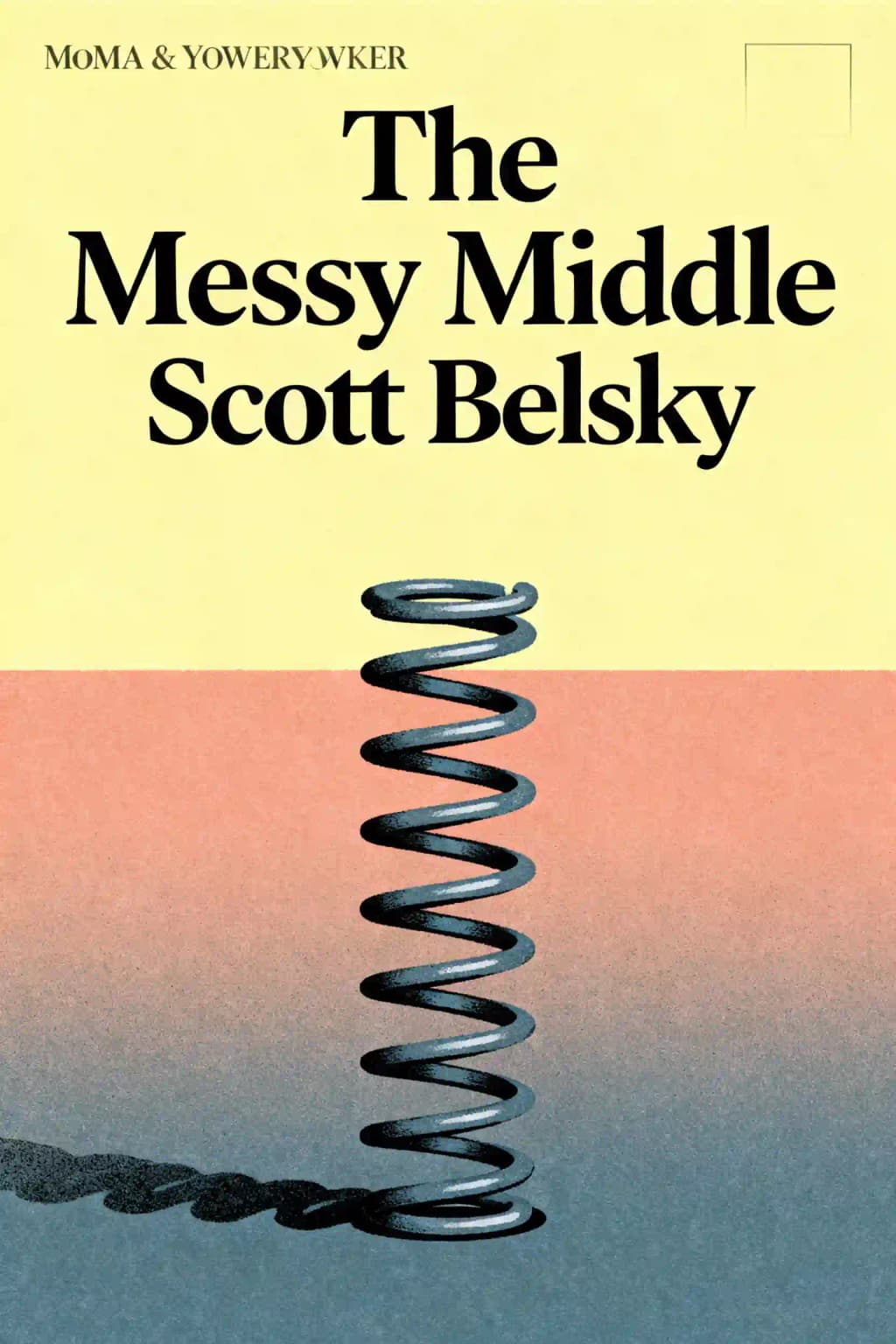
Ever found yourself in the middle of a challenging project, wondering if it's worth continuing? Scott Belsky's "The Messy Middle" offers a lifeline for anyone navigating the turbulent waters of building something meaningful. This isn't just another business book-it's a survival guide that has become required reading for founders like Alexis Ohanian and earned praise from industry titans like Seth Godin and Tony Fadell. The book's genius lies in shifting focus away from glamorous beginnings and triumphant endings to illuminate the chaotic, uncertain middle where success is actually determined. Drawing from his experience building Behance (acquired by Adobe for $150 million) and advising companies like Pinterest and Uber, Belsky provides a roadmap through the volatile terrain where most ventures either flourish or fail. In a culture obsessed with overnight success stories, this book reveals the hidden truth: the middle is where all the important work happens.
Kapitel 2
Enduring the Valleys: Leading Through Uncertainty
The middle years of any venture blend together in a haze of slow progress and psychological struggle. You feel constantly alone, burdened by the need to appear optimistic while feeling invisible, manufacturing hope beneath layers of fear. These middle miles are filled with ambiguity, uncertainty, and mundane tasks that require supernatural sustenance to endure.
When traditional validation is absent, leaders must find ways to sustain their teams. At Behance, we celebrated tiny milestones-like finally becoming a legitimate Google search result instead of "Did you mean: enhance?"-to create a sense of progress. We're biologically wired for short-term rewards; dopamine releases with each success make us crave immediate gratification. Rather than fighting this biological reality, hack your reward system by lowering the bar for what constitutes a "win" while ensuring these victories correlate directly with progress.
However, only celebrate genuine achievements. Tell hard truths without destroying morale by stating facts clearly, explaining how problems occurred, and outlining preventative lessons. Don't focus on "good news" at the expense of addressing failures. Only celebrate progress and actions you want repeated, not artificial accolades like paid press or raising capital (which should make you nervous, not celebratory). Fake wins are like cocaine-they temporarily inflate morale before crashing it lower than before.
We desperately crave certainty but must learn to function without it. Leaders who embrace uncertainty allow experimentation rather than claiming to know all answers. The constant processing of "unknown unknowns" creates an existential angst that's impossible to fully disconnect from-it becomes a "think blend" where work and personal life mesh inseparably. The key is developing parallel processing skills: staying present with your team while maintaining awareness of the bigger picture.
Society's natural resistance to innovation manifests as doubt, cynicism, and pressure to conform. Overcoming this requires more than passion-you need a commitment to suffering for years. As investor Doug Clinton argues, entrepreneurs must commit to at least five years of suffering through rejection, unexpected losses, and founder conflicts before seeing meaningful traction. This commitment enables teams to overcome major psychological challenges like starting over. YouTube began as a failed dating site, Twitter evolved from a stalled podcasting network, and Instagram emerged from an unsuccessful check-in app called Burbn. By expecting suffering, you can manage expectations and build a culture that values the journey as much as the destination.
Though we associate friction with negativity, it's fundamentally creative-giving us fire, moving mountains, and advancing both individuals and societies. Hardship unites teams by triggering our ancestral preference for group survival through collaboration. When companies support employees through adversity, it creates belonging and commitment. Rather than avoiding tension, use it to force deeper exploration of solutions. As Marcus Aurelius said, "The impediment to action advances action. What stands in the way becomes the way."
Kapitel 3
Building Resilience: Strengthening Your Resolve
Your sense of self shifts at peaks and valleys. During great moments, we develop an inflated sense of self, becoming less open to advice. During struggles, we blame external forces to maintain confidence. Self-awareness begins by recognizing that you're not your greatest self at extremes. Understanding your triggers helps you manage them-like my need to right injustices even when economically irrational.
Being permeable to feedback is crucial; founders who openly absorb and selectively integrate what they hear consistently outperform defensive ones. Self-awareness comes from chronicling your patterns through coaching or therapy. As Jung said, "Knowing your own darkness is the best method for dealing with the darkness of other people." With greater self-awareness, you have more data to inform decisions, making you more competitive in business.
When building something new, you'll be tempted to describe it in familiar terms like "Uber for massage" to be understood. But what you gain in relatability, you lose in innovation. Designer James Victore advocates embracing your uniqueness: "I do the work I do because I have to. I can't help it... I know what the current trends are, but I can't concern myself with them." Being "weird" is powerful-it attracts some and repels others. The future always starts as fringe. When pioneering something new, aim for a small audience that loves your product rather than pleasing the masses.
During tough moments when hope fades, your mind becomes your worst enemy, questioning your ideas and abilities. What you need then is a dose of OBECALP (placebo spelled backward)-suspending your disbelief in yourself to overcome doubt and see possibilities beyond reality's gravity, just as Larry Page pushed Google teams to aim for "100x" of their proposals.
When facing tough times, how do you decide whether to persist or quit? Angela Duckworth's research on "grit" shows that success comes from passion and perseverance toward long-term goals. But working hard doesn't mean pretending all is well-healthy successful people maintain self-awareness about their struggles. The key is separating hardship from learning: if knowing what you know now, you'd still pursue the project, don't quit. But if you've lost conviction and are continuing only because of sunk costs, reconsider.
Kapitel 4
Playing the Long Game: Strategic Patience
Our minds excel at recognizing immediate cause and effect but struggle with chain reactions and long-term planning. Playing the long game demands breaking conventional productivity rules-building relationships without immediate payoff, brainstorming when busy, investing in promising people rather than just promising projects.
Curiosity fuels this approach; when genuinely curious, you're content exploring without measuring productivity by completed tasks. Great venture investors like Bill Gurley exemplify this, deeply researching industries for months or years without concern for when an investment opportunity might emerge. As Jeff Bezos noted, "Invention requires a long-term willingness to be misunderstood."
Bezos's approach to patience at Amazon exemplifies strategic long-term thinking. In his famous letter to shareholders, he outlined principles that have guided Amazon since: focusing on long-term market leadership over short-term profits, analytically measuring program effectiveness, making bold investment decisions, prioritizing future cash flows over accounting appearances, maintaining transparency about strategic choices, reinforcing a cost-conscious culture, balancing growth with profitability, and attracting talent with ownership incentives.
Amazon structurally protects patience by normalizing failure as part of innovation and allowing new technologies time to evolve without immediate profit pressure. Similarly, Google's reorganization as Alphabet structurally separates bold initiatives from quarterly profit demands. As Aaron Levie noted, "Startups win by being impatient over a long period of time." Success stories like Netflix's transformation from DVD-by-mail to streaming giant took nearly two decades of persistent strategy execution despite industry mockery.
Pinterest CEO Ben Silberman approaches building his company with unusual patience, breaking the long journey into distinct chapters. Rather than conforming to Silicon Valley's compressed timescales, he draws from his background in a family of doctors where mastering a craft takes 7-12 years. Each Pinterest chapter has a clear beginning, goal, reflection period, and reward that applies company-wide. This chapter approach focuses on goals rather than tactics, requiring fresh product perspectives, renewed user empathy, and honest team assessment for each phase.
Disruption often comes from thesis-driven outsiders who haven't been constrained by industry norms and established practices. The key is simply surviving long enough to develop the expertise needed to compete effectively with a fresh approach. Companies like Airbnb and Uber exemplify this pattern-their founders began as industry outsiders with strong opinions about necessary changes, then persisted until they became experts themselves.
Kapitel 5
Optimizing Your Team: Building a High-Performance Culture
Great teams aren't simply assembled from great people-they're grown through constant iteration of roles, cultures, and processes. In entrepreneurial environments, your team must take priority over your goals, and team health must precede product development.
When scaling, leaders often default to hiring more people, but the best managers know adding headcount isn't always the answer. Resourcefulness provides a competitive advantage that resources alone cannot. At Behance, Will Allen pushed teams to "refactor, refactor, then hire"-improving processes before adding people. The business of innovation thrives on resourcefulness, not just resources.
When building your team, prioritize initiative over experience. People with excitement and willingness to learn can make up for what they lack in experience with hustle. Inexperienced yet smart people with initiative almost always exceed expectations, while experts often try to apply the same solutions that worked before. Initiative is contagious; expertise is not.
Your product's unique attributes distinguish you from competition, and these attributes emerge through clashes of opinion and divergent thinking. The greatest teams comprise extraordinarily different extraordinary people. Innovation happens at the edge of reason, and you can't reach that edge with similar people. Diversity in gender, race, background, and even language creates a competitive advantage.
Look to build a team of people who have overcome substantial challenges in their own lives. This brings strength and tolerance to your team's DNA. Tristan Walker, CEO of Walker & Company Brands, made courage his company's first value, drawing from his experience growing up in the projects where he witnessed violence. His worst-case scenario was returning to that life, which gave him determination to make his business survive.
In a world of pithy sound bites and smooth pitches, work with people who build on your ideas and invite you to build on theirs. Your second conversation with a potential hire should feel more interesting than your first. The best team players throw around nascent ideas while helping build on others'. In improv comedy, this is the "Yes! And..." principle-accepting what others present and adding to it.
Creating something from nothing requires passionate debate. Your team's vehement disagreements force exploration of unpopular options, but only if colleagues are determined enough to fight it out without apathy. People who are argumentative, opinionated, and polarizing protect you from groupthink and harmful compromise. Learn to tolerate difficult people-great creative minds have their demons, and technical geniuses often possess stubbornness and frustration.
Every team has a natural immune system that quickly identifies and rejects problems. But this same system can backfire when you're trying to change team chemistry. When new leaders join, they often make changes that trigger the team's immune response-complaints, active disagreement, passive resistance, or humor. Your team needs both "doers" (antibodies that extinguish risky ideas) and "dreamers" (foreign bodies with fresh perspectives).
Kapitel 6
Creating a Thriving Environment: Culture, Communication, and Structure
Culture isn't designed through foosball tables and happy hours-it emerges organically through the stories your team shares. These stories reinforce why you're there, what makes the team special, and provide institutional knowledge that orients new employees. At Behance, we constantly retold tales from our early days-how founders met, buying our first engineer better jeans, eating salads for breakfast. These seemingly insignificant stories became our cultural fabric, imparting values of loyalty, eccentricity and determination.
In chemistry, free radicals are highly reactive molecules with unpaired electrons. In the professional world, they're the unbound energy sources who take their careers into their own hands, operating at higher risk for higher reward. They're not defined by age but by mindset-resilient, self-reliant, and extremely potent whether working solo or within organizations. Free radicals do intrinsically rewarding work but expect validation when they make impact. They demand freedom to experiment and participate in multiple projects simultaneously.
While managing expenses carefully matters in business, certain frugalities backfire. Since you spend 30 percent of your life in bed and sleep profoundly impacts waking life, never skimp on your mattress. Similarly, invest in the best office chair possible since modern workers often spend more time sitting than sleeping. Beyond individual furniture, your overall workspace significantly influences focus, motivation, and creativity.
Startup founders and new managers constantly ask about optimal team structures: Should remote work be allowed? Should marketing be separate or integrated? Can cofounders share CEO roles? Should designers report to product managers? When to implement hierarchy? While these norms have merit, such questions can't be answered without understanding the specific people and circumstances involved. When you have the right people playing their A-game, you can and should be creative with structure.
In startups, "process" is considered a dirty word. When the right people work together with shared goals and transparency, they operate with remarkable efficiency without burdensome procedures. Small teams outperform large ones not because of size but because alignment eliminates friction between thought and action. As teams grow, misalignment inevitably occurs. The solution? Process-the very thing unnecessary in early days.
One crucial unspoken role of a leader is that of internal marketer. While we obsess over customer-facing messaging, we often neglect internal branding. The best leaders constantly devise creative ways to capture attention and drive action. This might include visual representations of milestones on walls, internal communications campaigns highlighting goals and progress, or pithy declarations like Pinterest's "Year of Going Global" or Uber's "Year of the Driver" that refocus priorities.
If a picture is worth a thousand words, a mock-up answers a thousand questions. In strategic planning, there's too much abstract talking and not enough visualization. Ideas remain misunderstood until they can be seen. Visual representations anchor discussions in something concrete rather than abstract. Without a mock-up, people try to interpret concepts in the dark, feeling one edge at a time. A mock-up or prototype turns the lights on, aligning people quickly.
Kapitel 7
Simplifying Your Product: The Power of Focus and Clarity
Your competitive advantage comes from conscious trade-offs-knowing what you'll excel at and what you're willing to sacrifice. As one psychologist noted, "To be a great psychologist, you need to be great with patients and just fair with paperwork." Southwest Airlines exemplifies this principle: while never compromising safety, they deliberately limited their routes and simplified meal offerings to focus on exceptional service at competitive prices.
Great products maintain simplicity not by avoiding evolution but by continuously improving core value while removing peripheral features. As products mature, you must eliminate friction to keep growing, even if it means disappointing your vocal minority of power users. At Behance, we eliminated numerous features like the Tip Exchange and Groups, making the product simpler but more engaging for the majority of users.
The hardest cuts are not the failures but the promising initiatives that aren't quite good enough to merit your singular focus. Most teams keep nurturing any features showing potential, splitting their energy across multiple projects. This approach stunts progress in any particular direction, confuses your narrative, and prevents reaching the "escape velocity" that comes from deep focus on one problem.
When a team no longer believes in what they're building but hasn't admitted it to themselves, they're heading for failure. If your motivation is just finishing something you started, you'll fail to inspire and capitalize on resources around you. When you fall out of love with what you're making, your gut is telling you something important. The litmus test is whether you have more or less conviction about the vision than when you started.
In building Behance, we got too creative with terminology, using "realms" instead of the more literal "creative fields." New products are hard enough to figure out without needing to decipher new terminology. While disruption requires difference, adoption requires familiarity. The most widely adopted products accommodate new customers with recognizable patterns rather than retraining users.
Customers make sweeping judgments in their first experience with your creation-especially in the first 30 seconds. This "first mile" is critical yet often an afterthought. For physical products, it's the packaging and instructions; for digital products, it's onboarding and explanatory copy. A failed first mile cripples a new product regardless of how brilliant what's behind the locked door might be.
In those crucial first 30 seconds of any new experience, people are fundamentally lazy, vain, and selfish. They're lazy-unwilling to invest time learning something new without clear benefits. They're vain-concerned with how they appear to others, which is why social products provide immediate "ego analytics" showing likes and engagement. And they're selfish-wanting immediate personal benefit before committing further.
Kapitel 8
Customer-Centered Innovation: Building What People Actually Want
When talented designer Clement Faydi left Behance to found his news-sharing platform Topick, he had passion but lacked customer validation. Despite beautiful design, the product failed because he focused on his own interests rather than testing market needs. Similarly, Scott initially wanted to build an online creative community with Behance, but quickly discovered users actually wanted tools to manage portfolios and get discovered.
Counter-intuitively, you shouldn't attract all customers immediately. Start with a small cohort for high-touch communication. Different stages require different ideal customers: first seek WILLING customers who'll test your minimum viable product; then FORGIVING customers who tolerate missing features; then VIRAL customers who'll spread the word once your product is polished; then VALUABLE customers with high lifetime value; and finally PROFITABLE customers who pay the most while demanding the least.
Every creation needs a narrative-not just what your product does, but why it must exist. Many founders mistakenly delay crafting this story until launch, considering it merely marketing. For Behance, the narrative was about empowering creative professionals whose careers were "under siege" by giving them attribution and opportunity based on merit rather than connections.
The internet enabled networks that connect people and create value greater than the sum of their parts. Leaders of these communities must recognize they are stewards, not owners. At Behance, we understood that millions of portfolios didn't belong to us-our job was to protect and enrich the network. Networks are served, not led-decisions must prioritize participants' needs over company objectives, similar to hospitality businesses where customer comfort is paramount.
Despite being overlooked in business school curricula, sales is the most essential discipline for creators. Being a good salesperson means meeting others where they are rather than waiting for them to come to you. It requires pushing yourself to share ideas, discuss progress, meet people across different fields, and talk to anyone who will listen. At its core, sales is genuine empathy and connection-understanding everyone's problems, hopes, struggles, and fears.
While being first to launch a product is thrilling, being best in your market ultimately matters more. Periscope's founders faced this dilemma when competitors were rushing to market with similar live-streaming apps. Despite Meerkat launching a month earlier with much fanfare, Periscope's carefully conceived features and Twitter integration helped it thrive while Meerkat eventually shut down. The lesson? You're running a race to get it right, not just cross the finish line first.
Kapitel 9
Optimizing Yourself: Developing Leadership Capacity
While optimizing your team and product is essential, equally important is optimizing your own capacity to lead and make decisions. As Dwight D. Eisenhower noted, "plans are useless, but planning is indispensable." The act of planning forces us to pause and assess our direction, even if the final outcome bears little resemblance to our original vision. Looking back at old strategy documents often reveals how wildly off our projections were, yet the planning process itself remains valuable.
As your success grows, you'll face the burden of increasing opportunities. Whether you're an entrepreneur, artist, investor, or author, your continued success depends on your ability to decline opportunities and make focused choices. Tim Ferriss exemplifies this discipline, using specific criteria for evaluating opportunities. Early in his career, he only pursued projects that could be "a first" or "category killer."
In negotiations, optimizing for short-term gains often undermines long-term success. While aggressive negotiation tactics might yield immediate benefits in one-off transactions like real estate purchases, they create adversarial relationships that undermine ongoing partnerships. The best approach for long-term relationships is pursuing mutual fairness-being transparent about your reasoning and considering what's fair for both parties.
Great advice in one context can be disastrous in another. Entrepreneurs and investors often dispense wisdom as if sharing winning lottery numbers, but these "best practices" are entirely context-dependent. As investor Hunter Walk told entrepreneurs: "Never follow your investor's advice and you might fail. Always follow your investor's advice and you'll definitely fail." The most valuable advice doesn't instruct-it provokes thought. By collecting contradictory perspectives, you can triangulate your own approach.
Our obsession with metrics often leads us to forget what we're actually trying to measure. We track website visitors or ad clicks when our real goal might be sales or brand establishment. Seth Godin calls these "stand-ins"-easy-to-measure proxies that employees eventually game rather than improving what truly matters. The danger is that these artificial measures abstract your goals. Always ask "What is the real goal here?" and choose measures that align with your true objectives.
It's impossible to know how you truly come across to others. People see you through their personal lens of experiences, insecurities, fears, and aspirations. Despite your best efforts to adjust, you'll never be perceived exactly as intended. Two major factors determine how others see you: context and psychology. To address this blind spot, ask questions like "If you were me right now, what would you do differently?" This helps gauge how others view your position and actions.
Kapitel 10
The Final Mile: Finishing Well and Moving Forward
The final stage of a journey brings a mixture of elation, disbelief, and fear. When Behance was acquired by Adobe for $150 million in December 2012, the team experienced this complex emotional cocktail. Seven years of volatility, doubts, and fears culminated in a definitive exit point that would change their lives forever. Despite the euphoria of success and financial reward, questions lingered: Would Adobe protect their product and community? Would their culture change? Would newfound wealth corrupt their ambitions?
The final stage of a venture requires completely different skills than those that brought you success. One entrepreneur nearly derailed his acquisition by Facebook by giving away too much leverage too early-meeting with their team and sharing roadmaps before discussing price or deal terms. Great founders aren't necessarily great finishers. For Behance, the final mile began when partnership discussions with Adobe evolved into acquisition talks. This required enlisting advisors who could confidently guide the process, from board members to other entrepreneurs who had completed similar deals.
Facebook's headquarters features stickers and posters declaring "THIS JOURNEY IS 1 PERCENT FINISHED"-embodying the paradox that progress often moves us past the early period when we're most willing to make bold moves that accelerate growth. While most companies follow Myspace's path of iterating to a "successful" product then focusing on sustaining it, Facebook has consistently acted like they're just getting started. This mentality keeps teams questioning assumptions and thinking bigger.
When you pour your life into a project, the final mile becomes emotional as you reconcile how your venture has changed your identity. When people don't feel ready for success or question whether they deserve it, they unknowingly fight it through self-sabotage. Most lapses in judgment during major transitions stem from deeper psychology-a part of us that fights our own progress. Overcoming this resistance is the first step in setting up your finish.
No venture turns out exactly as imagined, and when it's time to wind down, resist the urge to quickly shut down and move on. Some entrepreneurs shut down projects silently to avoid spotlighting failure, while others make excuses or falsely spin dissolutions as "acquisitions." The most respectable entrepreneurs own their outcomes, whatever they may be.
The idea of being "done" suggests your interest has ceased, but for those who love what they do, creativity never ends. Brad Smith, a serial entrepreneur, notes that despite having end goals for his ventures, he never ends up where expected-and finishing one project merely creates space to begin anew. Projects and passionate pursuits die only to become soil for new growth, as embers of dying projects feed the next creation. When you ship your creations, celebrate the accomplishment but then kill the feeling of being "done" by starting something new.