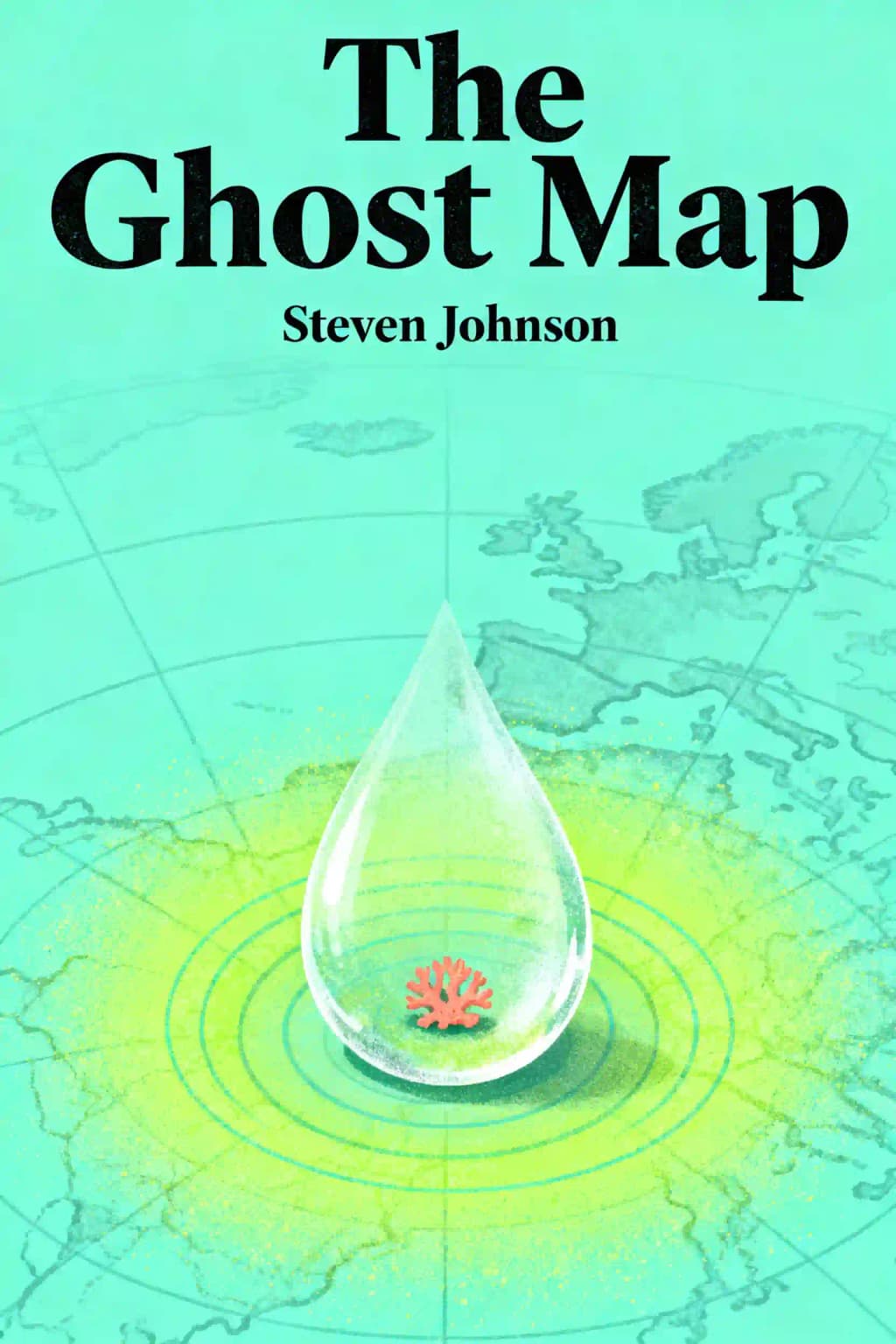
In 1854 London, 616 people died in one week from cholera. "The Ghost Map" chronicles how a doctor and reverend revolutionized epidemiology by challenging scientific dogma. This National Bestseller reads like a thrilling detective story - what mysteries of disease await you?
Steven Johnson is the bestselling author of The Ghost Map: The Story of London's Most Terrifying Epidemic—and How It Changed Science, Cities, and the Modern World, and a leading historian of innovation and technology. Routinely compared to Malcolm Gladwell and James Gleick, Johnson specializes in multidisciplinary storytelling that connects science, urban development, and cultural transformation.
The Ghost Map explores the 1854 cholera outbreak as both medical thriller and examination of how cities evolve—themes central to his broader work on innovation and ideas.
Johnson has authored twelve books, including Where Good Ideas Come From, How We Got to Now, and Everything Bad Is Good for You. He hosts the podcast American Innovations and co-created the PBS and BBC series How We Got to Now.
A Distinguished Writer in Residence at New York University, Johnson lives between Marin County and Brooklyn. The Ghost Map has been adopted as a common book by universities nationwide and praised for its compelling blend of history, science, and urban studies.
The Ghost Map chronicles the 1854 cholera outbreak in London and how Dr. John Snow and Reverend Henry Whitehead discovered that cholera spreads through contaminated water, not foul air. Steven Johnson weaves together the detective work of these two men with broader themes about urbanization, scientific inquiry, and public health infrastructure. The book shows how Snow's famous map plotting cholera deaths transformed our understanding of disease transmission and shaped modern epidemiology.
The Ghost Map appeals to readers interested in medical history, public health, urban planning, and the history of scientific discovery. It's ideal for those who enjoy narrative nonfiction that combines detective-like investigation with broader social implications. Healthcare professionals, epidemiologists, city planners, and anyone curious about how cities manage disease will find Steven Johnson's multidisciplinary approach particularly engaging and relevant to contemporary urban challenges.
The Ghost Map is widely considered essential reading for understanding how evidence-based medicine triumphed over prevailing theories. Steven Johnson's vivid storytelling brings Victorian London to life while explaining complex scientific concepts accessibly. The book's exploration of how cities can sustain growing populations remains highly relevant today. While some readers note the epilogue's connections to modern urbanization feel stretched, the core narrative about Snow and Whitehead's groundbreaking work is consistently praised as compelling and illuminating.
Steven Johnson is a bestselling author of twelve books, including How We Got to Now, Where Good Ideas Come From, and Everything Bad Is Good for You. He's known for exploring the intersection of science, technology, and social history through a multidisciplinary lens. Johnson hosts the podcast American Innovations and co-created the PBS and BBC series How We Got to Now. Critics frequently compare him to Malcolm Gladwell, James Gleick, and Dava Sobel for his ability to make complex ideas accessible and engaging.
The ghost map refers to Dr. John Snow's innovative visualization plotting cholera deaths in relation to water pumps in London's Soho district during the 1854 outbreak. Snow used a Voronoi diagram to show which households were closest to the contaminated Broad Street pump, revealing a clear correlation between pump proximity and death rates. This map became one of the earliest examples of epidemiological mapping and data visualization in medical science, demonstrating that reducing information made patterns more visible and conclusive.
Dr. John Snow was a London physician who pioneered the theory that cholera spreads through contaminated water rather than miasma (bad air). Before his cholera investigations, Snow had made his name refining anesthetics using chloroform and ether into a reproducible science. When the 1854 Broad Street outbreak occurred near his home, Snow saw an opportunity to prove his waterborne theory. His methodical mapping of deaths and investigation of water sources challenged the medical establishment and ultimately revolutionized disease prevention.
The miasma theory held that diseases like cholera spread through foul-smelling air emanating from rotting garbage, sewage, and decomposing matter. Steven Johnson explains this was the dominant medical belief in Victorian London, endorsed by the General Board of Health and most prominent physicians. Even brilliant medical minds rejected waterborne contagion despite contrary evidence because the pervasive stench of London made miasma seem obvious. The theory's persistence demonstrates how deeply entrenched beliefs can blind scientists to alternative explanations.
The 1854 outbreak began when Sarah Lewis washed her sick infant's soiled diapers and disposed of the contaminated water in a cesspool that leaked into the Broad Street well. Reverend Henry Whitehead traced this index case through meticulous investigation of local families. The bacteria-laden well water then spread cholera to anyone who drank from the pump. Steven Johnson emphasizes that London's lack of proper sewage infrastructure and high population density created perfect conditions for the disease to kill hundreds within weeks.
Reverend Henry Whitehead was the local parish priest who initially doubted Snow's waterborne theory but became convinced by evidence. His intimate knowledge of Golden Square residents proved crucial—Whitehead tracked down survivors who had fled, confirming they hadn't drunk from the tainted well. He also identified the index case: the sick infant whose contaminated diapers started the outbreak. Steven Johnson credits Whitehead's localized understanding and willingness to change his mind as essential to solving the epidemic's mystery.
The Ghost Map explores urbanization as humanity's most significant modern trend, questioning whether cities can sustain massive populations while remaining livable. Steven Johnson examines the relationship between scientific facts and theories, showing how preconceptions blind researchers to evidence. The book also addresses waste management systems, from Victorian "night-soil men" to modern infrastructure, and emphasizes interconnectedness—how individual actions affect public health. Johnson argues our survival as a "city-planet" depends on embracing science and strengthening public health systems globally.
Steven Johnson argues that understanding the 1854 cholera outbreak remains vital because over 50% of the world's population now lives in cities. The Ghost Map demonstrates how urban density requires sophisticated infrastructure—sewage systems, clean water, waste management—to prevent epidemics. Johnson views urbanization positively for its ecological benefits but emphasizes that developing societies need robust public health systems. The book's lessons about disease surveillance, data visualization, and evidence-based policymaking directly apply to contemporary challenges like pandemic preparedness and urban planning.
Some readers find The Ghost Map's epilogue loses focus when connecting Victorian cholera to modern urbanization and genome mapping, feeling these metaphors stretch too far. Critics note that while Johnson excels at describing Victorian London and the outbreak investigation, the broader philosophical discussions about cities and sustainability aren't as tightly integrated with the core narrative. However, most reviewers praise the book's central story about Snow and Whitehead as riveting, with criticisms focusing mainly on pacing in the final sections rather than the historical account itself.
Erlebe das Buch durch die Stimme des Autors
Verwandle Wissen in fesselnde, beispielreiche Erkenntnisse
Erfasse Schlüsselideen blitzschnell für effektives Lernen
Genieße das Buch auf unterhaltsame und ansprechende Weise
London was the wealthiest city in the world yet drowning in its own waste.
The prevailing 'miasma theory' held that disease spread through foul air.
Soho had transformed from an aristocratic enclave to London's most densely populated area.
Cholera victims remained mentally alert until the final stages.
Zerlegen Sie die Kernideen von The Ghost Map in leicht verständliche Punkte, um zu verstehen, wie innovative Teams kreieren, zusammenarbeiten und wachsen.
Erleben Sie The Ghost Map durch lebhafte Erzählungen, die Innovationslektionen in unvergessliche und anwendbare Momente verwandeln.
Fragen Sie alles, wählen Sie Ihren Lernstil und gestalten Sie Erkenntnisse, die wirklich zu Ihnen passen.

Von Columbia University Alumni in San Francisco entwickelt
"Instead of endless scrolling, I just hit play on BeFreed. It saves me so much time."
"I never knew where to start with nonfiction—BeFreed’s book lists turned into podcasts gave me a clear path."
"Perfect balance between learning and entertainment. Finished ‘Thinking, Fast and Slow’ on my commute this week."
"Crazy how much I learned while walking the dog. BeFreed = small habits → big gains."
"Reading used to feel like a chore. Now it’s just part of my lifestyle."
"Feels effortless compared to reading. I’ve finished 6 books this month already."
"BeFreed turned my guilty doomscrolling into something that feels productive and inspiring."
"BeFreed turned my commute into learning time. 20-min podcasts are perfect for finishing books I never had time for."
"BeFreed replaced my podcast queue. Imagine Spotify for books — that’s it. 🙌"
"It is great for me to learn something from the book without reading it."
"The themed book list podcasts help me connect ideas across authors—like a guided audio journey."
"Makes me feel smarter every time before going to work"
Von Columbia University Alumni in San Francisco entwickelt

Erhalten Sie die The Ghost Map-Zusammenfassung als kostenloses PDF oder EPUB. Drucken Sie es aus oder lesen Sie es jederzeit offline.
In the sweltering summer of 1854, death swept through London's Soho district with terrifying speed. Within days, nearly 700 residents were dead, victims of a cholera outbreak so devastating it would reshape our understanding of disease and transform modern cities forever. At the heart of this medical mystery stood two unlikely heroes: Dr. John Snow, a physician from humble origins, and Reverend Henry Whitehead, a sociable local clergyman. Together, they would challenge the scientific establishment and uncover the truth about how disease spreads through urban environments. Their detective work produced what Bill Gates has called one of his favorite books of all time - not just for its gripping narrative but for what it reveals about how scientific thinking evolves in the face of overwhelming evidence.
London in 1854 was a city of stark contradictions - the wealthiest metropolis on earth yet drowning in its own waste. Each night, "night-soil men" removed human excrement from cesspools for a shilling, earning twice what skilled laborers made. Yet these four-man teams couldn't keep pace with a city of 2.4 million lacking modern sewage systems. As London expanded beyond medieval boundaries, waste management collapsed. Cellars filled with excrement, yards became covered in filth, and dung heaps festered openly. Water closets, which increased tenfold between 1824 and 1844, worsened the problem by flushing more water into cesspools without proper sewage connections. The streets teemed with both human and animal waste. Smithfield market regularly sold 30,000 sheep in two days. Residents converted rooms into stables, some even winching animals into attics. One documented case showed a man keeping twenty-seven dogs in a single room. Ironically, cholera has a simple cure: water with electrolytes. Though British doctor Thomas Latta discovered this treatment in 1832, his insight was lost among countless proposed remedies in Victorian newspapers - a strange historical overlap between mass communications and pre-specialized medical science.
When cholera struck, it transformed healthy humans into shrunken, blue-skinned corpses within days. Modern science now reveals how this occurs. The culprit, Vibrio cholerae, is a curved bacterium with a rotating tail for propulsion. Infection requires ingesting millions of organisms - seemingly impossible, yet 10 million bacteria per milliliter of water is barely visible. A clear-looking glass could contain 200 million V. cholerae. Inside the body, bacteria mount a two-pronged attack: reproducing explosively in the small intestine, forming dense mats hundreds of layers thick, then injecting a toxin that disrupts the intestine's water balance. Victims can lose thirty percent of body weight within hours. For victims like the Broad Street tailor, it began with mild stomach upset before progressing to vomiting, muscle spasms, and crushing thirst. The disease's hallmark was the evacuation of vast "rice-water stool." Most cruelly, victims remained mentally alert until near death, fully aware of both their physical agony and impending mortality - "a spirit, looking out in terror from a corpse."
As death swept through Soho, two men emerged as crucial investigators. John Snow, forty-two, had risen from a Yorkshire laborer's son to become a respected physician. His experience during the 1831 cholera outbreak suggested the disease stemmed from social conditions rather than innate susceptibility. Though taciturn, Snow was exceptionally observant with remarkable memory. His fame came primarily from pioneering work with anesthesia, including administering chloroform to Queen Victoria during childbirth in 1853. Henry Whitehead, a sociable twenty-eight-year-old clergyman, was well-known throughout Soho. Oxford-educated but preferring tavern debates to solitary study, he often claimed he "got more good out of men than books." He combined liberal politics with conservative morals and an empirical, open mind. In early September, as Whitehead made his rounds discussing current events with locals, residents still gathered at the Broad Street pump for its renowned cold water. Neither man yet realized this beloved pump would soon connect them in a historic investigation.
Even more damaging than ineffective treatments was the prevailing miasma theory. Edwin Chadwick, London's sanitation reform leader, claimed: "All smell is, if it be intense, immediate acute disease" - with catastrophic consequences. Ironically, Chadwick's reforms worsened Thames pollution. While plans for expanding London's sewage system stalled, the Metropolitan Commission of Sewers eliminated 30,000 cesspools in six years without creating alternatives, diverting all waste directly into the river. The supreme irony: just as Snow developed his waterborne theory, Chadwick was building a system delivering cholera bacteria directly to Londoners. When cholera returned in 1848-1849, deaths rose in perfect correlation with increasing river waste, killing nearly 15,000 people. The first major act of modern public health had effectively poisoned the city. As the outbreak peaked, Snow began methodically investigating, studying patterns of lives and deaths across neighborhoods, though unaware of Vibrio cholerae (recently discovered but ignored by Filippo Pacini).
Snow analyzed mortality data and found deaths clustered around the Broad Street pump, with revealing exceptions. Ten deaths outside his boundary had clear connections to Broad Street water, including a Hampstead family who had the "refreshing" water delivered. The exceptions proved equally telling: the St. James Workhouse's 535 residents suffered only two deaths despite proximity - they had their own water supply. The Lion Brewery workers remained healthy because they drank beer, while the Eley Brothers factory saw numerous cases from workers drinking pump water. Despite skepticism, the Board of Governors voted to remove the pump handle on September 8, one week after the outbreak began. Snow's revolutionary map showed cholera deaths as black bars clustered around the pump. This visual innovation transformed an amorphous cloud of death into a clear pattern radiating from a single point - making complex microbial concepts immediately comprehensible. Henry Whitehead, initially skeptical, conducted his own investigation using his local connections. He tracked down 497 former residents who had fled, discovering forgotten connections to the Broad Street pump. His calculations showed drinking from the well increased infection odds sevenfold.
Whitehead's breakthrough came when he discovered baby Lewis at 40 Broad Street had fallen ill before the outbreak. The infant's soiled diapers had been emptied into a cesspool near the well. A second excavation revealed decayed brickwork with "swampy soil" between them - the transmission route Snow had predicted. Though the Vestry Committee's report vindicated Snow's theory, Benjamin Hall's Board of Health stubbornly clung to miasma theory despite evidence. When London's "Great Stink" of 1858 failed to produce any disease outbreak, it further contradicted miasma theory, but Snow had already died of a stroke at forty-five. Engineer Joseph Bazalgette subsequently built eighty-two miles of sewers using over 300 million bricks - an engineering marvel still functioning today. When Whitehead died in 1896, a portrait of Snow hung in his study. He lived to see London fend off the 1892 Hamburg outbreak and his friend's theories vindicated. Little remains of 1854 Soho, yet today's neighborhood still buzzes with entrepreneurial energy. Their story reminds us that scientific truth and courage to challenge established thinking can save countless lives.