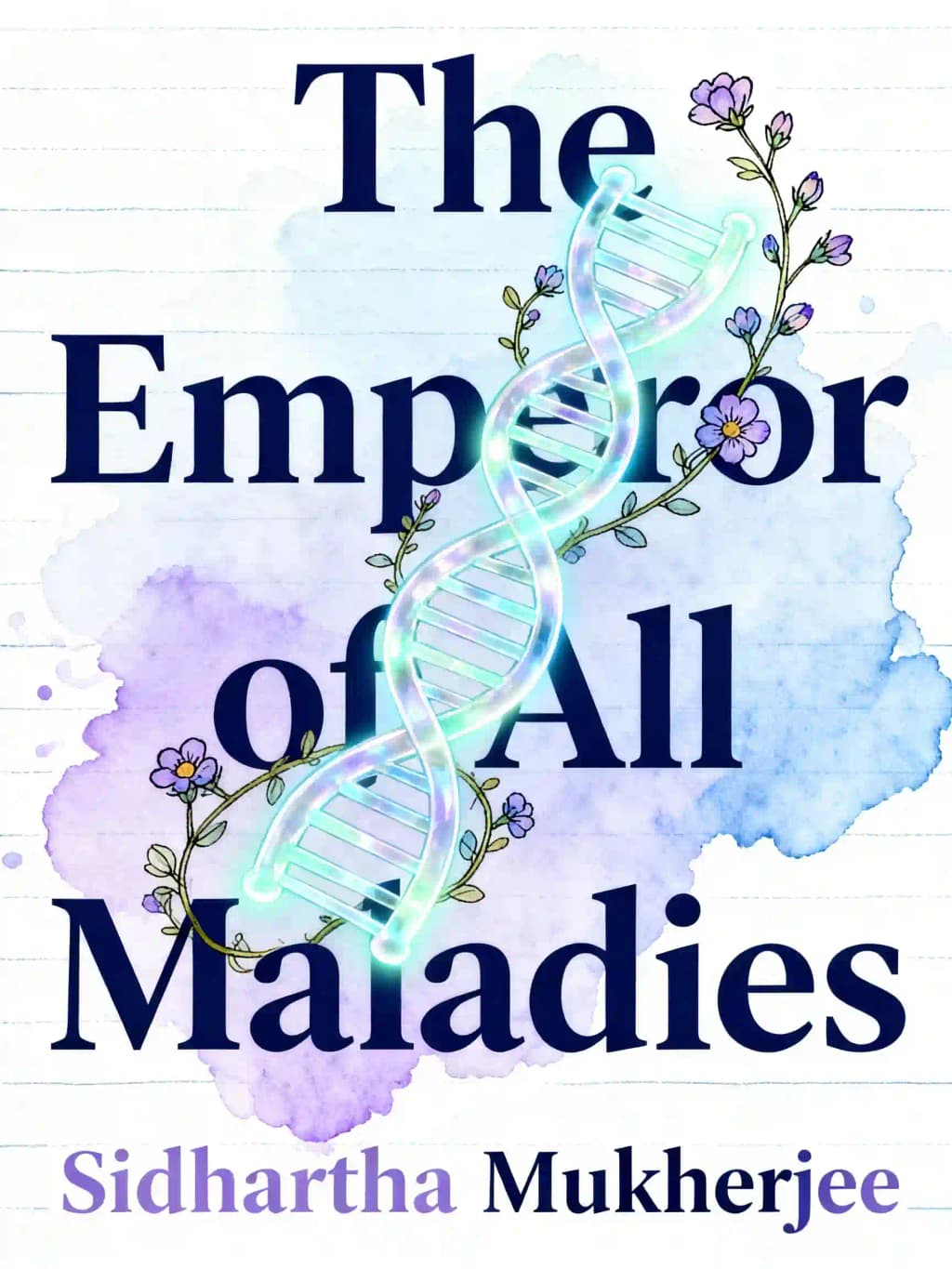
Pulitzer Prize-winning "Emperor of All Maladies" charts cancer's 4,000-year journey through human history. Recommended by Bill Gates and transformed into a PBS documentary, Mukherjee's "biography of cancer" reveals why this cellular rebel remains our most formidable medical adversary.
Siddhartha Mukherjee, Pulitzer Prize-winning author of The Emperor of All Maladies: A Biography of Cancer, is an Indian-American physician, oncologist, and leading voice in medical literature. A Columbia University professor and cancer researcher, Mukherjee blends his clinical expertise with narrative mastery to explore humanity’s complex relationship with disease.
His groundbreaking work traces cancer’s history from ancient times to modern therapies, informed by his laboratory research on blood disorders and compassionate care for patients. The book, lauded as a "biography" of cancer, won the 2011 Pulitzer for General Nonfiction and was later adapted into an Emmy-nominated PBS documentary by Ken Burns.
Mukherjee’s acclaimed follow-ups, The Gene: An Intimate History and The Song of the Cell, further establish his reputation for transforming intricate scientific concepts into compelling narratives. A regular contributor to The New Yorker and The New York Times Magazine, his work has been translated into 50+ languages and cited in over 10,000 academic papers. Born in New Delhi and educated at Stanford, Oxford, and Harvard, he received India’s Padma Shri award in 2014. The Emperor of All Maladies remains a modern classic, named to Time’s "All-Time 100 Nonfiction Books" and required reading in medical and literature curricula worldwide.
The Emperor of All Maladies by Siddhartha Mukherjee is a Pulitzer Prize-winning exploration of cancer’s history, blending scientific breakthroughs, patient narratives, and societal responses. It traces the disease from ancient times to modern therapies, examining milestones like chemotherapy’s development and the "war on cancer" initiative, while humanizing the struggle through intimate stories.
This book is ideal for readers interested in medical history, oncology, or impactful nonfiction. Patients, caregivers, and healthcare professionals gain insights into cancer’s complexities, while general audiences appreciate its accessible science and human-centered storytelling. It’s recommended for anyone seeking a holistic understanding of cancer’s past, present, and future.
Yes. Acclaimed for its meticulous research and narrative depth, the book balances historical context with contemporary relevance. Its Pulitzer Prize win and inclusion in Time’s "All-Time 100 Nonfiction Books" underscore its value as an essential read for understanding cancer’s societal and scientific dimensions.
Siddhartha Mukherjee is an Indian-American oncologist, Pulitzer Prize-winning author, and Columbia University professor. Renowned for The Emperor of All Maladies and The Gene, he bridges medical expertise with literary craftsmanship, earning accolades like the Padma Shri and influencing global health discourse.
Key themes include the interplay of scientific progress and human resilience, the evolution of cancer treatment, and societal mobilization against the disease. The book frames cancer as both a biological adversary and a cultural force, exploring chemotherapy’s origins, patient advocacy, and the emotional toll of cancer.
Mukherjee chronicles 5,000 years of cancer history, from ancient Egyptian descriptions to targeted therapies. He highlights pivotal moments: the first mastectomies, radiation’s emergence, Sidney Farber’s chemotherapy trials, and the discovery of oncogenes, contextualizing these within shifting medical and public perceptions.
Patient narratives ground the science in human experience, illustrating cancer’s physical and emotional toll. Stories range from Mukherjee’s own patients to historical figures, emphasizing resilience and the doctor-patient relationship. These accounts transform abstract medical concepts into relatable struggles.
Mukherjee combined archival research, scientific literature reviews, and interviews with researchers, survivors, and clinicians. His dual perspective as a physician and storyteller allows rigorous yet accessible explorations of oncology’s evolution, enriched by firsthand clinical experiences.
Key breakthroughs include Sidney Farber’s pioneering chemotherapy trials, the HPV vaccine’s role in preventing cervical cancer, and the identification of oncogenes. The book also examines genetic research advancements and their impact on personalized treatments.
Yes. A PBS documentary directed by Ken Burns expands the book’s reach, blending archival footage, patient interviews, and expert commentary. The film visualizes cancer’s history and ongoing battles, amplifying the book’s themes for a broader audience.
The book won the 2011 Pulitzer Prize for General Nonfiction and the Guardian First Book Award. It was named to Time’s "All-Time 100 Nonfiction Books" list, and Mukherjee received India’s Padma Shri for his contributions to literature and medicine.
It analyzes cancer’s influence on public health campaigns, policy changes, and advocacy movements, such as the American Cancer Society’s founding. The book also explores global disparities in treatment access, framing cancer as a medical and social equity challenge.
Erlebe das Buch durch die Stimme des Autors
Erfasse Schlüsselideen blitzschnell für effektives Lernen
Cancer has been a relentless adversary to humanity for millennia.
Cancer is an expansionist disease.
To confront cancer is to encounter a parallel species.
Cancer remains an ever-changing enemy.
The story of cancer is a story of human resilience.
Zerlegen Sie die Kernideen von Emperor of All Maladies in leicht verständliche Punkte, um zu verstehen, wie innovative Teams kreieren, zusammenarbeiten und wachsen.
Destillieren Sie Emperor of All Maladies in schnelle Gedächtnisstützen, die die Schlüsselprinzipien von Offenheit, Teamarbeit und kreativer Resilienz hervorheben.

Fragen Sie alles, wählen Sie die Stimme und erschaffen Sie gemeinsam Erkenntnisse, die wirklich bei Ihnen ankommen.

Von Columbia University Alumni in San Francisco entwickelt
"Instead of endless scrolling, I just hit play on BeFreed. It saves me so much time."
"I never knew where to start with nonfiction—BeFreed’s book lists turned into podcasts gave me a clear path."
"Perfect balance between learning and entertainment. Finished ‘Thinking, Fast and Slow’ on my commute this week."
"Crazy how much I learned while walking the dog. BeFreed = small habits → big gains."
"Reading used to feel like a chore. Now it’s just part of my lifestyle."
"Feels effortless compared to reading. I’ve finished 6 books this month already."
"BeFreed turned my guilty doomscrolling into something that feels productive and inspiring."
"BeFreed turned my commute into learning time. 20-min podcasts are perfect for finishing books I never had time for."
"BeFreed replaced my podcast queue. Imagine Spotify for books — that’s it. 🙌"
"It is great for me to learn something from the book without reading it."
"The themed book list podcasts help me connect ideas across authors—like a guided audio journey."
"Makes me feel smarter every time before going to work"
Von Columbia University Alumni in San Francisco entwickelt

Erhalten Sie die Emperor of All Maladies-Zusammenfassung als kostenloses PDF oder EPUB. Drucken Sie es aus oder lesen Sie es jederzeit offline.
Cancer, the emperor of all maladies, the king of terrors, has been a relentless adversary to humanity for millennia. My journey into the heart of this disease began during my fellowship at Massachusetts General Hospital, where I encountered a 31-year-old mother named Carla Reed, who had just been diagnosed with leukemia. Her story, like many others, is a testament to the enduring and often brutal battle against cancer. The history of cancer stretches back 4,600 years to ancient Egypt, where the physician Imhotep first identified the disease. In those times, cancer was a mysterious and often fatal affliction. The Greeks, with their limited understanding of cells, attributed illness to an imbalance of the four cardinal fluids: blood, black bile, yellow bile, and phlegm. Galen, a prominent Greek physician, believed cancer was caused by an excess of black bile, a theory that persisted until the 16th century. One of the earliest recorded surgical interventions for cancer was the excision of a breast tumor from Atossa, the queen of Persia, by a Greek slave named Democedes in 440 BC. This procedure, though temporary in its success, marked one of the first attempts to combat the disease surgically.