Kapitel 1
Consulting: The Noble Calling That Transforms Organizations
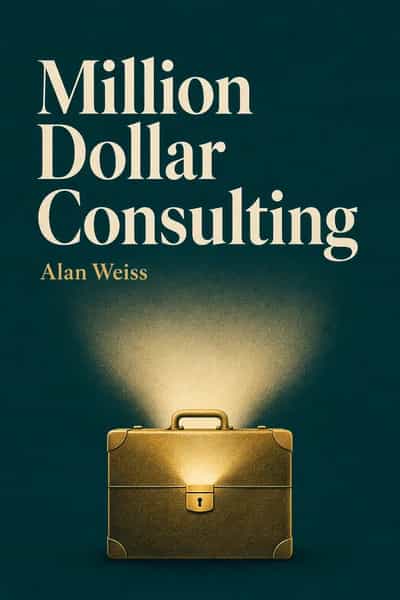
The Consulting Bible by Alan Weiss stands as the definitive guide for independent consultants seeking to build thriving practices. Since its publication, it has become the go-to resource for aspiring and established consultants alike, with readers ranging from solo practitioners to executives at major consulting firms. What makes this book particularly remarkable is Weiss's contrarian approach-challenging conventional wisdom about specialization, hourly billing, and business development that pervades the industry. Weiss himself embodies the success of his methods, having built a multi-million-dollar consulting practice with zero employees while maintaining extraordinary profit margins. The book has gained cult status among professional service providers worldwide, with many crediting it for transforming their businesses from struggling to seven-figure successes. Beyond the consulting world, it's frequently cited by entrepreneurs and business leaders for its insights on value-based pricing and client relationships. As Weiss often reminds readers, consulting isn't just a business-it's a noble calling that, when done right, transforms organizations and enriches lives.
Kapitel 2
The Essence of Consulting: Improving Client Conditions
Consulting traces back to prehistoric times when a wanderer showed a tribesman how to create better spearheads and received food and a talisman in return. This fundamental transaction-improving someone's condition in exchange for value-remains unchanged despite our technological evolution. The consultant's role is elegantly simple yet profoundly important: to leave clients better off than before your involvement. Modern examples range from helping Fortune 500 companies restructure their operations to guiding startups through critical growth phases.
True consulting differs dramatically from contracting. Consultants improve client conditions through unique intellectual capital, operate as peers to economic buyers, collaboratively create project parameters, and charge based on value delivered. They bring strategic insights, methodologies, and transformative solutions that extend beyond tactical execution. Contractors, in contrast, merely perform assigned tasks at the buyer's direction as temporary employees, typically paid hourly for specific deliverables. Despite countless people claiming consultant status, only about 200,000 true consultants exist in the US (perhaps 400,000 globally), with just 20% earning high six or seven-figure incomes. This elite group has mastered both technical expertise and business acumen.
The most successful consultants operate at the intersection of three critical factors: valuable content expertise, transferable processes, and trust with buyers. Content expertise might include deep knowledge of supply chain optimization, digital transformation, or organizational development. Transferable processes encompass frameworks, methodologies, and tools that can be applied across different situations. Trust is built through consistent delivery, transparent communication, and genuine commitment to client success. This diagonal approach-combining knowledge with process skills while building deep trust-positions you as a partner rather than merely an expert or facilitator.
Success means consistently improving client conditions across multiple dimensions. This includes collecting powerful testimonials that demonstrate tangible results, working beyond niche limitations to address broader business challenges, operating globally across cultural boundaries, delivering value remotely through virtual platforms, generating sufficient income for sustainable growth, establishing a credible brand through thought leadership, earning peer respect through innovation, creating diverse intellectual property (books, courses, methodologies), and maintaining work-life balance. One consultant I mentored transformed from making $500,000 while working constantly to generating $2.5 million with five subcontractors, a two-year pipeline, and 12 weeks of vacation annually - achieving both financial success and personal freedom.
Looking ahead, five major trends will create significant consulting opportunities: organizations rebuilding employee loyalty through innovative compensation and engagement strategies; HR departments continuing to shrink as transformational functions create opportunities for external consultants; companies reversing outsourcing trends as overseas operations prove inadequate for complex needs; surging volunteerism requiring expertise in volunteer management and program design; and the growth of "right-on-time learning" communities organized around value creation and knowledge sharing. These trends are already creating new niches for consultants who can help organizations navigate change while maintaining competitive advantage.
Kapitel 3
Building Your Consulting Foundation: Structure, Support, and Strategy
Establishing the right foundation for your consulting practice begins with proper legal structure. Despite occasional advice to the contrary, incorporation is essential-it protects personal assets, enables independent borrowing, creates tax advantages, and allows you to do business with major clients. For solo practitioners, Subchapter S corporations offer an ideal structure where revenues flow through personal tax returns while maximizing deductions. Making $250,000 as a consultant can equal $350,000 on someone else's payroll when you properly structure business expenses.
Financial infrastructure requires careful attention. Essential insurance includes errors and omissions coverage (protecting against claims of harmful advice), liability insurance (for accidents involving your equipment), and disability insurance (more likely than death for consultants). Maximize retirement contributions through SEP IRAs and similar vehicles, which are deductible business expenses. Maintain separate business and personal accounts, and establish business lines of credit to manage uneven cash flow.
Contrary to popular belief, office space and staff are often unnecessary expenses. As Weiss discovered when starting his practice, most client work happens at their locations. He calculates that avoiding a modest office with utilities and part-time help saved him $450,000 over 21 years-exactly what his children's education cost. Instead of hiring staff: master efficient task management, delegate to outsourced specialists (designers, printers, studios), shift administrative work to clients, and hire hourly help only when absolutely necessary. Weiss runs a $2.5 million business with zero employees.
Emotional support, however, is the most vital resource and cannot be virtual. Ideally, it comes from family first, then friends, colleagues, and finally professional counselors. Many consultants struggle without proper emotional backing from their families. Three common challenges include fear of risk (addressed through visualizing risk/reward ratios), time demands (requiring strategic compensation for missed events), and dueling careers (requiring outsourcing of mundane tasks).
Two viable consulting business structures exist, and you must choose one rather than getting caught between them. The true solo practitioner works alone from home or shared space, maximizes both short-term and long-term income, and doesn't reinvest in corporate growth. The firm principal continually reinvests to build a sellable entity with staff, infrastructure, and brand recognition. The danger lies in creating a "consulting welfare state"-essentially a solo consultant carrying unnecessary staff who don't generate new business. Weiss advocates for solo practice, noting "I can always make another dollar, but I can't make another minute."
Kapitel 4
The Philosophy That Drives Success: Value, Buyers, and Conceptual Agreement
The foundation of successful consulting rests on three philosophical pillars: value-based fees, identifying true buyers, and establishing conceptual agreement. These principles differentiate thriving practices from struggling ones.
Fees must be based on value, not time units, which creates an ethical conflict between client and consultant interests. Value can be objective (profit, market share) or subjective (stress reduction, reputation). Speed of improvement adds tremendous value, allowing clients to benefit longer from improvements while experiencing less disruption. The ideal formula balances tangible benefits (which can be annualized), intangible benefits (emotional impact), and peripheral benefits against your fee to create at least a 10:1 return on investment.
Reducing labor intensity is as important as raising fees because wealth is discretionary time. Five key strategies: First, only deal with buyers who can say "yes"-avoid HR, training, and internal consulting departments. Second, streamline delivery models rather than rigidly following predetermined steps. Third, use client resources for administrative support. Fourth, outsource back-room work like printing and web development. Finally, use subcontractors for high-volume work or specialized expertise.
The true buyer (economic buyer) can metaphorically "sign a check," unlike feasibility buyers who evaluate approaches but can't make purchase decisions. You can descend from buyer heights to work with anyone, but can't ascend to significant buyers if seen as a peer of HR or lower-level management. Economic buyers aren't always identified by title; some directors have significant buying power while some vice presidents have none. Finding the true buyer requires asking specific questions about budget control, approval authority, and decision-making power.
Conceptual agreement sits at the sweet spot of the consulting model. This critical phase has three aspects: objectives, measures of success, and value. Objectives must always be business outcomes (improved client conditions), never inputs or deliverables. Measures of success establish indicators of progress that demonstrate your contribution's value. Value articulation helps the buyer stipulate the project's worth, enabling you to demonstrate ROI. Never skip conceptual agreement-doing so leads to missed sales, smaller engagements, or implementations with zero pragmatic results.
Leveraging means exponentially improving your odds and outcomes without extra work. Three key principles: always provide a choice of "yeses" rather than take-it-or-leave-it options; unbundle services as options and menu items while focusing on results rather than deliverables; and ensure your full capabilities are understood-don't fear being seen as a "jack-of-all-trades," as this outdated concept doesn't apply to modern consulting.
Kapitel 5
Marketing Your Practice: From Visibility to Accelerated Growth
Marketing a consulting practice requires a mindset shift from traditional selling. Instead of viewing promotion as selling something, see it as providing value. Rather than feeling it's adversarial, recognize it's collaborative. Prospects, unlike existing clients, have no frame of reference for your value-you must "talk the walk" not just "walk the talk."
Social media platforms have generated excessive promotional noise with limited practical application for consultants. While they can amplify your message, they also amplify everyone else's, creating a cacophony. Corporate buyers rarely use social media to find consultants. For effective use: create repositories of intellectual property through brief, valuable posts; establish uniqueness; utilize multimedia; make major announcements; and create focused groups. Limit social media to 30 minutes daily, but invest more in blogging (3+ times weekly) with varied content that showcases your expertise.
The Accelerant Curve views business relationships as long-term journeys where clients progress through increasingly intimate and higher-fee services. On one axis is ease of doing business (from free downloads to exclusive services), on the other is increasing intimacy and fees. Services range from competitive (left third) to distinct (middle) to proprietary (right third), culminating in your "personal vault" of exclusive high-value offerings. Three factors drive clients along this curve: your trust and brand development, absence of "chasms" between service levels, and "bounce factors" that propel clients to jump ahead.
A brand is a uniform expression of quality-ultimately, your name should become your strongest brand. Three requirements for a powerful brand: identifying a vibrant market need (existing, created, or anticipated), possessing competency (to create intellectual property and differentiate from competitors), and maintaining passion (to handle rejection and constantly evolve). For sole practitioners, the brand must center on you; for companies meant to be sold, it should focus on the business.
Beware of SOSO-"same old, same old." What worked brilliantly in the past may not serve clients optimally today. The most successful consultants continuously evolve their offerings-between two-thirds and three-quarters of Weiss's current income comes from products and services that didn't exist three years ago.
Referrals are the "coinage of your realm." Most successful consultants can trace their business to just a handful of original sources. If you don't actively seek referrals, you're not convinced of your own value. Request referrals from current clients about two-thirds through your project, using choice-based language: "If you would make the introduction, that would be appreciated. If not, may I simply use your name? But if you prefer, I won't mention you at all."
Kapitel 6
Reaching Celebrity Status: Thought Leadership and Value Creation
Thought leadership represents the pinnacle of consulting status. True thought leaders create intellectual capital that they transform into tangible intellectual property others can implement. They fearlessly make their approaches public, understanding that their strong brand identity protects them from imitators. Rather than diminishing demand, their books, speeches and content actually make them more sought-after.
Celebrity consultants must appear in print, with commercially published books representing the gold standard of credibility. While self-publishing serves specific niches and offers higher margins, it lacks the third-party validation that corporate buyers value. A commercially published book establishes your brand effectively, creates opportunities for continuous publishing, forces you to articulate your methodology, and provides potential passive income.
Value-based fees become even more effective as your celebrity grows. Initially, higher perceived value justifies higher fees, but at a certain point of celebrity status, the relationship inverts-your fees actually drive perceived value. When you achieve sufficient brand recognition, clients expect to get what they pay for, much as with luxury brands like Bulgari or Bentley. Celebrity status transforms buyer conversations from "prove you can help me" to "how can we work together?"
When you achieve celebrity status, you'll face the pleasant challenge of a filled pipeline. To manage this abundance, you have four options: First, carefully select which business to accept personally based on challenge level, profit margin, and brand consistency. Second, use subcontractors-people you pay to deliver what you sell. Third, franchise your approaches to others who can market themselves. Fourth, license your intellectual property directly to client organizations. The final option is doing the work yourself at premium rates-as the celebrity, you are the talent, and should charge more for your personal involvement.
The greatest pitfall in your celebrity journey is the "success trap"-the failure to jump to the next S-curve before your current growth plateaus. Counterintuitively, the best time to leap to your next innovation is near the peak of your current growth cycle, when you have maximum momentum. Even at high levels of success, about 75% of revenues should come from products and services that didn't exist three years ago.
Communities provide a powerful extension of your influence, allowing members to receive value attributed to you even when you're not present. These communities should include multiple touchpoints: free teleconferences or podcasts, premium chat rooms, periodic videos, in-person workshops, an active blog, an interactive website with downloadable resources, published intellectual capital, and strategic social media presence.
Kapitel 7
The Perfect Proposal: Creating Agreements That Get Accepted
Creating proposals that get accepted every time requires careful preparation before writing a single word. Many consulting firms focus on proposal volume rather than acceptance rate, measuring input (production) instead of output (resultant business).
Success begins by finding and establishing trust with the economic buyer-the person who can actually approve your fees. Many consultants make the tactical error of remaining at lower levels where people can say "no" but not "yes." Position yourself as a peer of the buyer through professional appearance, quality accessories, and industry-specific knowledge. Always create definitive next steps with dates on both calendars rather than vague follow-ups.
Conceptual agreement forms the foundation for proposals with strong chances of acceptance. Objectives must focus on business outcomes rather than tasks or deliverables. Measures of success must provide clear indicators of progress. Value represents the total impact of meeting objectives, which creates the basis for return on investment and justifies higher fees.
Effective proposals are concise (about two and a half pages) with nine essential components: (1) Situation Appraisal-a brief description of the issues prompting the project; (2) Objectives-bullet points of agreed outcomes; (3) Measures of Success-specific indicators of progress; (4) Value-benefits accruing from meeting objectives; (5) Methodology and Options-escalating choices that each embrace preceding ones; (6) Timing-clear project duration for each option; (7) Joint Accountabilities-partnership responsibilities for both consultant and client; (8) Terms and Conditions-fees, payment schedules, and quality guarantees; and (9) Acceptance-language allowing the proposal to serve as the contract.
Proposal submission requires strategic finesse. Never suggest phases that require multiple buying decisions-instead, offer options that build upon each other. Always send a hard copy via FedEx alongside any electronic version to stand out and facilitate signing. Create a specific time to review the proposal rather than allowing vague follow-up commitments. Include invoices for each option to accelerate acceptance and payment processing.
When buyers want to involve others in decision-making, remind them that strategic decisions belong to the economic buyer alone, as subordinates often raise objections. For price negotiations, offer discounts for advance payment, or negotiate terms rather than fees. Never fold on price-if discussing fee instead of value, you've lost control. When buyers say "yes," begin immediately-the sooner you start action, the faster the project accelerates and payment arrives.
Kapitel 8
Implementation and Disengagement: Delivering Value and Creating Future Opportunities
Implementation requires a partnership between consultant and client. The buyer must be the project's champion, leading the charge like a Civil War general on horseback shouting "Follow me!" rather than directing from afar. Effective buyers exemplify desired behaviors, enforce subordinate accountability, and use their organizational clout to remove barriers.
Beware of "scope creep"-the gradual expansion of project work beyond original parameters. Hewlett-Packard called these "undocumented promises"-informal agreements where consultants take on extra work to avoid saying no. These seemingly minor requests can destroy project profitability like termites bringing down a house. When buyers request work outside the proposal's scope, offer alternatives: charge separately, create a new proposal, or defer until the current project completes.
Unlike scope creep (client-initiated expansion), scope seep occurs when consultants unilaterally enlarge projects without changing agreements or fees. This self-sabotage happens through several traps: the perfection-over-success trap (fixing things that merely need to be adequate), the tidy-up detour (organizing unrelated matters), and the ego catch wire (teaching anyone who'll listen).
All consulting engagements must eventually end-whether moving to another project with the same client or departing entirely. Formal disengagements reduce scope creep/seep risks, decrease labor intensity, and free you to focus on marketing and self-development. When disengaging, schedule a personal meeting with your buyer, avoid large formal presentations, bring a confidential executive summary, and include recommendations for building on current progress.
Referral business is the coinage of the consulting realm. Establish the referral process early by asking your buyer: "As this project progresses and provides value, I'd like to request referrals from you, which is a discipline I pursue with all clients. Is this acceptable?" When disengaging, follow up assertively: "I asked about referrals when the project started generating value, and that time has arrived!"
Mature consulting practices should have about 80% repeat business and 20% new business. Repeat business includes: more work of the same kind for the same buyer; different work for the same buyer; same work for different buyers in the organization; or different work for different buyers in the organization. Don't wait for clients to instigate repeat business-plan for it in as many categories as possible.
When seeking testimonials, be aggressive but strategic. Prepare your buyer early, provide options (written testimonials, video testimonials, references, endorsements), and consider sources beyond just your buyer. Offer examples of what you need, guarantee how you'll use their information, and if asked, write options yourself for their approval.
Kapitel 9
Ethics and Legacy: Building a Practice That Matters
Professional consultants must navigate ethical dilemmas by balancing organizational needs with proper conduct. Leadership hypocrisy undermines ethical culture, as demonstrated by a hospital where management behavior contradicted the "We value our employees" plaques on every wall. The consultant's role is often to surface these contradictions between stated values and actual behaviors.
An immutable consulting law: difficult prospects become even worse clients. When prospects show disrespect through lateness, cancellations, rudeness, or constant interruptions, walk away regardless of the money involved. Four additional reasons to decline business: When it conflicts with your values; when labor demands are too severe; when you don't believe in the client's product or service; and when the work doesn't align with your core strengths.
George Merck's philosophy "Do good and good will follow" represents the ideal alignment between core values and operating values. As consultants, we have two ethical dimensions: how we advise clients and how we personally conduct ourselves. We must alert clients to ethical issues we discover, regardless of whether they're central to our project-just as we would notify them about a fire or theft.
At some point, every consultant must leave their practice, so preparation for departure should begin early. Building equity differs between the two ideal consulting models: the solo practitioner (no employees, few physical assets, taking most profits personally) and the boutique firm (owned office, employees, infrastructure, reinvesting profits).
Life balance isn't about a 50/50 split between work and personal life-it's about fulfillment. You don't have separate "work" and "business" lives; you have one life. Wealth is discretionary time, not money (which is merely fuel). The key to fulfillment is utilizing your full diversity of talents daily, distributing them between work and personal life in a way that allows you to exercise your capabilities regularly.
Unlike coaching clients for revenue, mentoring is about contributing to the profession. No profession grows unless its successful members create and disseminate best practices. Mentoring serves your self-interest too: you'll learn more than anyone else, stay connected to the profession's pulse, gain perspective on what approaches are truly transferable, and enhance your thought leadership.
While the fundamental transaction of consulting-improving a client's condition for agreed-upon payment-remains unchanged, our methodologies continuously evolve. Management fads come and go like commuter trains: reengineering, lean, quality circles, and countless leadership theories. As successful consultants, we must create new paths for others by developing innovative approaches and frameworks.
There's never a need to retire, but we must continually evolve our practices. Remember that wealth is discretionary time, not money. Mold your future deliberately because the default position won't satisfy you. In the end, consulting remains what it has always been: a noble calling that transforms organizations and enriches lives-both yours and your clients'.