Kapitel 1
The Deadly Game of Family Secrets
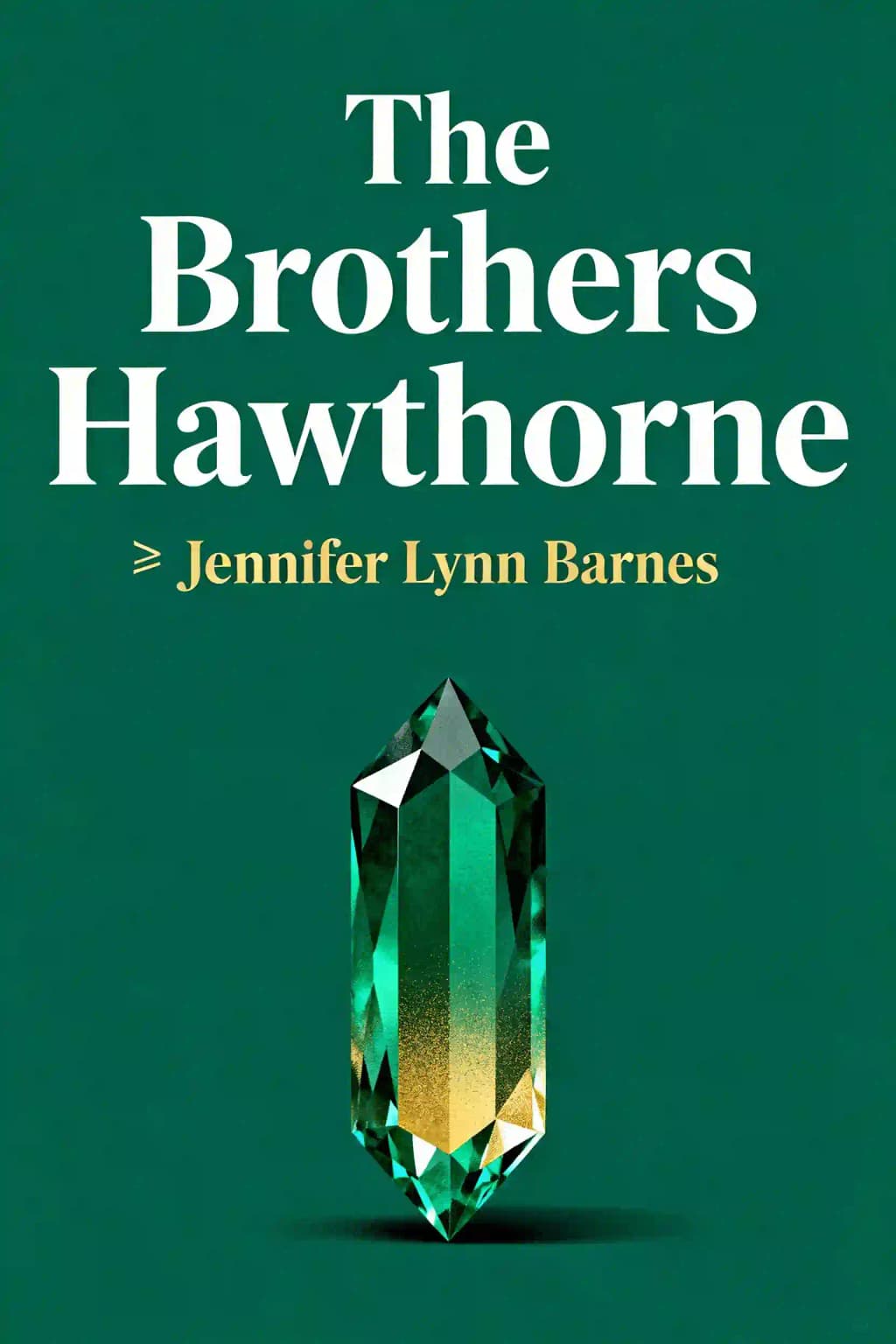
What happens when you're born into a legacy of wealth and power, yet constantly question your place within it? In Jennifer Lynn Barnes' "The Brothers Hawthorne," this question haunts the four Hawthorne brothers as they navigate dangerous games, family secrets, and unexpected revelations. This thrilling continuation of Barnes' bestselling Inheritance Games series has captivated millions of readers worldwide, including celebrities like Taylor Swift who reportedly called it "the perfect blend of mystery and family drama." The novel's exploration of identity, belonging, and the price of winning has made it a cultural touchstone for readers fascinated by wealth, power, and the games people play to obtain both.
Kapitel 2
The Restless Hawthorne: Jameson's Quest for Purpose
Jameson Hawthorne has everything most people could want-wealth, adventure, and a beautiful girlfriend-yet he feels fundamentally unfulfilled. Traveling the world with Avery Grambs, the heiress who inherited his grandfather's billions, should be enough. But as their gap year draws to a close, Jameson finds himself increasingly restless, hungry for something more meaningful than merely standing on the sidelines of Avery's philanthropic endeavors.
This restlessness stems from Jameson's lifelong conditioning. From childhood, Tobias Hawthorne raised his grandsons to compete, achieve, and constantly prove themselves worthy of the Hawthorne name. In flashbacks, we see young Jameson being told by his grandfather that his mind is "ordinary" compared to his brothers, but that he could overcome this by "wanting success more desperately than others." These formative experiences created a man who constantly needs to prove himself, who feels alive only when taking risks and overcoming challenges.
When Jameson receives a mysterious calling card from Ian Johnstone-Jameson, he's presented with exactly the kind of challenge he craves. The meeting reveals that Ian is Jameson's biological father-a professional poker player estranged from his wealthy British family. Ian needs Jameson's help to win back his mother's ancestral Scottish home, Vantage, which he lost gambling at an exclusive underground establishment called the Devil's Mercy.
The proposition appeals to everything that defines Jameson: risk, challenge, and the opportunity to prove himself. When Ian tells him, "You love challenges. You love to win. You always need more," he's articulating the very essence of Jameson's character. Despite initially refusing, Jameson can't resist the pull of the game, especially when he realizes it might help him discover his own identity separate from the Hawthorne legacy. As he confesses to Avery, part of him wants to prove something to the father who abandoned him-perhaps to show Ian made a mistake by staying away, or to impress him only to ultimately be the one who walks away.
This quest for purpose drives Jameson to take increasingly dangerous risks, culminating in his participation in the Devil's Mercy's ultimate game, where the stakes involve not just property but deeply personal secrets that could destroy lives.
Kapitel 3
The Devil's Mercy: A High-Stakes Underground World
The Devil's Mercy represents everything dangerous and seductive about wealth and power. This exclusive underground gambling establishment operates beneath London's streets, accessible only to the elite and those who catch the Proprietor's attention. The club embodies the seven deadly sins quite literally-with separate areas dedicated to Sloth (massage areas), Gluttony (fine dining), Lust (private chambers), Wrath/Envy/Pride (fighting rings), and Greed (gambling tables).
What makes the Devil's Mercy truly sinister is its currency: secrets. To gain membership, patrons must provide "a secret and proof"-blackmail material that becomes the Proprietor's leverage. Those who break the club's rules risk having their secrets exposed or used as prizes in the establishment's annual Game. It's a brilliant metaphor for how the wealthy and powerful maintain control-through knowledge that could destroy reputations and lives.
The physical space itself reflects this duality of beauty and danger. Accessed through an underground river journey guided by a young boy, the club features Roman architecture with a grand domed room, marble arches, and a floor inlaid with an infinity symbol in onyx and white agate. This opulence masks the predatory nature of the establishment, where even the dealers wear triangular necklaces containing listening devices.
The club's hierarchy is equally fascinating. The mysterious white-haired Proprietor rules from above, while his right-hand man Rohan (the Factotum) manages operations and enforces rules. The members themselves form a complex social ecosystem where status is determined by one's relationship with the Proprietor and knowledge of others' secrets.
When Jameson and Avery infiltrate this world, they discover that gaining entry requires losing half a million pounds over three nights. But the real goal is securing an invitation to the Game-an annual competition where the winner can claim valuable prizes, including property lost in previous wagers. To get the Proprietor's attention, Jameson fights in brutal matches and makes strategic bets, including one about "what's getting ready to happen to the price of wheat"-information he shouldn't possess.
The Devil's Mercy represents the dark underbelly of privilege, where games aren't just entertainment but mechanisms of control. As Zella (a duchess who becomes their ally) explains, some call it "court" for its politics and intrigue. It's a world where outsiders should stick together, but only "to a point"-because ultimately, everyone is playing their own game.
Kapitel 4
The Burden of Brotherhood: Grayson's Divided Loyalties
While Jameson chases thrills in London, his brother Grayson faces a different kind of challenge in Phoenix. Summoned by a mysterious phone call, he discovers a teenage girl named Juliet "Gigi" Grayson in police custody-his half-sister from his father's marriage. This revelation forces Grayson to confront the complicated legacy of Sheffield Grayson, the father who rejected him but apparently kept surveillance photos of his entire life.
Grayson embodies the weight of responsibility that comes with being a Hawthorne. In flashbacks, we learn that Tobias Hawthorne singled him out among the brothers, telling him, "Someday, it's going to be me"-Grayson would be the heir responsible for growing the fortune and protecting the family. This burden shaped him into someone meticulous, controlled, and deeply protective of those he considers family.
When Gigi enlists his help to find her missing father, Grayson faces an impossible choice. He knows the truth-that Sheffield Grayson attempted to murder Avery for revenge against the Hawthornes-but revealing this would devastate his newfound sisters. Instead, he walks a dangerous line, helping them investigate while simultaneously working to protect them from the truth.
This creates profound internal conflict for Grayson. As he grows closer to Gigi and her twin sister Savannah, he finds himself genuinely caring for them despite his initial intention to manipulate the situation. When he discovers their family is being financially exploited by Kent Trowbridge (their mother's lawyer), Grayson's protective instincts override his usual calculated approach. He admits to his brothers, "I'm getting too emotionally involved," revealing a vulnerability rarely seen in his character.
The relationship between the Hawthorne brothers provides a fascinating contrast to Grayson's newfound connection with his half-sisters. With his brothers, Grayson can be vulnerable in ways he can't with others. When overwhelmed by the situation, he sends a simple "911" text, and his brothers immediately rally around him. Their childhood game of "Drink or Dare" becomes a vehicle for emotional honesty, allowing Grayson to finally admit, "My sisters will probably never speak to me again, and I'm not good at losing people."
This storyline powerfully explores how family loyalty can become complicated when different families collide. Grayson ultimately chooses to protect both his Hawthorne family and his Grayson sisters, finding a middle path that allows him to be truthful without being destructive. When Gigi finally confronts him about manipulating them, he can only say "I can't" when asked to reveal everything. Yet by the end, he's earned enough of her trust that she returns, acknowledging the complexity of their situation while accepting him as her brother.
Kapitel 5
The Game: A Test of Character and Cunning
The climax of Jameson's storyline comes with the Game at Vantage-a high-stakes competition that tests not just intelligence but character. The Game's structure is deceptively simple: three keys hidden throughout the estate unlock three boxes. Two boxes contain secrets paid by players, while the third holds a valuable prize-a black and white mark redeemable for either information from the Mercy's ledger or an asset claimed that year.
What makes this sequence so compelling is how it reveals character through competition. Each player approaches the Game differently, reflecting their motivations and values. Branford (Jameson's uncle) plays to protect family interests. Zella (the duchess) seeks leverage against those who would threaten her position. Katharine (a silver-haired woman in white) represents outside interests trying to gain power within the Mercy's hierarchy.
The Game's challenges require both physical prowess and mental acuity. Players must decipher cryptic clues like "Ladies first" and "Watch yourself," navigate dangerous cliff staircases to reach smugglers' caves, and solve puzzles hidden throughout the ancient manor. These challenges mirror the ones Tobias Hawthorne created for his grandsons, suggesting that games within the novel aren't merely entertainment but tests of worthiness.
For Jameson, the Game represents his chance to prove himself without his family name or Avery's wealth backing him. When Katharine taunts him-"What are you without the Hawthorne name? Without the money? Without Avery Grambs by your side?"-she strikes at his deepest insecurity. Has he ever truly accomplished anything on his own merit?
The most revealing moment comes when Jameson must choose between winning and saving Zella's life as she dangles precariously from the bell tower. Without hesitation, he chooses to save her, demonstrating that beneath his reckless exterior lies a moral core. This moment transforms how others see him, particularly Branford, who later tells him, "You thought you were handing over the game, and you chose to put the life of another person over winning. I call it honor."
Ultimately, Jameson wins not through physical prowess or even cleverness, but through understanding the game on a deeper level than his competitors. When Katharine believes she's won by obtaining the silver ballerina figurine from the final box, Jameson realizes the true answer is "silence"-the music box should play music but doesn't. This insight allows him to claim Vantage legitimately, not as his father's proxy but as his own accomplishment.
Kapitel 6
Family Secrets: The Power of Hidden Truths
Throughout "The Brothers Hawthorne," secrets function as both weapons and currency. The most explosive secret belongs to Jameson-his discovery that "ALICE HAWTHORNE IS ALIVE." This revelation that their grandmother, long believed dead, still lives somewhere has profound implications for the entire Hawthorne family. It explains why Tobias Hawthorne disinherited his family in favor of Avery and suggests that the games are far from over.
Sheffield Grayson's secrets drive Grayson's storyline. The safe deposit box containing surveillance photos of Grayson's entire life reveals an obsession that borders on pathological. More disturbing are Sheffield's journal entries, which document his embezzlement schemes, his rage at the Hawthornes, and ultimately his plans to kidnap and harm Avery. These secrets force Grayson to make impossible choices about what to reveal to his sisters.
The novel explores how secrets can both protect and damage families. When Grayson creates a sanitized version of Sheffield's journal for his sisters, he's attempting to protect them from painful truths. Yet this deception ultimately damages his relationship with them when Gigi discovers his manipulation. Similarly, when Avery burns Jameson's secret without reading it, she's respecting his autonomy while potentially missing crucial information.
The architecture of Vantage itself becomes a metaphor for how secrets operate in wealthy families-hidden passages, secret rooms behind mirrors, and compartments that only open when specific combinations are achieved. Even the Devil's Mercy operates on this principle, with its elaborate surveillance system of mirrors that aren't just mirrors and moldings masking peepholes.
Perhaps most poignant is how secrets isolate characters from one another. Grayson keeps his knowledge about Sheffield from his sisters. Jameson initially keeps his discovery about Alice Hawthorne from Avery. Branford refuses to acknowledge his secret son publicly because it would "ruin lives." These secrets create barriers between people who might otherwise connect authentically.
By the novel's end, many secrets have been revealed, but others remain hidden, setting up future conflicts. Eve Blake (daughter of Tobias Hawthorne's disinherited son) plans to approach Savannah with information about her father, while Jameson finally shares his discovery about Alice with Avery. The novel suggests that while secrets hold power, the choice to reveal them-and to whom-holds even greater significance.
Kapitel 7
The Shadow of Tobias Hawthorne: Legacy and Identity
Though dead before the series began, Tobias Hawthorne's presence looms large throughout the novel. His philosophy of raising his grandsons through competition, challenges, and tests shaped them into the men they've become-for better and worse.
Flashbacks reveal how Tobias cultivated different qualities in each grandson. He told Jameson his mind was "ordinary" compared to his brothers but that he could overcome this through determination and seeing possibilities others missed. He singled out Grayson to be his heir, telling him, "Be more, do more, faster, stronger, smarter." He warned them all about the Hawthorne capacity for love-"fully, wholeheartedly, all-consuming and eternal."
These lessons created men constantly striving to prove themselves worthy. Jameson's need for challenges, Grayson's perfectionism, Xander's inventiveness, and Nash's resilience all stem from Tobias's training. Yet the novel questions whether this upbringing was beneficial or damaging. Did it create exceptional men or merely damaged ones unable to form healthy attachments?
The revelation that Tobias disinherited his family in favor of Avery takes on new significance with Jameson's discovery about Alice being alive. It suggests Tobias's final game wasn't about punishing his family but protecting them from something-perhaps connected to Alice's apparent death and subsequent disappearance.
The novel also explores how the brothers are attempting to define themselves outside their grandfather's shadow. Nash has found happiness with Libby. Xander channels his genius into creative pursuits. Jameson seeks challenges that test his personal limits rather than competing against his brothers. And Grayson begins questioning whether he wants more from life than the path Tobias laid out for him.
When Grayson finds himself holding his grandmother's black opal ring-which Nash suggested he might use himself someday-he finally asks himself, "Why not me?" This moment represents a significant shift, suggesting he's beginning to imagine a future based on his own desires rather than his grandfather's expectations.
Kapitel 8
The Price of Winning: What Victory Really Costs
"The Brothers Hawthorne" constantly interrogates what it means to win and what such victories cost. For Jameson, winning the Game at Vantage requires risking his most dangerous secret - his involvement in the Blackwood incident - while potentially destroying relationships he's only beginning to value. For Grayson, "winning" against Kent Trowbridge means potentially losing his sisters' trust and sacrificing the family unity he's worked so hard to maintain. For Eve Blake, planning her next move against the Hawthornes means sacrificing whatever normal life she might have had, including her budding career and the possibility of genuine connections untainted by revenge.
The novel suggests that true victory isn't about defeating others but about remaining true to one's values, even when the cost is steep. When Jameson chooses to save Zella rather than secure his win, he demonstrates this principle at great personal risk - not just to his chances of winning, but to his carefully constructed persona. Similarly, when Grayson risks his relationship with his sisters to protect them from their father's crimes, he's choosing their well-being over his own desire for connection, knowing the truth might permanently alter how they see him.
The most explicit exploration of this theme comes through the Devil's Mercy itself, where winning often means someone else loses catastrophically. The club's economy of secrets ensures that victory for one person frequently means destruction for another - whether through financial ruin, social ostracism, or the exposure of carefully guarded secrets. Members trade not just in money but in favors, information, and leverage, creating a web of obligations that can strangle even the most powerful players. This zero-sum approach contrasts with Avery's vision at the novel's end - creating "The Grandest Game" with cash prizes open to everyone, not just the wealthy and powerful, transforming competition from a tool of oppression into one of opportunity.
The novel also examines the psychological cost of being raised to value winning above all else. The Hawthorne brothers struggle with vulnerability and connection precisely because they were taught to see relationships as competitions. Their father's lessons - that trust is weakness, love is leverage, and family is just another game to be won - have left deep emotional scars. When Nash tells Grayson, "You haven't lost us, little brother," it's a profound statement that family isn't something to be won or lost but simply to be experienced and valued, challenging years of conditioning.
Perhaps most poignantly, the novel questions whether winning without meaning is truly victory at all. Jameson's restlessness despite his wealth and privilege stems from feeling he hasn't earned his place - that his victories are hollow because they come from his grandfather's influence rather than his own merit. When he finally wins Vantage through his own efforts, his satisfaction comes not from possessing the property but from having accomplished something meaningful on his own terms, proving to himself that he's more than just a Hawthorne heir. This victory carries weight precisely because it aligns with his personal growth rather than external expectations.
Kapitel 9
Dangerous Legacies: The Next Generation's Game
As "The Brothers Hawthorne" concludes, it sets up compelling conflicts for future novels. Avery announces her plan to host annual contests with life-changing prize money, some open to the public, others by exclusive invitation. This "Grandest Game" represents her attempt to democratize opportunity rather than restricting it to the privileged few.
Meanwhile, Eve Blake emerges as a formidable antagonist. With Vincent Blake's death, she inherits his considerable fortune and is no longer bound by his sense of honor. Her plan to approach Savannah about Sheffield Grayson suggests she's ready to use secrets as weapons, just as the Devil's Mercy does. "Avery has her game now," she thinks. "And I have mine."
These parallel developments suggest that while the Hawthorne brothers have been playing games created by others-their grandfather, the Devil's Mercy, their fathers-the next generation will create their own games with their own rules. This shift represents both opportunity and danger.
The novel also hints at unresolved mysteries that will drive future plots. Alice Hawthorne's apparent survival raises questions about why she disappeared and what she's been doing all these years. Sheffield Grayson's offshore accounts worth millions suggest his crimes went beyond what's already been revealed. And the mysterious girl who claims a Hawthorne was responsible for her father's suicide adds another layer of intrigue.
Perhaps most significantly, the novel explores how trauma and games are transmitted across generations. The Hawthorne brothers were shaped by their grandfather's challenges. Now they must decide what legacy they'll pass on to others. Will they perpetuate the cycle of competition and secrets, or will they create something healthier?
When Tobias warned his grandsons about how Hawthorne men love-"all-consuming and eternal"-he added, "Anything less, and you'll destroy her. And if she is the one... someday, she'll destroy you." This fatalistic view suggests the Hawthornes are trapped in patterns they can't escape. Yet the brothers' growing self-awareness offers hope that they might break these cycles rather than perpetuating them.
Kapitel 10
Beyond the Game: Finding Purpose in a World of Privilege
At its heart, "The Brothers Hawthorne" explores a fundamental question: How do you find meaning when you have everything? This question haunts Jameson as he travels the world with Avery, feeling like he's merely "standing behind the ropes" rather than doing something meaningful. It troubles Grayson as he questions whether his grandfather's path for him is truly what he wants. It even affects Eve, who inherits Vincent Blake's fortune but still feels she's missing what truly matters-belonging and family.
The novel suggests that purpose comes not from wealth or even achievement, but from connection and contribution. When Jameson wins Vantage, his satisfaction stems not from owning property but from having accomplished something that matters to him. When Grayson helps his sisters by confronting Trowbridge, he finds meaning in protecting people he cares about rather than in maintaining control.
This theme connects to broader questions about privilege and responsibility. Avery uses her inheritance to create opportunities for others, recognizing that her wealth gives her power that should be shared. The Devil's Mercy represents the opposite approach-using privilege to exploit others and maintain exclusivity.
The contrast between these models offers a powerful commentary on wealth in our own world. Do the privileged use their advantages to create more opportunity for others, or do they build higher walls to keep others out? Do games exist to identify merit regardless of background, or to reinforce existing power structures?
By the novel's end, each character has moved toward greater purpose. Jameson has won something meaningful on his own terms. Grayson has connected with family he never knew he had. Avery has found a way to use her inheritance to create opportunity rather than hoarding privilege. Even Nash and Xander have discovered that supporting their brothers provides more satisfaction than competing with them.
As Tobias Hawthorne once told his grandsons, they were "still works in progress." The novel suggests that finding purpose is never complete-it's an ongoing process of discovery, connection, and contribution that continues long after any individual game ends.