Kapitel 1
The Transformative Power of Narrative: A Journey Through Storytelling
Imagine sitting in a dimly lit auditorium in 1934, as Walt Disney stands on a bare stage illuminated by a single light bulb. For over an hour, he acts out every character from Snow White, changing his voice, using dramatic lighting, and bringing the tale to life with such emotional power that grown men are moved to tears. When he finishes, he simply announces, "That's going to be our first feature." This legendary storytelling session launched what many called "Walt's folly" - the seemingly impossible task of creating a feature-length animated film during the Great Depression. Yet that single story session transformed his studio team into believers who created a masterpiece that would earn a special Oscar and set box office records.
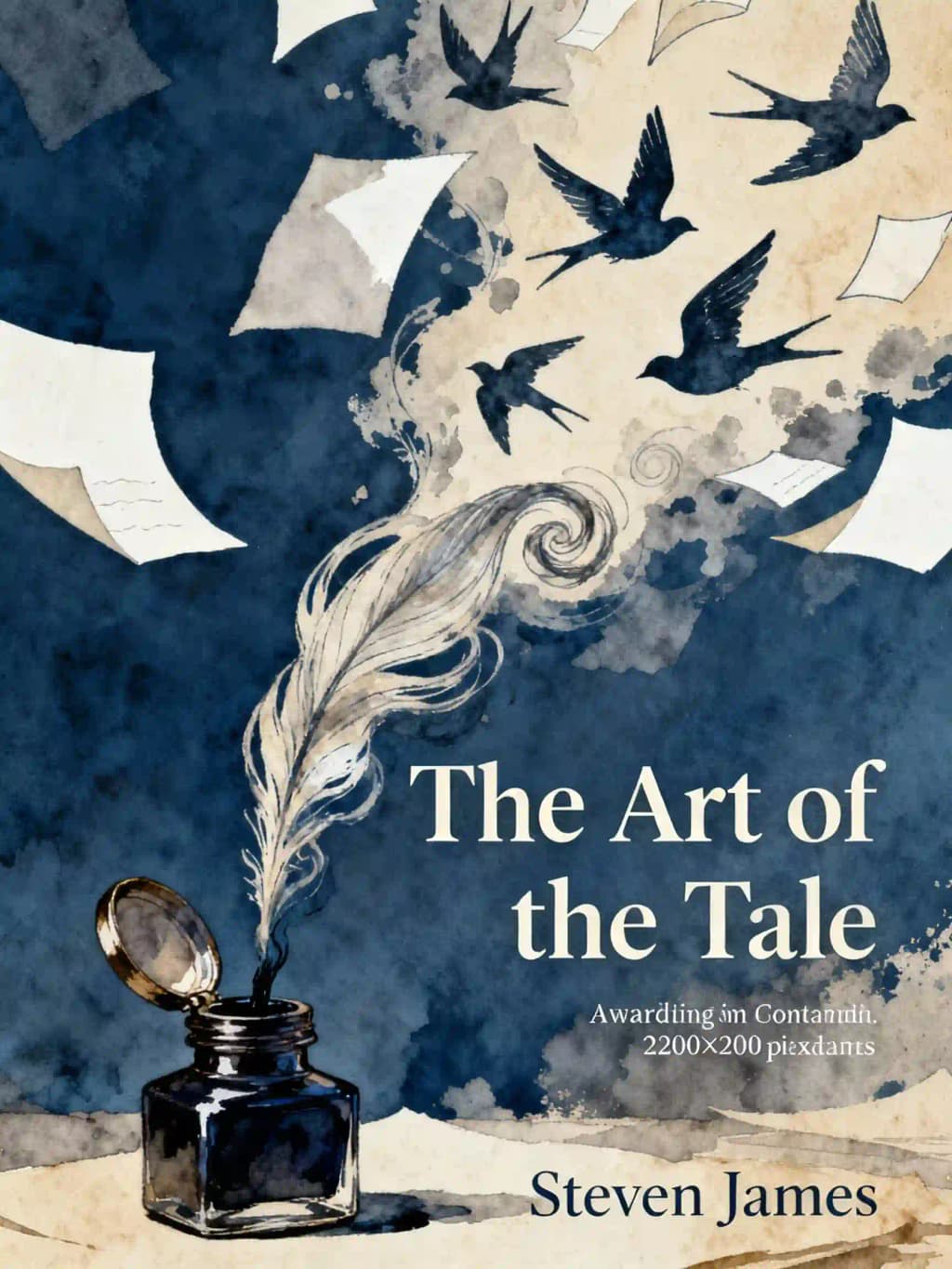
"The Art of the Tale" by Steven James and Tom Morrisey has become a phenomenon in business and academic circles, with Fortune 500 executives and university professors alike praising it as revolutionary. Endorsed by former Disney Parks president Meg Crofton and celebrated storytellers like Margot Leitman, the book has sparked a renaissance in corporate storytelling. Even celebrities like Matthew McConaughey have referenced its techniques in interviews about their communication style. What makes this work so culturally significant is how it bridges the gap between entertainment and business communication, revealing the neurological science behind why stories move us so deeply.
Kapitel 2
The Unparalleled Power of Story in Human Connection
We're natural storytellers. From the moment we learn to speak, we communicate and make sense of our lives through stories, connecting our choices, mistakes, and dreams with those of others. Stories help us remember our past and find meaning in our experiences. We're surrounded by countless stories daily-in news, social media, books, and films-yet often don't notice how they shape our thoughts and lives.
As humans, we don't remember events well unless they're connected within a story structure. Every time you tell your spouse about your day or reminisce about old times, you're telling a story. For millennia, humans have used stories to pass on values, morals, and culture-and you're part of that tradition.
But what exactly makes a story? It's not merely a list of events. A story isn't "I went to the beach, came home, ate a hamburger..." - that's just a report. A true story contains four crucial elements: character, setting, struggle, and pursuit. As Pulitzer Prize-winner Robert Olen Butler put it, "Story is a yearning meeting an obstacle."
Without a character to cheer for, you only have an event description. Without setting, listeners can't picture what's happening. Without struggle, you merely have a character existing in bliss. And without active pursuit, your narrative goes nowhere. These four elements form the sides of a square-remove any one, and it ceases to be a story.
While these four basic elements create a functional story, two additional components transform an ordinary tale into a great one: the pivot and the payoff. The pivot introduces surprise that avoids predictability while maintaining logical coherence. The payoff reveals why the story matters-its deeper meaning, theme, or application. Without both pivot and payoff, stories feel hollow or predictable.
This explains why simple case studies often fail as stories. "A customer had problems until trying our product and now they're happy" is too predictable and lacks deeper meaning. Instead, look for accounts of underdogs solving problems in unexpected ways or stories that share profound truths without explicitly stating them.
Stories slip past our natural defenses and take up residence in our hearts. They don't just touch heads-they change lives. Remember to embrace stories as bridges, adapt your telling to the setting, include all six sides of the Story Cube, focus on pursuit rather than plot, and keep your eyes open to the stories searching for you.
Kapitel 3
Beyond Information: The Art of Discovery Through Storytelling
When I taught logic to eighth graders, I discovered something crucial about effective teaching. The first year was rough, but by the second year, I'd learned to hook students by telling them "This year you're going to learn how to win arguments." More importantly, I noticed that the more time I spent preparing, the less I lectured but the more students learned. Conversely, when I prepared less, I talked more but taught less.
My explanations were never as impactful as my stories-even when teaching logic. Like artists who don't explain landscapes but capture their essence, or novelists who explore forgiveness rather than explain it, the best teaching draws audiences toward truth rather than merely presenting information.
We learn best when we discover truth ourselves, experience things firsthand, and teach what we've learned to others. Information alone doesn't transform us. We're moved by personal connection-the history, bond, and emotional investment we have with someone or something.
Consider how differently we respond to abstract tragedies versus personal losses. When the 2004 Southeast Asian tsunami killed hundreds of thousands, many of us found ourselves checking death tolls without emotional response. Yet we might cry when our beloved pet dies. This isn't a knowledge problem-we understand intellectually that hundreds of thousands of deaths outweigh one dog's passing. But information that only touches our intellect but not our emotions merely informs rather than transforms.
Rather than stating what to believe, share what you've learned. Listeners remember illustrations longer than outlines, so make the story the point rather than just dressing up your message. Stories can also work metaphorically, like my daughter gripping her bike handlebars tighter as she headed toward a tree-a perfect analogy for how we sometimes cling to things taking us toward calamity.
Experiential learning creates deeper impact than mere information transfer. Research by Uri Hasson at Princeton shows that storytelling literally synchronizes brain waves between teller and listener. Through stories, we vicariously experience struggles and identify with characters' discoveries. More profoundly, stories help us believe things we already know intellectually but haven't internalized emotionally.
The more specific you are in portraying universal desires, the more intimately people identify with them. A story about someone stealing office pens and justifying it resonates more powerfully than abstract talk about honesty. When listeners identify with characters, they vicariously experience emotion, tension, discovery, and transformation-applying moral lessons to their own lives without being directly instructed.
Kapitel 4
Stories vs. Anecdotes: Understanding the Distinction
What distinguishes stories from anecdotes? Many self-proclaimed "storytellers" in business are actually sharing anecdotes, not stories. The distinction isn't necessarily about length-Kafka's "An Imperial Message" tells a complete story in under 400 words, while anecdotes can ramble past five minutes. Similarly, Ernest Hemingway famously wrote a six-word story: "For sale: baby shoes, never worn." Meanwhile, workplace anecdotes about the company picnic or client meeting can stretch on indefinitely without achieving story status.
It's not exclusively about tone either-though anecdotes are often humorous, they can also be sobering or even depressing. A CEO might share an anecdote about a failed product launch, or a sales representative might recount a challenging customer interaction. These pieces carry emotional weight but still don't qualify as complete stories.
Truth isn't the distinguishing factor either. Anecdotes are presented as true, but many full stories are also based on real events. Consider how companies like Nike and Apple craft compelling brand stories from actual customer experiences and product developments. The crucial difference lies in their impact on "brand"-what others think about you, your organization, or your cause. While anecdotes offer glimpses of who you are, stories create profound resonance that encourages audiences to adopt your brand.
Anecdotes aren't lesser forms of narrative-they're simply different tools with specific purposes, like hammers versus screwdrivers. An anecdote about excellent customer service might illustrate a company value, while a story about how that same service transformed a customer's life creates lasting emotional impact. Fortunately, you don't need to choose between them. Both are narrative forms that humans naturally absorb, and using them strategically can make your presentation memorable.
Stories stand alone without explanation while anecdotes require context; stories make powerful closings while anecdotes work well as openings; stories deeply connect with people regardless of what you're selling, while anecdotes provide brand-reinforcing "nudges." For instance, a technology company might open a presentation with an anecdote about a coding challenge, but close with a story about how their software enabled a disabled person to communicate for the first time.
An effective presentation strategy is opening with an anecdote, developing its point through explanation, then closing with a story that reinforces your overall message. For example, start with an anecdote about a team's initial struggle with remote work, explain the solutions developed, then close with a story about how these changes transformed the entire organization's culture. While both can strengthen your company's image or values, stories typically establish brand more powerfully by creating deeper emotional connections and memorable narratives that resonate long after the presentation ends.
Kapitel 5
The Chemistry of Connection: How Stories Build Trust
"Just because I know why it works doesn't mean it isn't magic." This phrase captures the fascinating biochemistry behind human connection-specifically how oxytocin influences our relationships, from falling in love to forming snap judgments about others. This remarkable hormone, often called the "trust molecule" or "cuddle chemical," plays a fundamental role in how we form and maintain social bonds.
Unlike birds, fish, and insects that may act as "brood parasites" by tricking other species into raising their young, mammals universally care for their offspring. Common examples include cuckoo birds laying eggs in other birds' nests or cowbirds abandoning their eggs to be raised by other species. Mammals are also the only animals producing oxytocin-a connection that's not coincidental. Discovered in 1909 as a hormone stimulating birth contractions, oxytocin was initially used to assist childbirth. Scientists later found it also triggers milk release and creates the biological foundation for mother-child bonding, facilitating crucial behaviors like nurturing, protection, and emotional attachment.
Scientists were puzzled to discover oxytocin production in women who weren't pregnant or raising children-and even more perplexing, in men. Studies of burrowing mammals, particularly prairie voles and naked mole rats, revealed oxytocin helps animals accept close proximity with others of their kind. In primates, this "tribalism" creates strong bonds within family groups while generating suspicion of outsiders. This evolutionary adaptation helped ensure group survival but also explains modern phenomena like workplace cliques and sports team rivalries.
By the late twentieth century, economist Paul Zak, nicknamed "Dr. Love," discovered the connection between oxytocin and trust in business relationships. His groundbreaking research revealed that certain movies and commercials triggered oxytocin production in viewers-making them feel as if they were personally part of the narrative. For example, emotional commercials featuring family relationships or overcoming adversity consistently produced higher oxytocin levels than purely informational advertisements.
Studies funded by the Department of Defense confirmed that stories following a specific structure-building to a climax and then resolving-are most effective at generating oxytocin and related trust emotions in listeners. These narratives typically follow Gustav Freytag's five-element structure: exposition (background), inciting incident (rising action), climax, falling action, and denouement (resolution). This pattern appears consistently in everything from ancient myths to modern blockbuster movies.
For stories to create genuine connection, three essential elements must be present: the speaker needs a personal relationship to the subject (authenticity), the story must contain elements of jeopardy to create tension (conflict), and it should be simple enough to be easily digested and repeated (clarity). A well-told story does more than illustrate a point-it provides an emotional connection that cements the bond between storyteller and listener. This explains why personal anecdotes often resonate more deeply than statistics or abstract concepts in presentations, speeches, and business communications.
The biochemical response to storytelling demonstrates how our brains are literally wired for narrative, making storytelling not just an art form but a biological imperative for human connection and trust-building.
Kapitel 6
Common Pitfalls: Six Mistakes That Undermine Your Message
Public speaking mistakes can undermine your credibility and effectiveness, regardless of your intentions. After a speaking event in Dover, I discovered another storyteller had been telling my rock climbing accident story as her own, highlighting the first of six cardinal mistakes speakers make.
1. Stealing Other People's Illustrations: Claiming others' personal stories as your own is fundamentally dishonest and undermines your credibility. The most authentic approach is simply using your own experiences-your life contains enough bizarre material to craft compelling narratives.
2. Failing to Properly Prepare: Effective storytelling requires both thorough preparation and responsive flexibility. Practice your stories aloud to eliminate verbal tics like repeated "ums" or overused transitions. The best storytellers thoroughly learn their material while remaining alert to the room's energy, adjusting pacing and emphasis as needed.
3. Inadvertently Becoming the Hero: When sharing personal stories, position yourself as the mistake-maker rather than the hero. As my editor once advised, "No one wants to hear about how great you are." I discovered that my most embarrassing and foolish moments provided my richest storytelling material.
4. Portraying Yourself as the Victim: While avoiding being the hero, equally avoid casting yourself as the victim. Your audience isn't there for your therapy session. When speakers break into tears over unresolved issues or apologize for their nervousness, they make listeners uncomfortable and shift focus from the audience's needs to their own.
5. Going Too Long: Respecting time limits shows consideration for everyone involved. Going too long isn't "giving the audience their money's worth"-it's selfish. People rarely complain about talks being shorter than expected, but they'll disengage if you run long.
6. Being Too Predictable: My college speech professor taught the formula: "Tell people what you're going to say, say it, then tell them what you said." But I noticed this approach made audiences tune out rather than in. Instead, approach speeches like a movie director, trusting your audience's curiosity. The best presentations end in ways that are satisfying but not predictable.
When telling personal stories, remain vulnerable without being fragile. Walk the line between vain self-indulgence and uncomfortable confessions. Portray yourself truthfully-neither hero nor victim. Prepare diligently but remain adaptable. Be concise and get to the point.
Kapitel 7
Crafting Your Delivery: Transformative Techniques
Practice doesn't make perfect-it makes permanent. The key to effective storytelling isn't memorizing one version but knowing your story so well you can adapt it naturally for each audience. Great storytellers respond to their listeners rather than recite memorized lines, combining thorough preparation with spontaneous connection. This means understanding your core narrative so deeply that you can expand or contract sections based on audience engagement, adjust pacing to match the room's energy, and emphasize different elements depending on your listeners' backgrounds.
The most effective delivery considers four essential elements: story (content, truth, emotion) + listeners (readiness, familiarity, response) + context (setting, venue, expectations) + storyteller (goals, gifts, personality). Ignoring any element undermines your message. For instance, a powerful business story that works in an intimate boardroom setting might fall flat in a large conference hall. Similarly, a story rich in technical detail might engage engineers but lose a general audience. The key is calibrating these elements in real-time.
Just as in sports, overthinking storytelling mechanics can ruin your performance. Professional athletes don't consciously think about their muscle movements during a game - they've internalized these through practice. Similarly, when you've practiced thoroughly, it's time to stop focusing on technique and simply play. Storytellers should practice the mechanics (gestures, inflection, expressions) during rehearsal, but during the actual performance, they should experience the story alongside their listeners. This might mean allowing your voice to naturally crack during an emotional moment or letting your hands move instinctively as you describe action.
Effective storytellers don't merely pretend to be characters; they believe so deeply in their stories that their bodies respond naturally. As mime Tony Montanaro explained, "My belief ignites my audience's belief." Rather than pretending, great storytellers imagine the story happening around them and respond to it as it unfolds, making their gestures natural and their performance genuine. This might mean feeling actual surprise when revealing a plot twist, or experiencing real joy when describing a triumph, allowing authentic emotions to surface naturally.
The best stories communicate what cannot be easily explained. The more you explain a story, the less impact it has. If you need to interpret a story or tell listeners what it means, you have an anecdote, not a story. True stories contain context and require no explanation-in fact, explanations can insult listeners' intelligence and diminish the story's power. Consider parables or fables - their power lies in allowing listeners to discover meaning themselves rather than having it spelled out.
Every storyteller has unique DNA, including storytelling DNA. Your delivery style should grow naturally from your personality rather than imitating others. As Charles Spurgeon said, "Your mannerism must always be your own, it must never be a polished lie." Whether you're soft-spoken or dramatic, let your storytelling emerge from your authentic self. Introverts might excel at creating intimate connections through subtle gestures and measured tones, while more extroverted personalities might naturally incorporate broader movements and dynamic vocal ranges. The key is embracing and refining your natural tendencies rather than forcing yourself into someone else's mold.
Kapitel 8
Mining Personal Experiences for Powerful Stories
Crafting personal stories involves a sorting process similar to decluttering during a move-examining memories for significance and filtering through everyday trivialities to find moments that won't let go. Just as objects gain value through their narrative connections rather than commercial worth, our most powerful stories come from experiences that have shaped us.
To uncover meaningful personal stories, jog your memory by reviewing photo albums, souvenirs, childhood toys, old haunts, school records, or heirlooms. Look for memories that stick with you-missed opportunities, lost loves, unexpected celebrations, devastation, delight, despair, and discoveries. Consider people who inspired you or moments you wish you could experience or do over again.
As John Shea wrote, "We turn our pain into narrative so we can bear it; we turn our ecstasy into narrative so we can prolong it." Start with pivotal moments that altered your perspective or helped make you who you are, focusing on fragments of memory that spark imagination or ignite emotions-whether it's your grandmother's cookies, your father's whistling, or the warmth of your daughter's tiny hand.
To craft meaningful personal stories, look beyond exotic experiences to find profound meaning in familiar moments observed from fresh perspectives. The most powerful stories often emerge from small, subtle moments that caused an internal shift. Look for incongruities and deviations from normal experiences-what makes a particular memory exceptional or noteworthy?
When crafting personal stories, don't obsess over plot-instead, focus on instances where you faced problems and struggled toward new understanding. Since you've already lived the plot, your task is to extract meaning from everyday irrelevancies and highlight the thread of significance.
Even when telling personal stories, remember that the story isn't about you-it's about what was learned or observed. Position yourself behind the spotlight rather than in it. Avoid becoming the hero, savior, or champion in your own narratives. Instead, emphasize your vulnerabilities, mistakes, and what you learned from them. Audiences connect better with your flaws than your triumphs.
Kapitel 9
Orchestrating Your Storytelling: Bringing It All Together
Like Nashville musicians who play brilliantly without reading music, effective storytelling isn't about rigidly following rules but about creating an immersive experience. When you finish telling a story, you don't want listeners commenting on your clever techniques-you want them absorbed in the story itself, with all your communication skills working together seamlessly like instruments in perfect harmony.
While developing specific presentation skills is helpful, remember that telling your story well to move listeners is the primary goal. Once familiar with the instruments of storytelling, you can blend them creatively to craft your own unique arrangements.
The most fundamental instrument is your voice, which can differentiate characters, create sound effects, express emotions, and build suspense. Your face is a magnificent storytelling tool capable of expressing nearly every emotion imaginable. The key is authenticity-your facial expressions should match the emotions you're conveying in your story.
Unlike actors who pretend the audience isn't there, storytellers directly address their listeners. The secret to good eye contact is simple: look at whoever you're speaking to. When narrating, look at your audience; when delivering dialogue, look at where the characters would be in your story space.
Your posture communicates volumes before you speak a word. The ideal is standing straight with shoulders in a natural, comfortable position, projecting confidence and ease. Movement vocabulary is like language-the more you explore it, the more expressive you become. Your movement style should reflect your comfort level and suit your audience, proximity, story content, and personality.
If voice connects the storyteller to the audience, imagination connects the storyteller to the story. Effective storytellers remain observant while telling stories, using their imagination to see the narrative unfold and responding to those images in real time.
Being fully present while telling your story is essential. I illustrate this with an Indian tale about an old man who could extract gold from a pot of mud. When a young man asked for his secret, the elder explained the simple process of mixing mud with a stick for three days. Despite following these instructions exactly, the young man found no gold. Upon returning to the old man, he learned the missing ingredient: "While you're mixing the mud, you can't be thinking about the gold."
This wisdom applies directly to storytelling-be immersed in the present moment rather than worrying about audience reactions or future accolades. Mix the mud, enjoy the process, and produce your best work without being distracted by potential outcomes.
The key to effective storytelling is orchestration-developing expertise in all these instruments and blending them appropriately to serve the story as a whole. Like a moving melody that transcends its individual instruments, a good story is more than just voice, gestures, timing and eye contact. Focus on how your story impacts your audience while mixing these instruments together, always keeping your listeners in mind and helping them connect with your narrative in the present moment.