Kapitel 1
Beyond Intention: The Wisdom That Transforms Dreams Into Reality
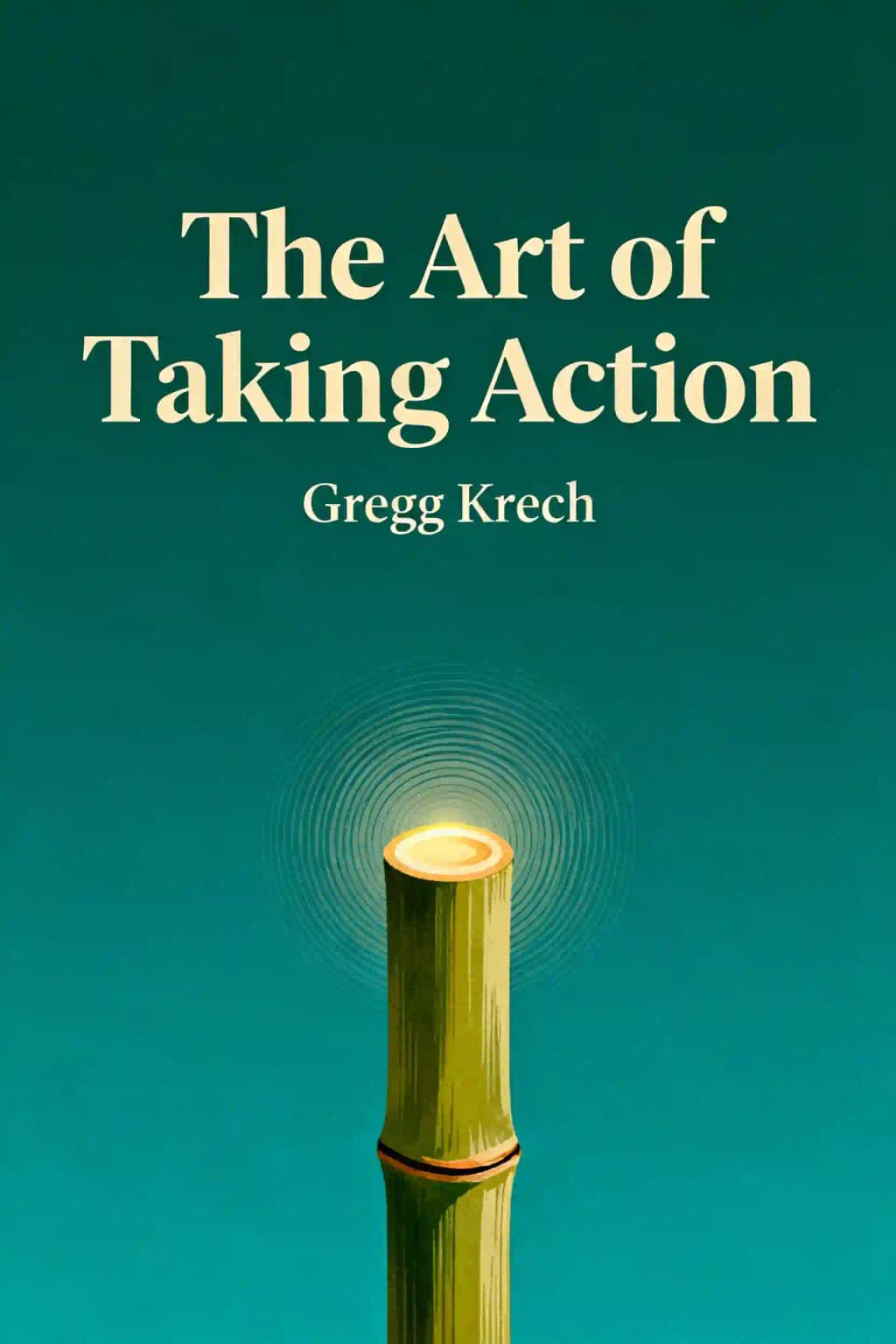
Have you ever found yourself stuck in the paradox of knowing exactly what you should do, yet somehow never doing it? You're not alone. "The Art of Taking Action" by Gregg Krech has become a quiet revolution in productivity literature, offering an Eastern alternative to Western hustle culture. Unlike conventional self-help that promises motivation hacks, this book draws from Japanese psychological traditions that have transformed lives for centuries. Endorsed by Buddhist priests, mental health professionals, and business leaders alike, Krech's approach has gained a devoted following for its practical wisdom that bridges contemplative practice with purposeful living. What makes this book particularly powerful is its counter-cultural message: your feelings about a task matter far less than your response to what needs doing. As we navigate a world increasingly paralyzed by anxiety and overthinking, this ancient wisdom offers something refreshingly straightforward-a path to move forward regardless of how you feel.
Kapitel 2
The Four Horses: Understanding Your Relationship with Action
In Buddhist tradition, there's a revealing story about four types of horses. The first horse responds to the mere shadow of the whip, the second to the driver's voice, the third when feeling the whip on its skin, and the fourth only when pain penetrates to the marrow of its bones. This parable perfectly illustrates our relationship with taking action-we're different horses in different situations. You might excel at washing dishes immediately but procrastinate for months on writing that novel.
Interestingly, the parable contains a profound twist: the fourth horse-the one requiring the most pain before moving-is said to possess "the truest spirit" and "the biggest heart." This horse understands suffering most deeply and thus has the greatest compassion for others' struggles. The insight here isn't about becoming the "best horse" but learning to work effectively with your unique temperament across different circumstances.
Most productivity systems assume you should strive to become that first horse-immediately responsive in all situations. But Krech's approach, rooted in Japanese psychology, offers something more nuanced: techniques for taking appropriate action regardless of which "horse" you happen to be in any given situation. The focus shifts from changing who you are to working skillfully with your reality.
This perspective liberates us from self-judgment. Instead of berating yourself for procrastination, you can recognize it as valuable information about your relationship with a particular task. The fourth horse isn't broken-it simply responds differently. With this understanding, you can develop strategies that work with your natural tendencies rather than fighting against them.
The horse parable also reveals something profound about motivation: external pressure (the whip) is ultimately less sustainable than developing an internal compass that guides action based on purpose and values. True mastery of action comes not from responding to external pressure but from clearly seeing what needs to be done and doing it-whether you feel like it or not.
Kapitel 3
Japanese Psychology: Three Pathways to Meaningful Action
At the heart of Krech's approach lie three Japanese psychological traditions that offer complementary paths to meaningful action: Morita Therapy, Kaizen, and Naikan reflection. Unlike Western psychology's focus on feeling better, these approaches emphasize doing better-taking appropriate action regardless of emotional state.
Morita Therapy, developed by psychiatrist Shoma Morita in the early 20th century, centers on four fundamental principles. First is acceptance (arugamama)-allowing uncomfortable feelings to exist without trying to escape them. When facing anxiety about public speaking, for instance, Morita doesn't suggest calming techniques but rather accepting the anxiety while still giving the speech. Second, it recognizes that thoughts and feelings are largely uncontrollable-like weather patterns that flow through us rather than states we can command. Third, it distinguishes between intentions (thoughts about future action) and actual action, emphasizing that only the latter creates change. Finally, it focuses attention on purpose rather than feelings-asking "What needs doing?" instead of "How do I feel about doing it?"
Kaizen, meaning "improvement," offers a complementary approach through extremely small steps. Originally developed in America during the Depression and later adopted in post-WWII Japan, kaizen bypasses the brain's fear response through actions so minimal they seem insignificant-like flossing just one tooth or pulling a single weed. These tiny actions gradually build momentum and establish habits without triggering resistance. This mirrors natural evolution rather than dramatic transformation-slow, steady progress that compounds over time.
Naikan, meaning "inside looking," provides the reflective foundation for action through three questions: What have I received from others? What have I given? What troubles have I caused? This structured self-reflection reveals how deeply we're supported by others and helps us see our impact on the world. While seemingly opposite to action, Naikan profoundly influences what actions we choose and how we take them, often prompting us to act from gratitude rather than obligation.
Together, these three approaches form a comprehensive system for taking appropriate action: Morita provides the framework for acting despite discomfort, Kaizen offers the method of small steps to build momentum, and Naikan supplies the motivation of gratitude and purpose. Unlike Western productivity systems focused on efficiency, this Eastern approach addresses the deeper psychological barriers to action while fostering character development.
Kapitel 4
The Hidden Costs of Inaction: Beyond Personal Productivity
While procrastination is often framed as a personal failing, Krech reveals its broader impacts on ourselves and others. The costs extend far beyond missed deadlines or personal disappointment.
First is the stress created by tasks left undone. Unfinished business occupies mental space, creating what psychologists call the "Zeigarnik effect"-uncompleted tasks remain active in our minds, consuming attention and energy. This mental burden accumulates over time, contributing to anxiety, sleep disturbances, and diminished well-being. As Dr. Hans Selye noted, reducing procrastination is more effective for stress management than conventional relaxation techniques.
More profound is the ripple effect our inaction creates for others. When we fail to complete our responsibilities, someone else often picks up our slack-a colleague staying late to finish a project, a spouse handling household tasks we've neglected, or family members adjusting their schedules to accommodate our lateness. These ripples extend outward in ways we rarely witness, creating resentment, frustration, and damaged trust. Even legitimate excuses don't help those affected by our failure to deliver.
Inaction also carries existential costs-dreams unrealized, potential untapped, and regrets accumulated. As we age, it's rarely the actions we took that we regret, but rather the actions we failed to take-the conversations we avoided, the risks we didn't take, the creative projects we never started. These "sins of omission" gradually shape our self-concept, reinforcing beliefs about what we're capable of and deserving of.
Perhaps most insidious is how inaction disguises itself as busyness-what Eknath Easwaran calls "painting the bullock cart wheels" when the harvest needs gathering. We stay busy with email, social media, and minor tasks while avoiding the important work that would move our lives forward. This creates the illusion of productivity while important priorities remain unaddressed.
Understanding these broader impacts helps transform our relationship with procrastination-from seeing it as a personal failing to recognizing it as a pattern with consequences for ourselves and others. This perspective shift often provides the leverage needed to break through inaction, as we realize what's truly at stake is not just personal productivity but our impact on others and the legacy we create.
Kapitel 5
Starting: The Art of Beginning Without Readiness
The most difficult part of any action is often the beginning. Krech offers counter-intuitive wisdom for this crucial moment: start before you're ready. Our tendency to wait for perfect conditions-complete information, ideal timing, sufficient motivation-keeps us perpetually preparing rather than doing.
As Steven Pressfield writes in his contribution to the book, "Don't prepare-begin." Our enemy isn't lack of preparation but Resistance itself-the internal force that generates endless excuses and self-justifications. Starting before we're ready demonstrates courage that begets more courage. The Scottish mountaineer W.H. Murray observed this phenomenon: "The moment one definitely commits oneself, then Providence moves too," bringing unforeseen assistance.
This principle extends to clarity as well. While clarity before beginning is valuable, sometimes we must begin before clarity arrives. Action isn't something that comes after figuring things out-action is a way of figuring things out. Like a cook experimenting with a stew, we must try things, taste, adjust, and sometimes start over. Most of us mistakenly associate figuring things out with thinking, but in real life, this keeps us stuck.
Several practical approaches can help overcome inertia. The "slightest move" technique from Morita Therapy recognizes that we have more control over our bodies than our thoughts. Often, once the body starts moving-even with the smallest action-our emotional state naturally shifts. This creates momentum, making it easier to continue than to start.
Another approach is simply showing up-committing only to being physically present with your materials without planning to do any work. Authors Levinson and Greider call this "Leading the Horse to Water." For overwhelming projects like organizing years of photos, just sit down with your materials without planning to do any sorting. The discipline is in showing up, which takes less effort than committing to hours of work.
A third technique is asking "What do we have here?"-a question learned from Zen cook Edward Espe Brown. This shifts attention from your feeling state to the concrete reality of your situation, creating a foundation from which to begin. When building a memorial bench, the author gathered old bench parts, inspecting each piece and assessing what was salvageable. This process of taking stock-examining what you have to work with-creates the context for action.
The common thread in these approaches is bypassing the mind's tendency to overthink and instead engaging directly with reality through physical presence and small movements. The suffering of anticipation is usually worse than the reality of doing the task.
Kapitel 6
Working with Reality: Navigating Obstacles to Action
Taking action means working with reality as it is, not as we wish it to be. This includes both external circumstances and internal states that might seem to prevent action.
Like trees that must grow wherever they're planted, we must learn to work with whatever conditions life presents rather than complaining about our circumstances. Trees don't lament poor soil or insufficient sunlight-they simply do their best with what they have. We often focus on how we were "dealt a lousy hand" and use this as an excuse for not doing better. Victoria Register-Freeman realized after fantasizing about perfect writing conditions that all she really needed was "a ballpoint pen and the back of a dry cleaning receipt... and the faith to take that first step."
Our likes and dislikes create another reality we must work with. We naturally gravitate toward activities we enjoy and avoid tasks that create discomfort, stimulate fear, seem overwhelming, offer no immediate reward, or have been difficult in the past. Over time, these preferences become conditioned responses that form the basis for many of life's practical and spiritual challenges. As Eknath Easwaran notes, mastering the ability to change our likes and dislikes is mastering life itself-otherwise we become victims, bound by our preferences.
Initial excitement often motivates us to begin projects but inevitably fades over time. The Sanskrit word "arambhashura" describes "heroes at the beginning" who start with enthusiasm but soon find their motivation has disappeared. Rather than constantly seeking new sources of excitement or trying to artificially rekindle it, we must stop depending on excitement altogether. The key is continuing what remains important even after excited feelings are gone, reaching for determination when facing frustration, tedium and doubt.
When facing challenging emotional states like depression or anxiety, direct confrontation often fails. The Buddhist concept of ocho-"overcoming by going around"-offers a wiser approach. Rather than battling these states head-on, we can navigate around them. Like walking around ice instead of crossing it, this requires wisdom rather than strength. A musician with stage fright exemplified this by writing a song about his anxiety, incorporating his shaking voice as a feature rather than fighting it.
Perhaps most importantly, we must learn to distinguish between what we can control (our efforts) and what we cannot (outcomes). This Morita Therapy principle helps us avoid attachment to goals, which are usually outcomes beyond our control. Instead of defining success by getting a job or finding a relationship, we focus on making our best effort-creating professional resumes, networking effectively, or showing up prepared for interviews. By focusing on sincere, attentive effort while leaving results to life itself, we discover that existence can be worthwhile even without being in control.
Kapitel 7
The Rhythm of Action: Finding Your Tempo
Everything has rhythm, from music to daily activities. Just as songs establish rhythm before melody, our days have underlying tempos that govern our actions. We develop habitual rhythms that may not always suit the situation-rushing through bedtime stories because we're accustomed to workplace speed, or bringing leisurely weekend pace to Monday morning tasks.
The key is adjusting our rhythm to each circumstance, neither too fast (where mind races ahead) nor too slow (where mind wanders). This requires awareness of our default tempo and the flexibility to shift gears as needed. When reading to a child, we might need to slow down to match their comprehension and enjoyment. When preparing for an emergency, we need to quicken our pace while maintaining precision.
Paradoxically, slowing down might be our most effective world-saving action. By moving at a gentler pace, we could walk instead of drive, clean our messes, properly consider decisions, and truly experience life. We'd use fewer resources, make fewer mistakes, and listen more deeply. As Thomas Merton warned, activism's frenzy can destroy its own purpose by killing "the root of inner wisdom which makes work fruitful." Our hurried pace prevents us from living fully-we're too busy saving the world to take the very advice that might save it.
Finding the right rhythm also means understanding the relationship between effort and rest. Julie Guroff's poetic reflection contrasts fish swimming upstream with human resistance to life's challenges. Fish accept the river's ever-changing current as they move in cycles of effort and rest, working with the water's force without complaint. They embrace their true nature, moving elegantly through and against the current. Humans, however, tend to complain about counter-pressure encountered while doing what needs to be done. The wisdom lies in finding a sustainable rhythm that includes both effort and recovery.
From the Universe's perspective, our entire life is merely a single beat in a timeless rhythm. So make your beat count-not by cramming more activity into each moment, but by finding the tempo that allows for both effectiveness and presence.
Kapitel 8
Defeating the Demons of Inaction
Specific psychological barriers-what Krech calls "demons"-prevent us from taking necessary action. Understanding these demons and their antidotes helps us overcome them.
Fear isn't necessarily our enemy-it can provide energy and warn us of danger. The problem comes when fear prevents necessary action. The solution isn't eliminating fear but learning to coexist with it: "Fearlessness is not freedom from fear or having less fear. It is 'going beyond' fear." This means acknowledging fear without letting it take charge of our decisions. We notice it, accept it, and shift attention to what needs doing. Sometimes fear can even be harnessed as energy for action, as Carol Jennett discovered when job-hunting: "When I was scared to make a networking call to someone I didn't know, I would be petrified, read that saying ['feel the fear and do it anyway'] and make the call. Fear actually helped me. It energized me."
Indecision paralyzes many of us, especially with complex life choices. When clarity is elusive despite thoughtful consideration, the best response isn't more thinking but action. "We can't figure out life in our minds. Life is resolved through life itself." Even small steps forward provide new information and experience that can help resolve indecision. Eventually, you may discover there is no "right" decision-just the actions you take and the situations that result.
Discouragement traps our attention on ourselves-"My life is so hard. I don't have the strength." When a student told Zen teacher Soen Nakagawa, "I am very discouraged. What should I do?" Nakagawa replied simply, "Encourage others." This counterintuitive advice works because attention works like fertilizer, helping whatever it focuses on to grow. By shifting attention to encouraging others, we remove the nourishment from our own suffering.
Perfectionism prevents both starting and finishing projects as we fixate on creating something flawless. Morita therapy offers this antidote: "Give up on yourself. Begin taking action now, while being neurotic or imperfect." Perfectionism often masks grandiosity-if you believe your work should be perfect, you must have an inflated view of your abilities. The solution isn't to avoid mistakes (which are inevitable) but to respond effectively when they occur.
Boredom uses distraction as its weapon, luring our minds away from necessary tasks. The solution lies at the boundary between mind and body-we can defeat boredom by physically persisting with the task while allowing bored thoughts to coexist. Clarity of purpose helps tremendously. Paying attention to details often awakens curiosity, which naturally counteracts boredom.
When we claim something is "too hard," we're often underestimating what we can accomplish. The Demon of Difficulty persuades us to remain in our comfort zone, but our minds frequently create boundaries that fall short of our true capabilities. To defeat this demon, we must risk discomfort, anxiety and possible failure. Complex tasks become manageable when broken into smaller components. Don't waste energy on self-talk or artificial confidence-simply take action and persist.
Kapitel 9
Compassionate Action: Moving Beyond Self-Concern
True compassion manifests through action rather than mere sentiment. As Aung San Suu Kyi notes, "Actions do speak louder than words"-merely expressing concern without taking action lacks credibility.
Korean Zen Master Seung Sahn taught his American students the principle "just do it" (before Nike's slogan) with two meanings: do one thing wholeheartedly without multitasking, and don't let your ego stop you from doing what needs to be done. He identified three mental habits that prevent action: "checking" (second-guessing ourselves), "holding" (hanging onto feelings after an interaction), and "making" (inventing stories about others' actions). The checking voice often creates excuses: "that's too hard," "I don't have enough experience," or "I might fail."
Morita therapy offers the antidote: "Be clear about your purpose, accept your feelings and thoughts, and then just do what needs doing." Vipassana teacher Joseph Goldstein practices this with generosity, always following through on impulses to give despite doubts, as does Pema Chodron who gave away a beloved sweater despite internal resistance. When our best selves want to step forward, we can listen to our resistant voices but then consider our purpose and just do it-without expecting applause or thanks in return.
In relationships, acting "as if" means choosing kind behavior even when you don't feel like it-not letting feelings dictate behavior but instead choosing actions aligned with becoming more spiritual. Susan Page offers practical tips: Start small with just five minutes of loving behavior; Take initiative by creating the activities you wish your partner would initiate; Be patient and persistent even without immediate results; Prepare for internal resistance ("My partner doesn't deserve this"); and Remember that only new behavior, not talking or blaming, creates change. As one workshop participant discovered, "It's so easy to get affection; just give it." You can't feel your way to new actions, but you can act your way to new feelings.
Compassionate action also means holding both sadness and purpose simultaneously. Chogyam Trungpa taught that we must "hold the sadness and pain of samsara in our heart and at the same time the power and vision of the Great Eastern Sun." Rather than avoiding or fixing our sadness, we acknowledge it with warmth and tenderness while simultaneously embracing the wisdom and discipline that helps us move forward. The haiku poet Issa, after losing his baby daughter, wrote about understanding impermanence ("the world of dew") while still feeling profound grief ("and yet, and yet..."). Trungpa's final advice is practical: make a proper cup of tea-take action. We must acknowledge our pain without drowning in it, carrying both our sadness and joy as we continue living and doing what's important.
Kapitel 10
Creating Your Legacy: From Audience to Actor
We spend much of our lives as passive audience members-reading books others wrote, watching movies others filmed, spectating at sporting events. While there's nothing wrong with appreciating others' creativity, we neglect our own creative expression. It's easier to consume than create, but everyone possesses creative capacity.
This passive orientation extends beyond entertainment to how we view our lives. We focus obsessively on what remains undone rather than celebrating what we've accomplished. Michael C. Gilbert notes that we cross items off to-do lists rather than building lists of completed tasks, creating an imbalance where "only the unfinished is important." This habit distorts our motivation and makes us see deficits more readily than achievements.
The challenge is shifting from audience to actor-from passive consumer to active creator of your life's meaning. Don't let uncertainty about process or outcome prevent you from starting. Take just ten minutes to do something creative-write a haiku, sketch a drawing, or begin that long-delayed project. Your creative expression benefits not only your neurons but the rest of the world.
This shift also means embracing impermanence rather than fighting it. Though we intellectually understand impermanence, we resist change and long for stability. The author references the Lego Movie, where Lord Business wants to glue everything in place while the Master Builders embrace creative destruction and rebuilding-a metaphor for our struggle with impermanence. Unlike model airplanes that remain static once built, Legos are meant to be reconfigured, similar to Tibetan sand mandalas that monks destroy after completion.
The challenge of living with impermanence is that change requires constant adaptation and action, which becomes exhausting. We must work with impermanence by responding to situations based on their needs rather than our feelings. The saving grace is that impermanence applies to everything-both difficult situations and pleasant ones will change. "If you don't like what's happening, rest assured, it will change. If you are pleased with the situation, rest assured, it will change. Those are the rules. Enjoy the game."
Your legacy isn't measured by tasks completed but by integrity, kindness, quality of attention, and gratitude. A successful day isn't determined by checking boxes but by how we treated others and maintained our presence and purpose. We're creating our legacy in each moment: "Do what you came here to do."