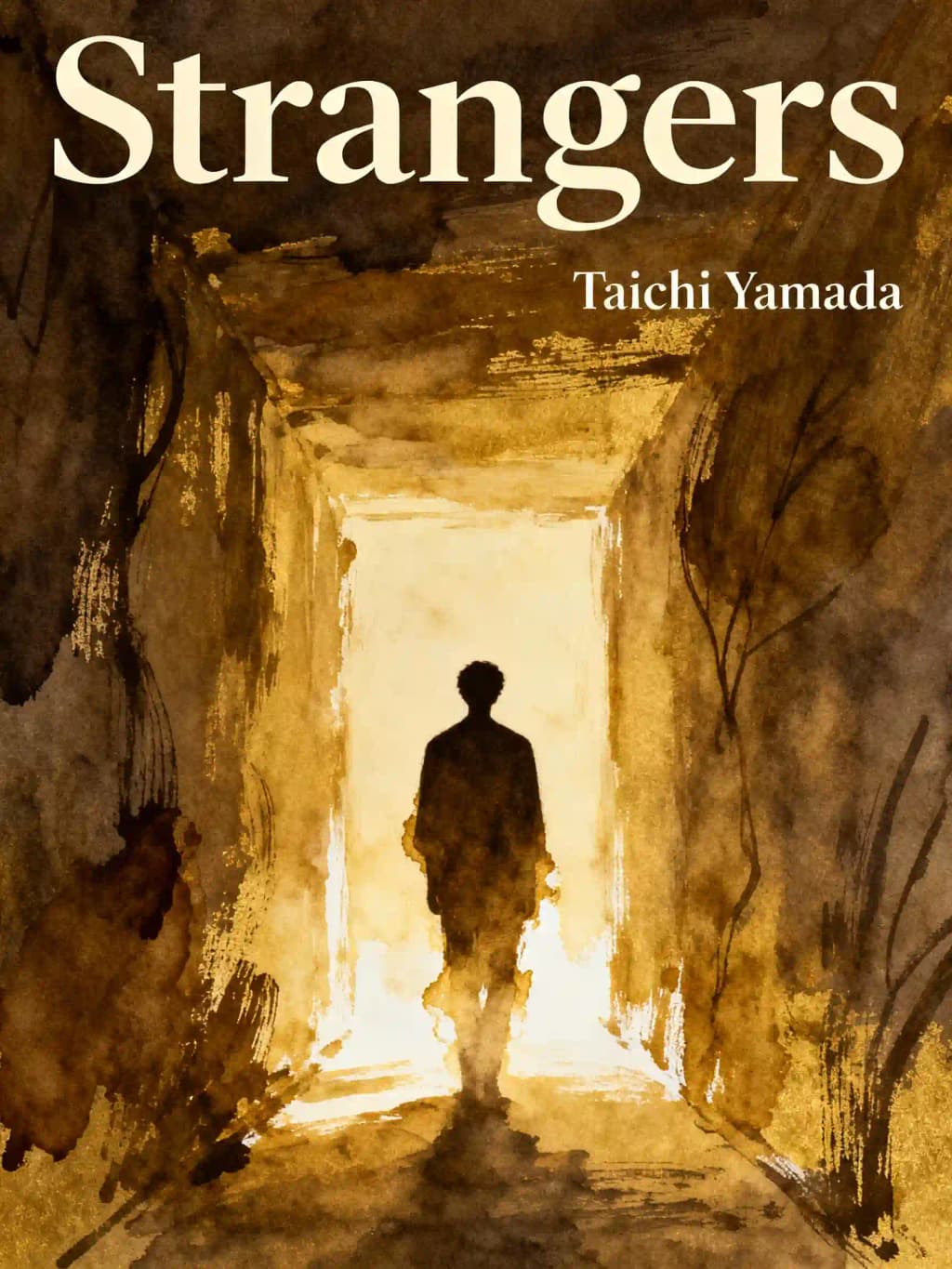
A haunting ghost story where a lonely scriptwriter meets his deceased parents, "Strangers" blurs reality and afterlife. Yamada's award-winning novel inspired two films, including 2023's "All of Us Strangers." What happens when the dead return - and why can't we let go?
Taichi Yamada (1934–2023) was an acclaimed Japanese screenwriter and novelist, best known for his seminal work of supernatural fiction, Strangers (1987). The novel explores themes of loneliness, familial longing, and the porous boundary between life and death.
Born in Tokyo’s Asakusa district, Yamada was educated at Waseda University. He began his career as a film studio assistant director before becoming a prolific television dramatist, penning hit series like Kishibe no arubamu. His transition to novels earned him the Yamamoto Shūgorō Prize for Strangers, which masterfully blends psychological depth with ghostly suspense, reflecting his lifelong fascination with memory and human connection.
The book’s enduring legacy includes two film adaptations: 1989’s The Discarnates and 2023’s BAFTA-nominated All of Us Strangers. Yamada’s other translated works, such as In Search of a Distant Voice and I Haven’t Dreamed of Flying for a While, further cement his reputation for haunting, introspective storytelling.
Originally published in Japanese as Ijintachi to no natsu, Strangers has been translated into over 15 languages, captivating global audiences with its ethereal meditation on grief and belonging.
Strangers explores loneliness and existential disconnection through Hideo Harada, a divorced TV writer who encounters mysterious figures resembling his deceased parents and an enigmatic neighbor. Blending psychological drama with supernatural elements, the novel delves into themes of grief, identity, and the blurred lines between reality and memory.
Fans of Japanese literary fiction and atmospheric, introspective narratives will appreciate this haunting story. Ideal for readers interested in existential themes, ghostly allegories, or post-war Japanese societal shifts. Its brevity (under 200 pages) also suits those seeking a concise yet layered work.
Yes—the novel won the 1988 Yamamoto Shūgorō Prize and inspired multiple film adaptations (The Discarnates, All of Us Strangers). Critics praise its elegant prose and ability to evoke unease through quiet, surreal moments.
Key themes include isolation (Hideo’s empty apartment building), unresolved grief (his parents’ ghostly return), and the fragility of identity. Yamada contrasts urban alienation with fleeting human connections, using the supernatural to mirror emotional repression.
Hideo’s solitary existence amplifies his vulnerability to eerie encounters—like Kei, a neighbor projecting desperation, and his “parents,” who reflect his unmet emotional needs. The sparse dialogue and vacant setting underscore his internal void.
The nearly vacant building symbolizes Hideo’s emotional isolation. Its silence (“utterly alone in a vast dark void”) mirrors his dissociation from society, while Kei’s presence hints at unrealized intimacy.
Yes—Hideo interacts with doppelgängers of his long-dead parents and questions their reality. These encounters blur psychological trauma with ghostly visitation, challenging readers to interpret their symbolism.
The train to Asakusa represents Hideo’s unresolved past, while his impulsive silk tie purchase reflects a futile attempt to construct identity. The champagne bottle Kei carries symbolizes transient escapism.
Beyond its Yamamoto Prize win, the 2003 English translation was longlisted for The Independent’s Foreign Fiction Prize. Film adaptations have won awards at Moscow International and Telluride festivals.
Unlike Yamada’s screenplay-driven TV dramas, Strangers adopts a minimalist, introspective style. However, it shares his focus on urban loneliness, seen in novels like In Search of a Distant Voice.
Yes: Nobuhiko Obayashi’s The Discarnates (1988) and Andrew Haigh’s All of Us Strangers (2023). Both reinterpret the novel’s themes through distinct cultural lenses.
Drawing from his Asakusa upbringing and screenwriting career, Yamada fused post-war Tokyo’s social fragmentation with universal questions about belonging. The story reflects Japan’s 1980s bubble economy alienation.
Erlebe das Buch durch die Stimme des Autors
Verwandle Wissen in fesselnde, beispielreiche Erkenntnisse
Erfasse Schlüsselideen blitzschnell für effektives Lernen
Genieße das Buch auf unterhaltsame und ansprechende Weise
The building becomes a physical manifestation of his emotional state-a hollow shell housing a single occupant, surrounded by emptiness.
Harada acknowledges his increasingly antisocial tendencies since the divorce.
This moment marks the crossing of a threshold.
His longing for connection...creates an opening through which the dead will soon return.
Zerlegen Sie die Kernideen von Strangers in leicht verständliche Punkte, um zu verstehen, wie innovative Teams kreieren, zusammenarbeiten und wachsen.
Destillieren Sie Strangers in schnelle Gedächtnisstützen, die die Schlüsselprinzipien von Offenheit, Teamarbeit und kreativer Resilienz hervorheben.

Erleben Sie Strangers durch lebhafte Erzählungen, die Innovationslektionen in unvergessliche und anwendbare Momente verwandeln.
Fragen Sie alles, wählen Sie die Stimme und erschaffen Sie gemeinsam Erkenntnisse, die wirklich bei Ihnen ankommen.

Von Columbia University Alumni in San Francisco entwickelt
"Instead of endless scrolling, I just hit play on BeFreed. It saves me so much time."
"I never knew where to start with nonfiction—BeFreed’s book lists turned into podcasts gave me a clear path."
"Perfect balance between learning and entertainment. Finished ‘Thinking, Fast and Slow’ on my commute this week."
"Crazy how much I learned while walking the dog. BeFreed = small habits → big gains."
"Reading used to feel like a chore. Now it’s just part of my lifestyle."
"Feels effortless compared to reading. I’ve finished 6 books this month already."
"BeFreed turned my guilty doomscrolling into something that feels productive and inspiring."
"BeFreed turned my commute into learning time. 20-min podcasts are perfect for finishing books I never had time for."
"BeFreed replaced my podcast queue. Imagine Spotify for books — that’s it. 🙌"
"It is great for me to learn something from the book without reading it."
"The themed book list podcasts help me connect ideas across authors—like a guided audio journey."
"Makes me feel smarter every time before going to work"
Von Columbia University Alumni in San Francisco entwickelt

Erhalten Sie die Strangers-Zusammenfassung als kostenloses PDF oder EPUB. Drucken Sie es aus oder lesen Sie es jederzeit offline.
In the heart of Tokyo, alongside the ceaseless hum of Route 8, stands a seven-story building where reality begins to unravel. Forty-seven-year-old scriptwriter Harada has moved into this building following his divorce, occupying an apartment he once used as an office. After three weeks of solitary existence, he notices something unsettling-an unnatural silence pervading the building at night. Looking out his window, he sees only a single pink van in the otherwise deserted parking lot, and realizes his might be the only illuminated window in the entire structure. This concrete ghost ship becomes a physical manifestation of his emotional state-a hollow shell housing a single occupant surrounded by emptiness. The building's liminal nature-neither fully residential nor commercial, neither fully occupied nor abandoned-mirrors Harada's own in-between state. Recently divorced, professionally adrift, and emotionally untethered, he exists in a borderland where the boundaries between past and present, living and dead, begin to dissolve. His isolation deepens when his colleague Mamiya delivers a shocking announcement: he intends to pursue Harada's ex-wife with marriage in mind. This betrayal by someone he's worked with for nearly a decade cuts deep, especially when Mamiya frames his declaration as a courtesy. The encounter leaves Harada reeling, adding another layer of abandonment to his already fragile emotional state.
