Kapitel 1
The Procrastinator's Paradox: Why We Know What To Do But Don't Do It
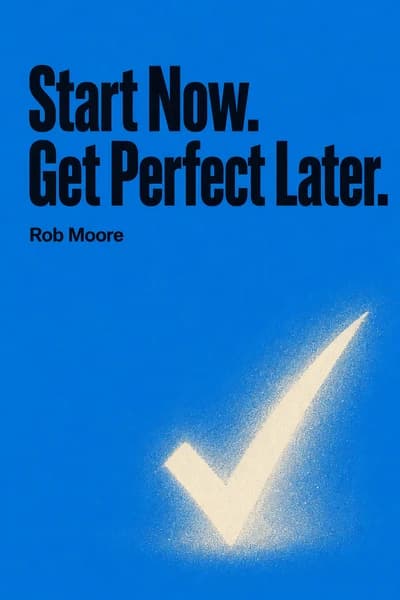
In a world obsessed with productivity hacks and self-improvement, Rob Moore's "Start Now. Get Perfect Later" addresses the elephant in the room: why do we know what we should do but still don't do it? This book has become a cult favorite among entrepreneurs and creatives alike, with celebrities like Richard Branson citing it as inspiration for their decisive leadership style. Moore, who built a multi-million-pound property empire from scratch after years of struggling as an artist, doesn't just theorize about procrastination-he's lived through its paralyzing effects and emerged with practical solutions that have resonated with millions worldwide. The book's cultural impact stems from its refreshing honesty: even as Moore wrote about overcoming procrastination, he found himself procrastinating on writing the very book in your hands.
Kapitel 2
You're Not Broken, You're Human
Everyone procrastinates, but that doesn't make you "a procrastinator." This subtle distinction matters tremendously. When you label yourself as "a procrastinator," you create a self-fulfilling prophecy that becomes nearly impossible to escape.
The truth is, you're already decisive in areas where you feel confident. Think about it-Lionel Messi doesn't hesitate when it's time to take a shot. Nelson Mandela didn't waver when it came to forgiveness. These weren't inherent traits they were born with; they built their "decision muscles" through repeated practice in their areas of expertise.
Procrastination emerges when we face unfamiliar territory or challenges outside our comfort zone. It's not a character flaw but a natural response to uncertainty. If you can make quick decisions about where to eat dinner but freeze when considering career changes, that's completely normal-you've simply exercised your decision-making abilities more in one area than another.
What we call procrastination often manifests in surprising ways. Perhaps you suddenly feel compelled to organize your sock drawer when an important deadline looms. Or maybe you're a "pre-crastinator"-someone who gets everything "ready" before starting the actual task, spending hours creating the perfect workspace while the real work remains untouched.
These behaviors aren't random. They serve as self-protection mechanisms when we feel our sense of worth or independence threatened. Procrastination isn't an illness or identity crisis-it's an evolutionary trait that helps us avoid fear, pain, and threatening situations while conserving energy for truly important tasks.
When you understand that procrastination is situational rather than definitional, you can stop the self-blame cycle and start building your decision muscle in new areas of life. Remember: if you can be decisive in one domain, you can transfer that capability to others. Form may be temporary, but class is permanent.
Kapitel 3
The Fear Behind Inaction
We often delay difficult decisions despite knowing exactly what we need to do. This hesitation isn't about laziness or incompetence-it's about fear. Behind procrastination lurk deeper anxieties that paralyze our decision-making abilities.
These fears take many forms: fear of the unknown, making mistakes, missing out, imperfection, taking risks, judgment, rejection, discomfort, not meeting expectations, losing what you have, lack of clarity, or waiting for something better. When examined closely, most of these concerns cluster around three core issues: defense against failure, resistance to authority, and fear of success with its accompanying expectations.
What's fascinating is that procrastination actually evolved as a survival mechanism. Our ancestors' tendency toward "complex planning" rather than impulsive action helped them avoid potentially fatal decisions. What once preserved life now hinders progress in our fast-paced world where quick decisions often yield the greatest rewards.
I remember when I was struggling as an artist, I'd spend hours perfecting minor details on paintings that nobody would ever notice, while avoiding the scary work of actually showing my art to gallery owners who might reject me. The irony is that by trying to protect myself from potential criticism, I guaranteed my failure by never giving my work a chance to be seen.
This pattern plays out in countless ways. The entrepreneur who endlessly refines their business plan instead of launching. The writer who continuously edits the first chapter rather than completing the manuscript. The single person who finds tiny flaws in every potential partner rather than risking vulnerability.
Understanding the evolutionary purpose behind procrastination helps contextualize it as a solvable challenge rather than a character defect. Your work is not your worth, and what once served as protective programming can be overcome with modern techniques designed to bypass these prehistoric impulses.
Next time you find yourself scrolling social media instead of tackling an important project, recognize that you're not being lazy-you're experiencing an ancient protective mechanism that's simply out of place in today's world. Acknowledging this is the first step toward building new patterns of decisive action.
Kapitel 4
The Perfectionism Trap
"Getting my ducks in a row" perfectly captures the futility of perfectionism and procrastination. We convince ourselves that everything must be perfectly aligned before we can start, but as Steve Jobs wisely noted, "you can't connect the dots moving forwards, you only can when you're looking backwards."
Perfectionism isn't the badge of honor many claim it to be in job interviews. I'm reminded of my university days when I obsessively arranged my wardrobe with shirts in perfect color order and precisely spaced hangers, unable to leave until everything was flawless-much to my friends' amusement. While organization and quality work are valuable, pedantic perfectionism paralyzes progress.
The true paradox is that we're already perfectly imperfect-flawed, unique individuals who make mistakes. Striving for excellence, not perfection, is the key to moving forward.
This perfectionism often manifests as "pre-crastination"-the illusion of busyness we create before starting real work. Like my mother's "clear-outs" that merely moved clutter around, many of us tidy desks, check analytics repeatedly, or refresh email instead of tackling important tasks. I confess to checking my podcast analytics and book rankings obsessively. This warming-up ritual creates the false impression of productivity.
Even more insidious is active procrastination: letting others dictate your productivity by solving their problems at the expense of your own, or convincing yourself you're busy while only completing low-priority tasks. This self-deluding behavior is like an "inner bas-tard" that mocks and manipulates you into avoiding meaningful work.
Remember Mark Twain's advice about not putting things off until "the day after tomorrow." When you procrastinate, problems compound like my university kitchen that went uncleaned for two years until it became a nightmare of flies and mold. A decision to do nothing is still a decision, and problems only grow larger with time.
Task jumping-constantly switching between multiple unfinished activities-creates an illusion of productivity while destroying efficiency. Research shows it takes an average of 23 minutes to regain focus after an interruption, and people typically switch activities every three minutes. This constant shifting prevents achieving "flow state"-that optimal condition where time seems to disappear and work becomes effortless.
The solution? Go narrow and deep rather than shallow and wide. Eliminate distractions, start with the most important task, and maintain focus for as long as possible. Remember: momentum builds momentum, and starting takes more energy than continuing.
Kapitel 5
Breaking Through Decision Paralysis
We dramatically overestimate the magnitude of our decisions. In reality, decisions take split-nanoseconds to make-it's the preparation, doubt, and second-guessing that consumes time and energy.
The average adult makes approximately 35,000 conscious decisions daily (including 226.7 food decisions alone), making it impossible for all to be "big." What appears to be a single momentous decision is actually built from countless smaller preceding choices that compound over time.
Success isn't one decision but a series of small choices that build upon each other. Even apparent "eureka" moments celebrated in popular culture are usually the culmination of thousands of iterations and experiments-like Edison's 10,000 attempts before perfecting the lightbulb.
We waste enormous mental energy having imaginary arguments and catastrophizing scenarios that rarely materialize. I once was so consumed by an imagined confrontation that I nearly walked into the ladies' restroom during an event where I was the main speaker! These mental constructs-whether arguments with people we've never met or fears about decisions we haven't made-consume our imagined life while disrupting our real one.
Worry is simply projecting a future that has a high probability of being wrong while ruining our present moment. The reality of situations typically unfolds differently than our anxious predictions. Even when we make poor decisions, we can correct course with subsequent choices rather than remaining paralyzed by fear of the unknown.
To handle pressure better, remember that most decisions aren't permanent-you can change course anytime. The key is turning a "threat state" into a "challenge state" by: 1) Removing permanence (recognizing decisions can be changed), 2) Diminishing importance (it's just one small task), 3) Contextualizing decisions (compared to life-or-death choices), 4) Balancing expectations (focus on small wins), 5) Taking your work seriously but not yourself (have fun), and 6) Figuring things out as you go rather than needing all answers upfront.
Instead of "fake it till you make it," which feels inauthentic, try "be it till you see it." This approach maintains authenticity while embracing growth. Get clear about what you want, visualize it, then act 'as if' you're already there-not as pretense but as authentic movement toward your goals.
When facing big decisions, focus on the first simple step. Set your big target for motivation, but don't let it overwhelm you. Make big decisions with your heart but small decisions with your head. Like strongmen pulling trucks, you'll struggle at first, but once momentum builds, you'll be unstoppable.
Kapitel 6
The Art of Letting Go
To grow, you must let go of control, perfectionism, responsibility and baggage. With limited time and energy in your short lifetime, how you invest it determines your happiness and success.
Most things aren't worth worrying about. Focus only on what takes you closer to your vision and goals or aligns with your values. You can't grow the big stuff if you sweat the small stuff.
You can't control everything or everyone. You control your decisions and actions, and can inspire others, but must then let go or risk pushing people away. Set the outcome but let go of the process, allowing people to find their own way.
Fight only your own battles and leave everything else. Too many battles drain you and cause others to tune out your message. Focus on the handful of things you truly believe in, investing most of your time there while letting the rest go.
Many activities create the illusion of being worthy but actually drain, waste or distract you. Your time-energy is either compounding or eroding. Ensure each decision or task provides value, progress, results, happiness and fulfillment.
Time should be invested, not spent or wasted. Focus on Key Result Areas and Income Generating Tasks that provide the greatest return on your time investment.
Show people your faith and confidence by treating them with respect and autonomy. Be available for support and guidance, but let them work in their own style and do meaningful work that inspires them.
No one wants constant interruption and criticism. When training people, teach them but then let them try themselves. Constant interference only demotivates. Everyone makes mistakes, including you.
The best way to have control is giving responsibility to smart people and treating them well. The more you need something, the more it controls you. Let others take credit and flourish under your gentle guidance, and you will win.
Your decision-making ability is like a muscle that can be trained and grown through practice. No one is inherently good or bad at decisions-we excel in areas where we've gained experience. Everything great in your life came from good decisions you've made, and you can apply this confidence to areas where you're currently procrastinating.
To build your decision muscle, take baby steps toward bigger decisions, get mentors to stress-test your choices, set research deadlines, review past decisions to learn from them, listen more than you talk, embrace mistakes as potential opportunities, and keep deciding-recognizing that every decision leads to another.
Kapitel 7
Mastering Productivity Through Strategic Action
Decisiveness is the leadership trait that enables quick, effective decision-making and ignites action. Though seemingly complex, it simply requires choosing from four options: Option A, Option B, Option A+B, or neither option. It's fundamentally simple when reduced to yes, no, or wait.
When uncertain about what you should be doing, identifying what you should not do becomes valuable. There are two forms of what NOT to do: time-wasting tasks and tasks that you can leverage to others. For time-wasting tasks, avoid social media, long meetings, online debates, interruptions, and active procrastination. Parkinson's Law states that work expands to fill available time, so you must identify these low-value tasks or they'll consume everything.
Understanding the distinctions between being busy, productive, and efficient can dramatically improve your results. Busy means working hard and doing lots. Productive means getting important things done. Efficient means getting important things done in the shortest time.
To become more efficient, keep a two-week work log tracking what you do in 30-minute blocks, noting the task, duration, type (work/rest/play), and how you felt doing it. This reveals your daily cycles, when you're most effective, and where you waste time.
We need to rethink traditional 'to do' lists since many items shouldn't be done by you at all. To manage lists effectively: 1) Order by importance/priority; 2) Create your list the night before; 3) Never start the next item until you've finished the current one; 4) Use a one-in-one-out rule with a maximum task limit; 5) Keep your list to 5-7 items only.
The '4D System' helps manage tasks: Delegate, Delete, Delay, and only then Do. Most people start with "Do" when they should follow the L1 M2 DL formula: Leverage first, Manage second, and Do last. This approach can help you achieve double the results in half the time.
All this 5am club nonsense misses the point-we each have our own optimal rhythms. After testing various sleep patterns, I found my ideal is 8 hours (9:30pm-5:30am), with strategic coffee times and no alcohol. I've structured my day around energy peaks: 6am-8am and 11am-1pm for high-value work, with family time and meetings scheduled strategically around these.
The Pomodoro Technique maximizes focus and creativity while reducing mental fatigue. Using 25-minute work sessions followed by 5-minute breaks, in sets of three, with longer breaks between sets, this approach has helped me write more than one book annually for nearly a decade.
Kapitel 8
Gaming Your Brain for Success
Since you're the easiest person to lie to, you can also trick yourself productively. First, be honest enough to recognize when you're making excuses-you're not too tired, you don't need another coffee, you don't need all your ducks in a row.
Here are strategies to game yourself toward action:
1. Compartmentalize your diary based on your energy patterns. Plan knowing your highs and lows, ebbs and flows of energy, productivity and time 'in the zone'.
2. Identify what gets you "in the zone" and use it as a trigger. Whether it's coffee, heavy metal music, a power workout, or a nature walk, use what works by repeating it often.
3. Set deadlines before actual deadlines and create painful consequences for missing them. I once invited 15 book critics to review this book one week after my self-imposed deadline-forcing myself to finish or face embarrassment.
4. Create competitions and challenges with others. If you're competitive, this is a great motivator. I've achieved six-packs through 30-day challenges with friends-even if I'd lost the challenge, I'd still have won through progress.
5. Identify what you love most and what you hate most. Set a goal to either receive your reward or accept your penalty. The more extreme the pain, the more effective the motivation.
6. Tell people about your goals to create traction toward action. Like Arnold Schwarzenegger, who told everyone he was already who he wanted to become, whether Mr. Olympia or a Hollywood actor.
7. Take yourself and your lies out of the equation by getting a coach, mentor, accountability partner, or joining mastermind groups. It's easy to let yourself down but harder to disappoint others-especially if you've paid them good money.
When distractions derail your focus-emails flooding in, kids bursting in, social media notifications exploding-remember that you've trained people to interrupt you. Turn off notifications, put your phone away, isolate yourself from distractions, and create an environment conducive to deep work.
You're often the biggest bottleneck stopping progress. Even when delegating tasks, your need for control keeps you involved. Whether you want control of outcomes, insist things be done your way, hold impossible standards, or need to feel important-these are all lies. Instead, let go to grow. Set the goal, then step aside and let others do it their way.
Contrary to the old saying, you should not do it yourself. Instead, give it to a busy person! Stop asking "how" questions like "How can I do it?" and start asking "who" questions: "Who can do it?", "Who has experience?", "Who would love to do it?"
Kapitel 9
The Science of Motivation and Decision-Making
We're hardwired to move toward pleasure and away from pain, with our brain providing chemical rewards and punishments. But these instincts, while useful for survival thousands of years ago, are often outdated now. Our vices fight our virtues, addictions battle our visions, and heart conflicts with head.
To master these competing forces:
1. Give yourself rewards along the way, not all at the end. Micro-reward yourself with little breaks and treats after deep work to feed your "inner bas-tard." Start small and scale up, matching reward size to outcome size.
2. Work out your strongest pleasure and pain motivations. Identify what truly motivates you, what you fear and hate, and what you'd love to become. List these out, then use them strategically.
3. Have a very clear picture of your vision and goals. The clearer your goal, the easier it is to build up the picture piece by piece. You will never arrive at a destination you do not set.
FOMO (fear of missing out) makes you susceptible to bad decisions. You look from afar with rose-tinted glasses, believing others have it easier and better, but this is never the reality. FOMO manifests by making you try to be everything to everyone, driving decisions based on competitiveness rather than vision, and causing you to decision-hop without sticking long enough for results.
To overcome inaction and procrastination, follow this six-step process:
1. Research (75%): Learn and prepare upfront, but stop at about 75% knowledge to avoid analysis paralysis.
2. Test: "Test" is better than "do" because it assumes less risk and permanence while embracing improvement. Get your Minimum Viable Product out fast and imperfect.
3. Review: Analyze and gather feedback on your initial test. Assess what worked well, what new elements you need, what to abandon, and what to preserve.
4. Tweak: Make improvements to your most recent action. Focus on small, steady refinements rather than slow, radical changes.
5. Repeat: Loop back and restart the process with improved skill, experience and confidence.
6. Scale: After completing several loops, you're ready to scale up-neither too quickly nor too slowly.
Kapitel 10
Balancing Intuition with Information
Balancing intuition and information is the dance between research and action. Beginners need more information to build intuition, while experienced people can rely more on their gut feelings-the accumulated wisdom of past experiences.
Intuition works best for areas of existing experience, relationships requiring trust, people-centered situations, and moral dilemmas. Information excels with data analysis, technological complexity, automation, business decisions, and binary choices.
When gathering data, collect about 75% of what you think you need, set clear outcomes and deadlines, then decide and act. Seek counsel from experienced people but limit yourself to 3-4 alternatives to avoid the paradox of choice.
Risk requires delicate balance-excessive risks can lead to devastating mistakes, but taking no risks might be the biggest risk of all. Risk and reward are interconnected, with lower risk typically yielding more secure but smaller returns, while bigger risks offer greater potential rewards alongside potential failure.
By approaching risk strategically, you can manage it progressively by starting with safer, proven models or investments, building up risk experience, reducing exposure as risk increases, only gambling with affordable losses, learning from increased risk, and protecting the downside.
Our minds often exaggerate fears and "what ifs," taking them out of context. In today's world, most decisions don't carry life-threatening consequences, yet we remain wired to prioritize fear over positive emotions.
To ease decision-making anxiety, try these approaches:
1. Ask "What's the worst that can happen?" to contextualize your situation.
2. Use worst-case, likely-case and best-case scenario planning:
- WORST-CASE: For most decisions, the true worst case is usually manageable-perhaps returning to employment with a pay cut and some humbled pride.
- LIKELY-CASE: You'll make mistakes and face struggles-that's normal. With persistence, you'll improve and eventually excel.
- BEST-CASE: You could gain freedom, choice and profit, make millions while making a difference, achieve wild success with a lasting legacy.
3. Use parallel universe thinking to mentally test different scenarios.
One of the simplest yet most effective ways to overcome procrastination is getting thoughts out of your head and onto paper. By creating a two-column list with "Pro/Upside" on the left and "Con/Downside" on the right, the decision often becomes clear as you brain dump everything.
Kapitel 11
The Testing Mindset
When all is said and done, more is said than done. To know and not to do is not to know. You do and you learn; you wait and you stagnate.
If you stop seeing decisions as final and start seeing them as tests that can be tweaked as you go, you'll find flow. Big decisions are just series of smaller ones. No decision is truly final-the more "final" a decision seems, the harder it becomes to change. Testing removes pressure and embraces improvement.
GOYA (Get off your arse) and JFDI (Just frickin' do it). No decision needs to be permanent-any can be changed or improved quickly. See every decision as a test that reduces risk and develops constant improvement. Get your "good enough" MVP decision out fast, not perfect.
When I started in property, I had just one house with no deposits for more. That first average book is now in its fourth edition and the UK's best-selling property book. You should have seen my first website and public speech-cringe! But over 1,200 speeches later with a five-figure fee, I'm getting perfect later.
Experience brings wisdom, intuition and confidence, but also drawbacks many overlook. The paradox: you need experience for confidence, but only get it by starting. With experience often comes hardened attitudes, diminished passion, cynicism, lack of energy and creativity, boredom, over-confidence, and taking things for granted.
Many see changing their mind as weakness, holding onto bad decisions to protect their ego. But changing your mind (not constantly) shows strength-you don't cling to the past and can separate ego from decision-making. It demonstrates adaptability to the only constant: change.
The law of proportional decision making states that the time invested in making a decision should directly correspond to its potential outcomes. Big decisions with significant outcomes deserve more time, while smaller decisions with minor outcomes should be given much less time.
If in doubt, leverage it out. Crowdsourcing allows you to pool other people's experience to reduce decision-making time and risk. Rather than coming up with all ideas yourself, get input from friends, mentors, customers and users who've experienced the problem or solution before.
Kapitel 12
From Decision to Mastery
Once you've tested or crowdsourced an idea, the work has only begun. Version one is never as good as version two, and shouldn't be. The "Review. Tweak. Repeat." stages are as crucial as the initial launch, with scaling coming only after multiple iterations.
For effective review:
1. Get good counsel from experienced people
2. Ask for feedback, shut up, listen, take note, don't judge
3. Get advice, but not too much
4. Sleep on bigger decisions or take time out
5. Analyze KPIs and data sets for insights
When tweaking:
1. Make small, regular adjustments like an aircraft that's off course 97% of the time
2. Change one thing at a time to identify what works
3. Progressively automate your improvements
Only after several rounds of review and tweaking should you consider scaling up. Scaling too early means scaling your problems.
As you make faster, better and harder decisions, you get better at making faster, better and harder decisions. See every decision as an investment you carry over into the next decision. What once was hard becomes easier over time.
Life is a marathon not a sprint. With the average life expectancy now over 80, it is wise to think in that length of time, and ensure you stay fit, healthy and motivated for the full duration.
Periodical clear-outs and cleanses of space and mind are important:
1. Remove all clutter from visible space
2. Conduct full diary cleanses once/twice a year
3. Purge devices of digital clutter
4. Clear your head daily through exercise or meditation
5. Regularly file away and clear out notes and ideas
6. Maintain your health through regular cleanses and check-ups
7. Forgive and let go of past mistakes
Mihaly Csikszentmihalyi's flow state is an optimal state of intrinsic motivation where you're fully immersed in what you're doing. Paradoxically, trying harder often produces worse outcomes. Power comes from relaxation, not tension.
When you have clarity and alignment with your vision and values, decisions and actions become spontaneously clear. Your values are what's most important in your life, organized by priority. Your vision is the ultimate, lifelong manifestation of your values lived with inspiration.
Kapitel 13
Creating Your Legacy Through Decisive Action
Decisions are most effective when fully committed to rather than constantly reconsidered. Flip-flopping not only leads to circular progress but erodes others' trust in your consistency.
While conventional wisdom says never make the same mistake twice, most of us repeatedly make both the same mistakes and achieve the same successes due to our deeply ingrained personality traits and habits.
Rather than trying to fix all weaknesses, focus primarily on leveraging your strengths to become exceptional. Dedicate a smaller portion of time to bringing major weaknesses up to a satisfactory level, then outsource the rest to others better suited to those tasks.
Your word is more than a fleeting comment-it's a measure of your worth. When kept, it builds trust, credibility, goodwill, equity, and a reputable brand. Breaking your word makes you seem flaky and untrustworthy.
Often, you already know what you need to do but aren't doing it. As the saying goes, "To know and not to do is not to know." Stop thinking and start doing-overthinking often leads to inaction. Don't blow tasks out of proportion; just start small.
The weight of a decision should be less on making it and more on making it right. Even a mediocre decision can become excellent through good management, while a supposedly good decision can fail through poor execution.
Spontaneous Right Action (SRA) is about trusting your intuition to make decisions without overthinking. When you trust yourself, the right action emerges with minimal conscious effort.
Problem-solving is as much about mindset as skill set. Because most people default to avoidance, those who tackle problems head-on become leaders with increased societal value. Your legacy and success directly correlate with the scale and meaning of problems you solve.
Each decision is an investment in your future efficiency. Repeated starts waste time, while carrying forward lessons makes decisions easier and more intuitive. Life is short-protect your time and increase leverage to do more of what you love, when and with whom you love.
What won't you achieve? Where won't you go? What might you regret? These questions remain unanswered if you don't start making decisions fast. I recommend an annual "Regret Test"-project to the end of your life and identify potential regrets, then use them as motivation to make decisions that minimize those regrets.
Life moves quickly-I'm approaching 40 and wasted my early years. You have amazing gifts the world needs. Shine your light and lead the way. Don't wish it were easier, become better. True happiness comes from continual progression toward meaningful objectives-often found in completing difficult tasks or seeing long-term projects finally become reality. Find happiness in taking on bigger decisions, knowing you're growing through challenges and solving more important problems.