Kapitel 1
The Art of Captivating an Audience: Lessons from World Champions
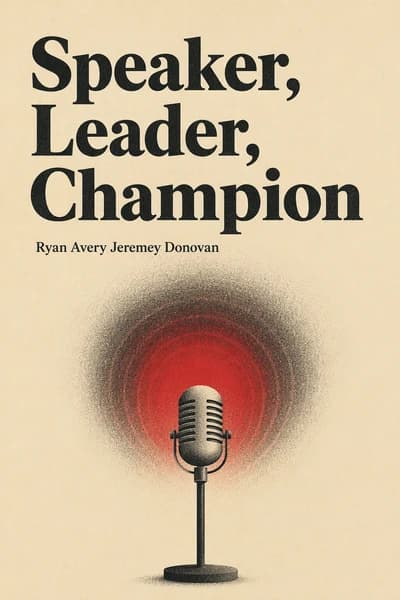
Have you ever wondered what separates a forgettable presentation from one that changes lives? In boardrooms and on stages worldwide, the ability to speak effectively determines who gets promoted, who secures funding, and whose ideas spread. "Speaker, Leader, Champion" has become a cult favorite among Silicon Valley executives and TED speakers alike, with Tim Cook reportedly gifting copies to Apple's leadership team. This masterclass in public speaking distills the wisdom of Toastmasters World Champions-individuals who rose from ordinary backgrounds to become extraordinary communicators through a proven system rather than natural talent. What makes this book particularly powerful is its accessibility: these champions weren't born gifted orators but developed their skills through the same Toastmasters program available to anyone for under $100 annually. Their journey from nervous novices to commanding speakers mirrors the transformation available to any dedicated practitioner willing to apply these championship-level techniques.
Kapitel 2
The Transformative Power of Public Speaking
Surveys consistently link verbal communication to professional success, with employers rating it their most desired skill. The authors' personal journeys exemplify this connection: Jeremey evolved from an anxious engineer hiding in his cubicle to a group vice president leading a 50-person global team, while Ryan transformed from an unemployed 25-year-old to receiving 269 speaking offers overnight after winning the World Championship of Public Speaking.
This isn't surprising when you consider that throughout history, effective communicators have shaped our world. From political leaders to business innovators, those who articulate ideas compellingly gain influence disproportionate to their formal authority. The Toastmasters program-founded by Ralph Smedley in the early 1900s to help YMCA patrons improve their speaking skills-has grown to over 292,000 members across 14,350 clubs in 122 countries precisely because it addresses this universal need.
What makes Toastmasters particularly effective is its focus on constructive feedback rather than criticism. Members develop through balanced evaluations that highlight strengths while suggesting improvements-creating a supportive environment where speakers can take risks without fear of humiliation. This approach accelerates growth by maintaining confidence while continuously raising standards.
The championship techniques revealed in this book demonstrate that effective speaking isn't about natural charisma but rather about mastering specific, learnable skills. When applied systematically, these methods transform not just how you communicate but how others perceive your ideas, your leadership potential, and ultimately, your career trajectory.
Kapitel 3
Finding Your Purpose: The Heart of Every Great Speech
The most compelling speeches begin with a clear purpose. Just as finding your professional calling gives direction to your career, identifying your speech purpose gives meaning to your words. While professional missteps merely waste your time, speech purpose mistakes waste everyone's time.
Effective speeches typically serve one of four purposes: to inform (sharing knowledge), to persuade (changing beliefs or inspiring action), to entertain (providing enjoyment), or to inspire (motivating through emotional connection). Beyond this general purpose, every speech needs a single core message-what you want the audience to know, feel, or do.
Lance Miller's breakthrough after 13 years of competition came when he shifted focus from himself to his audience, asking: "What have I learned that would make a difference in others' lives?" This audience-centric approach led to his championship speech about validation-showing that the most powerful messages serve others rather than showcasing the speaker.
In his winning speech, Lance presented validation as life's ultimate question through a personal journey. He shared how moving from Indiana to Los Angeles didn't improve his life until a receptionist simultaneously validated his parking ticket and him as a person. This experience transformed his perspective, leading him to validate others-his roommates ("Dumb and Dumber"), his critical girlfriend, and his boss. He discovered that validating others made him important to them, turning people from obstacles into pathways to success.
Championship speeches typically center on eternal truths or virtues-essentially functioning as seven-minute secular sermons. From 1995 to 2011, love appeared most frequently (five times), followed by perseverance (three times), mindfulness and action (twice each), and compassion, creativity, self-expression, hope, and tolerance (once each). These universal themes resonate because they connect to fundamental human experiences.
Beyond purpose and message, a winning speech must have compelling impact-showing why audience members should think, feel, or act differently. Lance Miller's speech can be summarized as: "I will inspire my fellow Toastmasters to validate the goodness in others so that the world becomes a safer and more loving place." This clarity of purpose, message, and impact creates a powerful foundation for any presentation.
Kapitel 4
Architectural Excellence: Building a Speech That Stands Tall
The structure of your speech significantly impacts how easily audiences grasp your message. Like a well-designed building, an effectively organized speech guides listeners through your ideas with clarity and purpose.
Jock Elliott's "Just So Lucky" (2011) demonstrates how a topical speech can transcend mere description to inspire an audience. His introduction establishes the contrast between superficial social media connections and true friendship, then presents his organizing structure: "the friends of my blood, the friends of my times, and the friends of my heart." This direct approach works because his message about friendship is readily acceptable. His provocative question about friends who would "roll out of bed at three o'clock in the morning" instantly connects with the audience on an emotional level.
Effective speech openings fall into three categories. Provocative questions, like Jock's about 3 a.m. friends, immediately engage audiences by creating curiosity. Shocking statements, particularly those using statistics, trigger emotional responses-like Jamie Oliver's TED talk opener that "four Americans that are alive will be dead from the food that they eat" during his presentation. Personal stories, used by 19 of 26 champions, build immediate emotional connections-like Vikas Jhingran's (2007) opening about his trembling hands holding an MIT acceptance letter.
Clear transitions help audiences follow your speech structure. Jock used ordinal transitions ("First, over here, the friends of my blood") and parallel phrasing ("Now here, we have the friends of my times" and "And finally here, we have the friends of my heart"). His consistent use of "here" in each transition created helpful parallelism that oriented his audience through the speech.
Since your content is new to listeners, remind them of key points by creating connections between speech sections. Jock subtly referenced his first point about family friends even while discussing his second point about friends of his times, noting "friends are the family you choose for yourself." These connective threads strengthen audience comprehension and retention.
For persuasive business presentations, the situation-complication-resolution framework transforms the familiar problem-solution approach into a more precise storytelling structure. Begin by establishing the situation or context, then describe complications resulting from changes to that situation, and finally offer resolution. Matt Abrahams of Stanford simplifies it as "What? So what? Now what?" This approach demonstrates your ability to not just identify problems but solve them, making you more valuable and promotable.
Effective conclusions directly "tell them what you told them" by summarizing key points and explicitly connecting them to your core message. Jock summarized his speech about friendship by reminding the audience that "sitting next to you, right by your side, if you are lucky may be the friend of your heart, or of your times, or of your blood," reinforcing his three-part structure while emphasizing his message about friendship's value.
Kapitel 5
The Storytelling Magic: Bringing Your Message to Life
Stories live in hearts forever, unlike mere facts or truths. Neuroscience confirms that different brain regions track various aspects of stories, allowing listeners to mentally simulate events and update their understanding as the story world changes. This direct feed into audience minds helps civilization learn without risk or excessive energy expenditure.
Effective storytellers don't just retell stories-they relive them on stage. As Toastmasters champion Craig Valentine explains, "You've got to invite them into the scene of your story so they can hear it how you heard it, see it how you saw it, and feel how you felt it." World Champion Ed Tate demonstrated this by beginning his speech with powerful silence, making eye contact, then physically acting out giving himself a speeding ticket before speaking. He brought characters to life through distinct voices, postures, and realistic dialogue that conveyed emotion through contractions, partial sentences, and subtext.
Well-developed protagonists have both extrinsic goals they're aware of (getting to Phoenix) and intrinsic needs they don't recognize but the audience sees (overcoming character flaws). This balance prevents speakers from appearing to put themselves on pedestals while maintaining authority.
While well-developed protagonists make good stories, great stories require worthy opponents introduced early. In Ed's story, he encounters a Customer Service agent who had just dealt with an angry passenger who called her the "B word" after being told there were no seats on the flight to Phoenix. This setup creates tension as Ed, who planned to make similar demands as the previous passenger, now faces a potentially hostile opponent.
To avoid putting themselves on a pedestal, effective speakers show how they succeeded not through special abilities but through a special process that audience members can replicate. Introducing a mentor makes this connection stronger-rather than appearing superior by discovering success independently, learning from a mentor puts the speaker eye-to-eye with the audience. In Ed's story, the customer service agent transforms from false enemy to mentor, rewarding his kindness with a ticket and teaching him about paying kindness forward.
At a story's climax, when stakes are highest for the protagonist, they're also highest for the audience. The more life-or-death the situation, the more engaged listeners become and the more they believe the protagonist has earned their reward. In Ed's story, after experiencing the power of compassion with the customer service agent, he needed to demonstrate selfless courage by confronting the angry young man in the food court-a genuinely dangerous situation for someone of his smaller stature.
Classic storytelling follows a three-act structure: Act 1 introduces the protagonist in their ordinary world until an inciting incident launches them on a journey; Act 2 subjects them to escalating conflicts where they gain tools and knowledge; Act 3 shows them transformed in their new world. Using the "Pixar pitch" format: Once upon a time, Ed was an entitled business traveler. Until one day, he missed his flight after a speeding ticket. Because of that, he witnessed another traveler abuse an agent, and showed compassion instead. Until finally, Ed confronted the abusive traveler. After that, he was rewarded with a first-class upgrade, teaching that compassion and standing up for others brings unexpected rewards.
Kapitel 6
The Laughter Advantage: Using Humor to Connect and Convince
Humor is essential in speeches for releasing tension, building rapport, and making audiences receptive to your message. The initial silence after applause creates physical and psychological tension that humor effectively breaks, helping speakers connect with their audience.
World champions understand the power of early laughter-from 1995-2011, champions earned their first laugh in just 25 seconds on average. Darren LaCroix, a former stand-up comic who won in 2001, secured his first laugh in 21 seconds by deliberately falling facedown on stage. His coach advised him to "stay down longer" because "our job as speakers is not to make people feel comfortable; it is to incite change."
While historic speeches like Lincoln's "Gettysburg Address" contained no humor, modern speaking demands comic relief. Even in tragedy, laughter helps healing begin-as when President Obama included a child's comment about knowing karate during his Sandy Hook address. Outside politics, humor serves dual purposes: it's the sugar that helps inspirational medicine go down and a foundational pillar of entertainment.
World champions average an impressive 2.5 laughs per minute, with Darren LaCroix achieving 3.7 laughs per minute in his winning speech. Three complementary theories explain why people laugh: superiority (laughing at others' misfortunes or eccentricities), surprise (from absurdity to wordplay), and release (relieving tension from embarrassment or fear). Self-deprecating humor works especially well because it hits multiple triggers-allowing audiences to feel superior while being pleasantly surprised by the speaker's vulnerability.
Effective speakers deliver jokes in clusters or "riffs"-getting one laugh, pausing briefly, then elaborating with increasingly outrageous comments along the same theme. Most comedians follow the rule of three, delivering successively funnier riffs before moving on. Of Darren LaCroix's 29 laughs, 23 came in clusters, with his introduction alone generating seven consecutive laughs.
Writing funny material is only half the battle-delivery is equally crucial. Many speakers fail to get laughs because they power through jokes without pausing for audience reaction. Successful humor requires exaggerated vocal variety, physicality, and facial expressiveness. Darren LaCroix demonstrated this by assuming a serious pose with hands on hips while enthusiastically nodding about his Subway sandwich shop purchase, and using raised eyebrows and pursed lips to amplify the humor of his business failure.
Avoid recycled jokes that rarely further your message, feel inauthentic, and risk falling flat if the audience has heard them before. Instead, use situational humor drawn from personal experience-especially sharing failures or repeating candid dialogue from children. While Willie Jones won in 1997 despite using a recycled preacher joke, the best humor always reinforces the speaker's core message rather than serving as mere entertainment.
Kapitel 7
The Emotional Symphony: Creating a Full-Spectrum Experience
Effective speakers understand that engaging audiences requires triggering a broad spectrum of emotions rather than focusing on just one or two. Championship speakers hit all seven key emotions (anger, disgust, fear, happiness, love, sadness, and surprise) in their speeches.
Randy Harvey's 2004 winning speech "Fat Dad" masterfully demonstrates this approach by weaving a narrative about his father that moves through surprise, fear, love, happiness, disgust, anger, and sadness. He structures his speech with distinct emotional movements-from the opening scene with dogs surrounding him as a child, through teenage misadventures with his car, to tender moments of his father's love for his mother during her illness, and finally to his own sadness and love as he carries on his father's legacy.
The most fundamental principle of effective speaking is authenticity-having a genuine conversation with your audience rather than memorizing mechanics. Your voice, body and face should naturally match the emotions you're conveying. Randy Harvey demonstrated this by physically embodying each emotion: showing surprise with protective raised hands and wide eyes; expressing fear through clenched fists and high-pitched speech; conveying love with a soft smile and hands touching his heart; displaying happiness with energetic movements; showing disgust through scrunched features; portraying anger by taking up more space; and expressing sadness with drooping features and slow, soft speech.
While emotional expression is essential for audience connection, speakers must maintain composure. Many novice speakers struggle with emotional disclosure due to nervousness or fear of ego exposure. Championship speakers like Randy Harvey and David Henderson (2010) express deep emotions while staying composed, even when discussing profound loss. Of the seven speaking emotions, only sadness typically risks overwhelming speakers. Despite the prevalence of "tragedy stories" in speaking competitions, only 4 of 17 recent champions relied primarily on sadness-successful speakers utilize all emotional dimensions rather than focusing solely on making audiences cry.
The emotional journey you create should mirror the natural flow of human experience. Just as we don't remain in one emotional state throughout our day, your speech shouldn't dwell exclusively in one emotional territory. By guiding your audience through contrasting emotional states-from laughter to contemplation, from tension to release-you create a richer, more memorable experience that keeps them engaged throughout your presentation.
Kapitel 8
The Language of Champions: Words That Resonate and Remain
Despite the common Toastmasters practice of encouraging "$10 words" like quixotic or mellifluous, championship speeches consistently use simpler language. According to Flesch-Kincaid grade-level measurements, winning speeches from the past 17 years ranged between 3.5 and 7.7 grade levels-accessible to 9-13 year olds. This simplicity comes from using short sentences with few multisyllabic words. Champion David Brooks' speech "Silver Bullets" exemplifies this approach, averaging just 9.7 words per sentence with only 7.7% of words containing three or more syllables, making it accessible to a fifth-grader while still employing sophisticated rhetorical techniques.
Simple language doesn't mean sacrificing emotional intensity. Like Steve Jobs, who used descriptive words like "amazing," "incredible," and "unbelievable," speakers should captivate audiences with sensory-rich language. The best speeches engage all five senses, making listeners feel truly connected to the message. David Brooks' championship speech demonstrates this perfectly-his description of tanks rumbling into Tiananmen Square creates such vivid imagery that audiences could hear, see, and feel the scene unfolding before them.
In championship speaking, clear catchphrases are essential. Between 1995-2011, twelve of seventeen winners used distinguishable catchphrases, with eight using their speech title as their catchphrase. This approach keeps speakers on message, makes the core idea crystal clear to audiences, and helps judges recall speeches. The most effective catchphrases are short, repeated, rhythmic, and actionable. David Brooks' "honor, integrity, and self-respect" met the first two criteria, successfully cementing his "silver bullet" values in listeners' minds, while Ryan Avery's "trust is a must" satisfied all four criteria.
Championship speeches employ various rhetorical devices to enhance their impact. These include assonance and consonance (repetition of vowel or consonant sounds), anaphora (repeating words at the beginning of successive phrases), epistrophe (repeating words at the end of phrases), symploce (combining anaphora and epistrophe), anadiplosis (repeating the last word of one sentence at the beginning of the next), and hendiatris (using three successive words to express a single concept). David Brooks masterfully incorporated these techniques throughout his winning speech, from consonance ("famous phrase... finish") to hendiatris ("honor, integrity, and self-respect") to strengthen his message.
The structure of lists serves different rhetorical purposes: single items command attention, pairs emphasize contrast, and threes create harmony. For dramatic effect, extended lists can build intensity, as demonstrated in Craig Valentine's 1999 championship speech where he rapidly delivered a string of contrasting pairs ("ups and downs and goods and bads...") before dramatically pausing and delivering his key insight about silence.
Despite the persistent myth that talented speakers must quote famous people, championship speeches rarely include quotations. They're typically seen as unoriginal, cliched, and inauthentic-audiences want to hear the speaker's original thoughts and stories. The rare exceptions work because they're either novel (unfamiliar to the audience) or customized for the specific occasion, like Jock Elliott's 2011 reference to Toastmasters' past president John Lau who was emceeing that very contest.
Kapitel 9
The Voice of Authority: Mastering Vocal Delivery
Speaking before large audiences often causes presenters to disconnect from their emotional content, sounding muted or robotic. The key is amplifying your natural delivery style while adapting to your venue and message tone. Authenticity means speaking as you would to someone you care about. Mark Brown, 1995 World Champion with his radio-worthy Jamaican accent, demonstrates masterful vocal variety in his speech "A Second Chance," using baseline, high, soft, loud, fast, slow, and melodic variations to enhance his message about intolerance, indifference, and ignorance.
Throughout his championship speech, Mark matched his voice to his emotional content, creating natural variations that held audience interest. Champion speakers frequently alter speed and volume since these dimensions are easiest to change and carry specific emotional connotations. Mark spoke slow and soft to create warmth and wonder, slow and loud to command authority (especially in his powerful closing line), fast and loud to express passion and urgency when railing against discrimination, and fast and soft to build suspense during emotional moments. These variations naturally draw attention to key points because humans are conditioned to detect change.
Beyond speed and volume, pitch variation adds another dimension to vocal delivery. Lower pitch conveys seriousness while higher pitch expresses curiosity or surprise. More subtle dimensions include rhythm (from monotone to dramatic), voice quality (breathy to full), and enunciation (gentle to crisp). Mark demonstrated this when shifting to a higher pitch for comic effect when mentioning "Beauty and the Beast."
Silence is perhaps the most powerful vocal technique available to speakers. Humans are hardwired to increase attention during silence, making pauses an evolutionary advantage for presenters. The dramatic pause works effectively at speech openings but can be used before, during, or after significant points. Professional speakers typically pause for one beat at commas and two beats at periods. To develop comfort with pausing, practice staying silent for three full seconds between sentences until standard one or two-second pauses feel natural to you and impactful to your audience.
Removing filler words requires systematic practice. Start by identifying your patterns through video review. Have a friend signal whenever you use extraneous words like "so," "and," or "but" at the beginning of sentences. Practice deliberate pausing-one beat at commas, two beats at periods-as people typically use fillers to soothe anxiety by speaking constantly. Finally, practice reading aloud as slowly as possible to become comfortable with a measured pace and to notice where you typically insert fillers.
Nonnative speakers can deliver championship-level presentations by making simple adjustments. The primary technique is slowing down-Presiyan Vasilev (2013 Champion) spoke 15% slower than native English-speaking champions, while Vikas Jhingran (2007) delivered at just 98 words per minute. Elongate words through crisp enunciation and include slightly longer pauses between words and sentences. Learn common idioms to help audiences embrace you, understand cultural body language differences, and consider your accent an asset that makes audiences listen more attentively.
Kapitel 10
The Silent Conversation: Body Language That Speaks Volumes
How you physically present yourself dramatically impacts audience perception and your own confidence. Harvard researcher Amy Cuddy discovered that one-minute "power poses" before speaking create "advantaged and adaptive psychological, physiological, and behavioral changes" that instantly make speakers more powerful. These poses emphasize expansiveness (taking up space) and openness (keeping limbs open). Two effective poses: leaning back in a chair with hands behind head and feet up on a table, or standing and leaning forward with fingertips on a table and one leg in front of the other.
Speakers are judged from the moment they walk onstage. Despite inevitable nervousness, champion speakers like Ryan Avery channel nervous energy into calm confidence, entering with head up, genuine smile, and smooth pace. Your entrance energy should reinforce your speech's purpose and match the audience's exuberance. After greeting the contest master, effective speakers take a moment to settle themselves-standing in a relaxed posture with feet shoulder-width apart and arms at their sides. Before beginning, they make deliberate eye contact with audience sections and take a deep but subtle breath.
Eye contact is the most crucial element of body language for effective presentations. Too brief and you lose trust; too long and you create discomfort. Successful speakers maintain 3-5 second eye contact bursts (roughly one or two sentences) with individual audience members, engaging people in different areas rather than sequential rows. With larger audiences, speakers can focus on entire sections for the length of a paragraph, making everyone in that area feel personally addressed.
While excessive rocking or pacing always distracts, appropriate movement varies by speech type and venue. Championship speakers make locations meaningful by associating different stage areas with specific physical locations, characters, time periods, or key concepts tied to their message. For most audiences, time flows from their left to right, so position your stories accordingly-childhood at stage right, adolescence at center, and adulthood at stage left-to match the mental map listeners create.
Begin and end your speech at the front and center of the stage for psychological impact. Center stage is a natural focal point requiring minimal audience effort to see you, while standing near the front minimizes distance and creates intimacy even in large venues. Taking small steps toward the audience during key moments (breaking the fourth wall) enhances connection. Returning to your starting point signals conclusion-avoid returning there mid-speech as this falsely suggests you're finishing.
When bringing stories to life, give each character a unique physical presence and voice to help audiences visualize them. Ryan distinguished his characters through specific traits: his mother with nightgown, bunny slippers, bent knee stance and soft Southern accent; Sheriff Snodgrass with puffed chest, heavy drawl and exaggerated swagger; and Chelsea consistently positioned to his right with curly hair gestures. For consistency, he acted out each character at their designated stage location and gestured toward those locations when referencing characters in other scenes.
Dress in the same style as your audience but one step above them. At the World Championship finals, Ryan wore a two-piece suit with a tie while the audience typically wore business casual. Audiences disengage from speakers who are overdressed as much as from those underdressed. Don't dress to impress-dress to relate so your audience connects with you and becomes part of your story.
Kapitel 11
Embracing Fear and Finding Your Zone
Fear of public speaking should be accepted rather than eliminated-the adrenaline it produces can enhance performance. Speakers typically appear less nervous than they feel, and slight nervousness makes you more authentic and relatable to modern audiences who prefer conversational speakers over polished orators. The key is being mindfully present, focusing on sharing your message rather than worrying about past failures or future expectations.
Rather than trying to eliminate fear, embrace it as a performance enhancer. The adrenaline released during anxiety can actually improve your physical and mental capabilities. Remember that you never look as nervous as you feel, and hints of nervousness make you more relatable to audiences who prefer authentic conversations over polished performances. Focus on being mindfully present-define success simply as sharing your message, nothing more. Remember that your audience is rooting for you because your success means you've improved their lives.
Champion speaker LaShunda Rundles developed her skills through her mother's "trial by fire" approach, reciting poetry as punishment until she could effectively interpret and deliver it. Two valuable feedback sources are available to everyone: video recording yourself for self-critique, and soliciting input from others (preferably expert coaches). When receiving feedback from non-experts, treat it as an opinion-act on it only if it resonates or if multiple people offer the same advice. Above all, confidence comes through repeated practice.
Control what you can by eliminating sources of uncertainty: commute to the venue in advance to know the route and timing, check the room setup, pretest technology with backup plans ready, and learn about your audience's size, demographics and interests. Champion Ryan Avery exemplified this approach by renting the contest venue room beforehand to practice every aspect of his speech, including where he would sit and how he would move to and from the stage.
According to the National Center for Voice and Speech, English speakers in the United States average 150 words per minute in normal conversation. During presentations, you need to slow down, as nerves tend to accelerate speaking pace. World champions delivered speeches at an average of 125 words per minute, with LaShunda Rundles speaking even more slowly at 114 words per minute. Combat rapid speaking by filling your lungs with air every few sentences, pausing one beat at commas and two beats at periods, and clearly enunciating each word while sounding natural.
Despite conventional wisdom suggesting early speakers in competitions are disadvantaged, statistical analysis of 26 years of Toastmasters World Championships shows no significant speaking-order bias. The average winning position was 5.6 out of 9.2 finalists, with first speakers winning twice. In business presentations as in contests, focus on delivering value rather than worrying about factors beyond your control. You are your own most formidable opponent.
Champion Vikas Jhingran (2007) advises against following formulaic "must-do" lists for winning speeches. The key is finding what works for you and being original. When you "do nothing"-forgetting yourself to focus entirely on sharing your message-your verbal and nonverbal communication achieve harmony. The most effective way to improve is through regular practice in feedback-rich environments. Focus on developing one skill at a time until reaching proficiency, rather than pursuing perfect mastery of all techniques simultaneously.
The greatest compliment isn't a standing ovation but hearing someone say "I'm looking forward to your presentation"-evidence you've built a reputation for consistently delivering valuable content that people want to hear. By applying the championship techniques in this book while finding your authentic voice, you too can transform from a nervous speaker into someone whose words inspire action, change minds, and leave lasting impressions.